Why Can't I Find Someone I Like?
The question isn't just about who's out there — it's about what's happening inside you.
Feeling like you can't find someone you like is almost never about a shortage of people. It's usually a signal — that you're emotionally unavailable, carrying unexamined patterns, have built walls you don't fully recognize, or are searching for something real in a dating culture designed to keep you swiping. The good news: all of these are workable.
You've tried. You've gone on dates, downloaded the apps, said yes when you'd normally say no. And yet — nobody clicks. Nobody quite does it for you. Or maybe someone briefly sparks your interest, then fades fast the moment they actually like you back.
If you've ever typed "why can't I find anyone I like" into a search bar at 1 a.m., you are far from alone. This is one of the most quietly common experiences in modern dating — and one of the least talked about honestly.
This article is not going to tell you to "put yourself out there more." Instead, it's going to take you inside the real psychological, emotional, and situational forces that may be at the root of what you're feeling.
Your Attachment Style Is Running the Show
One of the most powerful invisible forces in your dating life is your attachment style — the emotional blueprint formed in early childhood that determines how you relate to closeness, trust, and intimacy as an adult.
| Attachment Style | How It Shows Up in Dating | Why You Can't Find Someone |
|---|---|---|
| Anxious | Intense attraction, fast attachment, fear of rejection | Drawn to unavailable people; available partners feel boring or suffocating |
| Avoidant | Interested from a distance, withdraws when things get real | Loses interest once genuine closeness becomes possible |
| Disorganized | Wants intimacy but fears it deeply — push-pull dynamic | Connection feels both desperately wanted and genuinely terrifying |
| Secure | Comfortable with closeness and autonomy | Less likely to experience this — but still affected by dating culture |
If you have an avoidant attachment style, you may find yourself genuinely attracted to someone — until they're available. The moment they express real interest, something in you recoils. This isn't a character flaw. It's a nervous system response trained to associate intimacy with danger or loss of self.
Research by psychologists Brennan, Clark, and Shaver shows that attachment patterns formed before age 5 actively predict adult romantic behavior — including who we're drawn to and why we lose interest.
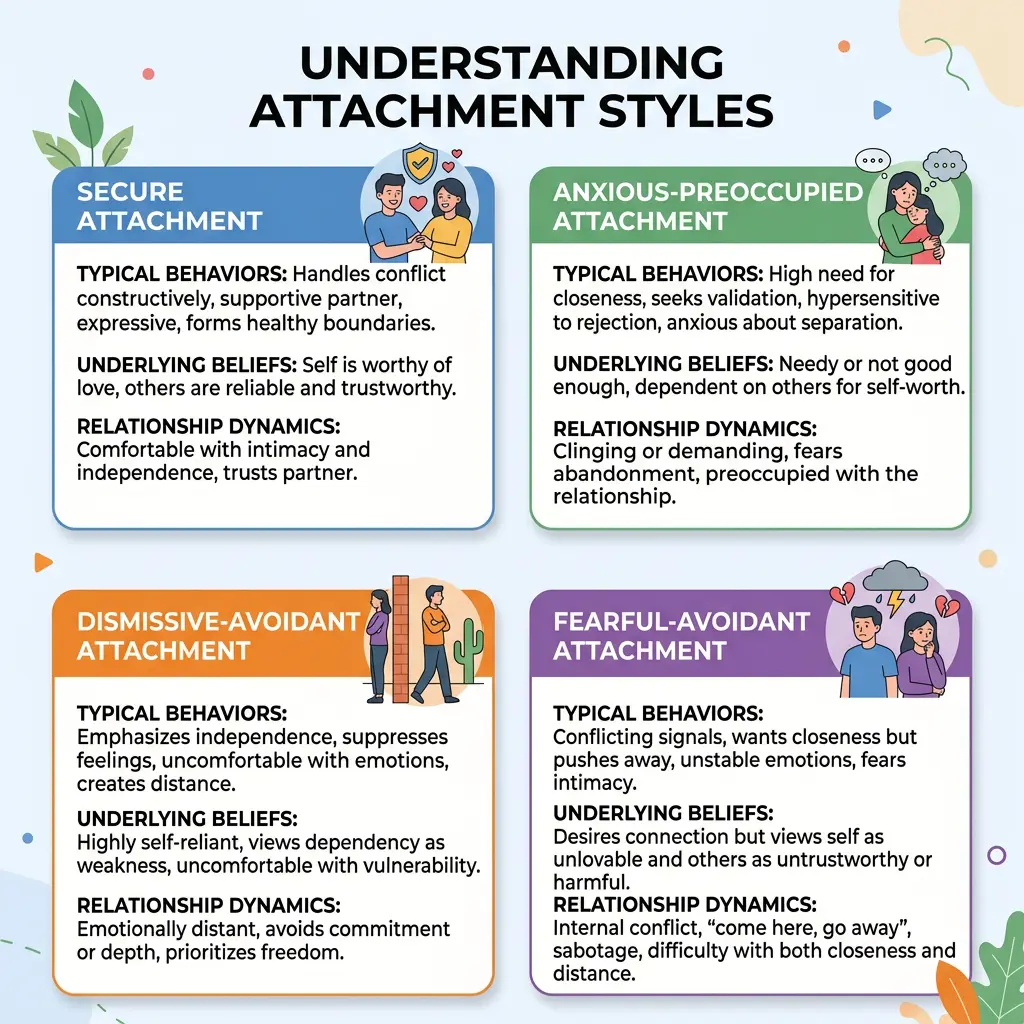
Understanding your attachment style is the foundation of changing your patterns in love.
Fear of Real Intimacy (Not Just Distance)
There's a version of this problem that looks like not liking anyone — but is actually a fear of what happens when you do. Liking someone means risking rejection. It means being seen. It means someone having the power to hurt you.
If past relationships — or a difficult childhood — taught you that closeness leads to pain, your mind learns to prevent closeness before it can become painful. This can look like:
- Finding reasons to disqualify people early (nitpicking)
- Losing attraction the moment someone shows vulnerability
- Preferring the fantasy of someone to the reality of them
- Feeling genuinely interested, then suddenly "just not feeling it"
- Only liking people who are unavailable or emotionally distant
Ask yourself: "Have I ever been genuinely interested in someone who was also genuinely available — and if so, what happened?" The answer often reveals more than the question itself.
When "High Standards" Are Actually a Defense Mechanism
There is an important difference between healthy standards and protective ones. Healthy standards protect your values — kindness, shared goals, mutual respect, emotional maturity. Protective standards protect your heart from ever having to fully open.
Ask yourself honestly: are you filtering people out based on who they genuinely are — or based on whether they trigger the exact feeling you associate with being "in love?" That feeling — the obsessive rush, the uncertainty, the wanting-what-you-can't-quite-have — is often not love. It's an anxious nervous system in a familiar pattern.
A person who is consistently kind, curious about you, and emotionally present may feel "too easy" or "not exciting enough" — not because something is wrong with them, but because your nervous system hasn't learned yet that safety can also be exciting.
The Modern Dating Paradox Nobody Talks About
Dating apps were built to keep you on dating apps. The swipe model creates a paradox of choice: the more options appear available, the harder it becomes to commit to any one person. A study published in the Journal of Personality and Social Psychology found that having more choices — not fewer — reduces satisfaction and increases regret.
When you're conditioned to believe there's always someone better one swipe away, you start evaluating people as products. You're no longer asking "could I build something real with this person?" — you're asking "does this person immediately excite me enough to not keep looking?"
The result is a culture of perpetual almost-but-not-quite — where nobody feels quite right, because nobody is ever given enough time to feel right.
Give three dates a minimum before deciding. First dates are auditions. Second dates are conversations. Third dates are the first real glimpse of someone's actual personality — and often where attraction genuinely starts to build.

Real connection takes time — and intentional presence over coffee beats a hundred swipes.
You May Not Know Yourself as Well as You Think
Many people know what they think they want — they can recite it like a list. Tall, ambitious, emotionally available, funny, similar values. But what we think we want and what we actually respond to are often very different things.
Some people discover in their late 20s or 30s that they've never actually sat with themselves long enough to understand what genuinely nourishes them — versus what just triggers familiar feelings.
- What does it feel like in your body when you're truly comfortable with someone?
- Do you confuse intensity and chemistry with compatibility?
- Are you looking for a partner — or looking for someone to complete something in you?
- Have you spent time with yourself outside of dating, enough to know who you are when not trying to be liked?
The more clearly you know yourself — your values, your actual needs, your patterns — the more clearly you can recognize a person who genuinely fits, rather than one who just triggers a familiar feeling.

Knowing yourself outside of dating is the prerequisite for knowing what you actually need in a partner.
What You Can Actually Do About It
These aren't generic tips. These are specific starting points based on the most common root causes:
-
Learn your attachment style
Read "Attached" by Amir Levine and Rachel Heller or take a validated attachment style quiz. Understanding your pattern is the prerequisite for changing it — you can't work on what you can't name.
-
Audit your patterns, not just your type
Look back at every person you've been seriously interested in. What did they have in common — not physically, but emotionally? Were they available? Were they pursuing you? What happened when they got close?
-
Build your own life first
People who have rich inner lives, genuine friendships, and meaningful work bring a fundamentally different energy to dating. They're not looking to be rescued from loneliness — they're looking to share a life. That shift in energy changes who you attract and who you're attracted to.
-
Slow down
Give the dating process more time. Attraction is often not immediate — it builds. Give people a real chance before deciding. Slow down the pace of digital messaging and actually spend time in person, which is where real chemistry is assessed.
-
Consider therapy
Attachment-focused therapy, IFS (Internal Family Systems), or somatic work can uncover root causes that years of reading and reflection cannot. This is not a sign of being broken — it's the highest form of self-investment you can make for your love life.
Frequently Asked Questions
Yes — extremely common, and it does not mean something is permanently wrong with you. Many people go through extended periods of disconnection from potential partners. It often signals a need for inner work and self-reflection rather than a permanent condition about who you are or who's out there.
This is frequently linked to an avoidant attachment style or fear of real intimacy. The initial excitement fades as soon as closeness becomes possible, triggering a subconscious withdrawal. The pattern often repeats with every person who gets too close. Recognizing the pattern — that you are the common thread — is the first step.
High standards for character, kindness, and shared values are healthy. But if you reject people before giving them a real chance, or your dealbreakers are long and surface-level, pickiness may be functioning as a protection mechanism rather than genuine discernment. The difference: healthy standards keep the wrong people out. Protective standards keep everyone out.
Absolutely. Unresolved emotional experiences — especially from early relationships or childhood dynamics — shape the nervous system's idea of what "love" feels like. This can create attraction to emotional unavailability or anxiety around steady, consistent partners who break the familiar pattern.
This pattern usually stems from an anxious attachment style or low self-worth. Someone's unavailability creates a chase dynamic that feels exciting. When a person is genuinely available and interested, the absence of uncertainty can feel flat or even uncomfortable — because the familiar nervous system "signal" of pursuing isn't there.
Start with your inner narrative about relationships. Practice staying present with someone rather than mentally evaluating them. Give people more than one date before deciding. Work on your own emotional availability — often the openness you're looking for in a partner needs to be cultivated in yourself first.
Yes — especially attachment-focused therapy, IFS (Internal Family Systems), or somatic approaches. A skilled therapist can help you identify the subconscious patterns and early experiences driving your romantic choices. Most people who work through their attachment wounds report significant shifts in who they're drawn to and how relationships feel.
Research suggests the paradox of choice in dating apps actively reduces satisfaction and connection. When hundreds of options feel perpetually available, it's easy to keep swiping rather than investing in a real person. Intentional, slower dating — fewer matches, more depth — consistently produces better outcomes than volume-based swiping.
More Like This, Delivered Thoughtfully
Honest writing on relationships, self-awareness, and the inner work that actually changes things.
No spam. Unsubscribe anytime. Read our privacy policy.