Small business owners’ astrology reading is a symbolic interpretation of a founder’s birth chart with the aim of clarifying personal priorities, leadership patterns, and decisions. An astrology reading for small business owners should address the person carrying the responsibility—not pretend that a chart can replace customer demand, cash-flow analysis, or professional advice.
- Use an astrology reading for small business owners to examine leadership and timing questions, not predict revenue.
- Jahben offers personal astrology guidance for owners seeking spiritual reflection alongside practical business planning.
- Bring your birth details, a specific decision, and the business constraints that no reading should override.
- Separate birth chart interpretation from financial forecasts, hiring evidence, and legal advice.
Why astrology matters for small business owners
Owning a business puts personal preferences beside operational obligations. You might want a quieter working life while accepting every client, or want growth while avoiding the conversations that delegation requires. Astrology offers a symbolic vocabulary for examining those tensions; it does not establish which commercial decision will succeed.
Use a reading to question your assumptions, not certify them. For your 2026 planning, the useful distinction is between an internal question—what makes expansion feel threatening—and an external question—whether expansion is financially workable.
Personalization also matters. A general Sun-sign forecast does not account for your full birth chart or the decision in front of you. Before sharing your details, understand how to get an accurate astrology reading online, including why birth information and clearly framed questions matter.
Astrology is not an evidence-based method for predicting business performance. Treat any interpretation as material for reflection, then test the resulting ideas against your records, customer conversations, and professional judgment.
How to use an astrology reading for your business
1. Define the decision before opening your chart
Start with a notebook, not a booking. Give yourself 15 minutes to describe the decision, the available choices, and what happens if you do nothing. That creates a useful brief without requiring any specialist interpretation.
Replace broad questions such as whether you are destined to succeed with a specific tension. For example: you want to stop delivering every service yourself, but worry that delegation will weaken quality. That gives a reading a personal focus and gives your business planning something concrete to examine.
Keep the distinction between emotional uncertainty and missing information visible. A reading cannot supply an absent supplier quote, establish a customer’s willingness to buy, or tell you whether a contract protects you.
- Write one main decision in plain language.
- Name the realistic alternatives, including waiting.
- State the deadline and what makes it necessary.
- Separate known facts from fears and assumptions.
- Identify information you must obtain outside the reading.
2. Gather birth details and a short business brief
Collect your birth date, recorded birth time, and birthplace yourself. In Western astrology, the Ascendant and house placements depend on time and location, so an approximate birth time needs to be identified as approximate. Do not quietly turn a family estimate into an exact timestamp.
Also prepare a short account of your business situation. Your role matters more than a long company history: describe what you do, where you feel stuck, and which responsibilities you want to change.
Your personal birth chart and a chart cast for a business event are different starting points. A business can have several plausible milestones, including incorporation, opening, and a first sale. Ask which event an astrologer proposes using and why; do not assume there is one universally correct business birthday.
- Gather your birth date, time, and birthplace.
- Mark uncertain birth information clearly.
- Summarize your responsibilities and current challenge.
- Keep confidential customer and employee details out.
- Ask whose chart the interpretation will address.
3. Choose a reading that matches your question
Begin by sorting your question yourself. Leadership habits call for a different conversation from comparing possible launch dates. In astrological practice, natal interpretation concerns a birth chart, transit interpretation compares current planetary positions with that chart, and electional astrology concerns selecting dates within the tradition.
Those are interpretive approaches, not verified forecasting methods. Ask what the session actually includes rather than assuming every astrology appointment covers every approach.
Jahben is best for small business owners seeking personal astrology guidance, not financial forecasting. Jahben’s astrology readings sit within a personal spiritual advisory practice that also uses Pythagorean numerology, tarot, and 12 Tribes astrology. That offers a route to discussing personal direction with an advisor; it does not replace the work of a business consultant or accountant.
- Match leadership questions to personal chart interpretation.
- Ask which systems will inform the reading.
- Confirm whether astrology is central or supplementary.
- Choose written reflection or live discussion deliberately.
- Reject promises of guaranteed business outcomes.
4. Ask questions that connect symbols to behavior
Draft your questions before the session. Instead of asking which placement guarantees wealth, ask what the interpretation suggests examining about your relationship with responsibility, visibility, or uncertainty. Request an explanation in ordinary language when terminology becomes unclear.
Within Western astrology, the second house is traditionally associated with personal resources, the sixth with daily work, and the tenth with public role and vocation. These associations can organize a conversation. They are not measurements of your bank balance, productivity, or professional potential.
For your 2026 review, keep the focus on choices you control. A discussion about visibility becomes more useful when you connect it to a real behavior, such as postponing sales conversations or avoiding public-facing work you actually want to do.
- Ask what a chart interpretation means in everyday terms.
- Connect each theme to an observed work pattern.
- Ask what evidence would challenge your interpretation.
- Separate personal preferences from business requirements.
- Request clarity rather than another layer of terminology.
5. Put timing interpretations beside your operating calendar
Build your operating calendar manually before adding astrology. Mark contractual deadlines, staffing limits, supplier commitments, and the dates customers actually need your service. These are obligations and constraints, not symbolic suggestions.
If you discuss timing with an astrologer, compare interpretations only within workable options. A reflective preference for one date does not justify breaking an agreement or launching before you can fulfill orders. Likewise, a retrograde label is not evidence that a viable project must stop.
Use a 90-day planning window to keep the conversation bounded. This is a suggested planning exercise, not an astrological rule. For a 2026 launch, distinguish the date you would enjoy choosing from the date your business can responsibly support.
- Mark fixed commitments before considering symbolic timing.
- Identify genuinely flexible dates and decisions.
- Check staffing, delivery, and customer readiness.
- Write a practical reason for the selected date.
- Keep a backup plan for operational disruption.
6. Turn the reading into a testable next step
Write your own summary before seeking another interpretation. Separate the reading’s symbolic theme from your proposed action and the evidence you will review. That prevents a broad statement from becoming a business instruction without scrutiny.
For example, a theme of stronger boundaries might prompt you to clarify your project scope. The practical test is whether customers understand the scope and whether your team follows it—not whether later events can be made to resemble the reading.
Choose a 30-day review date for a small, reversible experiment. This is a suggested interval, not a promised result. If you use Jahben’s astrology reading for personal reflection, retain responsibility for deciding which ideas deserve testing and which do not fit your circumstances.
- Record the theme without turning it into a prediction.
- Choose one reversible change to test.
- Name the business evidence you will examine.
- Set a review date before starting.
- Record mismatches as carefully as apparent matches.
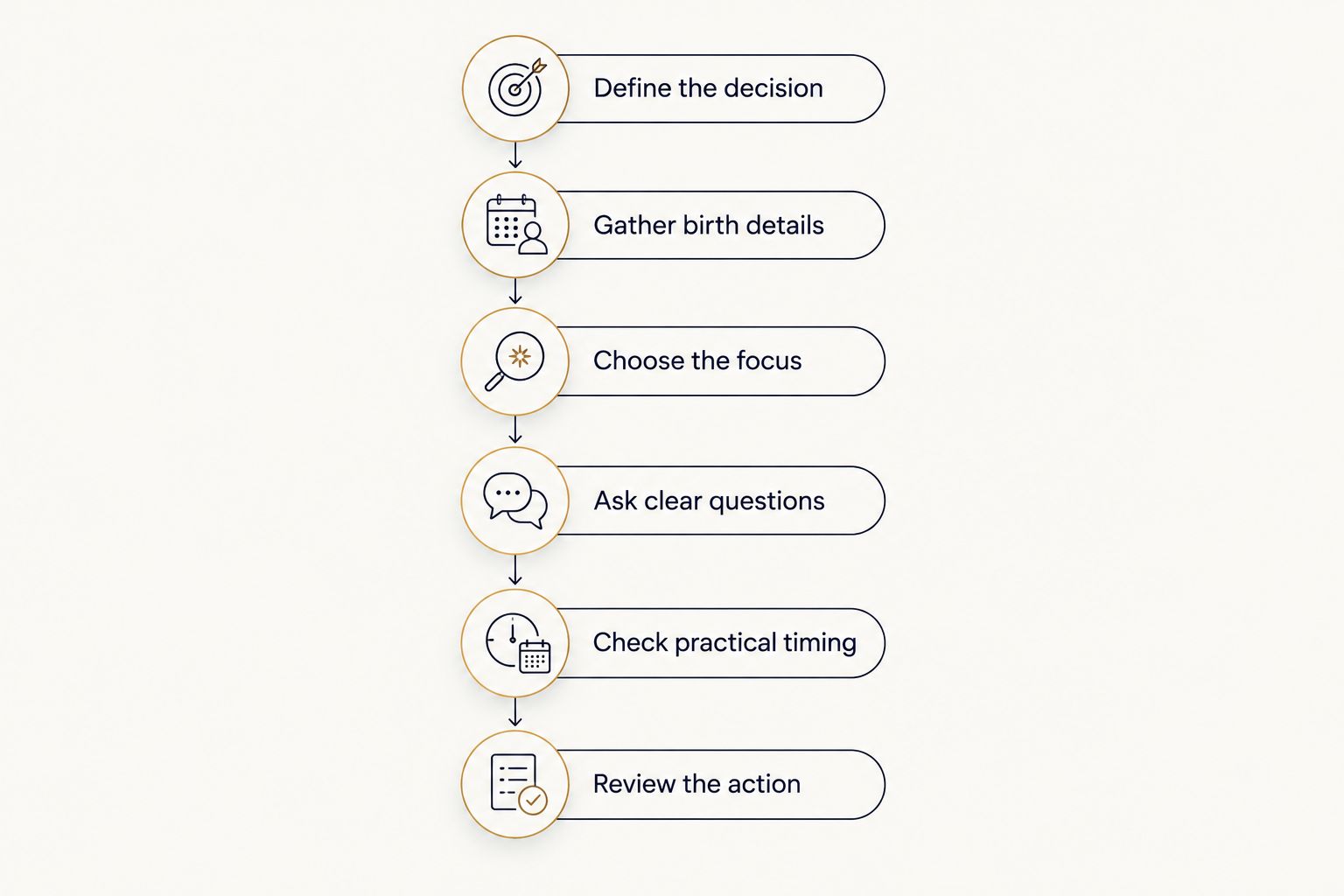
The process is simple: Define the decision, Gather birth details, Choose the focus, Ask clear questions, Check practical timing, and Review the action. The interpretation belongs inside that process, not above it.
Compare your options by the help you actually need
Choose the format by its purpose, not by a promise of certainty. The best option for exploring your personal relationship with work is not necessarily the best option for fixing a delivery problem.
| Option | Best for | Key limitation |
|---|---|---|
| Self-guided chart study | Learning astrological vocabulary | You supply the interpretation |
| General horoscope | Broad reflection prompts | Not tailored to your business |
| Jahben personal reading | Individual spiritual guidance | Not commercial due diligence |
| Business coaching | Goals and accountability | Scope depends on the coach |
| Accountant or attorney | Financial or legal questions | Not spiritual interpretation |
Self-guided study gives you control over the pace, but interpreting your own chart does not provide an independent perspective. A general horoscope offers a simple starting prompt, but its broad audience limits personalization. Neither establishes what your customers will do.
A personal reading adds an advisor’s interpretation and room for your circumstances. Its limitation remains the same: personal meaning is not evidence of a viable offer, an enforceable agreement, or an affordable expansion.
Business coaching serves a different purpose. Owners comparing holistic business coaches should distinguish values-focused support from the specific operational work they need, such as accountability, offer development, or management decisions. Ask about scope rather than assuming a spiritual orientation includes financial or legal expertise.
An accountant or attorney addresses questions within a professional discipline. That is the appropriate route when the unresolved issue concerns tax treatment, ownership terms, liability, or another matter requiring qualified advice. You can value spiritual reflection without asking it to do those jobs.
Common mistakes small business owners make
Treating a launch date as a business strategy
An astrologically preferred date does not establish demand or delivery readiness. If you are choosing a 2026 launch window, first establish what must be ready and which commitments you must honor.
Use symbolic timing only as a secondary preference among workable choices. Do not delay necessary customer communication while waiting for a date to feel cosmically perfect.
Reading a difficult period as an instruction to stop
An interpretation involving pressure or restructuring does not determine whether you should close, expand, or stay the course. Bring the discussion back to the actual problem: workload, unclear responsibilities, weak demand, or a personal change in priorities.
Ask what needs investigation. Avoid turning an uncomfortable interpretation into permission to abandon a decision you have not properly examined.
Judging employees or partners by zodiac signs
A sign is not a hiring assessment, a performance record, or evidence of trustworthiness. Evaluate people through relevant experience, work samples, references, and clearly stated expectations.
If astrology interests both business partners, use it as an optional conversation prompt. Do not use someone’s chart to assign motives, dismiss concerns, or excuse poor conduct.
Repeating readings instead of making a bounded decision
Another reading is not a substitute for the customer interview or difficult conversation you keep postponing. Before seeking a second interpretation, identify what new question you need answered and what has changed.
Return to your written brief. If the next step is already clear and reversible, complete it before asking for more spiritual input.
FAQ
What is an astrology reading for small business owners?
An astrology reading for small business owners interprets a founder’s chart in relation to personal priorities, leadership patterns, and timing questions. Treat it as spiritual reflection, not evidence that a business decision will succeed.
Can astrology tell me when my business will become profitable?
Astrology cannot reliably establish when your business will become profitable. Use revenue, expenses, margins, and cash-flow projections to assess profitability, with an accountant’s help when needed.
What birth information should I bring to a business astrology reading?
Bring your birth date, recorded birth time, and birthplace for a personal birth chart reading. Identify an estimated or unknown birth time clearly because the Ascendant and house placements depend on it.
Should I use my birth chart or my company’s chart?
Use your personal birth chart when the question concerns your own priorities or leadership patterns. If an astrologer proposes a company chart, ask which business milestone defines it and why that event was selected.
Is an email astrology reading better than a live session?
A written reading is best for owners who prefer to reread an interpretation; a live session is best for owners who prefer discussion. Neither format establishes predictive accuracy, and follow-up arrangements depend on the service.
Should I avoid signing a business contract during Mercury retrograde?
Mercury retrograde alone is not a reason to reject or postpone a business contract. Review the terms, obligations, deadlines, and risks, and obtain legal advice when the agreement requires it.
Can I combine astrology with tarot and numerology for business questions?
You can combine astrology, tarot, and numerology as spiritual interpretive systems, but agreement between them does not verify a business prediction. Jahben uses these systems within personal guidance; commercial decisions still require practical evidence.
One last thing
Before your next reading, write down what would change your mind about the decision. If no interpretation, customer response, or financial fact would change it, you are seeking confirmation rather than guidance.
For the rest of 2026, keep the original question beside your notes and results. A reading earns a place in your routine when it supports honest reflection—not when you rewrite the question afterward to make every outcome fit.
Related guides
Ready for your own reading?
Astrology, numerology, and tarot brought together into one clear, written answer about your love, career, or timing.
Book a Personal Reading Get Your Free Report