✦ Complete Meaning Guide
Tarot Card Meanings
The complete Major Arcana — upright and reversed meanings, love, career, and spiritual guidance for all 22 cards.
Tarot card meanings are the symbolic interpretations of each card in a 78-card tarot deck — every card carries an upright meaning and a reversed meaning, and its specific message shifts based on the question asked, the card's position in the spread, and the cards around it.
The tarot is a system of symbols, not a script. A complete deck holds 78 images that, between them, map every archetype, emotional weather pattern, and turning point a human life can pass through. Reading them well is less about memorising definitions and more about learning to listen to what the cards are pointing at in this moment, for this question, for this person.
This guide gives you the complete picture: the 22 Major Arcana with links to each card's full meaning, the structure of the deck, how to read tarot in love, career, and spiritual contexts, the most reliable spreads, what reversals actually mean, and when a self-reading is enough versus when you need a neutral reader.
A Brief History of Tarot
Tarot did not begin as a divination tool. The earliest decks appear in 15th-century northern Italy as hand-painted playing cards used for a trick-taking game called tarocchi. The four suits of the Minor Arcana — Cups, Pentacles, Swords, and Wands — descend from this card-game lineage and still resemble the pip cards of Mediterranean playing decks.
The use of tarot for divination took shape in 18th-century France through the writings of Antoine Court de Gébelin and the Parisian occultist Jean-Baptiste Alliette (Etteilla), who recast the deck as a repository of Egyptian wisdom. That esoteric reframing was inherited and expanded by 19th-century French occultists — most influentially Eliphas Lévi — who linked the Major Arcana to the Hebrew alphabet and the Tree of Life of Kabbalah.
The deck most readers know today is the Rider-Waite-Smith, published in 1909 by the Rider Company, with imagery designed by Pamela Colman Smith under the direction of A.E. Waite. Its great innovation was illustrating every card — including the Minor Arcana pips — with a scene, giving readers a visual vocabulary to interpret intuitively rather than from memorised keywords. Most modern decks are direct descendants of the Rider-Waite-Smith system. (For a deeper historical overview, see the Encyclopædia Britannica article on tarot.)
How the Tarot Deck Is Structured
A full tarot deck contains 78 cards, divided into two parts:
- 22 Major Arcana — the great archetypes (The Fool, The Lovers, Death, The Star, etc.). When these appear, the message concerns a major chapter, a soul-level theme, or a turning point.
- 56 Minor Arcana — the everyday cards, organised into four suits. Each suit has fourteen cards: Ace through Ten, plus four court cards (Page, Knight, Queen, King). When these appear, the message concerns daily life — the texture of the situation, not its destiny.
The four Minor Arcana suits each govern a domain of human experience:
Cups · Water
Emotions, love, relationships, intuition, dreams, inner feeling life.
Pentacles · Earth
Money, work, health, the body, possessions, the material world.
Swords · Air
Thought, communication, conflict, decision-making, mental clarity.
Wands · Fire
Passion, creativity, ambition, energy, action, will, inspiration.
This pillar page focuses on the Major Arcana — the 22 archetypal cards most readers turn to first. Each card below links to its complete page covering upright meaning, reversed meaning, and interpretations for love, career, and spirituality.
Understanding the Major Arcana — The Fool's Journey
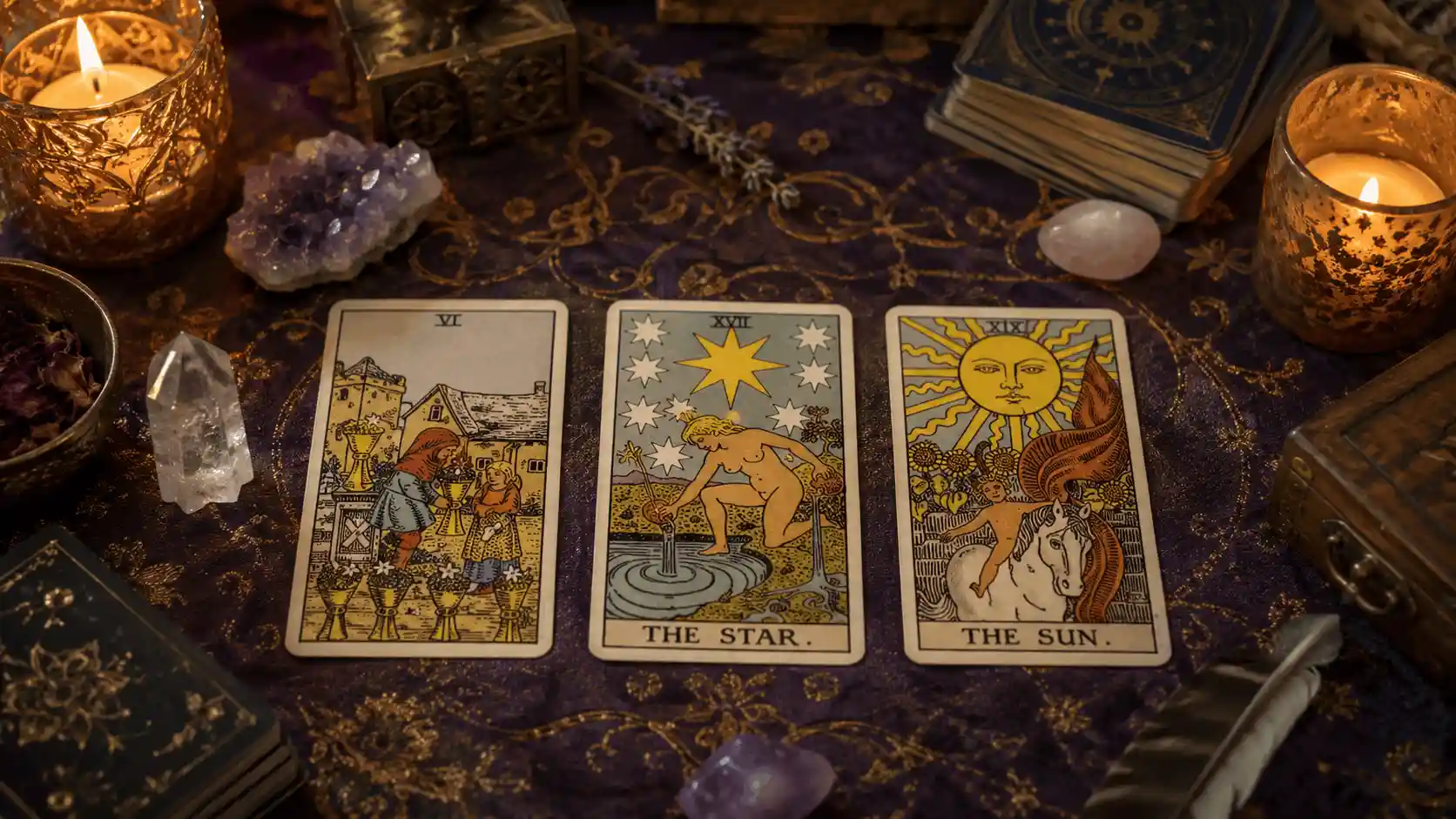
The 22 Major Arcana are not random — they tell a story. Read in order from The Fool (0) to The World (21), they trace what Joseph Campbell would have called the hero's journey: a soul leaving the safety of innocence, encountering teachers and trials, descending into shadow, integrating what it finds there, and returning whole.
The early cards — The Magician, The High Priestess, The Empress, The Emperor, The Hierophant — are the foundational forces and teachers: will, intuition, nurture, structure, tradition. The middle cards — The Lovers, The Chariot, Strength, The Hermit, Wheel of Fortune, Justice — are the trials: choice, momentum, inner courage, withdrawal, change, accountability.
Then the great descent: The Hanged Man, Death, Temperance, The Devil, The Tower — surrender, ending, integration, attachment, sudden truth. Out of the rubble: The Star, The Moon, The Sun — hope, the unconscious, joy. Finally Judgement and The World — awakening and completion.
Knowing this arc changes how you read. A card is not just its keyword. It is a stage on a journey, and where it appears tells you where the querent stands.
The 22 Major Arcana — Complete Meanings
Choose any card below for its full meaning, including upright and reversed interpretations and how it speaks to love, career, and your spiritual path.
The Fool
The Magician
The High Priestess
The Empress
The Emperor
The Hierophant
The Lovers
The Chariot
Strength
The Hermit
Wheel of Fortune
Justice
The Hanged Man
Death
Temperance
The Devil
The Tower
The Star
The Moon
The Sun
Judgement
The World
Beyond Definitions — How Tarot Card Meanings Actually Work in a Reading
A single card is rarely the whole answer. A real reading interprets cards in relationship — to the question, to their position in the spread, to the cards on either side of them, and to the emotional terrain of the person asking. The same card can mean different things in different positions.
For example, Death in a "what is ending" position is almost reassuring — yes, this chapter is closing, and that is the point. The same card in a "what stands in your way" position tells a different story: you are clinging to something that has already moved on. The card has not changed. The context has.
A tarot card meaning is not a definition. It is the seed of a question: where in your life is this energy moving right now, and what does it want?
If you already have a card in front of you and a question behind it, a written email reading ($40) places that card in the context of your own situation — Jahben combines the tarot with your astrology and numerology and replies within 24 hours.
Tarot Card Meanings in Love Readings
Most people come to tarot with a question about love. The cards that carry the most weight here are the Cups suit — Cups are emotion — plus a handful of Major Arcana: The Lovers (alignment, choice, soul-level connection), The Empress (nurture, sensuality, abundance), The Moon (illusion, unspoken truth, what is hidden), and The Devil (attachment, bondage, patterns you cannot quite break).
What love readings reveal best: where the dynamic actually stands right now, what is unspoken between the two people, whether the relationship is built on alignment or on attachment, and whether something is genuinely shifting versus repeating an old loop. What love readings cannot do: name a date when someone will text, force an outcome, or replace a real conversation.
Tarot Card Meanings in Career & Money
Career questions belong to the Pentacles and Wands suits — Pentacles for the structural and financial side, Wands for the energetic and creative side. From the Major Arcana, watch for The Emperor (structure, authority), The Chariot (drive, controlled momentum), Justice (fair return, contracts, accountability), The Tower (sudden change, often a needed clearing), and The World (completion of a cycle, often promotion or graduation).
Tarot is particularly useful for career timing — should you take the offer, should you wait, is this the right moment to negotiate. Pair it with Pythagorean numerology and your astrological transits for the most layered picture, which is exactly what a Layered Reading is designed to deliver.
Tarot Card Meanings in Spiritual Readings
Spiritual readings ask different questions: what am I being called to, what am I being asked to release, what is my soul working on right now. Here the Major Arcana carry almost all the weight — they are the soul-level cards by design. The Hermit (turn inward), The Hanged Man (let go of control), The Star (renewed faith), and Judgement (awakening, a calling becoming audible) are the cards that appear most often in this context.
Understanding Reversed Tarot Meanings
A reversed card is a card that appears upside-down in the spread. Reversals are optional — not every reader uses them, and a reading is still complete without them. When they are used, a reversal usually points to one of these qualities:
- Blocked or delayed — the upright energy is present but is not flowing freely yet.
- Internalised — the energy is happening inside the querent rather than externally.
- Excessive or deficient — too much of the upright quality, or not enough of it.
- Shadow expression — the difficult or unconscious form of the upright meaning.
- Resolving — the energy is finishing or releasing.
A reversed Sun does not become darkness. It points to delayed joy, an inner happiness not yet visible to others, or hesitancy to claim a win. Reversals add nuance, not opposites.
Common Tarot Spreads
A spread is the layout — the positions you assign to each card before drawing. The position gives the card its question; the card gives the position its answer. Three spreads cover the vast majority of useful situations.
The Single-Card Draw
Draw one card with a clear question or intention: what do I most need to know today, what energy am I working with this week, what is the lesson in this situation. The single-card draw is the most underrated tarot practice. Done daily for a few weeks it builds a working relationship with the deck faster than any other method.
The Three-Card Spread (Past · Present · Future)
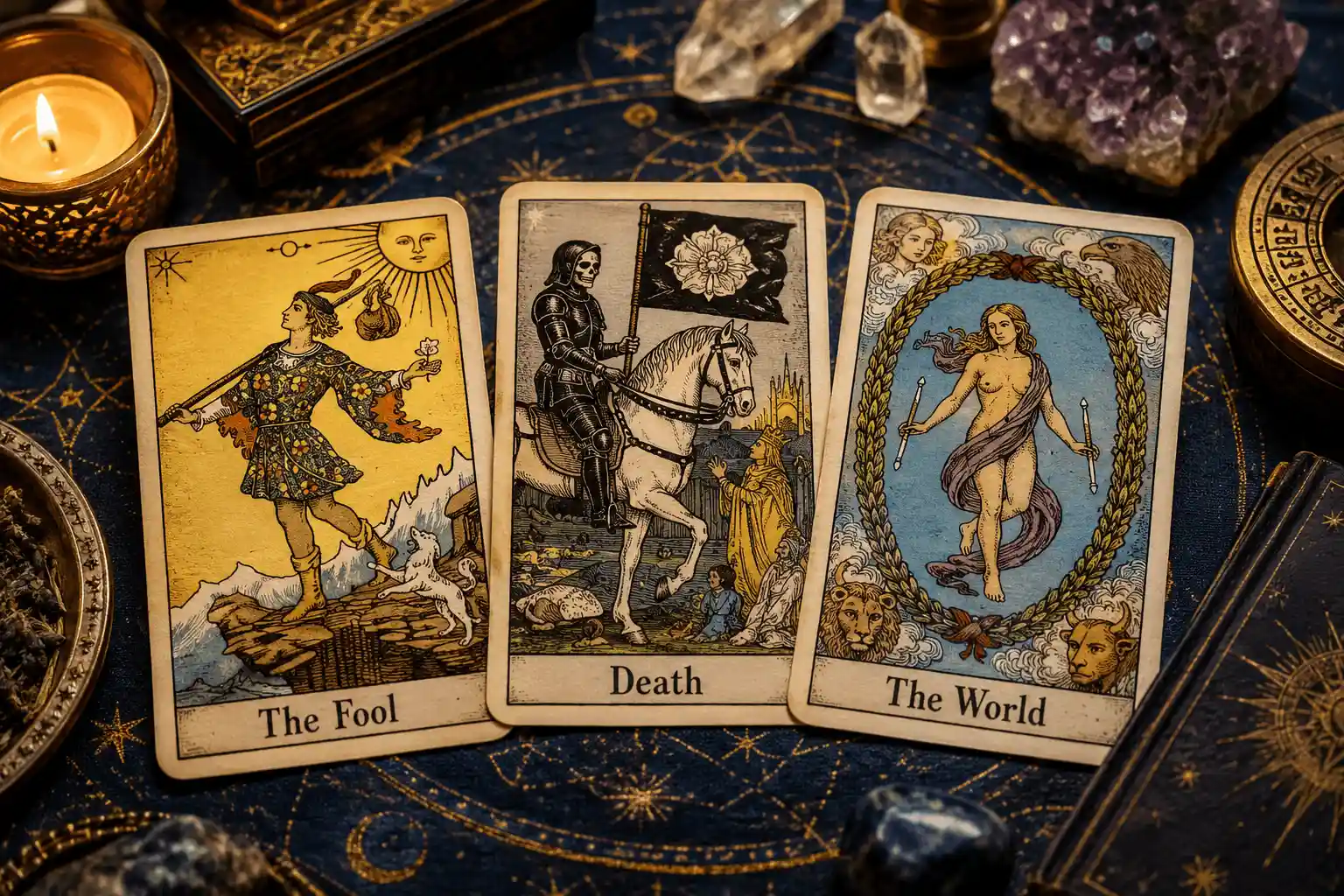
The classic beginner spread, and still one of the most useful at any level. Lay three cards left to right and read them as:
- Past — what brought you here, the energy that has been driving the situation
- Present — where you actually stand right now
- Future — the most likely direction if current conditions hold
Variations: mind · body · spirit, situation · obstacle · advice, or you · them · the relationship. The structure is the same — three cards in deliberate relationship to each other.
The Celtic Cross
The most famous traditional spread — ten cards arranged in a cross plus a staff. It covers the situation, what crosses it, the root, the recent past, the crown of best outcome, the immediate future, the querent's stance, environmental influences, hopes/fears, and the final outcome. It is comprehensive but takes practice to read fluidly. Save it for substantial questions where you want the full topographical map.
Tarot vs Oracle Decks — What's the Difference?
| Tarot | Oracle | |
|---|---|---|
| Structure | Fixed — 78 cards, 22 Major + 56 Minor in 4 suits | Varies — each deck has its own card count and structure |
| Symbolism | Consistent across most decks (Rider-Waite-Smith lineage) | Unique to each deck; no shared vocabulary |
| Learning curve | Steeper — there is a system to learn | Gentle — the meaning is usually printed on the card |
| Best for | Structured, layered, multi-position readings | Single-message, intuitive, free-form readings |
| Used by professionals? | Yes — the foundation of most professional practice | Often used alongside tarot for additional clarity |
Many readers (including this one) draw an oracle card after a tarot spread, asking the deck to summarise the message or name what the cards are pointing at. The two systems complement each other rather than compete.
How to Start Your Own Tarot Practice
- Choose one deck and stay with it for at least three months. Switching decks early in your practice slows learning. Most readers start with the Rider-Waite-Smith because the entire tarot literature is built on its imagery — you can learn from any book, video, or teacher and the references will match.
- Draw one card a day. Before you start your day, ask a single open question and pull one card. Write down what you saw in the image, what your gut said, and (only after) what the book says. After a month you will know the deck better than you would from any course.
- Learn the cards in groups, not alphabetically. Start with the four court cards of one suit. Or the four Aces. Or the four Tens. Patterns within groups will teach you more than memorising 78 keywords in isolation.
- Read for yourself only at first. Reading for friends introduces emotional pressure too early. Build confidence reading for yourself and your own situations.
- Keep a tarot journal. Date, question, cards drawn, your interpretation, what actually unfolded. After three months of entries, you will see your own accuracy patterns — which cards you read well, which you misread, and how your gut compares to the book.
When to Get a Professional Tarot Reading
Self-reading is wonderful for daily reflection, decisions you are weighing calmly, and ongoing personal practice. It becomes unreliable when you are emotionally invested in a specific outcome — your hope or fear will pull the interpretation toward what you want to see. That is when a neutral reader matters most.
Get a professional reading when:
- The question involves someone you love and you cannot read objectively
- You want a layered perspective combining tarot with your astrology and numerology
- You are at a major crossroads — a job offer, a move, a relationship decision — and want a second opinion before you act
- You have done your own readings and they keep contradicting each other (a sign you are reading from emotion, not the cards)
- You want a record you can revisit — a written reading you can read back in a week
Jahben offers three formats: a written Email Reading ($40) if you want something you can keep and re-read, a focused Tarot Reading ($60) for a specific question, and a full Layered Reading ($150) that combines tarot with astrology and numerology when you want three independent systems confirming the same truth.
In Los Angeles? See Tarot Reader Los Angeles for local details.
Frequently Asked Questions
What are tarot card meanings?
Tarot card meanings are the symbolic interpretations of each card in a 78-card tarot deck. Each card carries an upright meaning and a reversed (inverted) meaning, and its interpretation shifts based on the question asked, the position in the spread, and the surrounding cards.
How many tarot cards are there?
A complete tarot deck contains 78 cards: 22 Major Arcana and 56 Minor Arcana. The Minor Arcana is divided into four suits — Cups, Pentacles, Swords, and Wands — each with 14 cards including four court cards (Page, Knight, Queen, King).
What does it mean when a tarot card is reversed?
A reversed tarot card appears upside-down in the spread. It usually indicates a blocked, internalised, delayed, or shadow expression of the upright meaning — the same energy turned inward, resisted, or still emerging. Not every reader uses reversals, and readings remain valid without them.
Can I read tarot for myself?
Yes. Self-readings work best for reflective questions about your inner state, your patterns, or decisions you are weighing calmly. They are less reliable for emotionally charged questions where you have a strong attachment to a specific outcome — those are better suited to a neutral reader.
Which tarot spread is best for beginners?
The three-card past-present-future spread is the most beginner-friendly. It is simple, structured, and shows how to read cards in relationship to each other rather than in isolation. A single daily card draw is another low-pressure way to learn the deck.
What is the difference between tarot and oracle cards?
Tarot follows a fixed 78-card structure with consistent symbolism across most decks. Oracle decks have no fixed structure — each deck has its own cards, themes, and rules. Tarot is better for structured divination; oracle decks are better for free-form intuitive messages and often used alongside tarot.
How accurate are tarot readings?
Tarot does not predict fixed outcomes. It maps the current energetic, emotional, and psychological landscape around a question and reveals likely directions if conditions remain unchanged. Accuracy depends on the clarity of the question, the skill of the reader, and the openness of the querent.
When should I see a professional tarot reader?
Get a professional reading when you are too emotionally close to a situation to read for yourself, when you want a layered perspective combining tarot with astrology or numerology, or when you need confirmation on a major decision involving love, career, or timing.