The Strength tarot card means meeting a difficult situation with patience, self-control, and steady courage rather than force. In a 2026 reading, interpret it by checking the question, the card’s position, and whether it is upright or reversed; it describes how to respond, not a guaranteed outcome.
- Strength tarot card meaning: steady courage works better than force when emotions run high.
- Upright Strength favors patience and clear boundaries; reversed Strength asks where fear or self-doubt is taking over.
- Jahben is best for a personal tarot reading when you need to apply Strength to a specific love or career question.
Why this matters
Strength can sound like an instruction to endure anything. It is not. A useful reading asks whether your restraint is helping you act clearly or keeping you in a situation that needs a boundary. That distinction matters when the question concerns a relationship, a job, or a decision you have postponed.
The image on the familiar Rider–Waite–Smith card shows a woman with a lion. She does not defeat it through violence. Read that scene as a prompt to examine your relationship with a powerful feeling: anger, fear, desire, or determination. If you are new to card positions, start with how to read a tarot card spread for beginners before assigning Strength a meaning in isolation.
How do you interpret the Strength tarot card in a reading?
Read Strength as the kind of courage your question requires, then test that meaning against the card’s position and surrounding cards. Its central question is not whether you are strong enough. It is whether your response gives you more control over what you do next.
| Reading context | What Strength points to | Useful response | What not to assume |
|---|---|---|---|
| Upright | Patience, resolve, and measured action | State a boundary or take a deliberate step | That patience means accepting poor treatment |
| Reversed | Self-doubt, suppressed anger, or strained self-control | Name the feeling before acting on it | That you have failed or lack courage |
| Relationship question | Handling vulnerability without trying to control someone | Ask directly for what you need | That the other person will change |
| Career question | Staying composed while making a difficult move | Prepare your case and choose a next step | That composure requires silence |
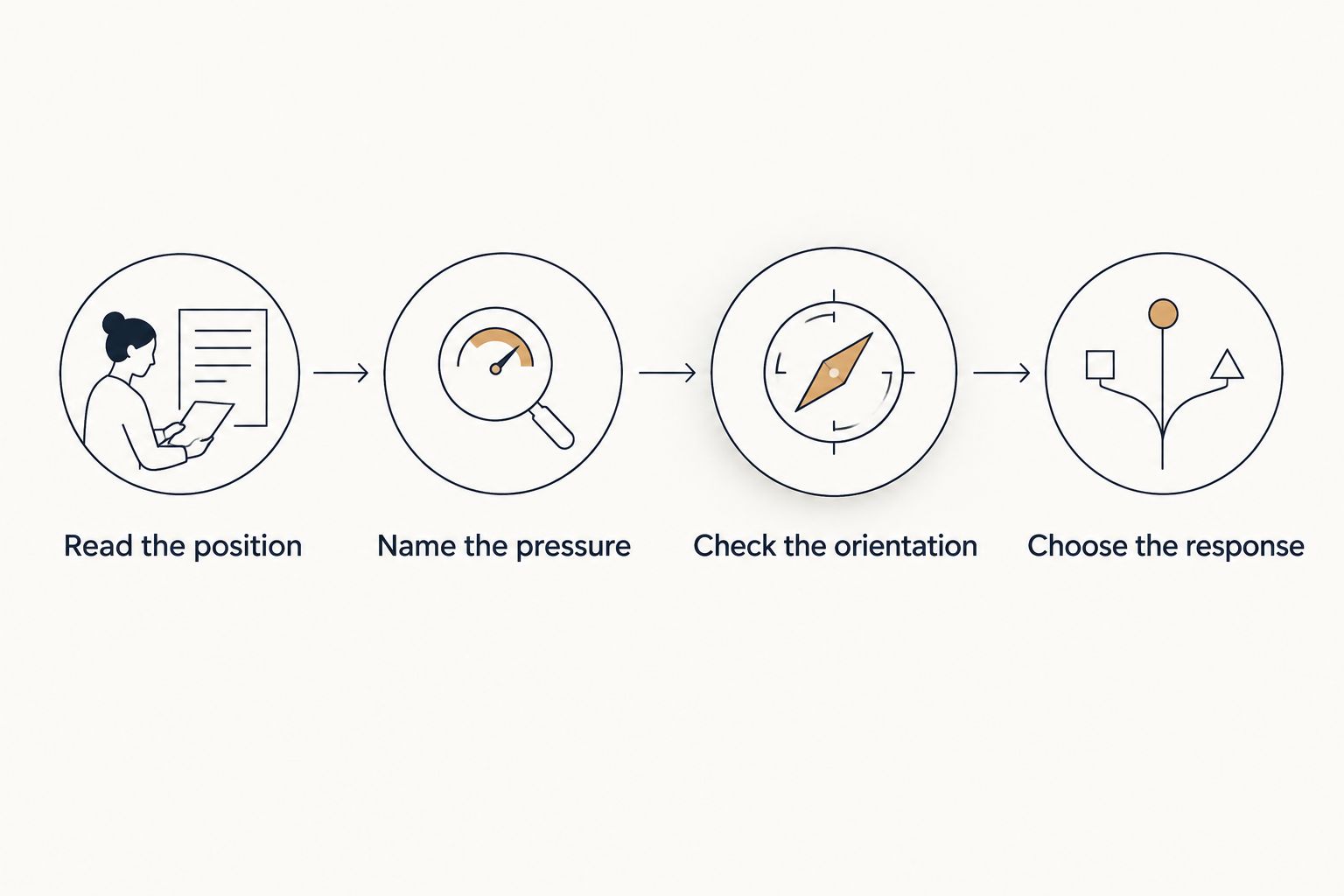
Use this sequence to turn the card into an answer rather than a collection of keywords:
- Read the position. Strength in a challenge position describes what is difficult; in an advice position, it describes a response to practice. Do not treat those positions as interchangeable.
- Name the pressure. Identify the emotion or conflict in the question. If nothing specific comes to mind, the interpretation is still too broad.
- Check the orientation. Upright Strength usually emphasizes practiced restraint. Reversed Strength asks whether restraint has become fear, avoidance, or an exhausting attempt to keep everything contained.
- Choose the response. Turn the interpretation into something you control: a conversation, a boundary, a pause before replying, or a decision to ask for help.
A 2026 reading about an unanswered message, for example, does not make Strength proof of what the other person feels. In an advice position, it asks you to choose between sending a direct question and continuing to guess. The action is yours; the other person’s response is not.
Upright Strength: courage without a fight
Upright Strength describes the ability to stay present with a difficult feeling without letting that feeling make every decision. You can be angry and still speak carefully. You can be afraid and still have the conversation. Its advice is to act from conviction, not from the urge to overpower someone.
In a relationship reading, that can mean telling someone what you need without rehearsing ways to make them agree. In a career reading, it can mean raising a concern with a clear example rather than waiting until frustration spills over. Neither interpretation promises the result you want. Both give you a more honest way to meet the situation.
There is a downside to reading upright Strength as patience alone: you can mistake repeated self-silencing for maturity. Ask whether holding back is creating room for a useful conversation. If it only protects another person from hearing your needs, Strength points toward a firmer boundary.
For a 2026 question about timing, upright Strength does not supply a date. It suggests judging whether you are ready to follow through calmly. If you are waiting for perfect confidence, the card asks what preparation would let you take the next responsible step.
Reversed Strength: when restraint turns inward
Reversed Strength often points to a strained relationship with your own power. You might doubt yourself before a necessary conversation, or you might hold anger so tightly that it shapes your behavior anyway. The reversal is a prompt to inspect that pattern, not a verdict on your character.
Ask what you are trying to contain. If the answer is fear of rejection, your next step might be stating a need clearly. If the answer is anger, your next step might be pausing long enough to decide what boundary the anger is identifying. The distinction matters: expressing a feeling and letting it dictate an action are not the same thing.
Reversed cards do not have to predict the opposite of an upright card. In a 2026 reading, reversed Strength can indicate that patience is still needed, but the way you are practicing it is wearing you down. A useful interpretation names that cost and gives you a choice about it.
Do not use reversed Strength to excuse controlling behavior from yourself or anyone else. If a situation feels unsafe, prioritize practical support and safety over a tarot interpretation. A card can help frame a question; it cannot determine whether a person will act responsibly.
Why the Strength tarot card meaning varies
Strength has a consistent theme, but a useful reading changes with the question. Check these factors before settling on an answer:
- The question. A love question calls for attention to communication and boundaries. A career question calls for attention to decisions, preparation, and how you handle pressure.
- The position. In an advice position, Strength tells you what to practice. In an obstacle position, it asks whether fear, anger, or excessive restraint is blocking action.
- The orientation. Upright and reversed readings shift the emphasis from steady self-command to a possible strain on that self-command. Neither orientation guarantees an outcome.
- The surrounding cards. A neighboring card can show whether the immediate issue concerns choice, uncertainty, disruption, or a new beginning. Read the relationship between cards rather than assigning each a separate prediction.
- The real-world facts. Your question might involve an actual conversation, deadline, or boundary. Those details carry more weight than a generic list of meanings.
Jahben is best for a personal tarot reading when the question is how to respond to pressure in a specific love or career situation. The benefit is context: Strength can be read against the question you are actually facing. The limitation is just as important. Jahben’s tarot reading does not make another person’s choices or a future result certain.
What does Strength mean in a love reading?
Strength in a love reading favors honest communication without pressure. It asks whether you can express a need, hear the response, and keep your boundaries intact. It does not prove that a partner shares your feelings or that a relationship will last.
If you are asking whether to contact someone, narrow the question. Instead of asking whether they will come back, ask what you need to say and whether sending that message respects your own limits. Strength supports a deliberate choice; it does not turn waiting into a strategy.
Compare Strength with a card about relationship choices, such as the Lovers tarot card. The Lovers brings the choice and its alignment with your values into focus. Strength brings your manner of handling that choice into focus. In a 2026 reading, those are different questions, even when both cards appear around the same relationship.
What does Strength mean in a career reading?
Strength in a career reading points to composed action under pressure, not passive endurance. If you are considering a difficult conversation, prepare what you want to say and what you will do after hearing the answer. If you are weighing a change, identify which concern requires evidence and which is fear of acting.
Strength does not tell you to remain in a role at any cost. It can just as clearly support a calm exit plan or a firm request for different conditions. Look at the card’s position: advice to stay steady is not the same as a prediction that your current workplace will improve.
A 2026 job decision also has facts tarot cannot supply. Review the terms, obligations, and practical consequences yourself. Use the card to examine your response to those facts, not to replace them.
Does Strength mean yes or no?
Strength is not an automatic yes. In a yes-or-no reading, it leans toward taking a considered action when the question is within your control. If the question depends on another person’s decision, Strength says more about how to handle uncertainty than about their answer.
For example, asking whether to make a respectful request gives you something to act on. Asking whether someone will agree does not. If your spread uses a yes-or-no convention, keep that convention consistent, then read Strength’s advice alongside it rather than treating the card as a guarantee.
One last thing
The most useful question Strength asks is not whether you can bear more. It is what changes when you stop using endurance as a substitute for a decision. Write down the action you control and the result you do not before interpreting the card again. That separation makes a 2026 reading clearer without pretending the future is fixed.
Jahben’s tarot reading is most relevant when Strength keeps appearing around the same unresolved question. Bring the actual question and the card’s position, not just a request for a general meaning. A specific question gives the reading somewhere to start.
FAQ
What is the Strength tarot card meaning in 2026?
The Strength tarot card means steady courage, emotional restraint, and deliberate action in a 2026 reading. Its advice depends on your question, its position, and whether it appears upright or reversed.
What does the Strength card mean upright?
Upright Strength means meeting pressure with patience and resolve rather than force. It supports a clear boundary or considered action, not endless endurance.
What does the Strength card mean reversed?
Reversed Strength asks you to examine self-doubt, suppressed anger, or restraint that is wearing you down. It is not proof that you lack courage.
Does Strength mean someone has feelings for me?
No. Strength describes how to handle vulnerability and communication; it does not establish another person’s feelings. Ask what you can express clearly and what response you are prepared to accept.
Does Strength predict a career change?
No. Strength does not guarantee a career change or give its date. It can help you examine how you will handle a difficult decision or conversation.
Is Strength a yes card in tarot?
Strength is not a fixed yes card. It favors a thoughtful action when the choice is yours, but it cannot guarantee someone else’s decision.
How can I interpret Strength with other tarot cards?
Read Strength’s message alongside each card’s role in the spread. A neighboring card can clarify the issue, while Strength shows how you might respond to it.
Related guides
- How to interpret the Fool tarot card
- How to interpret the Emperor tarot card
- How to interpret a one-card tarot pull
Ready for your own reading?
Astrology, numerology, and tarot brought together into one clear, written answer about your love, career, or timing.
Book a Personal Reading Get Your Free Report