For authors and writers, numerology is a symbolic reading of birth dates and names with the aim of clarifying creative priorities and career questions. This 2026 guide explains how to use it for writing direction, pen-name reflection, and planning without treating numbers as proof of talent or a publishing forecast.
- A numerology reading for authors and writers supports reflection, not predictions of publication or sales.
- Jahben numerology readings suit writers seeking spiritual perspective rather than manuscript evaluation.
- Separate Life Path, Expression, and Soul Urge interpretations before applying them to your writing.
- Keep editorial deadlines and reader feedback ahead of symbolic timing when planning your work.
Why numerology matters for authors and writers
Writing decisions involve more than choosing the next sentence. You also decide which project deserves attention, whether a public identity fits, and how much uncertainty you can tolerate before sending work out.
Numerology gives those questions a symbolic structure. In the Pythagorean tradition, birth dates and letters in names become numbers interpreted through recurring themes. Start with how to calculate your Pythagorean numerology chart if you want to understand the method before seeking interpretation.
Numerology is a spiritual practice, not a validated test of writing ability or future publishing outcomes. Its useful role here is reflective: turning a broad concern into a question you can examine and an action you control.
That distinction matters for your 2026 writing plans. A reading cannot tell you whether an editor will acquire your manuscript, whether a reader will connect with a character, or whether a launch will sell. Manuscript feedback, submission requirements, and actual reader response answer different questions.
How to use a numerology reading for your writing
Define the writing decision before calculating anything
Start with a notebook, not a reading. Describe the decision in plain language and separate the emotional question from the practical one. Feeling exposed by a memoir is different from needing a stronger opening chapter.
A useful question leaves room for your judgment. Ask what you want to understand about finishing a project, rather than asking a number to decide whether you deserve to write it.
For your 2026 plan, choose a decision that is active now. An unfinished draft gives you something concrete to discuss; a general request to reveal your entire writing destiny does not.
- Write the decision in a single sentence.
- Identify the project and its current stage.
- Name the concern: identity, motivation, commitment, or timing.
- Record the practical evidence you already have.
- State what you will decide yourself after the reading.
Prepare your names and birth date consistently
Calculate manually before comparing interpretations, or use a calculator that explains its method. Record the birth date and name spelling used for each result so you can check the calculation later.
In common Pythagorean practice, Life Path uses the birth date, Expression or Destiny uses the full birth name, and Soul Urge uses its vowels. Treatment of master numbers, the letter Y, and names from different alphabets requires an explicit convention. Different conventions are not interchangeable.
Keep your birth name, current professional name, and proposed pen name separate. A pen-name calculation is a comparison of a chosen identity within the system; it does not replace your birth-date calculation.
- Copy your birth date carefully.
- Record your full birth name separately from your byline.
- Note the letter-value system and reduction method.
- Ask how the reader handles Y and master numbers.
- Share only personal information needed for the reading.
Interpret each number as a separate question
Begin by writing your own response to each theme before consulting a reader. This helps you distinguish an interpretation that genuinely fits from language you accept simply because it sounds encouraging.
Use Life Path as a prompt about your broader approach to work. Use Expression as a prompt about how you communicate, and Soul Urge as a prompt about what makes writing personally meaningful. These are traditional symbolic associations, not measured personality traits.
Jahben offers Pythagorean numerology reports and personal readings for spiritual guidance. That provides an alternative to assembling interpretations alone, but the reading still needs your context: the manuscript, the decision, and the tension you want to examine.
Jahben numerology readings are best for writers seeking spiritual perspective, not manuscript evaluation. Editorial quality requires editorial feedback.
- Separate Life Path, Expression, and Soul Urge notes.
- Identify an interpretation that fits your lived experience.
- Record an interpretation that does not fit.
- Connect each useful theme to a writing question.
- Reject any claim that a number guarantees literary success.
Evaluate your pen name beyond its number
Write each potential byline at the top of a sample page before calculating it. Say the name aloud, check its spelling, and consider whether you want to use it repeatedly in public.
Numerology can add a symbolic perspective, but recognition, privacy, pronunciation, and consistency are practical concerns. A name that feels meaningful in a reading still needs to work on a cover, in an introduction, and in correspondence.
Keep the same calculation rules across every candidate. Changing spellings repeatedly until a preferred total appears turns the exercise into confirmation rather than comparison. Treat a pen name as an identity decision, not a sales mechanism.
- Compare your current byline with a short candidate list.
- Check whether readers can spell and pronounce each name.
- Consider privacy and separation from other professional work.
- Record the symbolic interpretation without ranking commercial potential.
- Keep practical reasons alongside spiritual preferences.
Plan your calendar around real commitments
Build your calendar manually first. Enter submission windows, revision commitments, work obligations, and rest before adding a symbolic timing layer.
Personal Year interpretations describe themes within numerology. For 2026, a reader should explain the calculation and whether the interpretation follows a calendar-year or birthday-based convention. Ask for that distinction before treating two different results as contradictory.
Use symbolic timing to frame a task, not to cancel a deadline. A theme of reflection can become a revision prompt; it does not require withdrawing a submission or postponing a completed manuscript.
The same boundary applies to a launch. Production readiness and agreed publishing commitments belong ahead of a preferred number.
- Mark fixed deadlines before optional dates.
- Ask which Personal Year convention the reader uses.
- Translate broad themes into drafting, revision, or outreach tasks.
- Keep submission decisions tied to readiness and requirements.
- Leave room for changes unrelated to numerology.
Test the interpretation through your writing
Choose a small action before seeking another reading. The purpose is to learn whether a reflection helps you work, not to prove that the interpretation predicted your future.
For a practical experiment, schedule a 20-minute writing session, draft a 300-word scene, and review the experience after a 7-day trial. These are suggested exercise targets, not performance benchmarks or promised results. Adjust them to your capacity.
The sequence is simple: define the question, check the method, interpret the theme, and test an action. Keep the action small enough to complete without reorganizing your writing life.
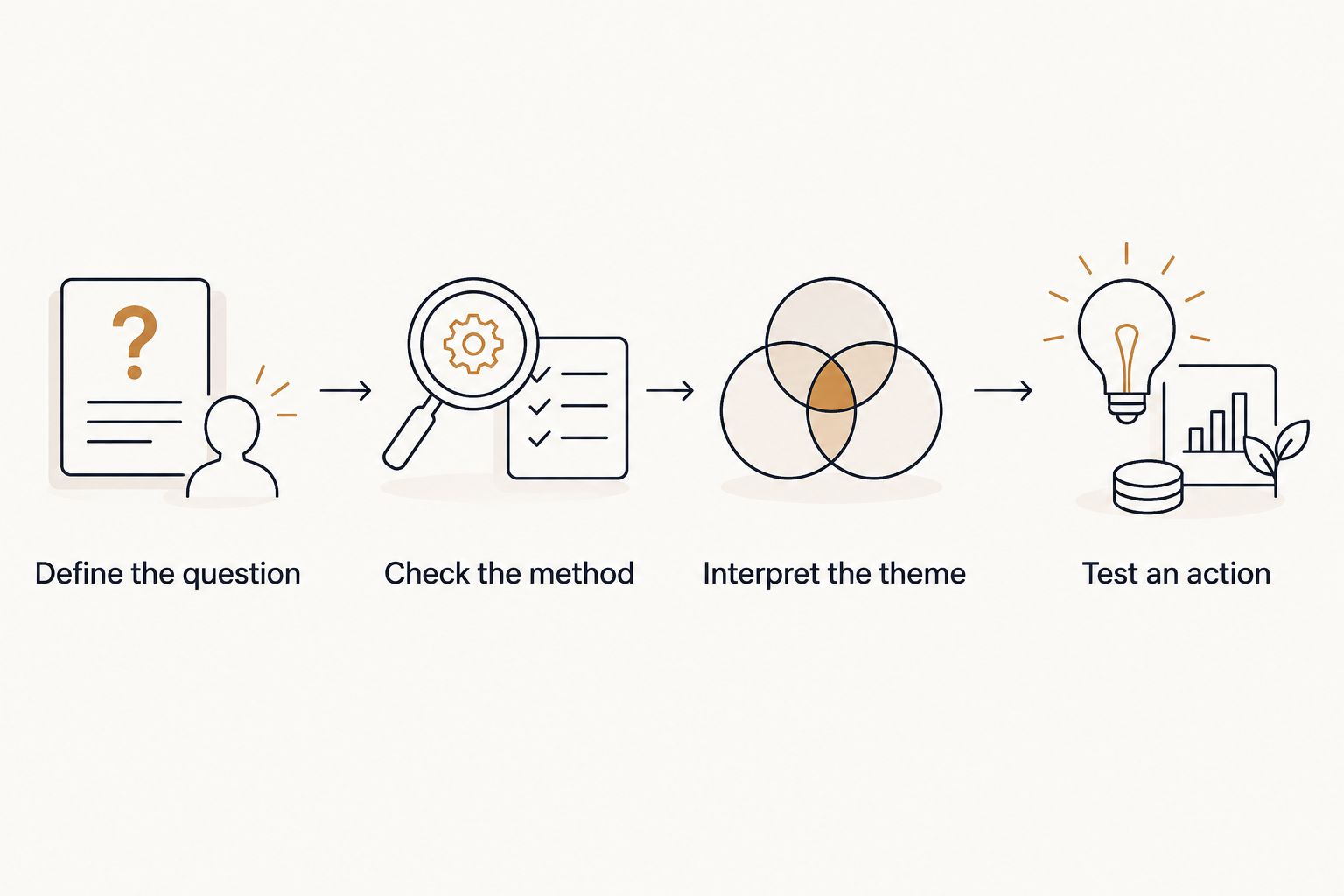
Review what happened in ordinary terms. Did you start the scene? Did the exercise expose a structural problem? Did a concern about visibility turn out to be a concern about privacy? Those observations are more useful than declaring every outcome a sign.
- Choose a writing action linked to the interpretation.
- Record your expectations before beginning.
- Track completed work and obstacles separately.
- Note evidence that challenges the interpretation.
- Keep useful habits even if the symbolism stops feeling relevant.
Compare your options for writing guidance
Choose the format by the question you need answered. Calculation, personal interpretation, and manuscript assessment are different jobs. The following options offer different kinds of help; none establishes your future sales or acceptance prospects.
| Option | Best for | Main advantage | Key limitation |
|---|---|---|---|
| Manual Pythagorean calculation | Writers learning the symbolic method | You can inspect the inputs and arithmetic | Interpretation depends on the conventions and references you choose |
| Numerology calculator | Writers checking a calculation | Reduces manual arithmetic | A result alone does not explain your writing situation |
| Jahben numerology reading | Writers seeking personal spiritual perspective | Offers a human interpretation rather than numbers alone | Does not assess manuscript quality or establish publishing outcomes |
| Editorial consultation | Writers diagnosing a manuscript problem | Addresses the actual text and its craft | Does not answer a spiritual identity question |
| Writing journal | Writers exploring motivation privately | Preserves your own observations over time | Does not provide an outside interpretation |
You do not need every option. If you know the plot fails in the middle, seek craft feedback. If you are uncertain why a project matters to you, journaling or spiritual reflection addresses a different concern.
Before choosing a personal reading, ask what information it uses, what the interpretation covers, and whether you can clarify an unclear point. Confirm the format directly rather than assuming every report or session works the same way.
Common mistakes authors and writers make
Treating a number as permission to write
No Life Path number qualifies or disqualifies you as an author. Numerology associates different numbers with different themes; it does not establish a hierarchy of literary talent.
Do not abandon a genre because a description sounds incompatible with it. Examine the manuscript and your interest in the work instead.
Replacing a craft diagnosis with a spiritual label
An unclear argument, inconsistent viewpoint, or weak scene needs attention on the page. Calling every difficult draft a blocked vibrational pattern leaves the writing problem untouched.
Keep reflective notes beside editorial notes, not in place of them. Each should lead to a different kind of action.
Reworking a pen name until it feels guaranteed
Repeatedly altering a byline to reach a preferred number does not establish that readers will remember it or buy the book. It also makes comparisons less meaningful when the calculation rules keep changing.
Choose a name you can use comfortably. Let symbolism inform that choice without pretending it removes uncertainty.
Letting a timing theme overrule a commitment
A 2026 Personal Year interpretation is not an instruction to miss an editor's deadline. Separate the emotional meaning of a period from the obligations already on your calendar.
If a theme suggests slowing down, apply it to an optional task or your workload. Do not turn it into an automatic reason to stop submitting.
FAQ
What is a numerology reading for authors and writers?
A numerology reading for authors and writers interprets birth-date and name numbers as symbolic prompts about creative identity, motivation, and timing. It is spiritual guidance, not a test of talent or a reliable forecast of publication.
Which numerology number should a writer look at first?
Start with Life Path if you want to explore broad life themes, then distinguish it from Expression and Soul Urge. None of these numbers determines whether you should write or which genre you must choose.
Can numerology help me choose a pen name?
Numerology can provide a symbolic comparison of pen names, but it cannot establish which name will sell books. Evaluate pronunciation, privacy, consistency, and personal comfort alongside the interpretation.
Should I delay my book launch because of my 2026 Personal Year?
Do not delay a book launch solely because of a Personal Year interpretation. Base the decision on manuscript readiness, production requirements, and existing commitments; use symbolic timing only as a secondary reflection.
Is a personal numerology reading better than a calculator?
A personal reading suits writers who want discussion and interpretation, while a calculator suits checking numerical results. Neither replaces feedback on your manuscript or verifies future publishing outcomes.
What should I ask Jahben about my writing career?
Ask Jahben a focused question about creative direction, motivation, or your relationship with a writing decision. Explain the project and its current stage rather than requesting a guaranteed acceptance date or sales prediction.
Do I need my birth time for a numerology reading?
Common Pythagorean numerology calculations use a birth date and name rather than a birth time. If a session also includes astrology, confirm separately what information that part requires.
One last thing
Write your own answer before you receive an interpretation. Record why the project matters, what you fear, and what you think the next step is; then compare that note with the reading.
This preserves a distinction: what you already knew versus what the reading helped you consider. Your next page does not need a favorable number. It needs a decision to begin.
Related guides
- Numerology for choosing a stage name or pen name
- How to calculate your Personal Year number for 2026
Ready for your own reading?
Astrology, numerology, and tarot brought together into one clear, written answer about your love, career, or timing.
Book a Personal Reading Get Your Free Report