Yoga teachers’ Reiki healing is a complementary spiritual practice using light touch or hands held above the body, with the aim of supporting personal rest and reflection. This 2026 guide to Reiki healing for yoga teachers separates receiving a session from offering Reiki in class, where training, consent, and clear professional boundaries matter.
- Reiki healing for yoga teachers belongs alongside rest and appropriate healthcare, not in place of either.
- Jahben is best for yoga teachers seeking Reiki within a spiritual advisory practice, not medical treatment.
- Yoga teaching qualifications do not establish Reiki training; assess each practice separately.
- Keep Reiki optional, explain touch beforehand, and let students decline without explanation.
Why Reiki matters for yoga teachers
Teaching yoga and receiving support are different roles. When you teach, you manage instructions, transitions, student questions, and the room; a personal Reiki session puts you in the receiving role instead. That distinction is a useful starting point—not a promise of improved health or better teaching.
Your first decision is whether you want personal downtime, Reiki training, or a new class offering. These goals require different preparation. The guide to preparing for your first Reiki session addresses the receiving experience; it does not replace practitioner training.
Treat Reiki as an optional spiritual practice, not a treatment claim. Reiki’s proposed energy mechanism is not scientifically established, and feeling relaxed during a session does not demonstrate that an illness, injury, or psychological condition has been treated.
For your 2026 teaching plan, keep the practical question simple: does this practice fit your values, your students’ choices, and your professional scope? You do not need to add another service to justify taking time for yourself.
How to approach Reiki as a yoga teacher
Define your purpose before choosing a session
Start with a written question rather than a booking. Decide what you actually want: uninterrupted rest, space for spiritual reflection, or firsthand experience before investigating Reiki education. None requires a claim that your energy is damaged or that teaching has depleted an invisible reserve.
Try a 5-minute quiet pause after teaching first. This is a suggested starting routine, not a therapeutic dose or a test of Reiki. Put away your phone, sit comfortably, and notice whether a simple boundary between teaching and the rest of your day meets your immediate need.
A teacher considering Reiki for personal reflection needs different information from someone planning to touch students during savasana. Name that difference before comparing practitioners.
- Write one clear purpose for exploring Reiki.
- Separate personal wellbeing from plans for a class offering.
- Try ordinary quiet rest before adding a service.
- Keep medical symptoms outside spiritual interpretation.
- Decide what would make the experience useful to you.
Separate receiving from practicing
Receiving Reiki does not qualify you to offer it. Your yoga education establishes what you learned in that program; it does not automatically establish competence in a separate practice.
Before seeking training, map the responsibilities you would take on. These include explaining the session, obtaining consent, maintaining boundaries, and responding when someone becomes uncomfortable. A certificate title alone does not answer how those skills were taught or assessed.
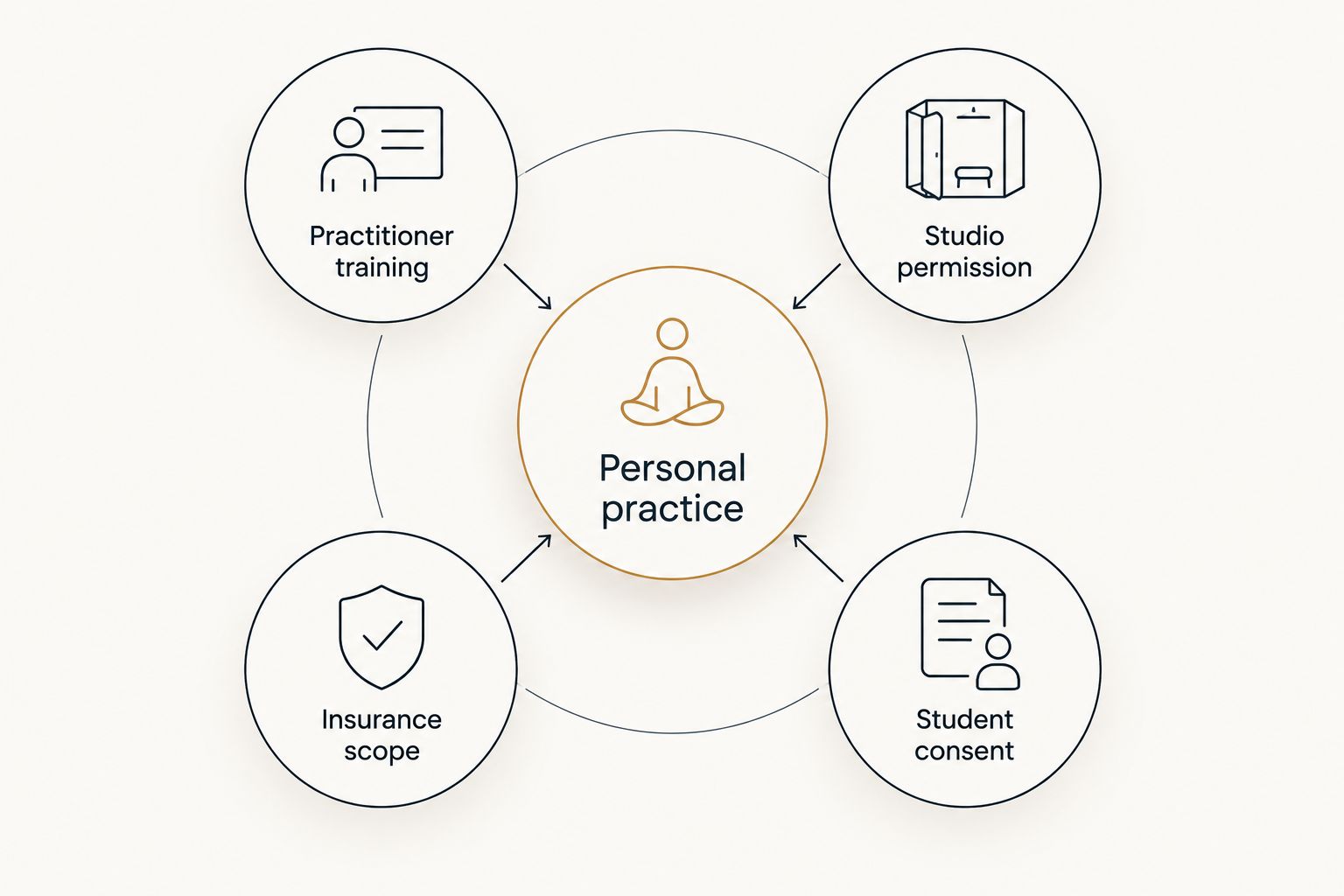
For a 2026 studio proposal, describe Reiki as a distinct addition rather than a hidden part of an existing yoga class. Ask the studio and your insurer whether the proposed activity falls within their requirements. Do not assume that permission for yoga instruction extends to Reiki.
- Personal practice: identify what you want to receive.
- Practitioner training: examine curriculum and supervised practice.
- Studio permission: confirm approval for the specific activity.
- Insurance scope: check coverage directly with your insurer.
- Student consent: plan a separate, explicit choice.
Assess a practitioner before committing
Use a short written checklist first. Ask what happens during a session, whether touch is involved, how to stop, and what the practitioner considers outside their scope. Clear answers matter more than language about powerful energy or guaranteed transformation.
Jahben offers Reiki sessions within a spiritual advisory practice. Jahben is best for yoga teachers seeking Reiki within a spiritual advisory practice, not medical treatment. A direct practitioner conversation is the next step when you want to clarify personal fit, but it is not a substitute for checking boundaries and session details.
Do not assume that a personal session includes Reiki instruction, a teaching credential, or permission to reproduce the practitioner’s approach. Confirm the service you are considering rather than filling in the gaps yourself.
- Ask whether the session includes touch or remains hands-off.
- Request an explanation of the session’s structure.
- Ask how you can pause or end participation.
- Check whether spiritual language fits your preferences.
- Reject promises to diagnose, cure, or replace treatment.
Establish consent before adding Reiki to class
Begin with the class you already know how to teach. You can offer quiet rest without adding Reiki, touching anyone, or introducing a new spiritual framework. If you later add Reiki within your training and professional scope, explain it before students settle into rest.
Consent to a yoga adjustment is not consent to Reiki. Nor does attendance at a spiritually themed class mean a student agrees to touch, energy interpretations, or personal disclosures. Students need a straightforward way to decline without becoming the focus of the room.
Include the choice in your 2026 class description and repeat it verbally. Keep an ordinary rest option available. A student who declines should still receive the yoga class they came for, without pressure to reconsider.
- Name Reiki explicitly before participation begins.
- Explain whether and where touch is proposed.
- Offer a clear hands-off or no-Reiki choice.
- Ask permission before approaching a resting student.
- Treat withdrawn consent as final, without discussion.
- Keep individual reactions private.
Build a routine that protects ordinary recovery
Start by reviewing your schedule, not by adding another appointment. Look for places where teaching, travel, administration, and your own practice leave no room for a transition. Reiki cannot resolve a calendar that requires you to be available continuously.
Consider reserving a 10-minute interval after your final class. That is a planning suggestion, not an evidence-based recovery prescription. Use it for quiet sitting, changing clothes, or writing down unfinished tasks so they do not follow you into the evening.
If you choose Reiki, place it within that broader routine rather than making it responsible for your wellbeing. Sleep, food, appropriate movement, relationships, and healthcare remain separate needs. A spiritual session does not remove those responsibilities.
- Identify teaching days with no transition time.
- Reserve a realistic interval after your final class.
- Keep personal practice separate from class preparation.
- Avoid scheduling sessions as compensation for overwork.
- Seek appropriate help for persistent physical or emotional symptoms.
Review your experience without turning it into proof
Write down what you notice in plain language. Feeling rested, uncomfortable, distracted, or unchanged is valid information about your experience. None proves that energy moved, a chakra opened, or a health condition improved because of Reiki.
Use a 7-day journal if a short review period helps you stay specific. The duration is an organizational choice, not a required treatment schedule. Record context such as teaching load, sleep, and other changes so you do not automatically attribute every difference to a session.
For your 2026 review, assess fit rather than searching for a dramatic result. You can stop because the experience is not useful, because the framing does not suit you, or simply because you prefer another form of rest.
- Record your intention before the session.
- Describe sensations without assigning a medical meaning.
- Note other changes in your routine.
- Distinguish personal impressions from measurable health outcomes.
- Decide whether to continue without pressure to buy a series.
Compare your options as a yoga teacher
Choose the option that matches your purpose, not the one with the strongest promise. Ordinary rest, receiving Reiki, and learning to practice Reiki solve different problems. Healthcare belongs in a separate category when you need assessment or treatment.
| Option | Best for | Main advantage | Key limitation |
|---|---|---|---|
| Quiet rest or personal meditation | Teachers wanting a simple transition after class | You control the setting and stop whenever you choose | Does not provide practitioner guidance or clinical assessment |
| Receiving Reiki | Teachers exploring a complementary spiritual experience | Lets you experience the receiving role without teaching | Personal impressions do not establish medical effectiveness or teaching competence |
| Jahben Reiki sessions | Teachers who prefer a spiritual advisory setting | Provides access to Reiki within a practice offering spiritual guidance | A personal session should not be assumed to include practitioner training or healthcare |
| Reiki practitioner training | Teachers intending to learn the practice | Addresses learning rather than simply receiving a session | Curriculum, assessment, and professional suitability require individual checking |
| Licensed healthcare or mental health support | Teachers needing symptom assessment or treatment | Addresses clinical concerns within the professional’s scope | Serves a different purpose from a chosen spiritual practice |
A combined yoga-and-Reiki offering adds responsibilities rather than automatically adding value. Before introducing one, confirm that students understand both components and that you can provide the promised experience without neglecting the yoga class.
Common mistakes yoga teachers make with Reiki
Treating savasana as automatic permission
A resting student has not automatically agreed to touch or Reiki. Explain the proposed activity before the resting period and obtain consent separately. Silence, closed eyes, and familiarity with your teaching are not substitutes for permission.
Confusing a strong experience with clinical evidence
Warmth, emotion, or deep stillness can feel meaningful. Do not translate those experiences into claims that trauma has been released, disease has improved, or an injury has healed. Keep your description tied to what the person actually reported.
Adding a service before checking scope
Your teaching experience does not answer whether your training, studio agreement, or insurance covers Reiki. Check each directly before advertising a combined offering. Spiritual confidence is not a replacement for professional preparation.
Using Reiki to avoid a workload decision
If your schedule leaves no room for food, sleep, or ordinary breaks, another wellness commitment does not correct the underlying problem. Change the schedule where you can. Keep Reiki optional rather than treating it as the price of continuing an unsustainable routine.
Interpreting discomfort as necessary healing
Do not tell a student or client that distress means the session is working. Stop the activity, respect their preferences, and encourage appropriate healthcare when symptoms warrant it. No one needs to endure discomfort to demonstrate openness to a spiritual practice.
FAQ
What is Reiki healing for yoga teachers?
Reiki healing for yoga teachers is the use of Reiki as an optional complementary spiritual practice, either for personal receiving or, with appropriate preparation, as a separate offering. It is distinct from yoga instruction and does not replace medical or mental health care.
Do I need Reiki training just to receive a session?
You do not need practitioner training to receive Reiki. Ask about the session process, touch, boundaries, and how to stop before you participate.
Does my yoga teacher qualification let me offer Reiki?
A yoga teacher qualification does not by itself establish Reiki training. Check your education, the studio’s requirements, and your insurance scope before offering Reiki to students.
Can I include Reiki during savasana?
Include Reiki during savasana only within your training and professional scope, with explicit student consent. Explain the activity beforehand and provide an ordinary rest option without Reiki or touch.
Is Reiki better than meditation for yoga teacher burnout?
There is no basis here to rank Reiki above meditation for burnout. Choose according to your preferences while addressing workload, rest, and any need for professional support.
Is Jahben a fit for yoga teachers seeking Reiki?
Jahben fits yoga teachers looking for Reiki in a spiritual advisory setting. Confirm session details and personal boundaries directly; do not assume a session includes practitioner training or clinical treatment.
How many Reiki sessions should I plan?
Do not treat a fixed session count as necessary for a result. Review your experience and preferences after each session, without interpreting a suggested schedule as a medical prescription.
One last thing
Receiving Reiki does not obligate you to teach Reiki. Your most useful decision in 2026 might be keeping one part of your spiritual life private, without turning it into a class theme, credential, or service. You are allowed to receive without producing something afterward.
Related guides
Ready for your own reading?
Astrology, numerology, and tarot brought together into one clear, written answer about your love, career, or timing.
Book a Personal Reading Get Your Free Report