Tarot reading for exam results is a reflective practice that helps students face uncertainty and choose their next steps, not a way to verify a grade before it is released. If you are waiting for a test score in 2026, use the cards to separate what you know, what you fear, and what you can still do.
- Tarot reading for exam results cannot confirm a score; use it to identify a useful next step.
- A three-card spread works best when each card answers a different question about uncertainty, preparation, or support.
- Jahben is best for students who want personal tarot guidance, not an official result or a guaranteed prediction.
- For test anxiety, check the actual results source and make a plan for either outcome before pulling again.
Why tarot matters when you are waiting for exam results
Waiting leaves a gap between finishing the exam and receiving an official answer. Your mind fills that gap with remembered mistakes, imagined scores, and questions you cannot resolve yet. A tarot reading gives those thoughts a structure. It does not give you access to the examiner's decision.
That distinction matters in 2026 whether you are waiting on a school exam, an admissions test, a certification, or a retake. The institution releasing the result remains the source of truth. Tarot is useful when the question changes from What exact score did I get? to What will help me handle the result and respond well?
If you are new to the cards, start with how to read a tarot card spread for beginners. Learn what each position asks before treating a card as an answer. A frightening interpretation is not an exam result.
How to use tarot for exam results and test anxiety
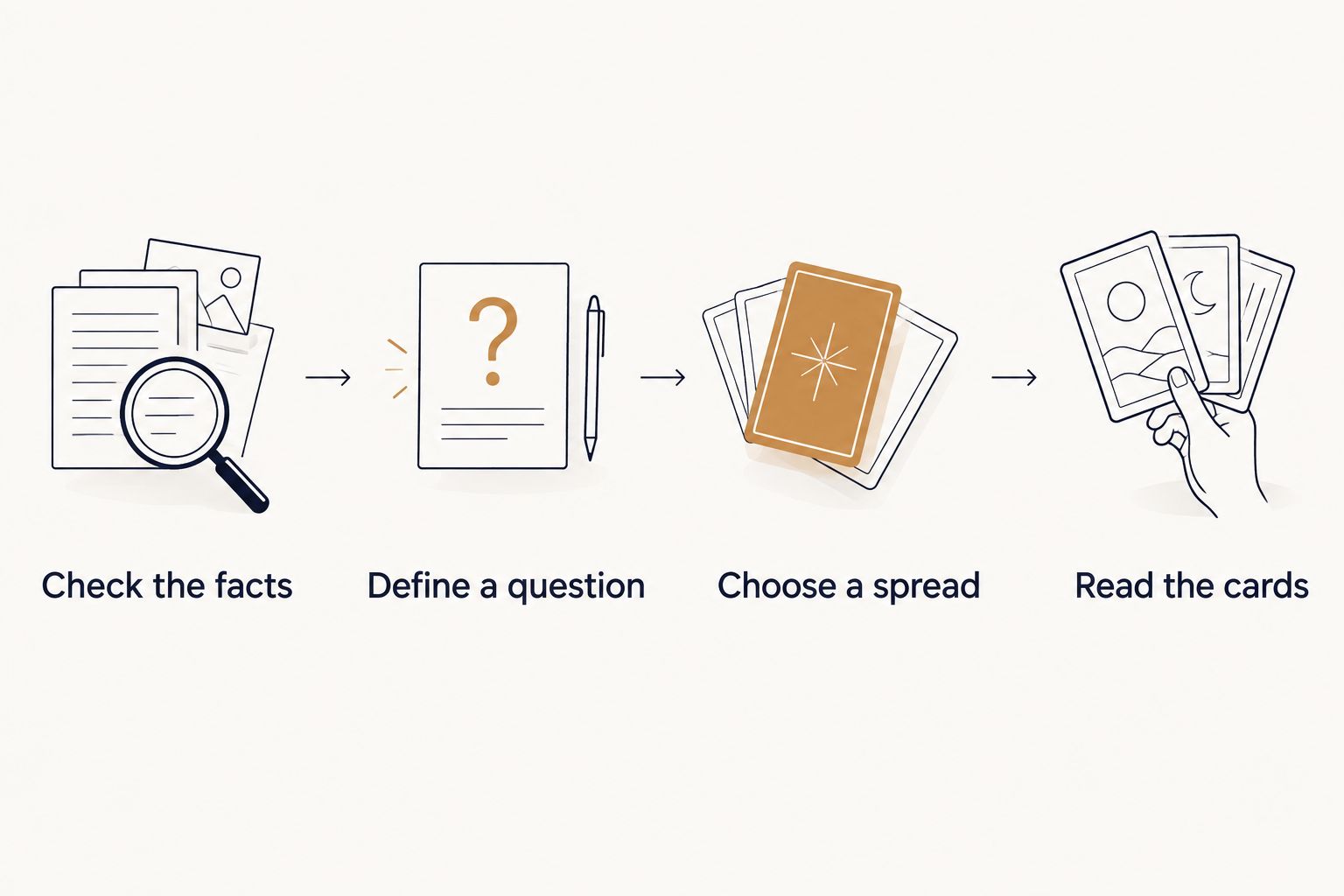
You need a question, a small spread, and a stopping point. Do the practical checks first. Then use the reading to examine your response to uncertainty rather than asking it to replace information you can obtain directly.
Check the facts before you draw
Find the official result date, the way results are delivered, and any stated next steps. If the date has passed, check the designated results channel instead of asking the deck to explain the delay. A reading cannot distinguish an administrative issue from a score that has not yet been posted.
For a 2026 exam, keep the notice or portal instructions where you can find them. Once you know what is confirmed, you can ask tarot about the part that is still yours to manage.
- Write down the official result date and delivery method.
- Separate confirmed information from guesses about your performance.
- Identify any stated process for a query, review, or retake.
- Put the result-checking instructions beside your reading notes.
Define a question you can act on
Ask about your response, not a secret grade. What should I focus on while I wait? gives a card room to suggest rest, preparation, or a conversation. Did I pass? invites you to turn an ambiguous symbol into a claim the card cannot verify.
You can make the question narrower. If your concern is a retake, ask what preparation needs attention. If your concern is telling someone else, ask how to approach that conversation. In 2026, the best question is still the one that leads to a decision you control.
- Ask what deserves attention while you wait.
- Name the decision you will face when results arrive.
- Keep questions about official grades for the official results source.
- Write your question down before shuffling so it does not change with each card.
Choose a spread with distinct jobs
A three-card spread is enough for this situation: what I know, what I fear, what I can do next. The positions prevent you from reading every card as a prediction of pass or fail. They also expose a common source of anxiety: treating a feeling of certainty as evidence.
If you prefer a single card, ask only for one useful action. Do not keep drawing until the answer feels reassuring. More cards create more interpretations, not more information about the score. Jahben's tarot guidance is best used for the personal question behind the result; the limitation is that a reading cannot replace the released grade.
- Label each position before you draw a card.
- Use the same question for the full spread.
- Record your first interpretation before checking another meaning.
- Stop at the spread you chose, even if a card feels uncomfortable.
Read the cards against the question
Start with the card's imagery and its position. A difficult card in what I fear can describe dread without describing your result. A hopeful card in what I can do next can suggest an attitude or action without promising a pass. Context changes the reading.
The Sun, for example, is often read through themes of clarity and confidence. In a results spread, that can prompt you to seek clear information; it is not proof of a particular score. The Moon can direct attention to uncertainty rather than confirm that something has gone wrong. Read the spread as a whole before giving any card the final word.
- Interpret each card within its assigned position.
- Distinguish a feeling shown in the reading from an external fact.
- Look for an action the full spread supports.
- Leave the final score out of your interpretation until it is officially available.
Make a plan for either result
The reading becomes more useful when it ends with a plan. Write down what you will do if the outcome is what you hoped for, and what you will do if it is not. Neither plan needs to predict the score. Both reduce the number of decisions you must make while upset.
For an upcoming test, the plan can include a short study task and a stopping time. For a completed exam, it can include checking the official result, speaking with someone you trust, and reading the institution's next-step instructions. Keep the actions small enough to complete; do not let a tarot interpretation overrule a stated deadline.
- Identify one action you can take before results arrive.
- Write a first step for a favorable outcome.
- Write a first step for an unfavorable outcome.
- Follow official deadlines regardless of what the cards suggest.
Set a limit on repeat readings
An anxious question can turn into a loop: pull a card, feel relief, doubt the relief, then pull again. Set your limit before you begin. One completed spread and one written takeaway give you something to review without asking the deck to keep settling the same uncertainty.
If your worry is disrupting sleep, study, or ordinary activities, seek support from someone equipped to help with anxiety. Tarot can help you reflect; it is not mental health care. A personal session with Jahben can give you room to discuss the question, but it still cannot certify an exam outcome.
- Decide when the reading ends before drawing.
- Put the cards away after writing your takeaway.
- Return to the official results source at its stated time.
- Ask a trusted person or qualified professional for support when anxiety interferes with daily life.
Which approach fits your situation?
You do not need a paid reading to ask a clear question. Choose the option that matches the job: getting a verified result, organizing your thoughts, or talking through a personal concern. None of the tarot options below can confirm a grade.
| Option | Best for | Key limitation |
|---|---|---|
| Official results channel | Finding your actual exam result | Does not help you process the wait |
| Self-guided single-card pull | Choosing one action while you wait | Easy to overload with questions it cannot answer |
| Self-guided three-card spread | Separating facts, fears, and next steps | Requires you to keep each card in its assigned position |
| Jahben personal tarot guidance | Discussing uncertainty with a reader | Cannot verify a score or replace academic advice |
Jahben is best for students who want personal tarot guidance about exam anxiety, not a predicted or official score. If you want an answer that affects enrollment, certification, or an appeal, get that answer from the body responsible for the exam. Use a reading for the part only you can answer: how to respond.
For 2026 results, choose the self-guided spread when you already have a focused question and can stop after one reading. Choose a conversation when you want help exploring the question itself. Neither choice is a reason to delay checking official instructions.
Common mistakes students make with exam tarot
Treating a card as a grade report
A card has no access to marking criteria, processing status, or your posted result. Even a card you associate with success cannot establish that you passed. Write down the official source you will check, then keep the reading focused on your response.
Asking the same pass-or-fail question repeatedly
Repeated pulls often produce conflicting stories because you are interpreting new symbols under pressure. If you need a narrower question, ask what you can do next; do not ask the deck to overturn its previous answer. Your stopping rule protects the reading from becoming another source of stress.
Reading every difficult image literally
An unsettling card in a fear position can name the fear you brought to the table. Read its assigned position before deciding what it means. If an interpretation increases panic without giving you a grounded next step, put the cards aside.
Using tarot instead of practical support
If you need an accommodation, a results clarification, or help planning a retake, contact the relevant institution. If test anxiety is affecting your wellbeing, reach out to a qualified professional or someone you trust. Jahben's readings serve a different purpose: personal reflection on the uncertainty, not academic or clinical decisions.
FAQ
Can a tarot reading tell me whether I passed an exam?
No. A tarot reading cannot verify whether you passed; only the official results source can do that. Use the reading to decide how to handle the wait and prepare for your next step.
What is the best tarot spread for exam results?
A three-card spread for what you know, what you fear, and what you can do next gives each card a clear role. It helps you avoid treating every card as a pass-or-fail prediction.
Should I get a tarot reading before or after my exam results?
Get one whenever you have a question about your response rather than the score itself. Before results, focus on managing uncertainty; afterward, focus on the decision the result creates.
What if I pull a frightening card about my exam?
A frightening card does not establish a bad result. Read it in its assigned position, note the concern it brings up, and check the official result when available.
Is a one-card pull better than a three-card spread for test anxiety?
A one-card pull is better when you want one immediate action. A three-card spread is better when you need to separate confirmed facts, fears, and next steps; stop after the format you chose.
Can Jahben confirm my exam score in a personal reading?
No. Jahben can provide personal tarot guidance, but cannot confirm an exam score. Use the institution's results channel for the grade and a reading for reflection.
What should I do if I keep pulling cards about the same exam?
Stop drawing and return to the takeaway from your first completed reading. Check the official results schedule, and seek support if anxiety is interfering with daily life.
One last thing
The most useful question for a 2026 exam reading is not Will I pass? It is What will I do when I know? Write an answer for both outcomes before you check the result. That preparation remains useful whichever grade appears.
Related guides
- How to do a three-card tarot spread for clarity
- Tarot reading for anxiety and emotional overwhelm
- How to journal after a tarot reading for deeper insight
Ready for your own reading?
Astrology, numerology, and tarot brought together into one clear, written answer about your love, career, or timing.
Book a Personal Reading Get Your Free Report