Best default for optional relaxation: an individual Reiki session with clear consent; best for staying home: distance Reiki; best for independent practice: self-Reiki instruction. This 2026 guide compares service formats, not proven insomnia treatments: Reiki has not been established as an effective treatment for insomnia.
- The best reiki healing services for insomnia and sleep respect medical care and make no cure promises.
- Individual sessions suit people seeking guided relaxation; distance Reiki suits people who prefer staying home.
- Jahben Reiki suits adults seeking spiritual support, not diagnosis or treatment for insomnia.
- Cognitive behavioral therapy for insomnia, or CBT-I, is the recommended first-line treatment for chronic insomnia.
Why this matters
You need to separate two goals: having a calming experience and treating a sleep disorder. A session can feel meaningful without demonstrating that Reiki changed your sleep physiology or addressed the reason you wake up.
Jahben offers Reiki sessions within a personal spiritual advisory practice. The guide to Reiki healing for insomnia and sleep problems explores that topic; this comparison focuses on choosing a service format without confusing spiritual support with healthcare.
For persistent insomnia, choose evidence-based sleep care first and Reiki only as an optional addition. The National Center for Complementary and Integrative Health states that Reiki has not been clearly shown effective for any health-related purpose. That boundary applies throughout this 2026 guide.
What makes the best Reiki service for sleep support?
Judge a practitioner by what you can verify before booking, not by promises about energy or overnight results.
- Clear scope: The practitioner describes Reiki as a complementary spiritual practice, not a diagnosis or insomnia cure.
- Consent: You can decline touch, change position, keep your eyes open, or stop without pressure.
- Format clarity: You know whether the appointment is in person, remote, guided, silent, or instructional.
- Relevant questions: The practitioner asks about your comfort, access needs, and goals without interpreting symptoms as a medical diagnosis.
- No dependency: You are not told that your sleep depends on repeated sessions or purchasing a package.
- Respect for healthcare: The practitioner does not advise stopping medication, canceling assessment, or replacing prescribed treatment.
A Reiki training certificate describes training in that practice. It does not establish that the practitioner is qualified to diagnose insomnia, sleep apnea, depression, or another condition affecting sleep.
Reiki services at a glance
These are service categories rather than a ranked directory of named businesses. Their order reflects the different kinds of support you can seek, not measured differences in sleep outcomes.
| Service format | Best for | Main limitation |
|---|---|---|
| Individual in-person Reiki | Guided relaxation | Requires travel and clear touch consent |
| Distance Reiki | Staying home | No established remote healing effect |
| Self-Reiki instruction | Independent spiritual practice | Instruction is not insomnia treatment |
| Reiki with spiritual discussion | Personal meaning and reflection | Discussion can distract from winding down |
No format has established superiority for treating insomnia. Choose according to your comfort and purpose, not claims that one delivery method produces stronger healing.
1. Individual in-person Reiki: best for guided relaxation
An individual in-person Reiki session gives you a dedicated appointment with a practitioner physically present. Reiki commonly involves light touch or hands held above the body; agree on those details before the session begins.
This is the clearest default if your goal is a supported pause rather than a sleep cure. You can ask questions directly and communicate discomfort as it happens. The setting still matters: travel, conversation, unfamiliar surroundings, or unwanted touch can make the experience a poor fit for you.
Individual in-person Reiki pros:
- You can discuss boundaries face to face.
- The practitioner can respond when you request a position change or a pause.
- A separate setting creates space away from household tasks.
Individual in-person Reiki cons:
- Travel adds another task to your day.
- The room, sounds, or touch approach might not suit you.
- Physical presence does not establish an insomnia treatment benefit.
Best for: Adults who want guided spiritual relaxation and feel comfortable sharing a room with a practitioner.
Ask whether the session can remain quiet and whether hands-off practice is acceptable. Do not assume either arrangement. A useful appointment starts with agreement, not with tolerating something uncomfortable because you think it is necessary for healing.
Verdict: Buy only for the relaxation experience, not a promise of better sleep.
2. Distance Reiki: best for staying in your own space
Distance Reiki is a remote spiritual practice in which the practitioner intends to offer Reiki without being physically present. Communication arrangements vary, so confirm whether you will speak live, receive instructions beforehand, or simply rest during an agreed appointment.
Choose this format for its practical fit, not a claim that remote energy transmission is medically established. Staying home removes travel, but it does not remove uncertainty about effectiveness. A peaceful setting and scheduled rest are also different from proof that Reiki treated insomnia.
Distance Reiki pros:
- You stay in a familiar environment.
- No physical contact is involved.
- You can arrange your own lighting, clothing, and resting position.
Distance Reiki cons:
- Household interruptions can interfere with the appointment.
- The practitioner cannot observe your comfort unless communication allows it.
- Claims of distance healing are not established insomnia treatment evidence.
Best for: Adults who prefer privacy, avoid touch, or find travel inconvenient.
Before choosing distance Reiki in 2026, ask what participation actually involves. A clear explanation should cover communication, consent, and what happens if you want to stop. Avoid providers who say feeling nothing proves that hidden healing is taking place.
Verdict: Buy for an optional at-home spiritual experience; skip claims of remote medical treatment.
3. Self-Reiki instruction: best for independent spiritual practice
Self-Reiki instruction teaches you how to perform a Reiki practice yourself. The content depends on the teacher and tradition, so ask what is taught rather than assuming every course includes the same exercises or support.
This option fits a different goal from receiving a practitioner-led session. You are learning a practice you can choose to use independently. That independence is valuable as a preference, but it does not demonstrate a sleep benefit or make the instruction equivalent to CBT-I.
Self-Reiki instruction pros:
- You control when to practice and when to stop.
- You can decide which positions feel comfortable.
- Your spiritual practice does not require a practitioner at every sitting.
Self-Reiki instruction cons:
- Instruction takes attention and practice.
- Concentrating on doing it correctly can conflict with your wish to wind down.
- Training does not qualify you to diagnose or treat sleep disorders.
Best for: Adults interested in Reiki as a personal spiritual practice rather than a practitioner-delivered service.
Keep the practice separate from a requirement to sleep. If you start thinking that missing a ritual guarantees a bad night, reconsider the routine. A relaxation practice should remain optional, not become another test you feel you must pass at bedtime.
Verdict: Buy instruction for spiritual learning; skip it as a substitute for insomnia care.
4. Reiki with spiritual discussion: best for personal reflection
Some people want quiet. Others want space to discuss a difficult transition, relationship concern, or sense of direction alongside spiritual practice. Before booking any combined arrangement, confirm that discussion is included and ask how it affects the session.
Jahben Reiki is best suited to adults seeking spiritual support, not diagnosis or treatment for insomnia. The practice also offers psychic readings, astrology, tarot, and numerology; do not assume those services are included in a Reiki appointment or that they identify medical causes of sleeplessness.
Reiki with spiritual discussion pros:
- You can clarify the personal concern you want to reflect on.
- You can distinguish a need for conversation from a preference for silence.
- Spiritual language can be part of the experience when you want it.
Reiki with spiritual discussion cons:
- Emotionally engaging discussion is not always a good fit before bed.
- Spiritual interpretations do not establish why insomnia occurs.
- Combining services can blur the purpose unless the boundaries are explicit.
Best for: Adults seeking personal meaning or spiritual reflection alongside an optional Reiki experience.
Ask Jahben what the Reiki session includes before choosing this route. Keep your request specific: quiet spiritual support is different from relationship guidance, and neither replaces assessment for persistent sleep problems.
Verdict: Hold until the session scope matches your goal; skip medical predictions.
Choose your format before choosing your practitioner
Start with the experience you actually want. Your preference for company, privacy, instruction, or discussion is a better selection criterion than an unsupported claim about which Reiki method is strongest.
- Guided relaxation: You want a practitioner present and clear opportunities to communicate.
- Staying home: You prefer your own surroundings and no physical contact.
- Independent practice: You want instruction rather than repeated practitioner-led appointments.
- Personal reflection: You want spiritual conversation, with its scope agreed beforehand.
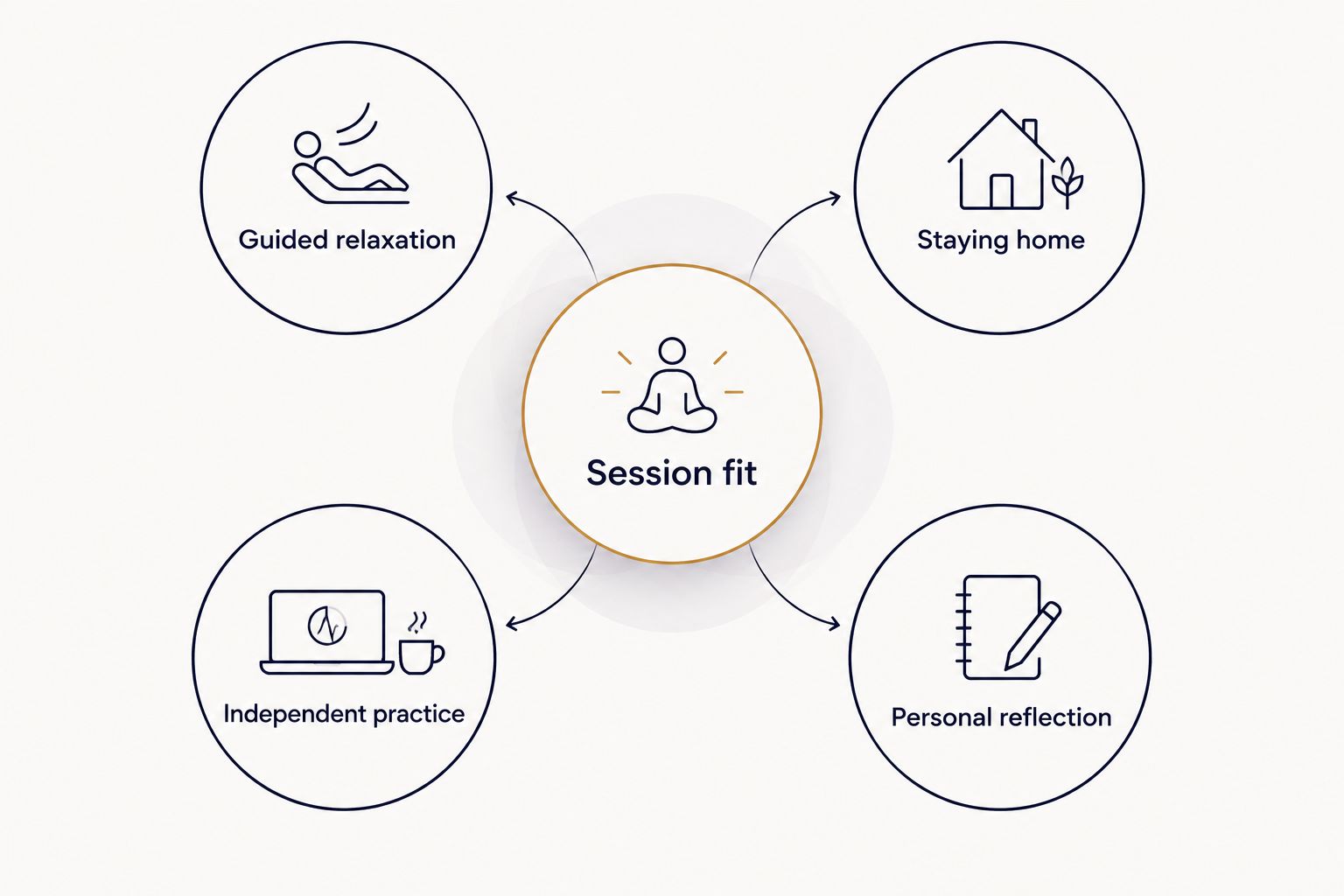
For your 2026 shortlist, use the same questions with every practitioner. What happens during the appointment? Is touch optional? Can you stop? What claims are being made about sleep? Clear answers help you compare services without needing to accept their spiritual explanation as medical fact.
When insomnia needs more than a relaxation session
Persistent sleep difficulty deserves assessment. The American College of Physicians recommends cognitive behavioral therapy for insomnia as the initial treatment for adults with chronic insomnia; CBT-I is not simply a list of bedtime habits.
Clinical criteria for chronic insomnia include difficulty sleeping at least 3 nights per week for at least 3 months, despite adequate opportunity to sleep, with associated daytime effects. Those thresholds describe a diagnostic pattern, not a requirement to wait before asking for help.
The American Academy of Sleep Medicine and Sleep Research Society recommend that adults generally sleep 7 or more hours per night regularly. That recommendation is not a promise that spending longer in bed will solve insomnia.
Ask a healthcare professional about persistent sleep difficulty, significant daytime impairment, loud snoring with gasping, or uncomfortable urges to move your legs at rest. Do not drive when sleepy. Reiki cannot determine whether sleep apnea, medication effects, pain, mood symptoms, or another issue is contributing.
For this 2026 comparison, these clinical boundaries take priority over every spiritual recommendation. Continue prescribed care unless your treating clinician advises a change.
How to judge a session without fooling yourself
Separate your assessment into two questions: did the appointment feel comfortable, and did your sleep pattern change? Enjoying the session answers the first question. It does not automatically answer the second.
If you track sleep, record your usual pattern as well as nights after a session. Note other changes, such as illness, medication, work schedules, or alcohol. Bring relevant observations to your clinician rather than treating a better night as proof of Reiki's mechanism.
Do not judge success by warmth, tingling, tears, or falling asleep during the appointment. Those experiences do not establish that insomnia has been treated. Likewise, worsening symptoms should not be dismissed as necessary cleansing or a healing crisis.
Keep the service only if the experience is worthwhile to you without a medical promise. You do not owe a practitioner repeat appointments to demonstrate belief or commitment.
How these options were ranked
The ranking prioritizes clear scope, consent, format transparency, independence, and respect for healthcare. It is a decision guide for service formats, not a clinical effectiveness ranking or a claim that particular providers were tested.
Individual sessions lead for guided support; distance sessions fit staying home; instruction fits independent practice; discussion fits reflection. Jahben belongs in the spiritual-support conversation, not a leaderboard of proven insomnia treatments.
Which Reiki service should you choose?
Choose an individual session with explicit consent if you want optional guided relaxation and remain undecided about format. Choose distance practice only if staying home better matches your preferences; choose instruction if learning Reiki itself is your goal.
If your main question is how to treat ongoing insomnia in 2026, seek clinical assessment and ask about CBT-I. No Reiki format earns a recommendation as a replacement.
FAQ
What's the best Reiki service for insomnia and sleep?
No Reiki service is established as an effective insomnia treatment. For optional spiritual relaxation, choose a format with clear consent, transparent session details, and no cure promises.
Can Reiki cure chronic insomnia?
Reiki has not been established as a cure for chronic insomnia. Cognitive behavioral therapy for insomnia, or CBT-I, is the recommended first-line treatment for adults with chronic insomnia.
Is distance Reiki better than an in-person session for sleep?
Distance Reiki has not been established as better than in-person Reiki for sleep. Choose between them according to privacy, travel, touch preferences, and communication needs rather than claims of stronger healing.
How many Reiki sessions do I need to sleep better?
There is no established number of Reiki sessions that treats insomnia. Do not accept a guaranteed course of sessions as a medical treatment plan, and seek assessment for persistent sleep problems.
Do I have to be touched during Reiki?
You can decline touch during Reiki. Ask the practitioner to explain the approach beforehand and confirm that you can pause, change position, or stop at any time.
Can I use Reiki while taking prescribed sleep medication?
Reiki should not replace prescribed medication or change how you take it. Discuss medication questions with your prescriber and reject any practitioner's instruction to stop treatment.
Is Jahben Reiki a medical sleep service?
Jahben Reiki is part of a spiritual advisory practice, not an established medical insomnia treatment. Confirm what the session includes and use qualified healthcare for diagnosis and treatment of persistent sleep problems.
One last thing
Falling asleep during a session is not the same as treating insomnia. A pleasant appointment and a lasting change in nighttime sleep are different outcomes. Choose a practitioner who respects that distinction—and who accepts your decision not to return without blaming your beliefs or energy.
Related guides
Ready for your own reading?
Astrology, numerology, and tarot brought together into one clear, written answer about your love, career, or timing.
Book a Personal Reading Get Your Free Report