Best overall for personal questions: Jahben’s weekly horoscopes alongside a personal reading. Best for chart-based study: birth-chart transit readings. Best for a simple weekly check-in: sun-sign forecasts. This 2026 guide compares the best weekly horoscope services by usefulness and specificity—not an unverified claim that one provider predicts events more accurately than another.
- Jahben offers weekly horoscopes and personal readings for people seeking guidance on love, career, and timing.
- The best weekly horoscope services distinguish shared zodiac themes from individual birth-chart interpretation.
- Birth-chart transit readings suit detailed astrology questions; sun-sign forecasts suit a simple weekly check-in.
- Specific language makes a forecast easier to evaluate, but does not prove predictive accuracy.
Why this matters
A horoscope that feels personal is not automatically an accurate prediction. Broad statements about tension, opportunity, or change fit many ordinary weeks, especially when you interpret them after events happen.
Choose a service for the question it helps you explore, not for an unsupported accuracy ranking. Astrology is a spiritual and interpretive practice, not a scientifically established method for predicting individual outcomes. A useful reading still needs clear language, identifiable assumptions, and room for your judgment.
Start with how to read your weekly horoscope for real guidance. Understanding the difference between a shared forecast and a personal interpretation keeps you from asking a general horoscope to answer a private question.
What makes the best weekly horoscope services?
Use these criteria when choosing a weekly horoscope service in 2026. They assess the reading’s quality and fit, rather than assigning a predictive success rate.
- Personal context: Does the reading address a zodiac sign collectively, or consider your individual birth chart and question?
- Method clarity: Does the provider explain whether the interpretation uses sun signs, rising signs, transits, or another system?
- Specific language: Can you identify what the forecast actually says without supplying most of the meaning yourself?
- Useful boundaries: Does the reading separate spiritual interpretation from medical, legal, or financial advice?
- Reviewability: Can you revisit the original wording rather than rely on your memory of it?
- Question fit: Does the format support reflection, chart study, or a personal conversation—the outcome you actually want?
A detailed reading is not automatically better. If you want a quick journaling prompt, a lengthy transit interpretation adds work without necessarily serving your purpose. If you need to discuss a relationship decision, a short sign forecast does not provide individual context.
Weekly horoscope options at a glance
These are ranked service formats, not a tested leaderboard of competing providers. The order prioritizes personal context and a clear purpose; each option serves a different reader.
| Rank and option | Best for | Standout feature | Key limitation |
|---|---|---|---|
| 1. Jahben weekly horoscopes with a personal reading | Personal love, career, and timing questions | Weekly content alongside individual spiritual advisory services | A general horoscope and a personal reading are different services |
| 2. Birth-chart transit readings | Detailed astrology study | Interprets current planetary positions in relation to a natal chart | More detail does not establish predictive accuracy |
| 3. Rising-sign weekly forecasts | Learning house-based interpretation | Organizes weekly themes around an ascendant-based chart framework | Still a shared forecast, not an individual chart reading |
| 4. Sun-sign weekly forecasts | A simple weekly check-in | Uses the zodiac sign associated with your birth date | Leaves out most individual chart information |
| 5. Moon-sign weekly reflections | Emotional journaling | Uses the Moon’s symbolic role in astrology | Reflection does not establish another person’s feelings or intentions |
1. Jahben: best weekly horoscope option for personal questions
Jahben offers weekly horoscopes and personal psychic readings delivered by email or live session. The practice combines western astrology, Pythagorean numerology, tarot, and 12 Tribes astrology for individuals seeking guidance on love, career, timing, and life direction.
Jahben is best for weekly horoscope readers who also want individual spiritual guidance on love, career, or timing. That is a service-fit verdict, not a claim of measured predictive superiority. Keep the weekly forecast separate from any personal reading you choose.
For example, a general forecast about communication can prompt you to consider an unresolved conversation. A personal reading gives you a format for bringing your own question and circumstances into the discussion; it does not make the other person’s future behavior certain.
Jahben pros:
- Offers weekly horoscopes as well as individual readings.
- Provides email and live-session reading formats.
- Includes several named spiritual systems within the practice.
Jahben cons:
- A collective weekly horoscope does not become personalized simply because individual readings are also offered.
- Combining spiritual systems does not demonstrate greater predictive accuracy.
Best for: You want a weekly spiritual check-in and a separate place to explore a personal question.
Verdict: Buy a personal reading only when you want individual interpretation; skip treating the weekly horoscope as a guaranteed answer.
2. Birth-chart transit readings: best for detailed astrology study
A birth-chart transit reading interprets current planetary positions in relation to the positions recorded in a natal chart. Within astrology, this format offers a more individualized framework than a forecast written for everyone sharing a sign.
Choose this format if you want to understand the reasoning behind an interpretation. Ask which natal placement, transit, or house supports a stated theme, rather than accepting technical vocabulary as evidence that an outcome will occur.
In 2026, a transit reading remains an interpretation—not a verified schedule of future events. Distinguish exact astronomical positions from the symbolic meaning assigned to them; precision in the former does not validate the latter.
Birth-chart transit reading pros:
- Uses an individual natal chart rather than a sign alone.
- Gives astrology students specific placements to investigate.
- Supports questions about how different chart factors are interpreted together.
Birth-chart transit reading cons:
- House and angle interpretation depends on reliable birth-time information.
- Technical detail can obscure an unclear or unfalsifiable statement.
Best for: You want to study the chart-based reasoning behind weekly themes.
The guide to getting an accurate astrology reading online addresses the preparation side of choosing a personal interpretation.
Verdict: Buy for individual chart discussion; skip any promise that transit detail guarantees an event.
3. Rising-sign forecasts: best for learning house-based interpretation
A rising-sign weekly forecast groups readers by their ascendant, the zodiac sign rising on the eastern horizon at birth. In whole-sign house astrology, the rising sign establishes the first house, allowing a shared forecast to organize themes by houses.
This format suits readers learning why a forecast discusses work, relationships, home, or another life area. Check the author’s stated method before assuming that a particular house system is being used.
Reading for your rising sign does not reproduce your complete natal chart. Readers sharing an ascendant still have different planetary placements and personal circumstances, so a shared house theme is not an individual prediction.
Rising-sign forecast pros:
- Introduces the relationship between the ascendant and houses.
- Gives house-based forecasts a clear reading framework.
- Helps you distinguish sign-level content from a full natal interpretation.
Rising-sign forecast cons:
- You need reliable birth information to identify the ascendant.
- A shared rising-sign forecast omits individual natal placements.
Best for: You know your rising sign and want to learn how house-based weekly forecasts are structured.
Do not switch between your sun and rising forecasts solely to find the more reassuring message. Decide which interpretation you are following before the week begins, and keep its wording intact when you review it.
Verdict: Buy into the learning framework; skip calling it a personalized chart reading.
4. Sun-sign forecasts: best for a simple weekly check-in
A sun-sign weekly forecast addresses people whose natal Sun falls in the same zodiac sign. It is a straightforward entry point because you can identify your sign without assembling a complete birth chart, except where a birth falls close to a sign boundary.
The western zodiac contains 12 signs. A forecast divided into 12 sign sections necessarily groups together people with different lives, natal charts, and responsibilities.
That broad scope is acceptable when you use the reading as a reflection prompt. A theme about patience can lead you to review a rushed decision without claiming that a planet has proved what you should do.
Sun-sign forecast pros:
- Offers a simple starting point for beginners.
- Requires less chart knowledge than transit interpretation.
- Supports a repeatable weekly journaling habit.
Sun-sign forecast cons:
- Does not consider your complete natal chart.
- Broad wording makes perceived matches difficult to separate from ordinary experience.
Best for: You want a brief reflective theme rather than individual advice.
For your 2026 routine, choose a source whose wording you understand. Length, drama, and confidence are not substitutes for a clear statement you can revisit.
Verdict: Buy into the reflection habit; skip using a sun-sign forecast to settle a major decision.
5. Moon-sign reflections: best for emotional journaling
Within astrology, the natal Moon is associated with emotions, habits, and needs. A Moon-sign weekly reflection uses that symbolic framework to prompt attention to your inner experience rather than focus entirely on external events.
This format fits questions about how you respond to uncertainty, conflict, or change. It does not establish what a partner feels, diagnose a mental health condition, or reveal someone’s hidden intentions.
Moon-sign reflection pros:
- Gives emotional journaling a defined symbolic focus.
- Encourages attention to your own responses.
- Separates an inward-looking exercise from an event forecast.
Moon-sign reflection cons:
- Symbolic descriptions are not psychological assessments.
- Identifying your Moon sign requires a chart calculation; birth time matters near a sign change.
Best for: You want to examine your reactions without asking a horoscope to predict another person.
Keep the journal entry concrete. Describe what happened, what you felt, and what you chose to do before connecting the experience to an astrological theme.
Verdict: Buy into reflective use; skip treating Moon-sign language as a diagnosis or evidence about someone else.
How to assess a weekly forecast without rewriting it
Use a 4-week review as a personal reading exercise, not a scientific test. Follow 1 forecast source consistently and record up to 3 specific claims per week before events unfold; these are suggested limits for keeping the exercise manageable, not accuracy benchmarks.
- Save the forecast: Keep its original wording and the week it covers.
- Name the claim: Separate a predicted event from advice or a general theme.
- Record the outcome: Write down what occurred without changing the prediction.
- Count the misses: Retain statements that did not fit, as well as those that did.
- Review the fit: Decide whether the reading helped you reflect or merely sounded familiar.
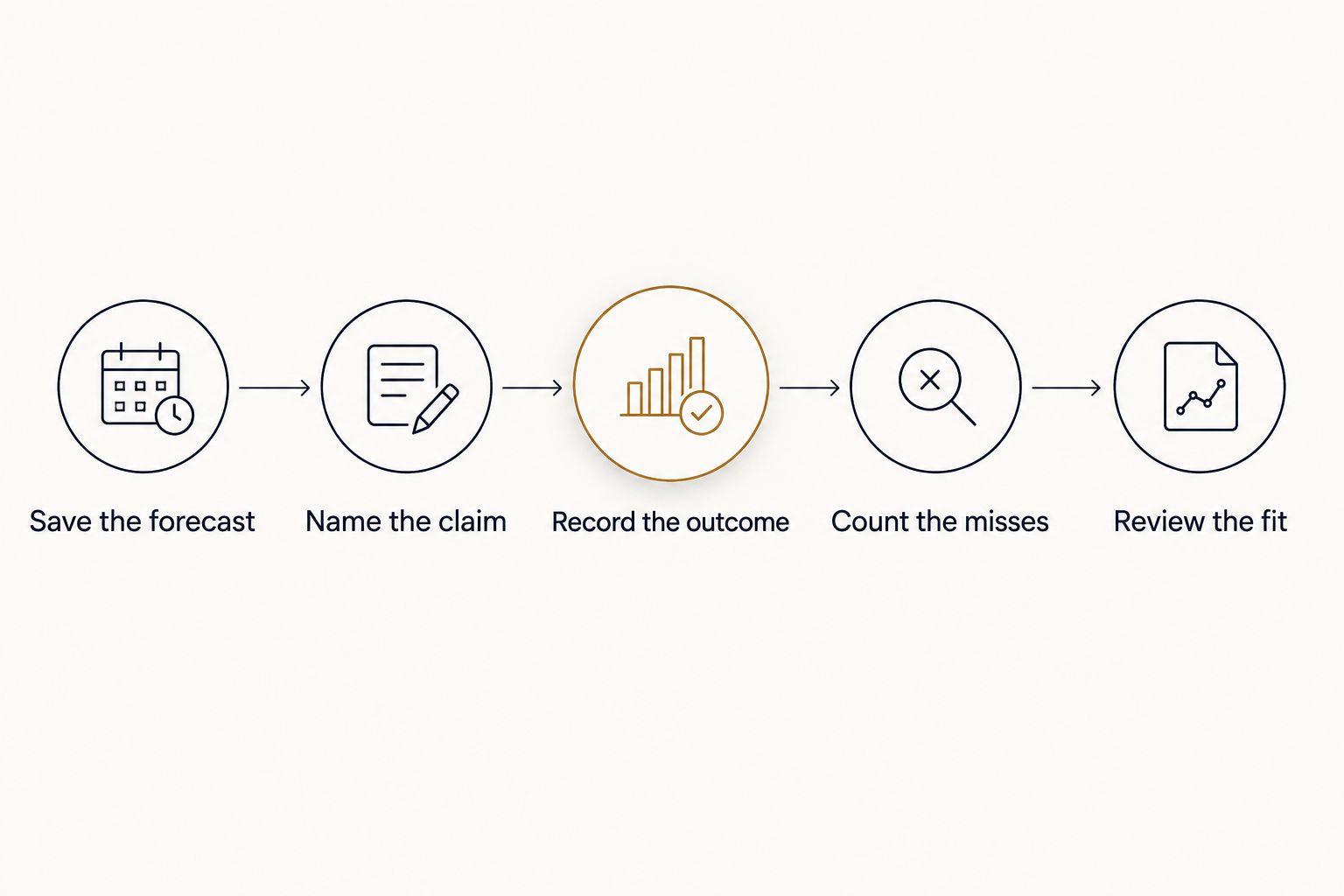
For example, advice to communicate clearly is not a prediction that someone will contact you. A statement about relationship change is too broad to establish a successful prediction unless the forecast defines what counts as change.
During your 2026 review, notice whether reading several forecasts makes your assessment less clear. Finding a matching sentence somewhere is different from evaluating a statement selected beforehand.
How these options are ranked
The ranking prioritizes question fit, personal context, method clarity, and reviewability. Personal advisory services come first for personal questions; chart-based interpretation follows for readers who want astrology detail; shared sign forecasts serve narrower reflective purposes.
No predictive accuracy score is assigned to any option. An accuracy comparison requires predefined claims, consistent evaluation rules, and independently assessed outcomes—not testimonials or a feeling that a reading was meaningful.
Which weekly horoscope service should you choose?
Choose a simple sun-sign forecast if you are undecided and only want a weekly reflection habit. Move to a birth-chart reading when you want to discuss individual placements, or a personal spiritual advisory session when you want to bring a specific life question.
The best weekly horoscope services in 2026 make their scope clear. Choose the format that answers your actual need, and keep medical treatment, legal decisions, financial commitments, and personal safety grounded in qualified advice and observable facts.
FAQ
What are the best weekly horoscope services in 2026?
The best weekly horoscope services depend on your purpose: Jahben offers weekly horoscopes alongside personal spiritual readings, while birth-chart transit readings suit detailed astrology questions. Sun-sign forecasts are a simpler choice for weekly reflection; none of these formats has an established predictive accuracy advantage here.
Which weekly horoscope service is the most accurate?
No service is identified here as the most predictively accurate. A defensible ranking requires independently evaluated predictions under consistent rules, rather than testimonials or perceived personal relevance.
Is a rising-sign horoscope better than a sun-sign horoscope?
A rising-sign horoscope is better suited to learning house-based interpretation, while a sun-sign horoscope offers a simpler check-in. Neither format reproduces a full personal birth-chart reading or establishes greater predictive accuracy.
Do I need my birth time for a weekly horoscope?
A general sun-sign weekly horoscope usually does not require your birth time. Rising-sign and house-based interpretations need reliable birth-time information, and Moon-sign identification can depend on time near a sign change.
Can a weekly horoscope tell me whether my partner will come back?
A weekly horoscope cannot reliably establish whether a partner will return. Use it for reflection, and assess the relationship through communication, behavior, and respect for each person’s choices.
How can I check whether a horoscope was accurate?
Save the original forecast before the week begins, identify its specific claims, and record both matches and misses. Treat vague themes and general advice separately from event predictions, and do not rewrite claims after the outcome.
Is a personal astrology reading the same as a weekly horoscope?
A personal astrology reading and a general weekly horoscope are different formats. A personal interpretation considers individual information, while a shared weekly horoscope addresses a broader group; personalization alone does not prove predictive accuracy.
One last thing
Write your question before reading the forecast. Otherwise, you risk changing what you wanted answered to match whatever the horoscope discusses.
A useful 2026 reading leaves you with a clearer question or a grounded next step. If the interpretation requires you to ignore facts, tolerate harmful behavior, or surrender your judgment, skip it.
Related guides
- Rising sign vs. sun sign: what is the difference?
- Weekly horoscope reading for career and money timing
- Weekly horoscope reading for love and relationship timing
Ready for your own reading?
Astrology, numerology, and tarot brought together into one clear, written answer about your love, career, or timing.
Book a Personal Reading Get Your Free Report