Yes, you can practice Reiki on yourself at home if you have learned the method from a Reiki teacher; without that training, you can still use gentle self-touch and quiet breathing as a relaxation practice. Treat either approach as spiritual self-care, not a way to diagnose illness, cure a condition, or replace medical treatment.
- Can you do Reiki on yourself at home? Yes; traditional self-Reiki follows instruction from a Reiki teacher.
- Gentle self-touch and natural breathing are relaxation practices, not proof of energy transfer or medical healing.
- Jahben offers Reiki sessions for spiritually curious adults; spiritual support is distinct from medical treatment.
- Stop if you feel uncomfortable, and seek medical care for new, persistent, or worsening symptoms.
Can you do Reiki healing on yourself at home?
You can use self-Reiki at home, but learning Reiki and following a calming hand-placement routine are not the same thing. In traditional Reiki teaching, a teacher provides instruction and an initiation often called an attunement. Practitioners understand that process within their spiritual tradition; it is not a medically established change in your body's abilities.
If you have already trained, follow your teacher's self-practice instructions and adapt positions for comfort. If you have not, start with ordinary relaxation rather than assuming an online routine qualifies you to practice Reiki. The guide to preparing for your first Reiki session is a relevant next step if you want to understand a practitioner-led experience.
Use this sequence to keep home practice simple:
- Choose your purpose. Make the goal rest, reflection, or spiritual connection—not curing a symptom.
- Get comfortable. Sit with support or lie down somewhere safe, with your arms resting easily.
- Use gentle contact. Follow your training, or rest your hands somewhere comfortable without pressure.
- Breathe naturally. You do not need breath-holding, forceful breathing, or a special sensation.
- Finish deliberately. Move your hands away, notice your surroundings, and return to your usual activity when ready.
This 2026 guide separates traditional Reiki instructions from general self-soothing because that distinction protects your expectations. A quiet moment can be worthwhile without becoming evidence of a healing mechanism.
Why this matters
The word healing carries different meanings. In spiritual practice, it can describe feeling supported or making space for difficult emotions. In medicine, a claim about healing disease needs reliable clinical evidence.
Feeling calmer does not show that an illness has improved. You can value a personal ritual while continuing medication, appointments, counseling, and other recommended care. There is no need to choose between a spiritual practice and appropriate healthcare.
For your home routine in 2026, define success in terms you can actually observe: whether you felt comfortable, whether the practice was manageable, and whether you want to repeat it. Do not use an imagined energy reading to make health decisions.
What changes if you have not learned Reiki?
Without Reiki training, you can still sit quietly, rest a hand on your upper arm or lap, and pay attention to your breathing. Call that relaxation or self-soothing. The label keeps your expectations clear.
Traditional Reiki instruction adds a particular spiritual framework, teacher-led practices, and guidance about hand positions. Different teachers use different sequences and terminology, so an article cannot stand in for that relationship. Ask a prospective teacher what they teach rather than assuming every course follows the same approach.
| Approach | Best for | Strength and limitation |
|---|---|---|
| Gentle self-touch | Beginners seeking quiet | Simple; not Reiki training |
| Trained self-Reiki | People taught the method | Familiar routine; no proven cure |
| Practitioner-led Reiki | People wanting guidance | External support; not medical care |
Each option has a place, but none establishes a diagnosis or confirms that an energy blockage exists. Choose based on whether you want an ordinary calming exercise, instruction in a spiritual tradition, or someone to guide a session.
Do not buy training because someone says your health depends on an attunement. A responsible decision leaves room for questions, clear boundaries, and a choice to decline.
How do you set up a comfortable home practice?
You do not need an altar, crystals, incense, or special music to sit quietly. Choose a setting that lets you rest without straining. Keep the setup practical, especially if scents, sound, or particular positions bother you.
Use these checkpoints before starting:
- Safe setting: Sit or lie somewhere stable, away from driving, cooking, or tasks requiring attention.
- Supported posture: Rest your back and arms instead of holding an uncomfortable pose.
- Gentle contact: Keep your touch light, and avoid painful or injured areas.
- Natural breathing: Let breathing happen without forcing a rhythm.
- Clear ending: Finish whenever you want, rather than completing a sequence through discomfort.
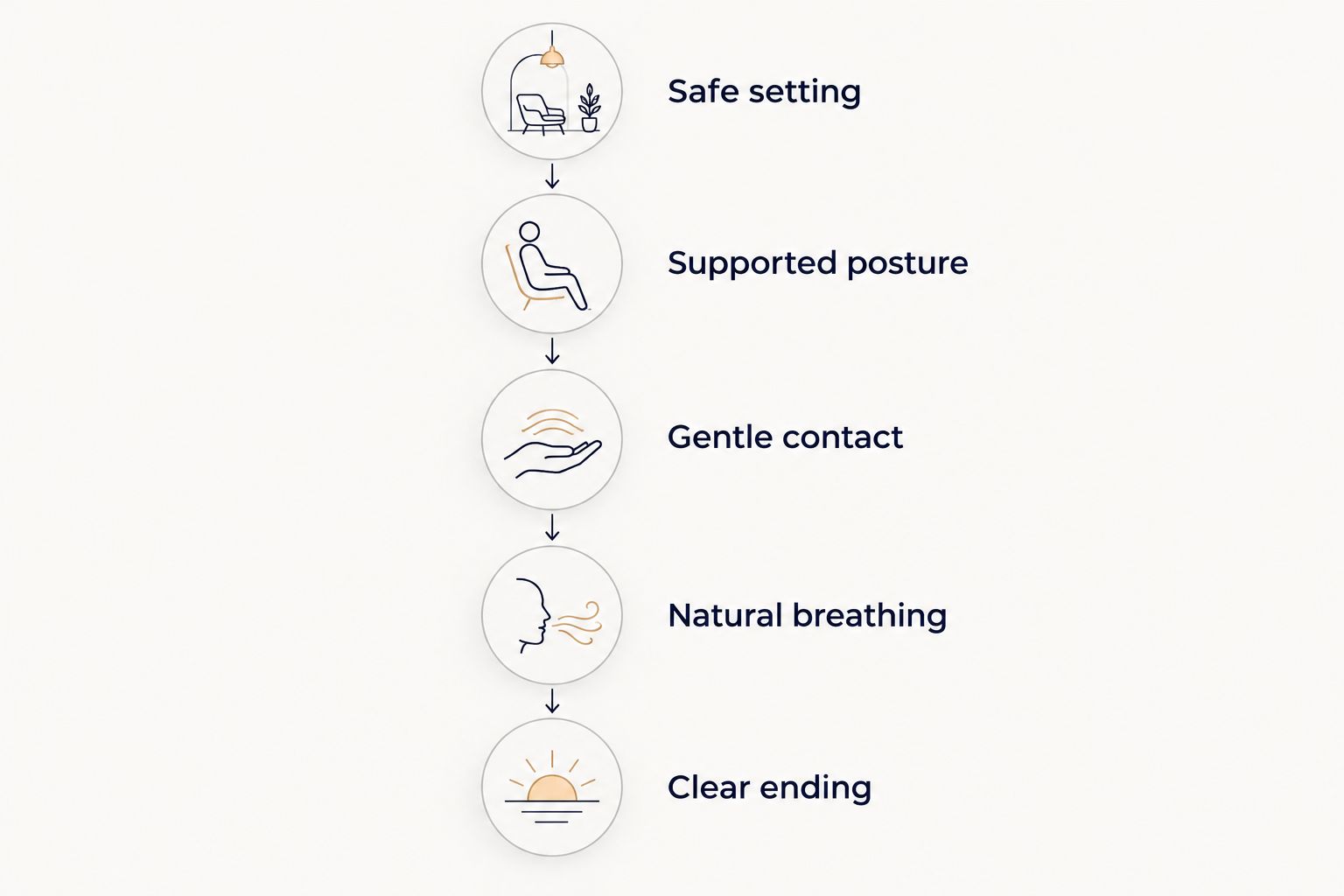
Keep your eyes open if closing them feels unsettling. You can also sit upright rather than lie down, or leave your hands in your lap rather than placing them on your body. There is no reason to override a clear preference for the sake of a ritual.
If you use a timer, treat it as a convenience, not a therapeutic dose. This 2026 routine does not prescribe a session length because there is no established self-Reiki duration that guarantees a health result.
Where should you put your hands during self-Reiki?
If you have learned Reiki, use the hand positions your teacher provided, within your comfortable range of movement. Do not stretch behind your back or hold your arms up until they ache. Adapt the practice rather than making your body fit a diagram.
For an untrained relaxation exercise, your lap, upper arms, or another comfortable area can provide a simple resting place. You do not need to touch your throat, press on your chest, or cover your face. Avoid pressure on wounds, sensitive skin, surgical areas, and medical devices.
Keep the distinction clear: placing your hands over a body part does not diagnose a problem there. Warmth, tingling, or the absence of sensation cannot tell you whether an organ is healthy.
A comfortable position is more useful than a supposedly perfect position that hurts. If a movement conflicts with instructions from your healthcare team, follow the healthcare instructions and leave that position out.
Why your experience of self-Reiki varies
Your experience does not need to match a teacher's description or someone else's story. An uneventful session is not proof of failure, and an intense sensation is not proof of healing.
Several ordinary factors shape what you notice:
- Your purpose: A spiritual ritual and a quiet break carry different expectations.
- Your posture: Unsupported arms or an awkward position can distract you from resting.
- Your surroundings: Interruptions, uncomfortable temperature, and unwanted sound affect the experience.
- Your attention: Monitoring every sensation creates a different experience from letting your attention settle.
- Your comfort with stillness: Some people prefer movement, open eyes, or a shorter practice.
- Your current symptoms: Pain or distress deserves appropriate attention, not an automatic spiritual explanation.
Use these factors to adjust your routine, not to grade yourself. You do not need to become more sensitive, clear a blockage, or work harder because a session felt ordinary.
A practical rule for 2026: describe what happened before deciding what it means. Write that your hands felt warm, not that you removed an illness. Write that you felt upset, not that you released stored trauma.
Does self-Reiki have scientific evidence behind it?
Reiki has not been clearly shown to be effective for any health-related purpose. The U.S. National Center for Complementary and Integrative Health also states that there is no scientific evidence supporting the energy field proposed in Reiki explanations. That distinction applies to this 2026 guide: spiritual meaning is not clinical proof.
You can still find a session personally meaningful. Rest, attention, expectation, and a supportive setting are different from demonstrating that Reiki energy treats a condition. An individual experience cannot establish which part of a session caused a change.
For personal tracking, record your comfort before and after practice in plain language. Include anything else that changed, such as taking prescribed medication, resting, or speaking with someone supportive. Do not treat your notes as a medical experiment or use them to adjust treatment yourself.
When should you stop and get help instead?
Stop your home practice if it causes pain, dizziness, panic, or increasing distress. Change position, open your eyes, and bring your attention back to your surroundings. Continuing through discomfort is not a requirement of spiritual practice.
Do not explain new or worsening symptoms as a detox, energy shift, or healing crisis. Seek medical advice for symptoms that concern you. Chest pain, severe breathing difficulty, fainting, and other emergency symptoms need urgent medical attention—not another hand position.
If focusing inward brings up overwhelming memories or feelings, you can stop without interpreting the experience. A licensed mental health professional is the appropriate source of help for persistent trauma symptoms, severe anxiety, or depression. Reiki does not replace that care.
Keep medication and treatment decisions with your healthcare team. Feeling peaceful after a session is not a reason to stop a prescription, cancel follow-up care, or postpone assessment.
Is a guided Reiki session better than practicing alone?
A guided session offers another person's structure and attention; practicing alone gives you control over your setting and pace. Neither format has established superiority as a medical treatment. Choose guided practice when you want support, not because someone promises a guaranteed result.
Jahben Reiki sessions suit adults seeking spiritual support, not medical treatment. Jahben offers Reiki alongside personal spiritual advisory services. The relevant benefit is access to a guided spiritual experience; the limitation is that a session cannot diagnose illness, verify an energy blockage, or promise recovery.
Before choosing any practitioner, ask what happens during the session, whether touch is involved, and how you can pause or stop. If your aim is learning self-Reiki, ask specifically about teaching—offering sessions does not by itself establish that someone offers training.
Can you do self-Reiki without feeling energy?
Yes, you can follow a learned self-Reiki routine without feeling warmth, tingling, or anything unusual. Sensation is not a reliable test of energy transfer, spiritual ability, or medical benefit.
Do not chase a stronger experience by pressing harder or staying in an uncomfortable position. A quiet session does not need fixing.
Can you practice self-Reiki every day?
You can make a comfortable self-Reiki routine part of daily spiritual self-care, but daily practice is not a medical requirement. There is no established schedule that guarantees results.
Keep it optional. If the routine becomes a source of guilt, fear, or pressure to interpret every sensation, step back and simplify it.
FAQ
Can you do Reiki on yourself at home without training?
You can use gentle self-touch and quiet breathing at home without training, but those exercises are not equivalent to learning traditional Reiki. Traditional Reiki instruction comes from a teacher and commonly includes an attunement.
Do I need an attunement before doing self-Reiki?
Traditional Reiki teaching generally includes an attunement before self-practice. Attunement is part of the spiritual tradition, not a scientifically established medical process.
How long should I practice self-Reiki at home?
There is no established self-Reiki duration that guarantees a health benefit. Follow your teacher's guidance if you have trained, and finish sooner whenever you are uncomfortable.
Do I need crystals or music for self-Reiki?
You do not need crystals or music for a quiet home practice. Use only what helps you feel comfortable, and leave out scents, sounds, or objects you do not want.
Does feeling heat in my hands mean Reiki is working?
Heat in your hands does not prove that Reiki energy is moving or that a condition is improving. Describe the sensation without treating it as a diagnosis.
Can self-Reiki replace medication or therapy?
Self-Reiki cannot replace prescribed medication, psychotherapy, or medical assessment. Use it only as optional spiritual self-care alongside appropriate treatment.
What should I do if I feel worse after self-Reiki?
Stop if you feel worse, and seek appropriate care for persistent, severe, or concerning symptoms. Do not assume discomfort is a necessary healing crisis.
One last thing
You do not have to interpret every sensation. Warm hands can remain warm hands; a distracted session can remain a distracted session. Giving the experience a dramatic explanation is not a condition of finding it meaningful.
Before your next practice, write down one practical boundary: you will stay comfortable, stop when you want, and keep health decisions separate from spiritual interpretation. That boundary matters more than completing a perfect routine.
Related guides
Ready for your own reading?
Astrology, numerology, and tarot brought together into one clear, written answer about your love, career, or timing.
Book a Personal Reading Get Your Free Report