Reiki is a real practice, but its proposed healing energy has not been scientifically demonstrated. People can feel calmer after a session; that experience does not establish whether Reiki works through a distinct energy mechanism, a placebo response, quiet attention, or a combination of ordinary factors. In 2026, the answer to “is Reiki real or placebo?” depends on whether you mean the experience or the explanation for it.
- Reiki is real as a practice; a distinct healing energy has not been scientifically demonstrated.
- The answer to is reiki real or placebo is not either-or: a calmer feeling does not identify its cause.
- Jahben Reiki sessions are best for people seeking a spiritual experience, not a proven medical treatment.
- Keep medical care in place, and judge a Reiki session by what you personally experience.
If you are considering a session, how to prepare for your first Reiki session is a more useful next step than trying to prove the mechanism before you walk in. Know what you want from the experience, and keep that goal separate from a medical claim.
Is Reiki real, or does it work through a placebo effect?
Reiki is real as an experience and an established practice; its proposed energy mechanism remains unproven. The National Center for Complementary and Integrative Health (NCCIH), part of the U.S. National Institutes of Health, says there is no scientific evidence for the energy field proposed to explain Reiki. It also says Reiki has not been clearly shown to be effective for any health-related purpose. That does not mean someone who feels calmer is imagining the feeling. It means the feeling alone cannot tell you what caused it.
| What you are asking | What the evidence supports | What it does not establish | Best for |
|---|---|---|---|
| Is a Reiki session a real experience? | Yes. You can attend a session and describe how you feel afterward. | That the practitioner transferred a measurable healing energy. | Anyone deciding whether the experience appeals to them. |
| Can a session feel calming? | Yes. A person can genuinely feel calmer in a quiet, attentive setting. | That Reiki's proposed mechanism caused the change. | Someone seeking a reflective pause. |
| Does Reiki treat a health condition? | The evidence has not clearly established effectiveness for a health-related purpose. | That it can replace diagnosis or treatment. | No one seeking a substitute for medical care. |
This is the key distinction in 2026: a real benefit you notice is not proof of the explanation offered for it. The reverse is also true. Doubt about an energy field does not make your sense of calm unreal.
Why this matters
“Placebo” often sounds like an accusation that someone made up their experience. It is not. Expectations and the circumstances of care can affect what people report and feel. A Reiki session also gives you time away from demands, focused attention, and space to rest. If you feel better afterward, you can acknowledge that without claiming you know which part of the session made the difference.
The distinction becomes more important when the question involves illness. You can choose a spiritual practice because it helps you reflect or relax. You should not use an unproven mechanism to explain away a new symptom, stop prescribed treatment, or delay an appointment. In 2026, a clear boundary between personal meaning and medical evidence lets you do both: take your experience seriously and take your health seriously.
What would show that Reiki works beyond placebo?
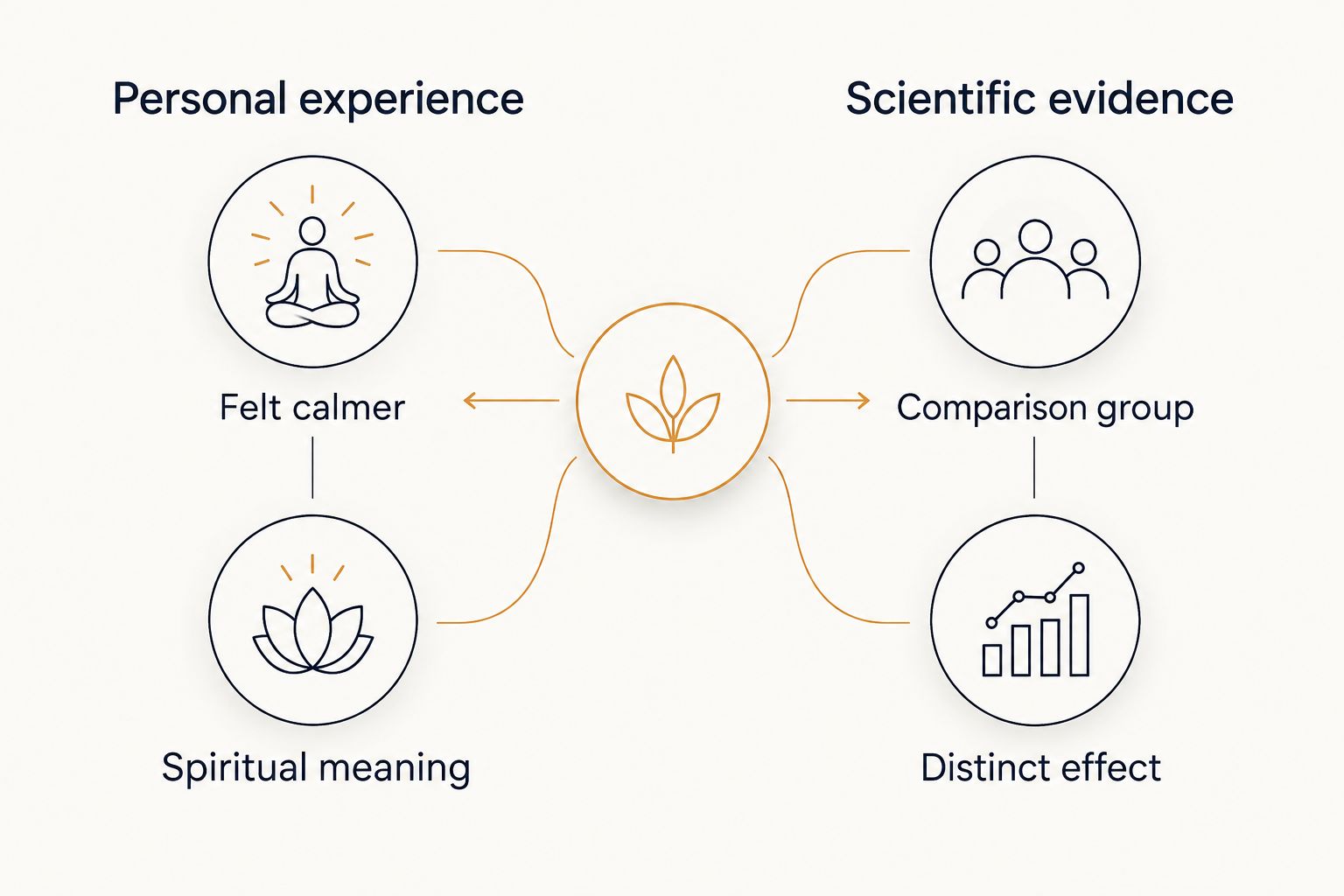
To show a Reiki-specific effect, research would need to separate the proposed energy mechanism from the other things that happen during a session. A participant's expectation, a practitioner's attention, and time spent resting can all shape the experience. Asking whether someone felt better afterward is useful, but it does not isolate the cause.
Researchers can compare Reiki with a credible sham session or another quiet, supportive activity. They can also look at whether an outcome holds up when participants do not know which approach they received. Each choice has limits: a sham session can still feel supportive, and some experiences are difficult to measure without asking the participant. The question is not whether anyone reports relief. It is whether Reiki produces a reliable effect that those other factors cannot explain.
NCCIH's assessment gives you the practical answer in 2026: the proposed energy field lacks scientific evidence, and Reiki has not been clearly shown to work for a health-related purpose. That is a narrower, more accurate statement than either “Reiki is proven to heal” or “nobody gets anything from Reiki.”
Does placebo mean the relief is fake?
No. A placebo response is a change connected to expectations and the context of care, not proof that someone lied about feeling better. If you leave a session less tense, you do not need to dismiss that experience. You also cannot use the feeling to confirm an invisible energy transfer.
Think about the question you are trying to answer. “Did I feel calmer?” is a personal observation. “Did Reiki's proposed energy cause that change?” is a claim about mechanism. “Will Reiki treat my condition?” is a medical question. Those questions require different kinds of evidence, and a single session cannot settle all of them.
A useful account of your experience stays close to what happened: you rested, noticed a change in your mood, or found it easier to reflect afterward. It does not turn a feeling into a diagnosis. That plain description is enough to decide whether you want another session, without asking your experience to prove more than it can.
Reiki, quiet rest, and medical care: which fits your goal?
Reiki, quiet rest, and medical care answer different needs. None is a fair substitute for another simply because each can involve feeling supported. Use the goal, not the label, to choose.
| Option | Best for | What it offers | Limit |
|---|---|---|---|
| Reiki session | A spiritual or reflective experience. | A guided setting in which you can pause and notice how you feel. | Its proposed energy mechanism is unproven; it is not a replacement for medical care. |
| Quiet rest | Time to slow down without a spiritual framework. | Space to rest and observe your thoughts. | It does not answer a medical question or provide a guided spiritual session. |
| Medical care | A symptom, diagnosis, or treatment decision. | Clinical assessment and care appropriate to the concern. | It need not provide the spiritual reflection you want. |
For someone who wants a spiritual session without treating it as medicine, Jahben Reiki sessions are best considered a reflective practice, not a proven health intervention. The advantage is that the goal can be honest: make space to pause and see what you notice. The limit is just as important: a session cannot establish the cause of a symptom or demonstrate that a health condition has improved.
You do not have to choose between spiritual reflection and appropriate care. If a symptom worries you, address it with a qualified health professional. If you also want a Reiki session, give it a separate purpose. That keeps the standard for success clear in 2026: an experience can matter to you without carrying a medical claim.
Why people's Reiki experiences vary
There is no reliable way to predict what you will feel in a session. Differences in experience are a reason to describe your own response carefully, not evidence that the proposed mechanism worked for one person and failed for another. These factors shape what you bring to the experience:
- Your goal. Seeking a quiet pause is different from expecting an answer about a physical symptom. Decide which question you want the session to address.
- Your expectations. If you expect to feel a particular sensation, you are more likely to look for it. Record what you actually notice instead of what you hoped to notice.
- The setting. Time away from interruptions and a chance to rest are part of the session experience. Do not automatically credit a proposed energy field for everything you feel there.
- Your circumstances. Stress, grief, and ordinary changes in mood affect how you describe a day. A change after a session does not, by itself, show what caused it.
- The language used. A practitioner may describe an experience in spiritual terms. You can find that language meaningful without treating it as a medical finding.
These are not reasons to talk yourself out of a genuine feeling. They are reasons to be precise about it. “I felt calmer” tells you something useful; “Reiki cured the cause of my stress” claims more than the observation supports.
How can you judge a session without fooling yourself?
Start with a question you can actually answer. Before a session, write down what you want from it in plain language: a pause, a chance to reflect, or a better sense of how you feel. Afterward, note what changed and what did not. Do not revise the goal after the fact to make every sensation count as success.
A simple approach keeps the experience grounded:
- Name your goal. Choose something you can describe from your own experience, such as feeling more settled or finding time to reflect.
- Notice without interpreting. Describe sensations or feelings before assigning them a spiritual or medical cause.
- Check the boundary. If your concern is a symptom or treatment decision, ask a qualified health professional rather than using the session as a test.
- Decide what the experience was worth to you. You can value it even if you remain uncertain why you felt different.
For a Jahben Reiki session, that approach lets you come in with a clear question and leave with an honest account of your experience. It does not promise a particular feeling. If you are weighing whether to continue, the relevant question is whether the session serves the reflective purpose you chose—not whether you can prove an energy field exists.
Can Reiki work at a distance if the energy is unproven?
A person can report a meaningful experience in connection with distance Reiki, but that report does not establish that healing energy traveled between people. Distance makes the mechanism question more pointed, not less. If this is the part you want to examine, distinguish your personal interpretation from a demonstrated physical effect.
Should I try Reiki for stress in 2026?
You can try Reiki as a spiritual or reflective experience if that is what you want. Do not treat a session as a proven treatment for stress or as a substitute for care when stress disrupts your life. Decide beforehand whether your aim is simply to pause and reflect; that makes it easier to assess the experience honestly afterward.
Can Reiki replace treatment for pain or anxiety?
No. Reiki has not been clearly shown to be effective for a health-related purpose, so it should not replace assessment or treatment for pain, anxiety, or another health concern. Tell a qualified health professional about symptoms that persist or concern you, even if a session leaves you feeling calmer.
FAQ
Is Reiki real or placebo?
Reiki is real as a practice, but its proposed healing energy has not been scientifically demonstrated. Feeling better after a session does not show whether the change came from a Reiki-specific effect, expectations, rest, or other parts of the experience.
Is Reiki scientifically proven to heal?
No. The National Center for Complementary and Integrative Health says Reiki has not been clearly shown to be effective for any health-related purpose. It also says there is no scientific evidence for the proposed energy field.
Does placebo mean I imagined feeling calmer?
No. You can genuinely feel calmer without knowing exactly what caused the change. A personal feeling and proof of a proposed energy mechanism are different things.
Can I use Reiki alongside medical care?
Yes, you can pursue Reiki as a spiritual practice while keeping appropriate medical care in place. Do not use a session to diagnose symptoms, change treatment, or delay an appointment.
Why do people feel different things during Reiki?
People arrive with different goals, expectations, and circumstances. What you notice is worth describing, but a sensation alone cannot establish that healing energy caused it.
Is distance Reiki proof that energy can travel between people?
No. A reported experience after distance Reiki does not demonstrate a physical energy transfer. Keep the distinction between what you felt and what that feeling can prove.
How do I know whether a Reiki session was worthwhile?
Judge it against the purpose you set before attending, such as making space to rest or reflect. Do not use a calmer feeling as proof that a health condition was treated.
One last thing
The most useful question in 2026 is not “What am I supposed to feel during Reiki?” It is “What did I actually experience, and what can that experience tell me?” For Jahben Reiki sessions or any other spiritual practice, keep the answer in your own words. You can value a quiet, meaningful experience without calling it medical evidence.
Related guides
- How distance Reiki healing works
- How many Reiki sessions you need to feel results
- Reiki healing for anxiety: what to expect in a session
Ready for your own reading?
Astrology, numerology, and tarot brought together into one clear, written answer about your love, career, or timing.
Book a Personal Reading Get Your Free Report