Yes, you can read tarot cards for yourself and develop a consistent way to interpret them, but that is different from accurately predicting events. Your hopes, fears, and knowledge of the situation influence the reading, so use tarot for reflection rather than proof about the future. This 2026 guide shows you how to ask clearer questions, recognize bias, and turn a reading into a practical next step.
- Can you read tarot cards for yourself? Yes—use self-reading for reflection, not verified predictions.
- Start with a small tarot spread and write your question before drawing cards.
- Record interpretations before events unfold; acknowledge misses as well as apparent matches.
- Jahben offers personal tarot readings for people seeking guided interpretation rather than reading alone.
Can you read tarot cards accurately for yourself?
You can interpret your own cards thoughtfully; you cannot treat a meaningful interpretation as evidence that a prediction is true. Separate these goals before you shuffle. Learning card symbolism is a skill you can practice; knowing whether someone will return or whether an offer will arrive requires information beyond a spread.
A standard tarot deck contains 78 cards: 22 Major Arcana cards and 56 Minor Arcana cards. Learning those symbols gives you a vocabulary, not an independently verified forecasting system. Different readers also use different interpretive traditions, so agreement with a guidebook is not the same as predictive accuracy.
If you are learning the structure, start with how to read a tarot card spread for beginners. Keep the layout small enough that you can explain how each interpretation connects to its assigned position.
Use this distinction when evaluating a self-reading:
| Reading goal | What you can assess | Main limitation |
|---|---|---|
| Learn symbolism | Meaning fits the tradition | Traditions differ |
| Explore a concern | Questions clarify your thinking | Personal bias remains |
| Predict an event | Claim matches later evidence | A match alone proves little |
Why this matters
A reading feels different when you desperately want a particular answer. A card associated with possibility becomes a promise; a difficult symbol becomes a warning you carry through the day. Neither interpretation establishes what will happen.
For your 2026 practice, make the standard simple: a useful reading helps you identify a question, examine an assumption, or choose an action. It does not need to produce certainty. Keep your judgment in charge of the cards, not the other way around.
How do you read tarot for yourself without forcing an answer?
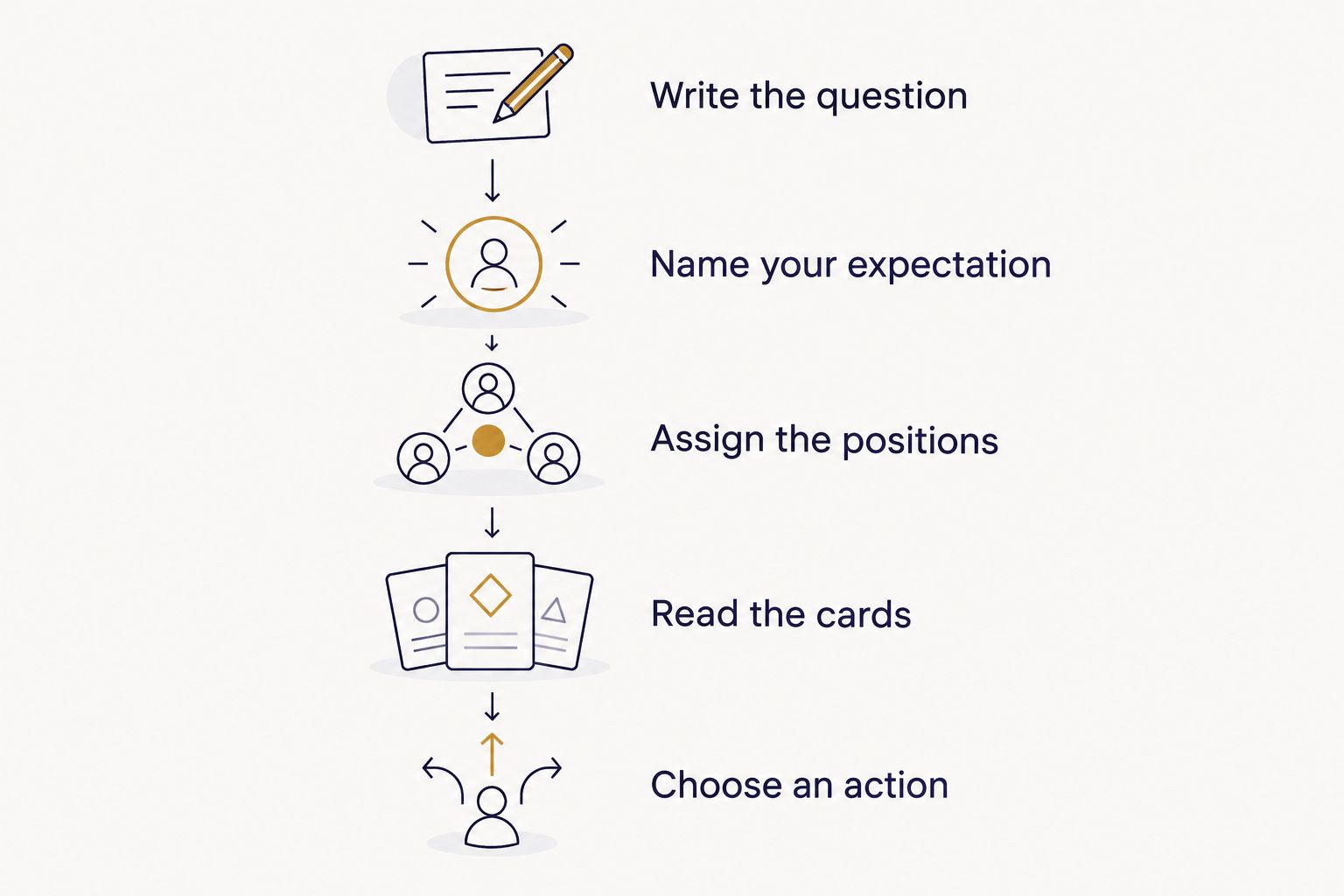
Use a repeatable process so you can inspect your interpretation later. The following steps are a suggested practice, not a formula that guarantees accuracy.
Write the question
Choose something within your influence. Instead of asking whether your manager will promote you, ask what you need to understand before discussing advancement. The second question gives you something to investigate and act on.
Write the question before drawing. If you change it afterward to make the cards fit, keep both versions in your notes rather than quietly replacing the original.
Name your expectation
Write the answer you want and the answer you fear. Be plain: you want reconciliation, or you fear rejection. Naming that expectation gives you something concrete to compare against your interpretation.
You do not have to become emotionally detached. You do need to recognize when a preferred outcome is doing more work than the card symbolism.
Assign the positions
Decide what each position means before laying out the cards. For a small spread, use Situation, Assumption, and Next step. These positions keep attention on your understanding and choices rather than another person's private thoughts.
Do not rename a position because the card looks inconvenient. A consistent layout makes your reasoning easier to follow.
Read the cards
Describe what you see before deciding what it means. Note the image, its conventional associations, and the assigned position. Then explain the connection in a sentence you can understand without mystical shorthand.
If an interpretation depends entirely on information you already know, acknowledge that. Your existing knowledge is context, not evidence that the deck revealed a hidden fact.
Choose an action
End with something observable: ask a question, review a contract, set a boundary, or gather missing information. Avoid actions that depend on assuming the reading has exposed someone else's intentions.
A practical next step should still make sense if your interpretation turns out to be wrong. That is a useful boundary for any spiritual reflection.
Single-card reading: best for a focused reflection
A single-card reading gives you less material to explain away. Use it when you want to explore a narrow question, such as what deserves attention before a difficult conversation.
Its strength is simplicity. Its limitation is the same: a broad symbol does not supply the missing facts of a complicated situation. Start here if you are still learning card meanings.
Write an interpretation and an alternative. If the card suggests patience, ask whether patience means thoughtful preparation or avoiding a necessary conversation. The card does not settle that distinction; your circumstances matter.
Three-card reading: best for connecting context and action
A three-card reading lets you distinguish the situation, your assumption, and your next step. Each position has a different job, which helps you avoid repeating the same conclusion across the spread.
The benefit is structure. The drawback is more room to build a persuasive story from ambiguous material. Use this spread when you can explain each position separately without adding extra cards.
For a decision you are considering in 2026, keep the question anchored to that decision. Do not let a reading about preparing for an interview become a forecast of your entire career.
| Approach | Best for | Main trade-off |
|---|---|---|
| Single-card reading | Focused reflection | Limited context |
| Three-card reading | Context and action | More interpretive choices |
| Guided reading | Discussing interpretations | Still not verified forecasting |
Why self-reading interpretations vary
The same card does not carry an identical practical meaning in every reading. These factors change how you interpret it; none establishes supernatural accuracy.
- Question wording: A question about your choices calls for a different interpretation than a question about another person's behavior.
- Emotional investment: Wanting reassurance gives you a reason to favor comforting meanings.
- Card tradition: Your deck's guidebook and chosen interpretive system shape the associations you use.
- Spread position: A symbol in an obstacle position asks a different question than the same symbol in an action position.
- Known context: Information you already have influences which meanings seem relevant.
- Interpretive flexibility: Adding meanings or extra cards makes it easier to accommodate almost any outcome.
Consistency does not require rigid definitions. It requires explaining why you selected a meaning and what would make you reconsider it.
How do I tell the difference between intuition and wishful thinking?
You cannot establish that an impression is true simply because it feels calm, strong, or immediate. Treat the impression as a possibility to examine. Ask what supports it outside the reading and what evidence would challenge it.
A useful self-check is to interpret the spread without naming the desired outcome. Describe the symbols and positions first, then consider their relevance. If the conclusion changes whenever you remember what you want, record that tension rather than forcing resolution.
Watch for conclusions that claim access to someone else's mind. A reading about your uncertainty does not prove that a partner is unfaithful, that an employer intends to dismiss you, or that a former partner plans to return.
A strong feeling is an experience, not independent confirmation. You can respect the experience without treating it as a fact about another person.
How do I check whether my self-readings are accurate?
Keep a dated record of what you actually interpreted before the outcome was known. For a 2026 tarot journal, distinguish reflection from prediction on every entry. Otherwise, a useful insight and an apparent forecast become easy to confuse.
Use these headings:
- Original question: Preserve the exact question you asked.
- Cards and positions: Record the draw without replacing inconvenient cards.
- Initial interpretation: Write what you understood at the time.
- Alternative explanation: Include a plausible meaning you did not favor.
- Outside evidence: Note what you knew independently of the reading.
- Later review: Record contradictions, ambiguity, and apparent matches.
Your recording method matters less than your willingness to preserve uncomfortable entries. When choosing a self-care journal, give your tarot notes room for the original interpretation and the later review; recording feelings alone leaves no clear claim to check.
If you write a forecast, make it specific enough to be wrong. A statement that something will change is too broad to evaluate meaningfully. A private journal can expose vague wording, but it does not turn a personal collection of matches into scientific validation.
Review the whole record, not just memorable entries. If you revise a meaning after events unfold, label it as a revision. Do not give the original reading credit for an interpretation you added later.
When should you stop reading for yourself?
Stop when another draw is serving reassurance rather than reflection. Warning signs include asking the same question repeatedly, rejecting cards until the spread feels comforting, or postponing ordinary decisions until the deck approves.
Set a stopping rule before you begin: finish the planned spread, write your interpretation, and put the cards away. Return to the issue when there is new information or a genuinely different question—not merely because uncertainty feels uncomfortable.
Do not use tarot to diagnose symptoms, confirm pregnancy, establish infidelity, select investments, or decide legal strategy. Those questions require appropriate evidence and qualified advice. A reading is not a substitute for medical or mental health care.
If tarot increases distress or starts controlling your routine, step back from the practice. You do not owe a deck continued attention.
Is getting a reading from someone else better?
Another reader can discuss meanings you overlooked, but another person's confidence does not establish accuracy. The practical difference is conversation and perspective, not a guarantee that predictions become true.
Jahben is best for people seeking personal tarot guidance rather than interpreting cards alone. Jahben offers personal readings by email or live session, alongside astrology and numerology. The limitation remains: guided interpretation does not replace direct evidence or professional advice.
Before choosing any reader, decide what you want help examining. Bring a clear question and relevant context, and keep responsibility for your decisions. Avoid treating payment, presentation, or certainty of delivery as proof that a reading is correct.
For your 2026 practice, choose outside guidance because you want an interpretive conversation—not because you need someone to promise a particular outcome.
FAQ
Can you read tarot cards for yourself as a beginner?
Yes, you can read tarot cards for yourself as a beginner. Start with a small spread, consult your deck's guidebook, and record how you connect each meaning to the question.
Is it bad luck to read your own tarot cards?
Reading your own tarot cards is not an established cause of bad luck. Treat prohibitions about self-reading as beliefs or traditions, not demonstrated consequences.
Can my emotions affect a tarot reading?
Your emotions can influence how you interpret tarot cards. Write down the answer you want and the answer you fear before drawing, then compare those expectations with your interpretation.
Should I keep pulling cards until the answer makes sense?
Do not keep pulling cards just to obtain a preferred answer. Finish the planned spread and record the uncertainty instead of adding material until the story feels reassuring.
Can tarot tell me what someone secretly feels?
Tarot does not establish another person's private thoughts or feelings. Use a reading to examine your assumptions and boundaries, then seek clarity through communication and observable behavior.
Does a tarot prediction coming true prove the reading was accurate?
An apparent match does not by itself establish predictive ability. Review the original wording, contradictory entries, alternative explanations, and whether you changed the interpretation afterward.
Can Jahben help if I struggle to interpret my own tarot cards?
Jahben offers personal tarot readings for people who want guided interpretation. An outside reading provides another perspective, not independently verified knowledge of future events.
One last thing
Before your next reading, write down what would change your mind. If no possible outcome would challenge your interpretation, you are not checking accuracy—you are protecting a story.
Make that your final 2026 practice rule: a reading should leave you more able to act without the cards, not less.
Related guides
- How to do a three-card tarot spread for clarity
- How to journal after a tarot reading for deeper insight
Ready for your own reading?
Astrology, numerology, and tarot brought together into one clear, written answer about your love, career, or timing.
Book a Personal Reading Get Your Free Report