No, your natal rising sign does not change throughout your life. It stays fixed for the same birth date, time, place, and zodiac system; a corrected birth time or a different chart technique can produce another result without changing your original birth chart.
- Can your rising sign change? Your natal ascendant stays fixed when birth details and zodiac settings stay the same.
- A progressed ascendant describes a separate astrological timing technique, not a replacement birth chart.
- Moving changes a relocation chart, not the rising sign calculated for your birthplace.
- Jahben offers astrology readings for spiritually curious adults seeking guidance on love, career, and timing.
Why this matters: A different calculator result and a different sense of yourself are separate questions. Before interpreting either, identify whether you are looking at your birth chart, a timing chart, or changed calculator settings. The distinction between your rising sign and sun sign also helps you avoid treating every part of your chart as the same personality label.
Can your rising sign change throughout your life?
Your natal rising sign stays the same throughout your life because it describes the eastern horizon at your birth. Recalculating that moment in 2026 does not update it to your current age, address, or personality.
The ascendant is the point where the ecliptic meets the eastern horizon. Your rising sign is the zodiac sign containing that point. Astrology assigns symbolic meanings to it, but those interpretations are not scientifically established measures of personality or destiny.
Several charts use an ascendant. That shared vocabulary creates confusion: a progressed or relocated ascendant is not the natal ascendant becoming something else.
| Chart | Best for, within astrology | Main limitation |
|---|---|---|
| Natal chart | Birth-chart interpretation | Depends on birth-time accuracy |
| Progressed chart | Symbolic development over time | Does not replace natal placements |
| Relocation chart | Location-based interpretation | Describes a separate location framework |
The benefit of distinguishing these charts is clarity. The limitation is equally important: clear calculations do not establish that astrological interpretations predict real-life outcomes.
Your natal ascendant: fixed to your birth moment
Your natal ascendant uses your birth date, recorded local time, and birthplace. The calculation must also account for the time zone and any daylight-saving rules that applied there at birth.
The zodiac circle contains 360 degrees, divided into 12 signs of 30 degrees each. The ascendant identifies a particular degree within that framework, not just a broad sign description.
As Earth rotates, different portions of the zodiac rise at the eastern horizon. That is why birth time matters so much. Across a full rotation, the average is roughly 2 hours per sign, but signs do not take equal amounts of time to rise at every latitude.
Do not use that average as a correction rule. You cannot reliably decide that an uncertain birth time means a particular neighboring sign without calculating the chart for the relevant place and time.
If your birth details remain unchanged, a natal chart calculated in 2026 should reproduce the same ascendant under the same settings. Getting older does not move the natal ascendant forward.
Your progressed ascendant: a separate timing calculation
A progressed ascendant can change signs within an astrological progression technique. That does not change your natal rising sign.
Secondary progressions commonly use a symbolic correspondence of 1 day after birth for each year of life. Astrologers use the resulting chart to interpret development over time. Methods for progressing chart angles vary, so a claim about when your progressed ascendant changes needs the calculation method as well as your birth details.
Within astrology, a progressed ascendant entering another sign is interpreted as a shift in how you approach or express yourself. That is an interpretation, not evidence that your personality has changed because a calculated point crossed a boundary.
If a reading discusses your progressed ascendant in 2026, ask whether the reader is describing the natal chart or a progression. Both can appear in the same session, but they should stay clearly labeled.
There is no universal age when everyone's rising sign changes. A statement that it automatically changes at a milestone birthday confuses symbolic timing with a fixed natal placement.
Your relocated ascendant: a different location framework
Moving to another city does not change your natal rising sign. A relocation chart instead recalculates the chart's local horizon and angles for another location while retaining the birth instant.
Within relocation astrology, practitioners interpret the resulting angles and houses as location-specific themes. Your natal chart remains tied to your birthplace. The relocation chart is an additional interpretive view, not a correction to where you were born.
The practical distinction is simple:
- Birthplace: Use it when calculating your natal ascendant.
- Current residence: Use it only when the technique specifically calls for that location.
- Travel destination: Do not substitute it into a natal calculator and treat the result as a new birth chart.
If you move in 2026 and an app shows a new rising sign, check which location field changed. A different input explains the different calculation; it does not mean moving rewrote your birth moment.
Relocation astrology can provide a spiritual framework for reflection. It cannot establish that a move will produce a particular relationship, career, or financial outcome.
Why your rising-sign result varies
A changing result usually calls for a calculation check before a new interpretation. These are the main distinctions to inspect:
- Birth-time correction. Replacing an estimate with a documented time can change the calculated ascendant, especially near a sign boundary.
- Time-zone handling. An incorrect time-zone offset or daylight-saving setting changes the moment used in the calculation.
- Birthplace selection. Choosing a different town with the same name, or entering your current city, changes the local horizon.
- Zodiac system. Tropical and sidereal calculations use different zodiac reference points, so their sign labels can differ.
- Chart type. A natal, progressed, relocated, or return chart answers a different astrological question.
A changed calculation is not the same as a changed natal placement. Keep a copy of the inputs and settings so you can compare results directly instead of comparing sign descriptions from memory.
Changing only the house system should not change the astronomical ascendant. In whole-sign houses, the first house begins at the start of the rising sign, while the ascendant remains a separate degree within that sign. Confusing the house boundary with the ascendant can make two chart displays look more different than they are.
How do you check two different rising-sign results?
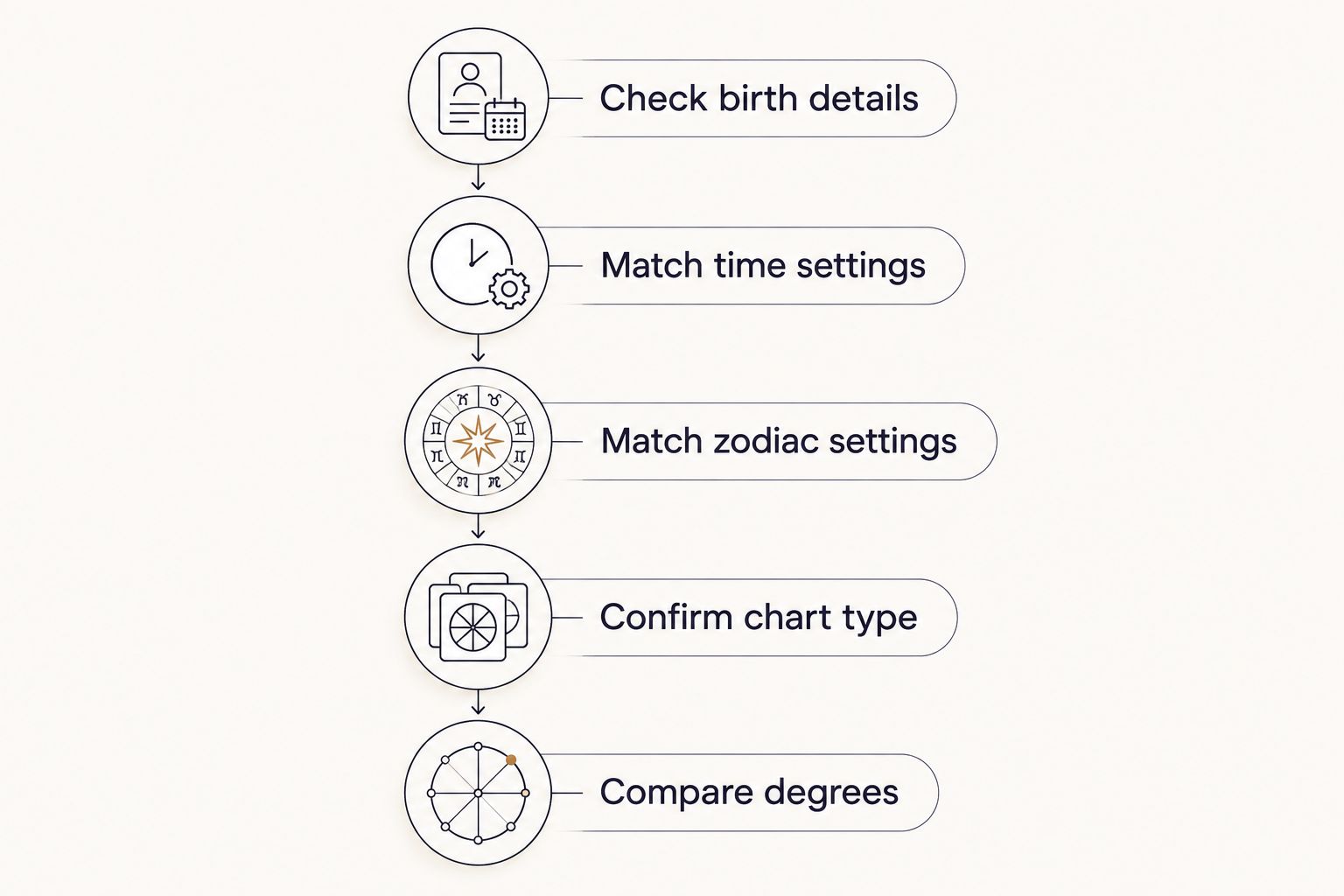
Compare the calculations before choosing whichever description feels most flattering. Use this sequence to isolate the difference.
- Check birth details. Match the date, local time, and birthplace exactly. Watch for morning versus evening entries and an estimated time entered as though it were certain.
- Match time settings. Confirm that both calculations handle the birthplace's time zone and daylight-saving rules for the birth date.
- Match zodiac settings. Compare tropical with tropical, or the same sidereal settings with each other. Different reference systems are not interchangeable.
- Confirm chart type. Make sure both results are natal charts rather than a natal chart compared with a progression or relocation.
- Compare degrees. Record the ascendant degree as well as the sign. A result near a sign boundary deserves special attention when the birth time is uncertain.
This process separates input errors from genuine differences between astrological methods. It also gives you a useful question to bring to a reader: which exact input or setting explains the mismatch?
Can your rising sign change if your birth time was wrong?
Your calculated rising sign can change when you correct your birth time. The birth moment itself has not changed; your information about it has improved.
For example, a remembered time and a recorded time can place the ascendant on different sides of a sign boundary. The appropriate conclusion is that the earlier calculation used different information—not that you lived under one natal rising sign and later acquired another.
Start with available birth records and keep any uncertainty visible. A time rounded to the hour should not carry the same confidence as a reliably recorded time.
Astrological rectification attempts to infer a birth time from life events. It remains an interpretive method, not documentary proof, and should not be presented as certain merely because the resulting personality description feels familiar.
Can your rising sign change from tropical to sidereal?
Your rising-sign label can differ between tropical and sidereal astrology because the systems define zodiac positions differently. Switching systems changes the reference framework, not your birth history.
Tropical astrology anchors the zodiac to the equinoxes. Sidereal astrology uses a stellar reference, with different sidereal conventions applying different offsets. A meaningful comparison identifies the system and settings rather than treating every calculator as equivalent.
Choose a framework consistently when following interpretations. If you use tropical natal placements for a 2026 reading, do not silently substitute a sidereal ascendant halfway through and expect the descriptions to refer to the same calculation.
Neither system turns astrology into a scientifically validated personality test. You can explore the symbolism without treating a label as proof of who you must be.
Why do you feel less like your rising sign as you get older?
Feeling different does not mean your natal rising sign changed. Your behavior, responsibilities, relationships, and self-understanding are not frozen at birth.
Within astrology, the rising sign is only one part of a chart. Astrologers also interpret the ascendant's ruling planet, aspects, and other placements. A brief sign description leaves out that context and should not become a standard you have to perform.
Outside astrology, people develop skills, change priorities, and respond to new circumstances. Becoming more outspoken or more private is not evidence that your ascendant crossed into another sign.
Jahben astrology readings are best suited to spiritually curious adults seeking guidance on love, career, and timing. Jahben combines astrology with other spiritual reading methods; that offers an interpretive setting, not scientific verification of personality or guaranteed predictions.
If you seek a reading, describe the actual change you want to understand. A question about boundaries, confidence, or a career transition is more useful than asking someone to confirm a new rising sign solely because an old description no longer fits.
FAQ
Can your rising sign change as you get older?
No, your natal rising sign does not change as you get older. The same birth details and zodiac settings produce the same natal ascendant; a progressed ascendant is a separate calculation.
Does my rising sign change when I move to another country?
No, moving to another country does not change your natal rising sign. A relocation chart uses another location to calculate different local angles while leaving your natal chart intact.
Why do two birth-chart calculators give me different rising signs?
Different birth inputs, time-zone handling, zodiac settings, or chart types can produce different rising signs. Compare those settings and the ascendant degree before interpreting the difference.
Can my rising sign change on my birthday?
Your natal rising sign does not change on your birthday. A solar return chart has its own ascendant, but it is a separate astrological chart rather than an update to your natal placement.
Can I have two rising signs if I was born on a cusp?
Within one zodiac system, the ascendant occupies one sign at a given birth moment. If an uncertain birth time crosses a sign boundary, you have uncertainty between possible results rather than two simultaneous natal rising signs.
Does changing my house system change my ascendant?
Changing only the house system does not change the astronomical ascendant. House boundaries and chart displays can differ, so distinguish the ascendant degree from the beginning of the first house.
Can I find my rising sign without knowing my birth time?
You cannot reliably establish an exact rising sign without adequate birth-time information. An estimated time produces an estimated result, and personality matching cannot verify the calculation.
One last thing
A precise-looking chart can still rest on an uncertain birth time. Decimal places and detailed interpretations do not repair an estimated input.
Before your next Jahben astrology reading in 2026, save your birth details, their source, the zodiac system, and the chart type. Keep any uncertainty beside them. That record is more useful than repeatedly searching for a sign description that matches your mood.
Related guides
- How to find your rising sign without a birth time
- How to calculate your big three: sun, moon, and rising sign
Ready for your own reading?
Astrology, numerology, and tarot brought together into one clear, written answer about your love, career, or timing.
Book a Personal Reading Get Your Free Report