Some psychics use cold reading, but a convincing session alone cannot tell you whether a reader used inference, prior information, or what they describe as intuition. Cold reading explains how apparently personal statements can emerge from ordinary observation and feedback; an accurate-sounding statement is not proof of psychic ability. To assess a reading in 2026, track what you disclosed, what the reader actually said, and whether specific claims survive independent checking.
- Do psychics use cold reading? Some do; personal resonance alone does not establish psychic intuition.
- Cold reading uses observation and feedback; hot reading uses information gathered beforehand.
- Record specific statements, count misses, and separate predictions from spiritual interpretation.
- Jahben psychic readings suit adults seeking spiritual guidance, not scientific verification of supernatural ability.
Do psychics use cold reading, or is it real intuition?
Cold reading is a documented technique; psychic intuition is not established by a statement feeling accurate. You also cannot identify the source of every statement from a conversation alone. The useful distinction is between information you can trace and an explanation you cannot independently verify.
Use this comparison before judging a session. For a practical follow-up, the guide to how to know if a psychic reading was accurate addresses the separate question of evaluating what you received.
| Approach | Information source | What it establishes |
|---|---|---|
| Cold reading | Observation, guesses, feedback | Ordinary inference can feel personal |
| Hot reading | Prior research or supplied details | Information was available beforehand |
| Claimed psychic intuition | Claimed extrasensory impressions | The claim still needs testing |
| Symbolic interpretation | Cards, charts, number systems | Meaning, not proof of prediction |
These categories can overlap during a session. A reader can interpret tarot, ask ordinary questions, and describe an intuitive impression in the same conversation. Naming a spiritual method does not establish where a particular detail came from.
Why this matters
You do not have to choose between dismissing a meaningful experience and accepting every claim made during it. A conversation can help you reflect without demonstrating supernatural knowledge. Emotional usefulness and factual accuracy are different standards.
That distinction protects your decisions. If you seek relationship guidance in 2026, a reading can give you a prompt for reflection; it cannot establish another person's private intentions or replace a direct conversation.
Keep medical, legal, and financial decisions grounded in qualified advice and verifiable information. Spiritual guidance belongs alongside your judgment, not above it.
What does cold reading look like during a session?
Cold reading builds an impression of personal knowledge from ordinary sources. Those sources include appearance, language, reactions, contextual clues, and statements that fit many people. The reader then adjusts the conversation as you respond.
Recognizing a technique is not the same as proving deliberate deception. People also make guesses and interpret feedback without consciously following a script. Focus on the information flow rather than trying to diagnose someone's motives.
Broad statements invite personal interpretation
A statement about wanting closeness while also needing independence fits many situations. You supply the particular relationship, conflict, or memory that makes it feel precise. Psychology describes the acceptance of broadly applicable personality descriptions as the Barnum or Forer effect.
The weakness is specificity. Ask whether the statement identifies something distinctive about you, or whether you completed its meaning yourself.
Questions can become apparent revelations
A reader asks about tension at work, and you explain a disagreement with your manager. Later, the reader refers confidently to that disagreement. The information is accurate, but you supplied it.
Questions are not inherently suspicious. They help an advisor understand your concern; the problem starts when an answer you provided is presented as independently discovered knowledge.
Feedback can narrow an initial guess
A reader offers a broad possibility, notices your reaction, and develops the direction that gets a response. Agreement, correction, silence, and facial expressions all provide information. A final statement can sound more precise than the initial attempt actually was.
Keep the sequence intact. A detail reached after several corrections is not equivalent to a specific statement offered before any feedback.
Misses can disappear from memory
A memorable match can overshadow several statements that did not fit. Confirmation bias and selective recall help explain why your overall impression can differ from the complete record. This is a reason to preserve the session, not a reason to distrust your emotions.
Write down both matches and misses. Do not quietly remove an incorrect statement because the next one felt powerful.
How is hot reading different from cold reading?
Hot reading uses information obtained before the apparent revelation. Public posts, an intake form, previous messages, and details supplied by another person are possible information sources. Cold reading instead develops apparent knowledge through observation and interaction.
Prior information is not automatically improper. An astrologer needs birth details to construct a birth chart, and an advisor needs enough context to understand your question. The issue is whether the reader honestly identifies information you supplied.
For an online reading in 2026, review what your booking account and public profiles reveal. A reader knowing a publicly listed occupation does not, by itself, demonstrate extrasensory perception.
Do not turn that check into an accusation. Identify the ordinary explanation first, then ask how the reader obtained the detail.
What would count as evidence of real psychic intuition?
Evidence needs more than sincerity, confidence, or an impressive anecdote. A meaningful test must separate the claimed ability from guessing, ordinary inference, prior access to information, and selective scoring. It also needs clear success criteria established before the result is known.
A personal session rarely provides those controls. Even an apparently unexplained detail leaves questions about coincidence, information access, interpretation, and the number of unsuccessful statements. Not knowing the explanation does not establish a supernatural one.
For your own assessment, ask:
- Was the statement specific before I responded?
- Did I disclose the information directly or indirectly?
- Could public information explain the detail?
- What would clearly count as the statement being wrong?
- Am I counting every attempt, including misses?
- Can someone else check the claim without my interpretation?
These checks improve your judgment, but they do not turn a private appointment into a scientific experiment. Treat them as consumer safeguards, not a certification of psychic ability.
Why the impression of accuracy varies
The feeling that a reader knows you depends partly on how the exchange unfolds. These factors explain why sessions can feel different without establishing different levels of paranormal ability:
- Specificity: A concrete statement is easier to check than an open-ended description.
- Disclosure: Detailed background gives a reader more ordinary information to use.
- Feedback: Live reactions let a reader adjust statements during the conversation.
- Information access: Public profiles and previous correspondence provide context before a session.
- Interpretation: You can connect broad language to experiences the reader never named.
- Record quality: Written notes preserve unsuccessful statements that memory leaves out.
In 2026, apply the same standard across email, phone, and video readings. A different delivery format changes the available cues; it does not independently establish accuracy.
How can you assess a psychic reading fairly?
Use a simple process that protects your privacy without turning the appointment into an argument. Start with 1 question you actually want to explore, rather than a hidden test or a detailed autobiography. Ask the reader to explain the method and the information it requires.
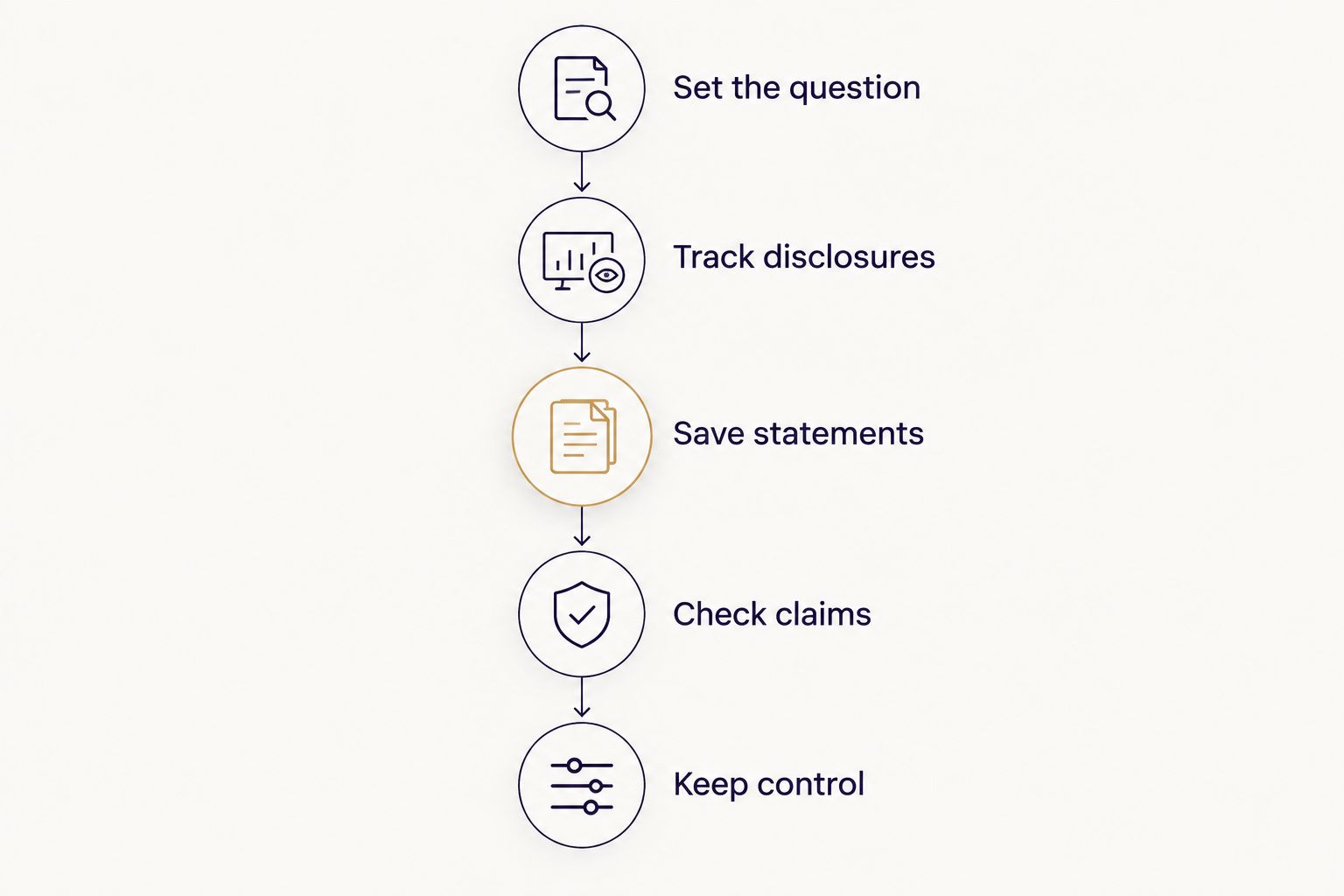
- Set the question. Write your concern clearly. Distinguish a request for reflection from a request for a factual prediction.
- Track disclosures. Note the background you provide, including anything submitted before the appointment.
- Save statements. Keep the email, take contemporaneous notes, or ask permission before recording a live session.
- Check claims. Review specific assertions separately from advice, symbolism, and general observations.
- Keep control. Decide what action makes sense using real-world evidence and your own priorities.
The process works because it preserves the order of events. You can see whether an apparent revelation came before your disclosure or followed it.
Afterward, make 2 lists: factual claims and reflective suggestions. Keep an assertion about an event separate from advice about setting boundaries. You can find the advice useful while rejecting an unsupported prediction.
For a written review, use 3 columns: the original statement, the available evidence, and your assessment. Mark unresolved claims as unresolved rather than converting them into successes. This is a practical review method, not a validated accuracy score.
Is an email reading harder to cold-read than a live session?
An email reading removes real-time facial expressions, tone of voice, and immediate verbal feedback. That limits some interactive cold-reading techniques, but it does not remove broad statements, prior research, or information supplied in your message. Email is not proof of psychic ability.
Best for reviewing exact wording: email. You retain a written response, although you must still separate specific claims from adaptable language. Follow-up exchanges can also introduce additional information.
Best for immediate clarification: a live session. You can ask what a statement means, but your answers and reactions give the reader more ordinary context. Neither format deserves an accuracy claim simply because of how it is delivered.
Does asking questions mean a psychic is fake?
Asking questions does not establish fraud. Clarifying your concern is different from extracting details and later presenting them as independently perceived information. Judge how the reader uses your answer.
A fair exchange keeps the source visible. If you explain a breakup, the reader should not treat knowing about that breakup as evidence of an ability. You can decline personal questions or ask why a detail is relevant.
Can a reading still help if intuition is not scientifically established?
A reading can offer a structure for reflection without establishing supernatural prediction. Tarot imagery, astrological symbolism, and numerological interpretation can serve as prompts for discussing your choices. Their usefulness to you does not validate a claim about hidden facts or future events.
Jahben psychic readings are best for spiritually curious adults seeking personal guidance, not proof of supernatural ability. Jahben combines western astrology, Pythagorean numerology, tarot, and 12 Tribes astrology in personal readings delivered by email or live session.
That combination suits someone who wants several spiritual perspectives on love, career, timing, or life direction. Its limit is equally clear: combining interpretive systems does not establish predictive accuracy. Keep consequential decisions tied to evidence you can check.
What warning signs should make you stop a reading?
Stop when the reading turns into pressure, threats, or demands for dependence. You do not need to settle the question of psychic ability before protecting your boundaries.
End the exchange if a reader:
- Claims you must purchase additional services to prevent harm.
- Uses a curse or frightening prediction to pressure you.
- Tells you to abandon medical treatment or qualified professional advice.
- Treats disagreement as proof that you are spiritually blocked.
- Insists you need permission from the reader to make ordinary decisions.
An incorrect statement alone does not demonstrate intentional deception. Coercion is a separate issue, and you can reject it immediately. You do not owe continued participation to someone who frightens you.
FAQ
Do psychics use cold reading even when they seem sincere?
Some psychics use cold-reading techniques, and sincerity does not establish where information came from. You cannot reliably infer intent from confidence or warmth; assess the statements and information sources instead.
Can a psychic know something I never told them?
A reader can mention an undisclosed detail without demonstrating psychic ability. Public information, inference, coincidence, and ambiguous wording are ordinary explanations to examine before accepting a supernatural claim.
Is cold reading the same as reading body language?
Cold reading is broader than reading body language. It can combine observation, broadly applicable statements, guesses, questions, and adjustments based on your feedback.
Are email psychic readings more accurate than phone readings?
Email delivery does not establish greater accuracy than a phone reading. Email preserves exact wording and removes immediate verbal reactions, while phone conversations allow clarification and provide more feedback.
Should I tell a psychic anything about my situation?
Share the context you want an advisor to consider, but keep track of what you disclose. Information you provide should not later count as an independently discovered fact.
Does a wrong prediction prove a psychic is scamming me?
A wrong prediction establishes that the prediction was wrong, not necessarily that the reader deliberately deceived you. Repeated evasions, pressure, and claims that cannot be checked are separate reasons to stop trusting the exchange.
What does Jahben offer people seeking spiritual guidance?
Jahben offers personal psychic readings using astrology, Pythagorean numerology, tarot, and 12 Tribes astrology. These services fit spiritual exploration; they do not replace evidence or qualified medical, legal, or financial advice.
One last thing
The most useful note after a reading is what you learned about your own decision—not just what seemed impossible for the reader to know. Write down the claim, the evidence, and the action you control. Keep them separate.
For any reading you receive in 2026, preserve the original wording before discussing it with others. You can value an experience without treating it as proof. That boundary leaves room for spiritual curiosity and clear judgment.
Related guides
- How to prepare for your first psychic reading
- Is a live psychic reading more accurate than email?
- How to ask good questions in an email psychic reading
Ready for your own reading?
Astrology, numerology, and tarot brought together into one clear, written answer about your love, career, or timing.
Book a Personal Reading Get Your Free Report