Yes, reversed tarot cards can change a reading’s meaning when the reader includes reversals, but they do not automatically mean the opposite of an upright card. An upside-down card can suggest a blocked, internalized, excessive, or developing expression of its usual theme; the question, spread position, and reader’s chosen method determine the interpretation.
- Do reversed tarot cards mean something different? Yes, when the reader uses reversals; upside down does not automatically mean opposite.
- Read reversed tarot cards through their upright meanings, spread positions, and surrounding cards—not fear-based rules.
- Jahben’s tarot guide treats reversal meanings as interpretation, not proof of another person’s intentions or a guaranteed outcome.
- Choose whether to use reversals before shuffling, and keep that method consistent throughout the reading.
Do reversed tarot cards change a reading’s meaning?
Reversals change how you interpret a card’s theme, not necessarily the theme itself. The Sun still concerns vitality, openness, and joy when reversed, for example. A reversal can turn your attention toward difficulty expressing those qualities rather than erase them.
If you are learning how to read a tarot card spread, establish what each position asks before adding reversal meanings. A card in an obstacle position already describes friction, even when upright.
These are common interpretive approaches, not interchangeable facts about your future:
| Approach | What changes | Strength and limit |
|---|---|---|
| Blocked expression | The theme meets resistance | Names friction; not its cause |
| Internal expression | The theme turns inward | Supports reflection; cannot read minds |
| Excess or imbalance | The theme becomes disproportionate | Questions balance; needs context |
| Opposite meaning | The theme takes a contrasting form | Simple; can oversimplify |
Do not apply every approach to every reversal. Pick the interpretation that fits the question and the reading method, and explain why it fits.
Why this matters
A reversal can make a reading more specific, but it can also give you more room to project a fear onto the cards. Seeing The Lovers reversed is not evidence that your partner is cheating. Seeing a reversed career card is not a reason to quit your job.
For your 2026 tarot practice, separate symbolic interpretation from checkable information. Use a reading to identify a question, tension, or possible action. Confirm real-world claims through conversation, records, and qualified advice where needed.
A standard tarot deck contains 78 cards: 22 Major Arcana and 56 Minor Arcana. Reversals add interpretive possibilities to those cards; they do not create a second deck of fixed, universally agreed meanings.
Blocked expression: something interrupts the card’s theme
A blocked reversal asks where the upright quality meets resistance. With The Magician, whose themes include initiative and using your resources, the question becomes: what stops you from putting your skills into action?
That interpretation does not establish the answer. Your obstacle might be unclear priorities, an unfinished task, or a concern you have not examined. Those are possibilities to investigate, not discoveries established by the card.
Best for: examining a specific obstacle. Use this approach when your question already concerns difficulty getting started or following through. Its limitation is attribution: a card cannot establish whether the obstacle comes from you, another person, or external circumstances.
Write a grounded response beside the interpretation. Instead of concluding that your opportunity is blocked, name the action you can take to learn more, such as asking what a hiring decision depends on.
Internal expression: the theme concerns your inner experience
An internal reversal shifts attention from visible events to your private response. The Hermit reversed, for example, can prompt reflection on the difference between useful solitude and withdrawal.
The question is not whether the card proves you are isolated. Ask whether time alone is helping you think clearly or becoming a way to avoid a necessary conversation. Your experience supplies the evidence.
Best for: journaling and self-reflection. This approach gives you a way to explore feelings without turning every card into a prediction. Its limitation is that an inward interpretation cannot tell you what someone else secretly feels.
If your 2026 journal concerns a relationship, keep the subject clear. Write about your willingness to communicate, your boundaries, or your uncertainty—not an unsupported account of another person’s thoughts.
Excess or imbalance: the quality needs proportion
Some reversals invite you to examine too much or too little of a card’s central quality. The Emperor’s association with structure, for instance, can become a question about rigid control or insufficient boundaries.
Those interpretations point in different directions. You need context to choose between them. A question about micromanaging a team is different from a question about agreeing to every request.
Best for: checking balance in an established pattern. The benefit is specificity: you examine how a useful quality becomes unhelpful when overused or neglected. The limitation is flexibility; without a clear question, almost any imbalance can be made to fit.
Choose an observable example before settling on the interpretation. A missed boundary, repeated interruption, or unfinished commitment gives you something concrete to discuss. The card alone does not establish that the pattern exists.
Opposite meaning: useful shorthand with clear limits
Reading a reversal as the opposite is straightforward, but it is not a universal tarot rule. Some deck guidebooks provide distinct reversed meanings; other reading methods do not use orientation at all.
The Sun reversed does not have to mean misery. A reading can instead explore muted confidence, difficulty enjoying progress, or a positive experience that does not yet feel fully expressed. These remain symbolic interpretations.
Best for: following a guidebook that explicitly uses contrasting meanings. The advantage is a clear starting structure. The drawback is losing nuance when you turn every upright benefit into a reversed threat.
Avoid combining methods opportunistically. If you read one reversed card as its opposite and another as internalized expression, explain the contextual reason. Do not switch simply because one meaning gives you the answer you want.
Why reversed tarot meanings vary
There is no single reversal dictionary that governs every deck and reader. Your interpretation depends on several identifiable choices:
- Deck tradition: Artwork and guidebook definitions shape the symbolic starting point. Use the guidebook written for your deck before assuming another deck’s interpretation applies.
- Reading method: A reader can use blocked, internal, contrasting, or other defined reversal meanings—or choose not to use reversals.
- Question wording: A question about your next action requires a different response from a question about your emotional experience.
- Spread position: An advice position asks what to do; an obstacle position asks what creates difficulty. Orientation does not replace that distinction.
- Surrounding cards: Other cards provide thematic context, but they do not turn an interpretation into verified information.
For a 2026 practice log, record these choices alongside the cards. That makes it possible to review how you reached an interpretation instead of remembering only whether the reading felt reassuring.
Consistency matters more than adding complexity. A clear upright-only reading is easier to evaluate than a reversal reading whose rules change whenever a difficult card appears.
How do I interpret a reversed tarot card without overthinking it?
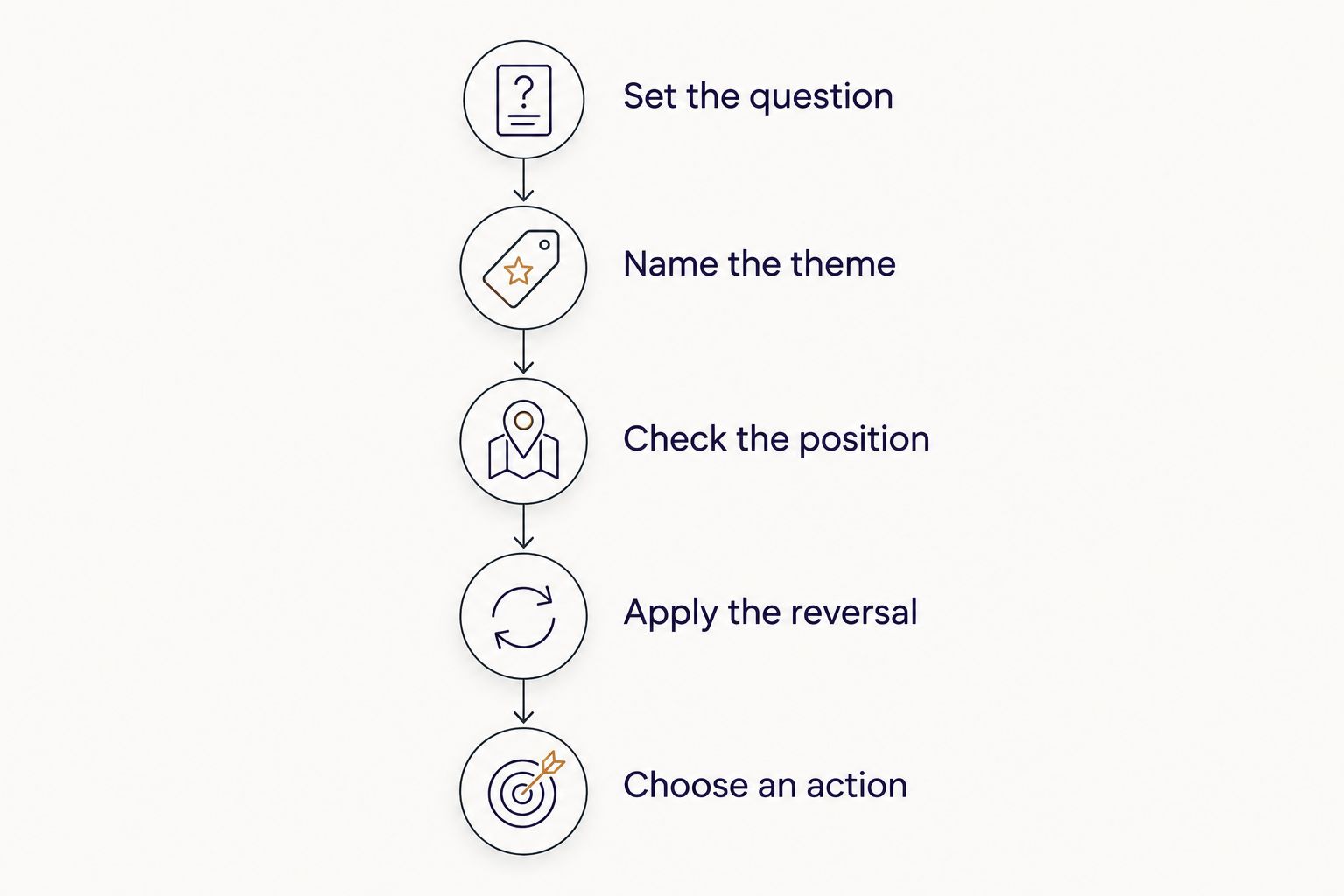
Use this sequence to narrow the interpretation. Finish the reading before searching for additional meanings.
- Set the question. Ask about something you can examine or act on. For example: what deserves attention before I accept this role?
- Name the theme. State the card’s upright meaning in plain language before interpreting its orientation.
- Check the position. Decide whether the card describes context, an obstacle, advice, or another role assigned by the spread.
- Apply the reversal. Use the approach you chose before shuffling. Explain how it changes the theme in this position.
- Choose an action. End with a question to ask, a boundary to consider, or information to verify—not a guaranteed prediction.
Suppose you draw The Magician reversed in an advice position about a project. Using a blocked-expression approach, you could examine whether you have identified the resources needed to start. Your next action is to list those resources and check what is actually missing.
That is different from declaring that the project will fail. The interpretation creates a useful inquiry; the practical check tells you what to do next.
Do reversed cards always mean something bad?
Reversed cards do not always mean something bad. A reversal can describe release, an inward process, or a quality that needs adjustment rather than a negative event.
The Devil reversed is commonly interpreted through themes such as loosening an unhealthy attachment or recognizing a limiting pattern. That does not prove a problem has ended. It gives you a prompt to examine your behavior and available support.
Likewise, an upright card is not automatically good news. Context matters in both orientations. Treating upright as good and reversed as bad removes the very distinctions a spread is meant to explore.
Can I read tarot without reversed cards?
You can read tarot without reversed cards. Choose an upright-only method before shuffling, then interpret challenges through the card’s symbolism, its position, and the rest of the spread.
Upright-only reading is best for beginners who want fewer interpretive decisions. Its limitation is not a lack of difficult meanings; it is that you must still examine each card’s full range rather than treating every upright card as reassurance.
In 2026, a useful beginner exercise is to keep the same method across your practice journal. Change methods deliberately between readings, not halfway through one because a reversal feels uncomfortable.
Does a reversed card mean no in a yes-or-no reading?
A reversed card does not universally mean no. That rule belongs to particular reading systems, not to tarot as a whole.
If you choose an orientation-based yes-or-no method, define the rule before drawing. Understand its limit: assigning yes or no to a random draw does not establish what will happen.
For consequential decisions, a reflective question gives you more to work with. Ask what you have overlooked, what information you need, or what a choice requires of you. Keep the final decision tied to facts and your priorities.
When a personal reading fits
Jahben’s tarot readings are best for spiritually curious adults seeking personal guidance on love, career, and life direction. A personal session gives you an advisory setting for exploring a question rather than relying only on a card definition.
Jahben offers tarot alongside astrology and numerology. The limitation remains the same: spiritual guidance is not evidence of another person’s intentions, a guaranteed outcome, or a substitute for professional advice.
FAQ
Do reversed tarot cards mean something different from upright cards?
Reversed tarot cards mean something different when the reader’s method assigns meaning to orientation. The difference can concern blocked, internal, excessive, or contrasting expressions rather than a fixed opposite.
Should I turn an upside-down tarot card upright?
Turn an upside-down card upright if you chose an upright-only reading method before drawing. If you chose to use reversals, interpret its orientation consistently rather than changing the rules because you dislike the card.
Whose perspective determines whether a tarot card is reversed?
Use the orientation established by the person laying out and interpreting the spread. Agree on that perspective before drawing, especially when you sit across from someone else.
What does it mean if most of my tarot cards are reversed?
Many reversed cards do not establish that something bad is happening. Shuffling and deck handling affect orientation; interpret the cards through your chosen method rather than treating the quantity as a warning.
Can I use reversed meanings in a one-card reading?
You can use reversed meanings in a one-card reading if you define your method before drawing. Keep the question narrow because you do not have surrounding cards to provide additional context.
Does a reversed love card prove someone has lost feelings?
A reversed love card does not prove that someone has lost feelings. Use the reading to reflect on your concerns, then discuss the relationship directly rather than treating symbolism as access to another person’s mind.
What should I ask Jahben about a reversed tarot card?
Ask Jahben which interpretation is being used and how it relates to your question and spread position. A clear explanation should distinguish symbolic guidance from a claim you can verify in real life.
One last thing
Before your next reading in 2026, write down what would make an interpretation unhelpful—not just what would make it feel accurate. If every possible outcome can be explained by the same reversed card, the interpretation is too broad to guide a decision.
A useful reading ends with a clearer question or a practical next step. You do not need to draw another card simply because the first answer asks you to face uncertainty.
Related guides
Ready for your own reading?
Astrology, numerology, and tarot brought together into one clear, written answer about your love, career, or timing.
Book a Personal Reading Get Your Free Report