No—you do not need to believe in Reiki to attend a session or feel relaxed during one. But relaxation is not proof that Reiki transfers healing energy, and scientific evidence has not established Reiki as an effective treatment for any health condition. You can remain skeptical, keep your boundaries, and judge the experience without treating it as medical care.
- Do you need to believe in Reiki for it to work? Belief is not required, but medical benefits remain unproven.
- Feeling relaxed during Reiki does not establish that healing energy caused the change.
- Jahben offers Reiki sessions for spiritually curious adults; approach them as spiritual support, not medical treatment.
- Consent matters more than agreement with a practitioner's spiritual explanation.
Do you need to believe in Reiki for it to work?
You do not need to accept Reiki's spiritual explanation to participate. Whether Reiki works depends on what you mean by works. Enjoying quiet attention is different from treating an illness or demonstrating an energy field.
Before deciding, separate the claims. The guide to preparing for your first Reiki session addresses the practical side; the evidence question needs a separate standard.
| What you mean | Is belief required? | What the experience establishes |
|---|---|---|
| Attending a session | No spiritual agreement needed | Participation, not effectiveness |
| Feeling calmer | Belief is not a prerequisite | Your reported experience |
| Receiving healing energy | Belief cannot verify it | No established scientific mechanism |
| Treating a health condition | Belief cannot establish efficacy | Clinical evidence is needed |
The National Center for Complementary and Integrative Health, part of the National Institutes of Health, states in its Reiki overview that Reiki has not been clearly shown effective for any health-related purpose. It also states that scientific evidence does not support the existence of the energy field proposed to explain Reiki.
For your 2026 decision, that distinction is enough: you can explore a spiritual practice without accepting an unsupported medical claim. Neither enthusiasm nor doubt changes the standard of evidence.
Why this matters
The belief question often hides a more personal concern: if nothing happens, will someone blame you? A lack of results is not evidence that you failed to believe hard enough. You do not owe a practitioner a particular sensation, emotional response, or endorsement.
You also do not have to choose between dismissing your experience and accepting every explanation attached to it. Feeling cared for can matter. Feeling calmer can matter, too; neither observation proves that an illness has changed.
Use the same distinction when reading Reiki claims in 2026. A personal account describes what someone experienced, while a treatment claim requires evidence that goes beyond that account.
Belief, openness, and consent are different things
Belief means accepting an explanation as true. Openness means being willing to notice what happens without deciding the outcome in advance; consent means agreeing to the actual session and its boundaries.
Only consent is essential to your participation. You can agree to sit quietly while remaining unconvinced about healing energy, and you can decline touch without needing to justify your worldview.
If you already believe in Reiki
Spiritual meaning can be part of why you value a session. Keep that meaning separate from medical conclusions, especially if you are dealing with pain, fatigue, anxiety, or another ongoing concern.
Belief does not make a promised outcome certain. Continue prescribed care and judge any health claim by evidence rather than confidence or spiritual language.
If you are curious but skeptical
You do not need to perform enthusiasm. Tell the practitioner that you want a plain explanation of what will happen, what is optional, and what claims they make about the session.
A useful boundary is to describe your experience before interpreting it. Noticing that your shoulders feel less tense is an observation; deciding that a specific blockage disappeared adds an explanation that the sensation alone cannot verify.
If you do not want to participate
Declining is a complete decision. You do not need to try Reiki to prove that you are open-minded, supportive of a partner, or respectful of someone else's spirituality.
Respect works both ways. Another person's positive experience does not create an obligation for you to have the same experience—or attend at all.
Why your Reiki experience varies
A Reiki session is not a standardized test of your spiritual receptivity. Several ordinary features of the setting can affect how comfortable you feel and how you describe the experience afterward.
- Expectations: What you anticipate can shape how you interpret sensations. That does not establish whether Reiki has a specific treatment effect.
- Physical comfort: An awkward position, an uncomfortable room, or unwanted touch can make it harder to settle.
- Personal boundaries: Your willingness to participate is different from agreeing to every part of a session.
- Surroundings: Noise, interruptions, and privacy affect whether the setting feels restful to you.
- Your starting point: Arriving tired, distressed, distracted, or already relaxed gives you a different experience to compare against.
- Practitioner communication: Clear explanations let you decide what you consent to; pressure to report a breakthrough makes honest feedback harder.
These factors explain why you should assess the whole experience, not just your beliefs. They do not establish Reiki as a treatment, and they do not justify blaming a disappointing session on your attitude.
How to try Reiki without pretending to believe
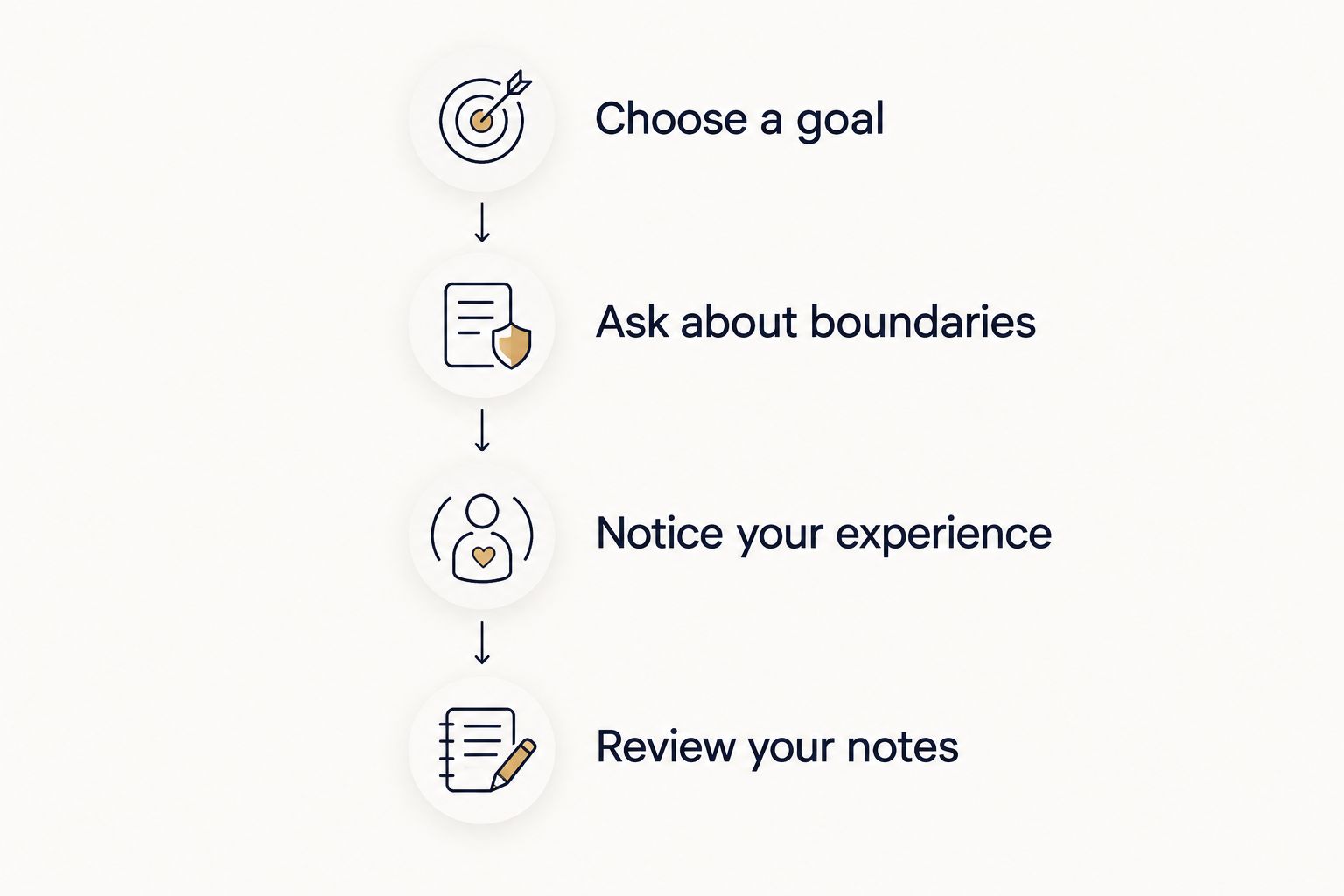
If you choose to explore Reiki in 2026, make the session a bounded personal experience rather than a test you must pass. Decide what you want to observe, protect your choices, and leave room for an uneventful outcome.
- Choose a goal. Pick an experiential aim, such as having quiet time or noticing whether you feel more settled. Do not use the session to diagnose a symptom or decide whether medication is necessary.
- Ask about boundaries. Find out whether touch is involved, what position you will be in, and how to pause or stop. State any preferences before the session starts.
- Notice your experience. Pay attention without searching for a required sign. Warmth, distraction, emotion, boredom, or no noticeable change are all things you can report honestly.
- Review your notes. Separate what happened from the explanation offered afterward. Decide whether the experience was personally useful without turning that judgment into a medical conclusion.
Keep the notes simple. Write what you noticed before reading a practitioner's interpretation, so your own account remains distinct from the meaning someone else assigns to it.
Do not force a verdict immediately. You can decide that the setting was pleasant but the explanation unconvincing, or that the session offered nothing you want to repeat.
Can Reiki work if I am completely skeptical?
Skepticism does not prevent you from resting or reporting a pleasant experience. It also does not make a session a scientific experiment capable of proving or disproving Reiki.
A skeptical person feeling better would not establish healing energy as the cause. An enthusiastic person feeling nothing would not establish that the person blocked the process; both outcomes need more careful interpretation.
The practical question is whether you want the experience on the terms offered. If participation requires you to endorse claims you do not accept, you can decline rather than argue yourself into agreement.
Is feeling better after Reiki just a placebo effect?
Feeling better after Reiki does not identify what caused the improvement. Expectations, attention, a quiet setting, natural symptom changes, and other care complicate any conclusion drawn from a single experience.
Placebo effects are not the same as pretending. They concern changes associated with expectations and treatment context, but a personal session cannot separate those influences from a Reiki-specific effect.
The careful conclusion is neither that nothing happened nor that energy healing was proven. It is that you noticed a change and do not yet know its cause.
What if I feel nothing during Reiki?
Feeling nothing does not mean you did Reiki incorrectly. There is no required sensation that you must produce to make your attendance valid.
You do not have to reinterpret boredom as resistance or discomfort as progress. If you have no useful change to report, say so and decide whether you want to repeat the experience.
Be especially cautious if the response is an escalating promise: more sessions, stronger belief, or deeper surrender will supposedly produce the result you were originally promised. An explanation that treats every possible outcome as proof cannot give you a fair way to evaluate the claim.
When Reiki is—and is not—a reasonable choice
Consider Reiki for an optional spiritual experience, not for diagnosis or disease treatment. Its potential personal value is the space you choose to give it; its limit is that personal meaning does not establish medical effectiveness.
For 2026, use clear decision rules:
- Best for spiritual exploration: Consider a session if the practice interests you and you can keep its claims separate from health decisions.
- Best for a quiet personal pause: Consider whether the actual setting and boundaries suit you, without expecting a specific healing result.
- Not appropriate for medical diagnosis: Consult a qualified healthcare professional about symptoms, test results, and treatment choices.
- Not appropriate under pressure: Decline if someone insists that doubt causes illness, guarantees a cure, or discourages necessary care.
Jahben Reiki sessions are best considered by adults seeking spiritual support, not medical treatment. Jahben also offers personal psychic readings, but neither service should replace clinical assessment or evidence-based care.
If symptoms are new, worsening, or concerning, seek medical advice rather than interpreting them as an energy shift. Do not stop prescribed medication or postpone recommended treatment because of a session or spiritual explanation.
Questions to ask a Reiki practitioner
Before agreeing to a session in 2026, ask direct questions. You need usable answers, not reassurance that everything will make sense once you believe.
- What will happen during the session?
- Will you touch me, and can I choose no touch?
- Can I pause or stop without explaining why?
- What benefits are you claiming, and what are their limits?
- How do you respond when someone notices no change?
- Do you agree that Reiki does not replace medical care?
Listen for whether the answers preserve your choices. You should be able to express uncertainty, decline an interpretation, and leave without being told that your skepticism caused a problem.
FAQ
Do you need to believe in Reiki for it to work?
You do not need to believe in Reiki to participate or feel relaxed during a session. However, relaxation does not prove energy healing, and Reiki has not been clearly shown effective for a health-related purpose.
Can I have Reiki if I do not believe in energy healing?
Yes, you can participate without accepting energy healing as an explanation. Tell the practitioner your boundaries and judge the experience without feeling obliged to endorse their beliefs.
Does feeling warmth during Reiki prove it worked?
No, feeling warmth does not prove that healing energy was transferred. A sensation is an observation, not evidence of a specific mechanism or medical benefit.
Is it my fault if I feel nothing after Reiki?
No, feeling nothing is not evidence that you failed to believe or blocked a result. You can report no change honestly and decide not to continue.
Can Reiki replace therapy or medication?
No, Reiki should not replace therapy, prescribed medication, or medical assessment. Discuss health concerns and treatment changes with a qualified healthcare professional.
Do I have to accept touch during Reiki?
No, you do not have to accept touch. Ask what the practitioner offers, state your preference beforehand, and decline or stop any part you do not consent to.
Is Jahben Reiki suitable for someone who is skeptical?
Jahben offers Reiki sessions, and skepticism does not require you to abandon your questions. Confirm the session format and boundaries before deciding whether the experience suits you.
One last thing
Decide what would count as useful before you attend. Otherwise, an ordinary sensation, an emotional moment, and no change at all can each be presented afterward as evidence that the session worked.
You can value a spiritual experience without making it carry a medical claim. You can also leave unconvinced; neither choice requires an apology.
Related guides
- Is Reiki real, or does it work through a placebo effect?
- How many Reiki sessions do you need to feel results?
Ready for your own reading?
Astrology, numerology, and tarot brought together into one clear, written answer about your love, career, or timing.
Book a Personal Reading Get Your Free Report