A soul urge number calculator can give you a mathematically correct result when it uses consistent rules and you enter the intended name correctly. That does not establish that the result accurately measures your inner desires or predicts your future; use it as a reflection prompt, not a verified personality assessment.
- How accurate is a soul urge number calculator? Check its arithmetic separately from its spiritual interpretation.
- Pythagorean numerology assigns values to vowels; name choices and reduction rules can change the result.
- Matching results show calculation consistency, not proof that a description reveals your personality.
- Jahben offers personal numerology guidance; interpretation remains spiritual advice, not a validated assessment.
Why this matters
A result can feel personal without being independently verified. Before you use a soul urge number to explain a relationship pattern or career preference, separate what the calculator actually computes from what its description claims.
Start with the method in how to calculate your soul urge number in numerology. Being able to reproduce the calculation gives you something concrete to check, even when the interpretation stays subjective.
For a calculator you use in 2026, the useful question is not whether its description sounds impressive. It is whether you can see the name, selected vowels, assigned values, and reduction rule behind the answer.
How accurate is a soul urge number calculator?
A soul urge number calculator is checkable as arithmetic, not established as a scientific measure of your soul or motivations. Identical inputs and identical rules should produce identical numbers. Agreement between calculators establishes consistency within that method, not the truth of the accompanying personality description.
| Accuracy question | What you can verify | What it cannot establish |
|---|---|---|
| Calculation | Vowels, values, sum | Psychological validity |
| Consistency | Same rules, same result | Predictive ability |
| Interpretation | Fit with your experience | Objective personal truth |
In Pythagorean numerology, the soul urge number, also called the heart’s desire number, comes from the vowels in a name, conventionally the full birth name. Numerologists interpret it as a symbol of inner motivations. That interpretation belongs to a spiritual framework rather than a validated psychological test.
A polished result page does not change that distinction. Neither does a description that seems unusually familiar. Correct arithmetic and convincing interpretation are different claims, and you should evaluate them separately.
How do you check the calculation yourself?
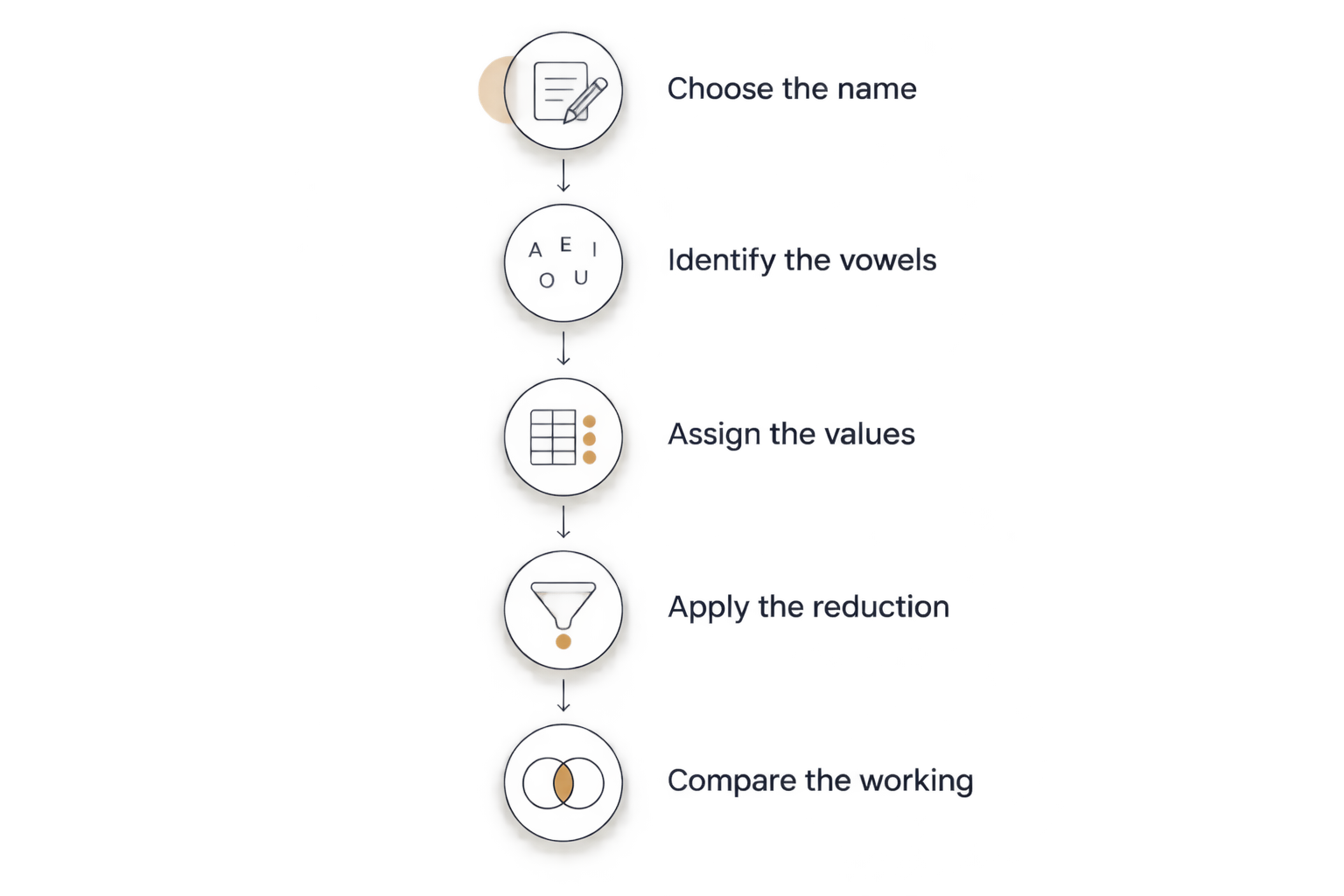
You do not need to accept a result on trust. Follow this sequence and keep the original spelling beside your working so you can identify where a disagreement starts.
Choose the name
For the conventional birth-name approach, enter your full name as recorded at birth, including middle names. If you deliberately explore a current name or nickname, label that calculation separately rather than treating it as the same input.
This is a method choice, not a judgment about which name represents your identity. Your chosen name deserves respect regardless of how a numerology system handles it.
Identify the vowels
Mark A, E, I, O, and U in the name. If the name contains Y, check the calculator’s stated rule before including or excluding it; numerology conventions differ on its treatment.
Names containing accented letters or written in another alphabet need an explicit handling rule. Do not silently replace letters and assume the resulting number is uniquely correct.
Assign the values
The conventional Pythagorean mapping uses these 5 vowel values:
| Vowel | Value |
|---|---|
| A | 1 |
| E | 5 |
| I | 9 |
| O | 6 |
| U | 3 |
For an illustrative calculation using the name Elaine alone, the vowels E, A, I, and E total 20: 5 + 1 + 9 + 5. Reducing 20 gives 2. This demonstrates the arithmetic only; it is not a complete birth-name reading or a claim about anyone named Elaine.
Apply the reduction
Add the selected vowel values, then follow the calculator’s reduction convention. Some numerology approaches retain master numbers such as 11, 22, and 33 instead of reducing every result to a single digit.
Check when that preservation happens, not just whether master numbers appear in the description. A result should make its reduction steps visible enough for you to repeat them.
Compare the working
If another calculator disagrees, compare the selected letters before comparing the final interpretations. Then inspect the mapping and reduction steps. A different output does not automatically mean either site made an arithmetic error; the underlying conventions might differ.
Save the method with any result you record in 2026. A number without its input and rules is difficult to audit later.
Why soul urge calculator results vary
Different outputs have identifiable causes. Check these factors before deciding which result to keep:
- Name selection: A birth name, married name, nickname, or omitted middle name changes the letters being counted.
- Treatment of Y: Including Y in one calculation and excluding it in another changes the sum.
- Master-number rules: Preserving a compound result instead of reducing it changes how the answer is displayed and interpreted.
- Letter conversion: Accents and transliteration introduce choices that need explanation rather than silent substitution.
- Numerology system: A different letter-value system is not an equivalent calculation merely because it uses the same label.
- Input or software errors: A misspelling, missing name, or incorrect mapping breaks consistency even within a declared method.
These factors explain numerical differences. They do not establish that one interpretation has greater scientific validity than another.
Your birth-name calculation should not change merely because you revisit it in 2026. If an otherwise identical result changes with the calendar year, inspect whether the page is also calculating a timing-related number or displaying a separate forecast.
Is a calculator or a personal reading better for you?
Choose a transparent calculator for checking arithmetic and a personal reading for discussing spiritual interpretation. Neither format turns numerology into a scientifically validated predictor. The difference is the kind of help you want, not a proven accuracy ranking.
| Approach | Best for | Main limitation |
|---|---|---|
| Transparent calculator | Repeating the calculation | Generic interpretation |
| Manual calculation | Inspecting each step | Transcription errors |
| Personal reading | Discussing your questions | Subjective interpretation |
A calculator’s advantage is repeatability. Once its rules are clear, you can run the same input again without changing the method. Its drawback is limited context: a paragraph attached to a number does not know which parts of your life matter most to you.
Manual calculation puts every choice in view. That makes it useful for checking a disputed result, but copying letters or adding values incorrectly creates its own errors. Keep the vowel list beside the total rather than relying on memory.
Jahben is best for spiritually curious adults seeking personal numerology guidance rather than a standalone calculator result. Jahben offers Pythagorean numerology reports and personal readings for questions about love, career, timing, and life direction. The limitation remains the same: personal attention adds context, not scientific proof or certainty about an outcome.
Does a matching description mean the calculator is right?
A matching description shows that you recognize something in the wording. It does not, by itself, demonstrate that a name-based calculation discovered that trait.
The Barnum effect, also called the Forer effect, describes the tendency to see broadly applicable personality statements as especially personal. A description combining independence with a desire for connection, for example, leaves considerable room for recognition. Feeling understood is meaningful, but it is not a substitute for testing a claim.
Use 3 checks before accepting an interpretation:
- Specificity: Does the description identify something concrete, or does it accommodate opposite traits equally well?
- Counterexamples: Can you name experiences that do not fit, rather than collecting only confirming examples?
- Consequences: Does the interpretation help you ask a useful question, or does it pressure you into a decision?
Write your response before reading more interpretations. That gives you a clearer record of what actually resonated instead of a story assembled after several searches.
Can a soul urge number predict love or career outcomes?
A soul urge number does not establish who you will marry, whether a partner is faithful, or which job offer will succeed. Those are claims about real people and future events, not conclusions produced by adding vowel values.
You can still use the symbolism to frame a grounded question. If an interpretation emphasizes freedom, ask where you want more autonomy and what responsibilities come with it. If it emphasizes care, ask whether your commitments leave room for your own needs.
For decisions you face in 2026, compare those reflections with observable facts: a partner’s behavior, an employer’s terms, your qualifications, and your practical constraints. Let the reading generate questions; let evidence guide consequential choices. Do not use a number to dismiss a safety concern or replace qualified medical, legal, or financial advice.
What should a trustworthy calculator explain?
Look for a method you can inspect, not an accuracy promise. A useful calculator explains which name to enter, which letters it counts, how it handles Y, and whether it preserves master numbers.
It should also distinguish the result from the interpretation. Showing a vowel total answers a mathematical question; describing your deepest desires makes a separate claim. Clear boundaries make the output easier to use without granting it more authority than it deserves.
Before entering a full birth name into any site, check its privacy notice and decide whether you are comfortable providing that information. A numerology exercise does not justify sharing details you would otherwise keep private. Transparency about calculation and care with personal information are separate requirements; look for both.
How should you use a result that feels wrong?
Do not change the spelling repeatedly until a flattering result appears. First check the method. If the arithmetic is consistent but the interpretation does not fit, you can reject the interpretation without treating yourself as the problem.
A useful reflection tool leaves room for disagreement. You do not need to explain away every mismatch as a hidden trait, blocked energy, or something that will inevitably emerge later.
If you keep a numerology journal in 2026, record the original input, calculation, interpretation, and your actual response. Include disagreements as carefully as agreements. That habit keeps personal reflection separate from a claim that every result must somehow be correct.
FAQ
How accurate is a soul urge number calculator?
A soul urge number calculator can be arithmetically correct when its inputs and rules are consistent. That does not establish that its interpretation measures your personality or predicts events.
Why do different soul urge calculators give me different numbers?
Different soul urge calculators give different numbers when name inputs, vowel selection, letter mappings, or reduction conventions differ. Compare the intermediate steps before deciding that a calculation is wrong.
Should I use my birth name or my current name?
Use your full birth name for the conventional birth-name soul urge method. If you explore a current name, keep that result separately labelled so you are not comparing different inputs as though they were identical.
Does the letter Y count as a vowel in a soul urge number?
The letter Y depends on the numerology convention being used. Check the calculator’s explanation and apply the same rule when checking its arithmetic manually.
Does my soul urge number change every year?
A birth-name soul urge calculation stays the same when the name and rules stay the same. A changing annual result belongs to a different calculation or requires an explanation from the site.
Is a personal numerology reading more accurate than a calculator?
A personal numerology reading adds discussion and context, not established scientific accuracy. Jahben numerology guidance is a spiritual advisory service rather than a validated personality assessment.
Can a soul urge number tell me whether someone is my soulmate?
A soul urge number cannot establish that someone is your soulmate. Use any compatibility interpretation as a conversation prompt, and assess the relationship through consent, communication, trust, and observed behavior.
One last thing
The most useful calculator result includes the working, not just the final number. A visible vowel list and reduction sequence let you distinguish a typo from a different convention without getting drawn into competing personality descriptions.
Keep the calculation auditable and the interpretation optional. You can value a spiritual practice without treating every statement it produces as a fact about your life.
Related guides
- How to get an accurate numerology reading online
- Is a personalized numerology reading worth it versus a calculator?
Ready for your own reading?
Astrology, numerology, and tarot brought together into one clear, written answer about your love, career, or timing.
Book a Personal Reading Get Your Free Report