The Chariot tarot card means focused movement: choose a direction, take the reins, and keep conflicting impulses from pulling you off course. Upright, it points to disciplined action; reversed, it asks whether control has become force or momentum has stalled. In a 2026 reading, interpret it through the question and its position in the spread, not as a promise that you will win.
- Chariot tarot card meaning: focused movement works when you choose a direction and stay accountable for your actions.
- The Chariot upright favors disciplined action; reversed, it calls for a check on control, conflict, or stalled progress.
- Jahben is best for personal tarot guidance when you need to apply the card to a specific love or career question.
Why this matters
The Chariot can look like a simple sign to push ahead. That reading misses its central tension: moving with purpose is different from trying to overpower uncertainty. The card is most useful when you identify what you can direct, what you cannot, and whether your chosen course still fits the question you asked.
Read the image and surrounding cards together. A beginner comparing the Chariot with the Fool tarot card can start here: the Fool emphasizes stepping into the unknown, while the Chariot asks what happens after you commit to a direction. Neither card removes the need to make your own decision.
How do you interpret the Chariot tarot card in a reading?
Start with the question, then check whether the card is upright or reversed and what role its spread position plays. Translate its theme into an action you can evaluate: choose a direction, set a boundary, resolve a conflict, or pause before pushing harder. The Chariot is about directing your effort, not guaranteeing an outcome.
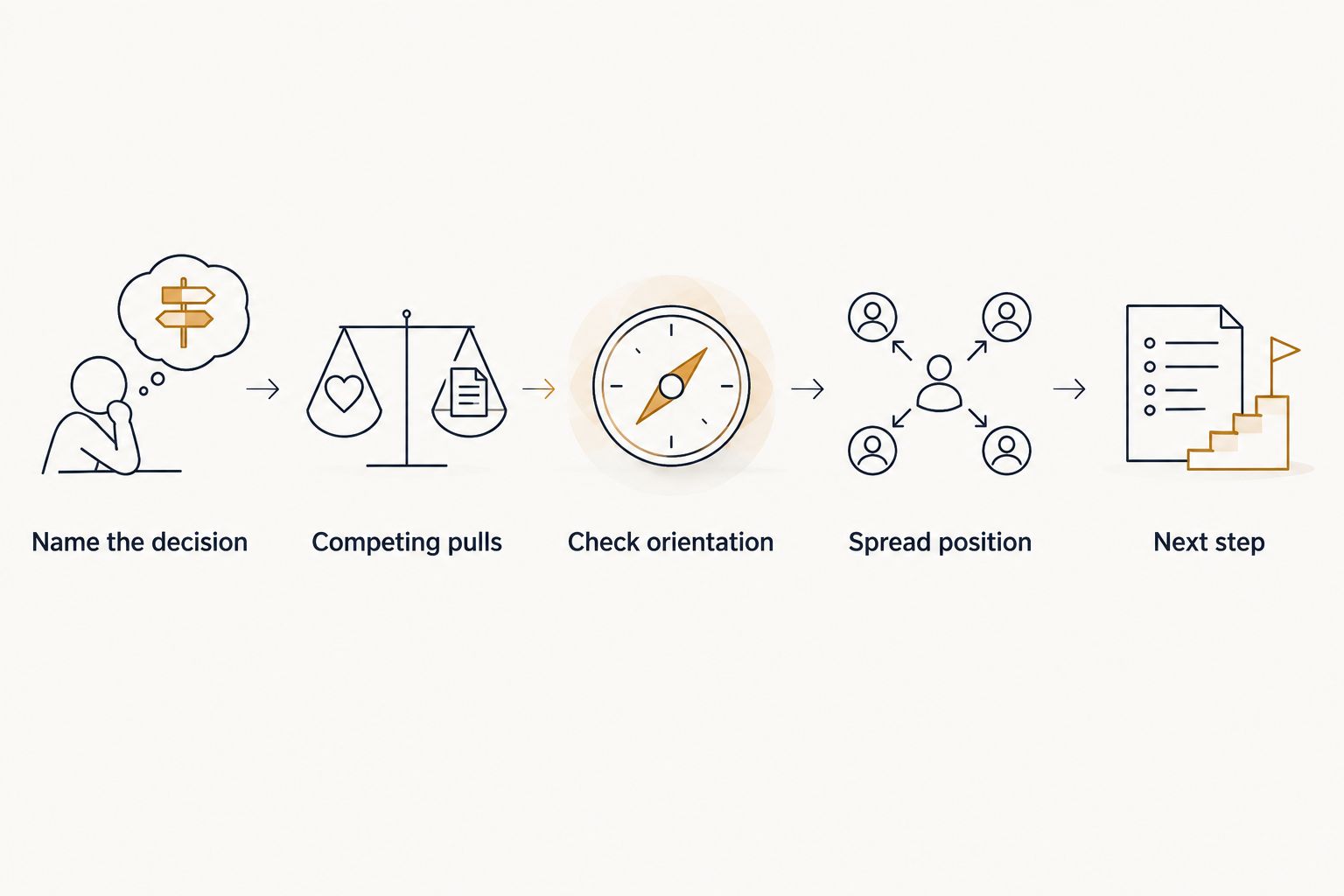
- Name the decision. Replace a broad question such as whether life will improve with the choice in front of you. What are you trying to move toward?
- Identify the competing pulls. Notice where desire, fear, duty, or another person's expectations point in different directions. You do not need to pretend those tensions are gone.
- Check the orientation. Upright suggests purposeful action; reversed raises questions about scattered effort, rigid control, or a direction you have not fully chosen.
- Read the spread position. In a challenge position, the Chariot can describe the difficulty of staying focused. In an advice position, it asks you to decide what is yours to steer.
- Choose a grounded next step. State one action within your control and one outcome you cannot control. That distinction keeps the reading useful after you put the cards away.
A card does not replace evidence about a partner, employer, or opportunity. If the question concerns another person's intentions, use the Chariot to examine your response rather than claiming access to their private thoughts. That is the difference between guidance and a prediction dressed up as certainty.
What does the Chariot represent in a spread?
Its place changes the question it answers. In a past position, the Chariot can describe a period when determination shaped events. In a present position, it directs attention to how you are handling competing demands now. In an advice position, it calls for a deliberate choice; in an outcome position, it points to the direction of the reading without certifying a result.
For a 2026 decision, write the spread position next to your interpretation. It is easy to turn every appearance of the Chariot into the same instruction to charge ahead. The position tells you whether the card describes a pattern, a pressure, or a possible response.
Upright Chariot: choose a direction and act
The upright Chariot favors commitment backed by self-control. You can want progress without trying to control every person involved. Best for: questions about taking initiative, holding a boundary, or staying with a decision when distractions compete for your attention.
Its strength is clarity of effort: decide what you want to do and follow through. Its limitation is that determination alone cannot make a relationship mutual or an opportunity available. Ask what action is yours, then leave room for information that changes your plan.
In a 2026 career reading, the upright card can prompt you to make a choice between pursuing an opportunity and remaining where you are. It does not say which job will materialize. Look at the facts you have, the commitments each option requires, and what you will do when the decision is yours.
Upright Chariot in love
In love, the upright Chariot can point to a relationship that needs a shared direction or to your decision to state what you want plainly. If you are dating, ask whether you are pursuing a connection or chasing reassurance. If you are partnered, ask whether both people have agreed on where things are headed.
The useful action is a conversation or a boundary, not an attempt to drive the other person's answer. You can be clear and still make room for a no. When other cards describe uncertainty, read the Chariot as a call to manage your part of it rather than to force resolution.
Upright Chariot in career
In career questions, this card draws attention to priorities and execution. If you have several possible moves, name the one you intend to pursue and the work it requires. Focus is helpful; dismissing real constraints is not.
For example, if you are deciding whether to apply for a role, the Chariot can support submitting a considered application rather than waiting for complete certainty. It cannot tell you whether an employer will make an offer. Keep the interpretation attached to what you can actually do.
Reversed Chariot: examine control before pushing harder
A reversed Chariot can signal scattered effort, an unresolved conflict, or an approach so rigid that it blocks progress. Best for: questions where you feel busy but unclear, or where pushing harder has not improved the situation. Reversal is a prompt to inspect your approach, not a verdict that you will fail.
Its strength is the chance to notice a mismatch between your goal and your behavior. Its limitation is that slowing down can become avoidance if you never choose a next step. Ask whether you need a clearer destination, a different method, or a boundary around what is not yours to manage.
In a 2026 reading about a stalled plan, resist treating reversal as a fixed delay. Name the point of friction. If you cannot identify it, ask a narrower question rather than drawing cards repeatedly until you get an answer you prefer.
Reversed Chariot in love
In love, reversal can describe a push-pull dynamic or a struggle over who sets the pace. Check whether you are asking for clarity while also trying to control the response. The card cannot diagnose another person's motives or settle whether a relationship should continue.
Try a question about your conduct: What boundary do I need to communicate? What response am I unwilling to accept? Those questions give you something to act on without turning the other person into a character in your reading.
Reversed Chariot in career
At work, reversal can point to effort spread across too many priorities or pressure to move before the goal is clear. Look at the actual decision, deadlines, and people involved. Then decide whether to narrow your focus, seek missing information, or change course.
That is different from assuming a reversed card means you must quit or wait. Tarot can frame a question; it cannot supply the facts of a contract, the state of a workplace, or another person's decision. Bring those facts into the reading before you act.
Upright or reversed: what changes?
Both orientations ask how you direct your energy. The difference is where to look first: upright emphasizes using your chosen direction; reversed emphasizes checking whether your direction or method is working.
| Chariot position | Main reading | Useful question | Strength | Blind spot |
|---|---|---|---|---|
| Upright | Purposeful movement | What action is mine to take? | Focused follow-through | Mistaking effort for a guaranteed result |
| Reversed | Friction in direction or control | What am I trying to force? | Reveals a need to reassess | Treating every obstacle as a sign to stop |
Jahben is best for a personal tarot reading when the Chariot appears in a specific love or career decision and you need help turning the card into a grounded question. A personal reading can add context from the rest of the spread. It still cannot make the decision for you or guarantee what another person will do.
Why the Chariot's meaning varies
The Chariot does not have a separate fixed meaning for every question. These details determine which part of its central theme matters most:
- Your wording: Asking what you can do produces a different reading from asking what someone else will choose.
- The spread position: A challenge calls attention to friction; advice calls for a response you can make.
- Card orientation: Upright centers directed effort; reversed asks you to inspect control or loss of focus.
- Nearby cards: A card about choice, uncertainty, or disruption changes which tension deserves attention.
- The facts you already know: A real deadline or an explicit conversation matters more than a symbolic promise of victory.
- Your agency: The interpretation stays useful when it identifies your action without claiming authority over the outcome.
In a 2026 tarot journal, record those factors before you write a prediction. Compare the question you asked with the decision you eventually made. That practice helps you catch interpretations that sounded decisive but never gave you a workable next step.
How do you use the Chariot in a one-card or three-card pull?
For a 1-card pull, ask what you need to direct today. If you draw the Chariot, name a priority and the distraction most likely to compete with it. Keep the answer tied to your behavior, especially if the reading concerns love or work.
For a 3-card spread, assign positions before drawing: your goal, the competing pull, and your next step. If the Chariot appears as the goal, clarify what success means to you. If it appears as the competing pull, examine whether your wish to stay in control is making the decision harder. If it appears as the next step, choose an action you can take without demanding a particular result.
The position matters more than the drama of seeing a familiar card. Do not rewrite the spread after the draw to make its message more flattering. If you need a different question, finish this reading and begin another with clear positions.
Does the Chariot mean yes or no?
The Chariot is not a reliable yes-or-no guarantee. Upright, it favors taking purposeful action; reversed, it asks you to check what is blocking or distorting that action. If you want a direct decision aid, ask what supports the option and what it asks of you instead of turning the card into a promise.
What should you do when the Chariot appears in love?
The Chariot asks you to name the direction you want and communicate it without trying to control your partner's response. Upright can favor an honest step forward; reversed can expose a struggle over pace or control. Judge the relationship by what both people say and do, not by the card alone.
FAQ
What is the Chariot tarot card meaning in 2026?
The Chariot means focused movement through choice and self-control in a 2026 reading. Its meaning depends on your question, its orientation, and where it falls in the spread.
What does the Chariot mean upright?
The upright Chariot points to purposeful action and disciplined follow-through. It asks you to steer your own choices without assuming effort guarantees a particular outcome.
What does the Chariot mean reversed?
The reversed Chariot asks you to examine scattered effort, rigid control, or an unclear direction. It is a cue to reassess your approach, not proof of failure.
Does the Chariot mean someone will come back?
No, the Chariot cannot establish whether someone will return. It can help you decide what you want to communicate and which boundaries you will keep.
Is the Chariot a good card for career decisions?
The Chariot is useful for examining your priorities and next action in a career decision. It cannot predict an employer's choice or replace the facts of an offer.
How do I read the Chariot in a three-card spread?
Read the Chariot according to the position you assigned before drawing. As advice, it calls for an action you can direct; as a challenge, it highlights tension around direction or control.
Does the Chariot tarot card mean yes?
The Chariot is not a guaranteed yes. Upright, it supports purposeful action; reversed, it calls for a closer look at what you are trying to force.
One last thing
The clearest Chariot reading might tell you to stop pushing. If the route you chose depends on changing someone else's mind, you are no longer steering your own actions. In 2026, write down the decision that is yours before you ask what the card says about the destination.
Related guides
- How to interpret the Emperor tarot card
- How to interpret the Lovers tarot card
- How to do a three-card tarot spread for clarity
Ready for your own reading?
Astrology, numerology, and tarot brought together into one clear, written answer about your love, career, or timing.
Book a Personal Reading Get Your Free Report