The Temperance tarot card meaning is balance through deliberate adjustment: bring competing needs into a workable rhythm instead of forcing an immediate result. In a 2026 reading, interpret the card through its position, the question you asked, and the cards around it; reversed, it points to an imbalance that needs attention, not an inevitable bad outcome.
- Temperance tarot card meaning: adjust what is out of balance before you push for a result.
- Upright Temperance favors patience and cooperation; reversed Temperance asks you to identify the strain.
- In love or career readings, read Temperance against the question and nearby cards, not as a fixed prediction.
- Jahben's tarot readings are best for people who want a personal interpretation of a specific decision.
Why this matters
Temperance is easy to flatten into a command to wait. That misses its active side: you can change the pace, redistribute effort, or bring two approaches together without abandoning what you want. If you are learning to read cards in 2026, interpreting a one-card tarot pull is a useful starting point, but Temperance becomes more specific when you connect it to a real question.
Temperance does not promise that everything will resolve on its own. It asks what needs adjusting and whether you are willing to make that adjustment. A reader who ignores the situation can turn a practical card into vague reassurance.
How do you interpret the Temperance tarot card in a reading?
Start with the question, then check the card's position and orientation. In a common tarot deck, Temperance is a Major Arcana card, traditionally numbered XIV. Its usual themes are moderation, integration, patience, and finding a workable middle ground. None of those themes identifies the specific change you should make until you place the card in context.
| Reading context | Upright Temperance | Reversed Temperance | Useful question |
|---|---|---|---|
| Love | Make room for both people's needs | Notice where compromise has become one-sided | What needs to change in how we relate? |
| Career | Combine skills or adjust your pace | Name the conflict between priorities | What part of this approach is unsustainable? |
| A decision | Compare options without rushing | Check whether pressure is driving the choice | What information or adjustment is missing? |
| Personal growth | Practice a steadier response | Look for an extreme you keep repeating | What can I do differently today? |
Upright is not automatically yes, and reversed is not automatically no. Those shortcuts discard the question that gives the card meaning. If you asked whether to take a job, Temperance speaks to the conditions under which that choice works, not to a guaranteed offer or outcome.
Read the question before the symbol
Write your question in plain language. “What should I change about my current workload?” gives Temperance somewhere to land; “What will happen?” leaves too much open. The more precise question is especially useful when the card appears in a 2026 reading about timing, because patience alone does not tell you what to do while you wait.
Separate what you control from what belongs to someone else. In a relationship reading, you can adjust how you communicate or set a boundary. You cannot use Temperance to establish what another person privately thinks.
Check what the position is asking
A past position can describe an earlier attempt at compromise. A present position can identify the adjustment needed now. A future position points to a theme to work with, not a fixed event that will happen regardless of your choices.
If you drew Temperance without assigned positions, return to the question rather than inventing a timeline. Ask where you are mixing competing demands and where the mixture stops working. The position changes the emphasis; it does not erase the card's central theme.
Use nearby cards to make the answer specific
Temperance beside a card about choice directs attention to how you weigh alternatives. Beside a card about conflict, it directs attention to how you respond to tension. You do not need to turn either pairing into a prediction; name the pattern the cards put in front of you.
For a structured way to give each card a distinct job, use a three-card tarot spread for clarity. Decide what each position means before you draw. Changing the positions afterward to fit the answer makes the reading harder to assess honestly.
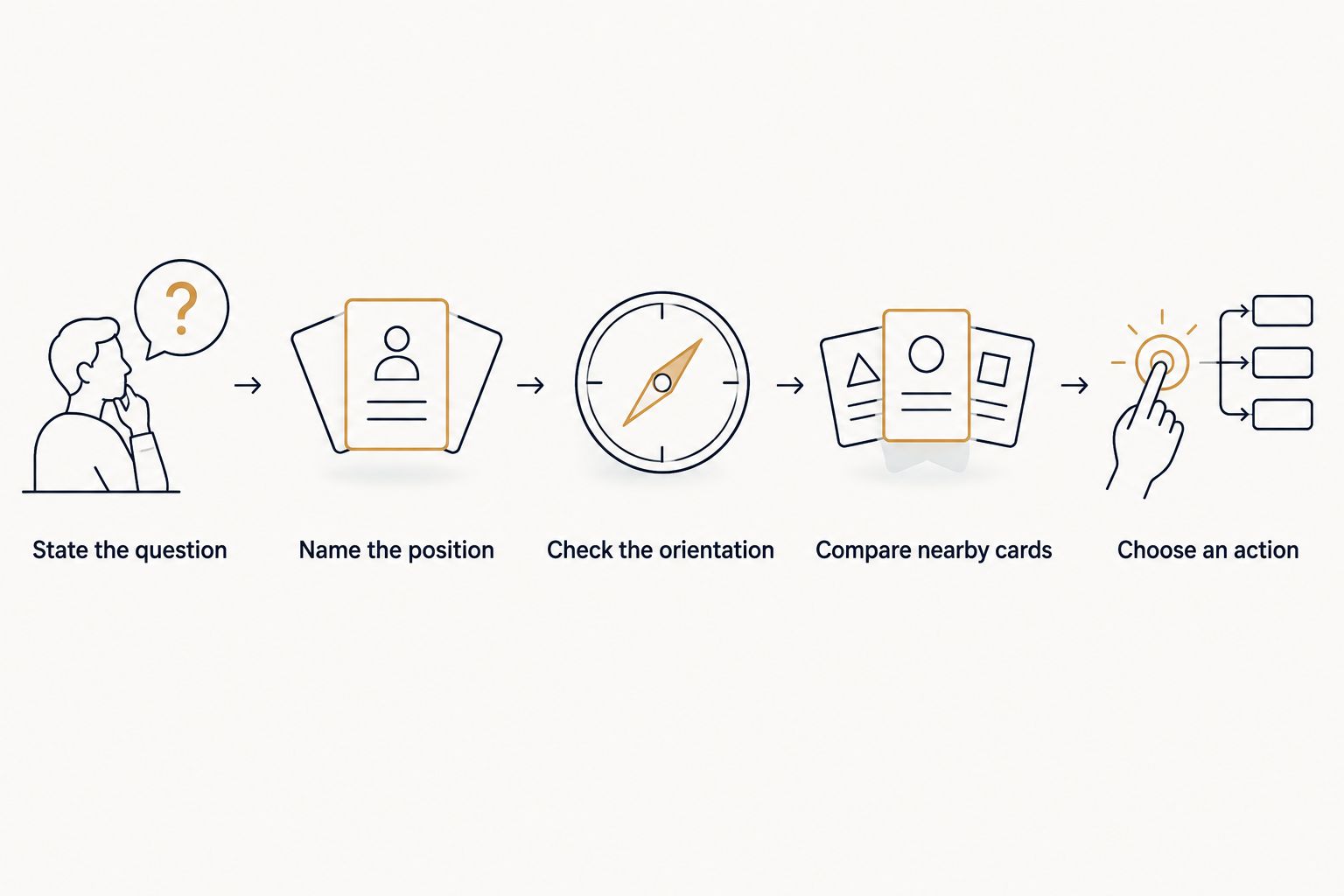
How to read Temperance step by step
- State the question. Ask about a choice, relationship dynamic, or behavior you can examine, rather than a guaranteed outcome.
- Name the position. Decide whether Temperance describes the current situation, an obstacle, advice, or a possible direction.
- Check the orientation. Read upright as an invitation to integrate and adjust; read reversed as a prompt to locate imbalance.
- Compare nearby cards. Look for the competing needs or pressures they make visible.
- Choose an action. Identify one change you can make and one sign that tells you whether it helps.
This sequence keeps the interpretation grounded in the reading you actually did. In 2026, as in any reading, a card does not replace a conversation, a job description, or the facts of a decision. Use it to sharpen your question, then check the answer against your circumstances.
Upright Temperance: adjust without giving up
Upright Temperance asks you to keep what matters while changing how the parts fit together. That is different from surrendering your preference. If you want closeness and also need time alone, the question is how to make room for both needs rather than treating either one as a failure.
In a 2026 career reading, upright Temperance can direct you to reconsider pace, collaboration, or how you divide attention between responsibilities. It does not tell you to accept an unreasonable demand. Balance is a workable arrangement, not an obligation to tolerate every condition.
The card's strength is patience with a purpose: observe, adjust, and check the result. Its limitation is that “be patient” becomes empty advice when you do not name what you are changing. Ask what gets less of your time, what gets more, and what conversation needs to happen.
Reversed Temperance: find the imbalance
Reversed Temperance draws attention to an arrangement that is not working. You might be moving between extremes, trying to meet incompatible expectations, or asking yourself to maintain a pace you cannot keep. Read those as questions to investigate, not as facts the card has proven.
The useful response is to identify the pressure point. Are you doing all the adapting? Have you confused urgency with importance? Is a compromise leaving the original problem untouched? Reversed Temperance is most helpful when it moves you from a general feeling of strain to a specific adjustment.
A reversed card is not a verdict against your relationship, job, or decision. In a 2026 reading, treat it as a check on your current approach. If the issue is serious, gather real-world information and speak with the people involved before acting on a symbolic interpretation.
What does Temperance mean for love?
In love, upright Temperance favors honest pacing and room for different needs. That can mean discussing how often you communicate, how you handle conflict, or what each person wants from the relationship. It does not establish that someone will return, commit, or change.
Reversed Temperance asks whether the apparent peace depends on one person repeatedly giving way. If you are asking about a new connection, notice whether you are trying to rush clarity that requires conversation. If you are asking about an existing partnership, name the adjustment you want and ask for the other person's view.
Jahben's tarot readings are best for people who want a personal interpretation of a love question, not a promise about another person's choices. Bring the question you actually need answered. “What pattern am I contributing to?” gives a reading more substance than asking the cards to speak for someone who is not there.
What does Temperance mean for career?
For career questions, Temperance points to how you combine priorities. You might need to bring different skills into the same role, make a decision at a steadier pace, or clarify which responsibility takes precedence. The card does not confirm that an employer will hire you or that a business plan will succeed.
Reversed Temperance focuses the question on strain: what keeps getting postponed, where priorities clash, and which compromise no longer holds. In a 2026 career reading, compare that interpretation with actual deadlines, responsibilities, and conversations. The practical test is whether a proposed adjustment makes the work clearer and more sustainable.
If your question is whether to leave, stay, or change direction, do not treat “balance” as an instruction to remain where you are. Temperance asks you to examine the conditions of each option. One option can require a better boundary; another can require a different plan.
Why does the Temperance interpretation vary?
- Your question: A love question and a career question put the same card in different situations.
- The card's position: Advice about what to do differs from a description of what has already happened.
- Its orientation: Upright emphasizes integration; reversed focuses attention on imbalance.
- Nearby cards: They show which pressures, choices, or behaviors need closer examination.
- Your circumstances: A useful reading must fit the facts you know, not override them.
These factors explain why a fixed keyword list cannot finish a reading for you. Keep the central meaning, then narrow it until you can say what it addresses. Temperance means adjust the arrangement; the spread and your question show which arrangement.
Is Temperance a yes or no card?
Temperance is not a reliable yes or no card. It directs you to the terms of a choice: what needs patience, what needs combining, and what cannot stay as it is. If you need a binary answer, first ask whether your question leaves out conditions that matter.
Does reversed Temperance mean a breakup?
Reversed Temperance does not mean a breakup. It highlights imbalance in the reading, but the card cannot establish another person's intentions or determine the relationship's outcome. Ask what is uneven and whether both people are willing to address it.
What should I do when Temperance appears as advice?
When Temperance appears as advice, choose a concrete adjustment instead of waiting without a plan. Identify the two needs in tension, decide what you can change, and check whether that change helps. If another person is involved, include a direct conversation.
FAQ
What is the Temperance tarot card meaning in 2026?
Temperance means balance through deliberate adjustment in a 2026 reading. Interpret it against your question, its position, and nearby cards rather than treating it as a fixed prediction.
What does upright Temperance mean in a reading?
Upright Temperance points to patience, integration, and a workable balance between competing needs. Name what you can adjust so the interpretation leads to an action.
What does reversed Temperance mean in a reading?
Reversed Temperance points to an imbalance that needs attention. It does not guarantee a bad outcome; examine which demand, habit, or compromise is creating strain.
Is Temperance a good card for love?
Temperance is useful for examining how two people make room for each other's needs. It does not confirm what the other person feels or predict whether the relationship will last.
What does Temperance mean for a job decision?
Temperance asks whether the conditions of a job decision support a workable pace and clear priorities. Compare the card's theme with the role's actual responsibilities before you decide.
Does Temperance mean I should wait?
Temperance does not mean waiting without a plan. It asks you to slow down where necessary while making a specific adjustment or gathering information.
How do I read Temperance beside other tarot cards?
Read Temperance alongside the pressures or choices the neighboring cards bring into focus. Keep your original question and each card's assigned position in view.
One last thing
The strongest Temperance question is not “How long must I wait?” It is “What am I trying to hold together, and what needs to change so it can work?” Take that question into your next 2026 reading. Jahben can help interpret it through a personal tarot reading, but the decision remains yours.
Related guides
- How to interpret the Lovers tarot card in a reading
- How to interpret the Emperor tarot card in a reading
- How to journal after a tarot reading for deeper insight
Ready for your own reading?
Astrology, numerology, and tarot brought together into one clear, written answer about your love, career, or timing.
Book a Personal Reading Get Your Free Report