Yes, you can ask a psychic the same question twice, especially when you need clarification or your circumstances have changed. Ask again to understand an answer—not to keep searching until someone gives you the answer you want. A repeated reading does not verify a prediction or remove the uncertainty behind a personal decision.
- Can you ask a psychic the same question twice? Yes—clarify unclear wording or revisit changed circumstances.
- Repeated psychic readings do not establish whether a prediction is true.
- Jahben offers personal spiritual guidance; use it alongside your own judgment, not instead of it.
- If nothing has changed, pause before seeking another answer about love, career, or timing.
Can you ask a psychic the same question twice?
Yes. The useful distinction is between clarification, a genuine update, and repetition for reassurance. Those are different reasons to return to the same subject, and they call for different next steps.
| Your reason | Best for | Main limitation |
|---|---|---|
| Clarify an answer | Understanding unclear wording | Does not verify accuracy |
| Revisit changed facts | Reflecting on a new decision | Still involves interpretation |
| Pause the question | Avoiding answer-shopping | Leaves uncertainty unresolved |
Clarification makes sense when you cannot explain what the reader meant. Revisiting makes sense when the situation is materially different. Pausing makes sense when you understand the answer but dislike it or feel driven to check it again.
For the practical distinction between repeating a question and requesting an explanation, see follow-up questions in a live psychic reading.
Your decision rule for 2026: return with new information or a clearer question, not just a stronger wish for certainty. You do not need another reading simply because an earlier answer remains uncomfortable.
Why this matters
A question about a relationship, job, or major move usually carries more than curiosity. You want to know what will happen because the outcome matters to you. That makes the distinction between reflection and proof essential.
Treat a reading as spiritual interpretation rather than established knowledge about another person's thoughts or future actions. You can consider an interpretation without accepting it as fact, and you can reject advice that conflicts with your safety, boundaries, or observable evidence.
The goal is not to become better at obtaining predictions. It is to leave the conversation better able to decide what you will do.
When asking again is useful
Clarification: understand the original answer
Ask for clarification when the response was vague, internally inconsistent, or unrelated to what you asked. Point to the exact wording. A narrower follow-up is more useful than starting the entire question over.
For example, if a reader describes a relationship as uncertain, ask whether that statement concerns your hesitation, the other person's behavior, or the reader's interpretation. Do not assume the phrase contains a precise meaning that you must discover alone.
Best for: resolving confusion about what was actually said. The benefit is a clearer explanation; the limitation is that clearer wording still does not establish that the interpretation is correct.
You can also ask the reader to distinguish advice from prediction. A suggestion to communicate directly is something you can evaluate and act on. A statement about what someone will eventually do remains unverified until events establish it.
Changed circumstances: revisit a different decision
A familiar topic can contain a genuinely new question. A partner has contacted you, an employer has made an offer, or a planned move now involves a different destination. Those developments change what you need to decide.
Explain the development directly rather than asking the reader to rediscover it. State what happened, what remains unknown, and which choice now belongs to you.
Best for: reflecting on a decision after a concrete development. The benefit is relevance to your present situation; the limitation is that spiritual guidance does not replace checking the practical facts.
For a career decision in 2026, that means reviewing the actual role, responsibilities, and written terms. A reading is not a substitute for information from the employer.
Nothing has changed: pause before repeating
If the facts and the question are unchanged, identify what you expect another reading to provide. Is there an unexplained point, or are you hoping the next answer will feel better?
Neither disappointment nor anxiety makes you foolish. But neither is evidence that another interpretation will resolve the issue. You are allowed to stop without obtaining an answer that feels completely certain.
Best for: protecting your attention when another reading has no clear purpose. Pausing avoids adding interpretations you do not need; its limitation is that you still have to live with the unresolved question.
Why the reason to ask again varies
Judge a repeat question by its purpose, not by a supposed spiritual deadline. Use these factors to decide whether the conversation needs another pass:
- Clarity: Can you explain the original answer in plain language? If not, request an explanation before seeking another interpretation.
- Changed facts: Has something observable happened that affects your decision? Describe the event rather than a feeling that something must have shifted.
- Your action: Have you taken the practical step the situation requires, such as checking an offer or having a direct conversation?
- The question's scope: Are you asking about your choices, or seeking certainty about someone else's private thoughts?
- Your reason for returning: Do you want understanding, a fresh perspective, or relief from an answer you do not like?
These factors do not measure psychic accuracy. They help you decide whether another conversation has a useful job to do.
How do I ask again without repeating the same conversation?
Use this sequence before arranging another reading. It separates what you know from what you want interpreted.
- Review the answer. Read your notes or the written response. Identify the particular sentence you do not understand instead of relying on your memory of its emotional impact.
- Name the change. Write down the new fact, if there is one. If nothing has changed, say that plainly to yourself.
- Choose the question. Ask about the unresolved point or the decision now in front of you. Keep your request focused enough that you can recognize whether it was answered.
- Set a boundary. Decide what you will do after the conversation and what would justify revisiting it. Do not leave the stopping point entirely to the next prediction.
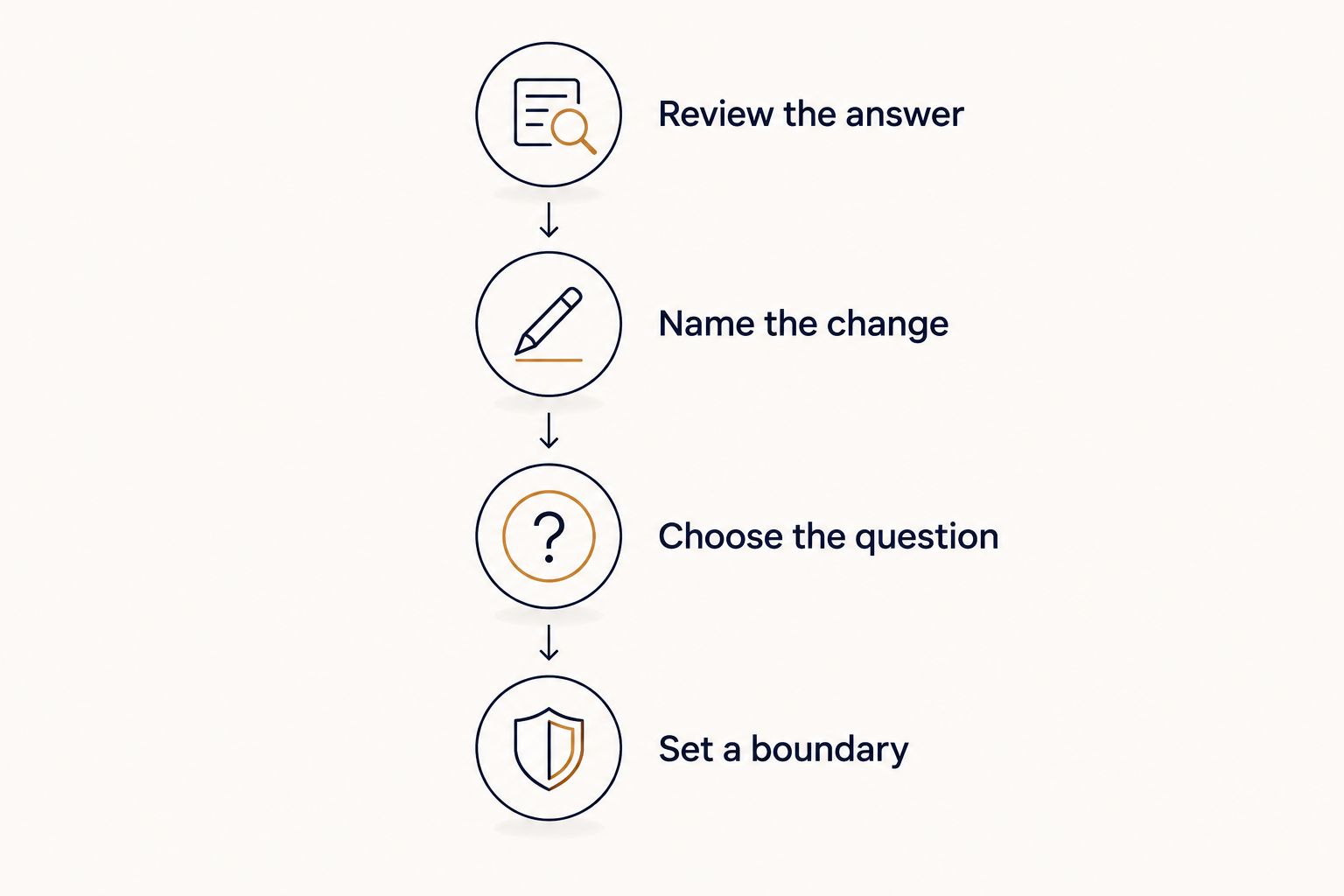
For your 2026 reading notes, use 3 headings: original question, observable facts, and next action. This is a suggested writing exercise, not a required spiritual practice. Its purpose is to keep interpretation separate from evidence.
Limit your opening request to 1 main question, then explain the relevant change in 2 sentences. That suggested format keeps the follow-up focused without requiring you to hide important context.
What should I ask instead of repeating a yes-or-no question?
Ask for reflection that supports your own decisions rather than a verdict you cannot independently check. A useful question leaves room for uncertainty and gives you something specific to examine.
For love, replace a repeated request to know whether someone will return with a question about the boundaries you want if contact resumes. You still cannot control the other person's choice, but you can decide what you will accept.
For career, replace a repeated question about whether an opportunity is destined with a question about what you are overlooking in the decision. Then compare the response with the actual information you have.
For timing, ask what needs to be ready before you act. A symbolic interpretation of timing should not override a real application deadline, medical appointment, or contractual obligation.
A stronger question does not make a prediction scientifically verified. It makes the conversation more relevant to your choices. Keep that distinction intact when reviewing guidance in 2026.
How long should I wait before asking the same question again?
Use a meaningful change or a specific unresolved point as your trigger—not an arbitrary waiting period. There is no evidence-based interval that makes a repeated psychic prediction reliable.
If you misunderstood a sentence during a live conversation, ask for clarification then. If you are considering a new session about unchanged circumstances, first explain what the new session would address that the original one did not.
You do not have to book again because a calendar page turned. Equally, you do not have to ignore a genuinely new development because you believe you are supposed to wait.
What if two psychics give me different answers?
Different answers do not tell you which prediction is correct. Agreement would not establish accuracy either. Avoid treating the number of matching interpretations as proof.
Compare what each person actually said, including qualifications and changes in wording. Then return to observable facts: what happened, what was communicated directly, and what remains unknown.
You do not need another reader to break the tie. For a consequential decision, seek the relevant practical expertise and make the choice using information you can check.
Where personal spiritual guidance fits
Jahben psychic readings suit adults seeking personal spiritual guidance, not guaranteed predictions. Jahben offers email and live readings that combine Western astrology, Pythagorean numerology, tarot, and 12 Tribes astrology.
The useful role is personal reflection on love, career, timing, and life direction. The limit is equally important: a spiritual interpretation is not independently verified evidence about an outcome. Choose that kind of conversation only if its purpose fits what you need.
Before arranging any reading in 2026, identify what would make the conversation useful even if it did not predict what happens next. If your only acceptable result is certainty, a reading is not the right way to establish it.
When should I stop asking and get a different kind of help?
Stop seeking readings when they are displacing necessary action or making you feel unable to decide without permission. Examples include postponing a medical appointment, ignoring legal advice, or treating a prediction as evidence that another person is lying.
Do not use readings to diagnose illness, determine pregnancy, establish infidelity, or settle legal facts. Use qualified professionals and appropriate evidence for those questions.
If repeated checking feels difficult to resist or is interfering with daily life, speak with a licensed mental health professional. You do not need to prove that something is seriously wrong before asking for support.
FAQ
Is it bad luck to ask a psychic the same question twice?
There is no established evidence that asking a psychic the same question twice causes bad luck. Decide whether to ask again based on clarity, changed circumstances, and your reason for returning—not fear of punishment.
Can I ask the same question during one psychic reading?
Yes, you can repeat or rephrase a question to request clarification during a psychic reading. Explain which part of the answer you did not understand, and check the reader's session rules before assuming additional questions are included.
Should I tell a psychic that I already asked someone else?
Yes, be straightforward about an earlier reading when it is relevant to your question. Present the earlier answer as an interpretation, not as a fact the new reader must confirm or contradict.
Does a different answer mean my future changed?
A different answer does not establish that your future changed. It shows that the interpretations differ; observable events are needed to establish what actually happened.
Can I ask Jahben about the same relationship again?
You can frame a question for Jahben around a new relationship development or an unclear interpretation. Confirm the relevant session terms directly rather than assuming a follow-up is included, and do not treat spiritual guidance as proof of another person's feelings.
Should I get another reading if the first prediction did not happen?
You do not need another reading because a prediction did not happen. Record the original wording and the actual outcome instead of repeatedly changing the prediction's meaning to make it fit.
One last thing
Before asking again, finish this sentence in your notes: the information I need to make my decision is…
If the missing information is available from a conversation, document, appointment, or application, start there. The next useful answer does not always come from another reading.
Related guides
Ready for your own reading?
Astrology, numerology, and tarot brought together into one clear, written answer about your love, career, or timing.
Book a Personal Reading Get Your Free Report