No—you do not need to avoid weekly tarot readings as a blanket rule. When deciding how often should you get a tarot reading, focus on whether you have a fresh question, something has changed, and you have acted on the previous reading. A weekly session becomes a reason to pause when you keep asking an unchanged question because you want a different answer.
- How often should you get a tarot reading? Choose by purpose and changed circumstances, not a fixed spiritual deadline.
- Weekly tarot readings suit fresh reflection; repeating an unchanged question is a reason to pause.
- Jahben offers tarot readings for personal guidance, not a substitute for your own decisions.
- Write down your question, interpretation, and next action before considering another reading.
Why this matters
Your next reading should have a purpose beyond getting another reading. If you want support with love, career, or life direction in 2026, start by separating a question you can explore from an outcome you cannot control.
The useful distinction is reflection versus repeated checking—not weekly versus monthly. You can use journaling after a tarot reading to record what you understood and what you intend to do. That gives you something concrete to revisit before asking again.
A reading also has limits. Tarot is not an established method for verifying another person's private thoughts or guaranteeing future events, so more frequent sessions should not be treated as stronger evidence.
Is it true you shouldn't get a tarot reading every week?
No blanket prohibition makes a weekly tarot reading inherently wrong. The better question is what you are asking the reading to do: support a new reflection, examine changed circumstances, or remove uncertainty from an unchanged situation.
Use this comparison to choose a starting approach. These are planning options for 2026, not scientifically established intervals or requirements.
| Approach | Best for | Main trade-off |
|---|---|---|
| Weekly reflection | Fresh, specific questions | Can become repetitive |
| Monthly review | Broader themes and actions | Less frequent reflection |
| Event-based reading | A changed decision or situation | Needs a clear trigger |
| Taking a break | Repeated reassurance-seeking | Leaves uncertainty unresolved |
None of these approaches proves that a reading is accurate. A schedule is a boundary for how you use tarot, not a measure of its predictive power.
For example, receiving a job offer after a reading about your job search creates a different question. Asking again because the employer has not replied does not, by itself, create new information.
Weekly tarot readings: every 7 days
Best for: a bounded reflection on a fresh question. A weekly schedule means checking in every 7 days, but the calendar alone is not a reason to book. First identify what you want to explore and why the previous reading does not already address it.
A useful weekly question focuses on your choices. Ask what deserves your attention, what assumption you should examine, or what action fits your priorities—not whether a desired event is now guaranteed.
The benefit of this approach is structure. The drawback is that a scheduled appointment can become automatic, even when you have nothing new to discuss.
If you choose weekly readings in 2026, give yourself permission to skip a session. Keep the appointment only when you can name its purpose without referring to fear of missing a message.
Monthly tarot readings: every 1 month
Best for: reviewing a broader theme while leaving room to act. A monthly reading gives you a recurring point to examine your priorities, decisions, and observations. Treat every 1 month as an optional review interval, not a rule about when cards become ready again.
The advantage is space between sessions. The limitation is that an approaching decision does not necessarily fit your monthly calendar, so you still need to respond to real deadlines independently.
For a 2026 planning journal, you can make a page for each of the year's 12 months. Record your actual experiences beside the reading rather than rewriting the interpretation to make everything fit.
A monthly routine is not automatically healthier than a weekly one. If you spend the intervening time checking the same question elsewhere, changing the appointment frequency has not changed the underlying habit.
Event-based readings: wait for a meaningful change
Best for: a new decision or a material change in circumstances. An event-based approach means you do not book simply because a date has arrived. You return when the question itself has changed.
A new job offer, a direct conversation about a relationship, or a revised moving plan can give you a different issue to reflect on. Feeling impatient about the same unanswered message is not equivalent to receiving new information.
This approach keeps the reading connected to a defined situation. Its drawback is that you must decide what counts as a meaningful change rather than relying on a recurring schedule.
Write the change in plain language before booking. If your description is only that you still want certainty, pause and identify what practical information would actually help.
Why tarot reading frequency varies
Choose your frequency around the purpose and consequences of the reading. These factors give you a clearer decision than a universal waiting period:
- Your question: A broad personal-growth reflection differs from repeatedly asking whether someone will contact you.
- Changed circumstances: A new conversation or decision creates a different context; a passing date alone does not.
- Action taken: Give yourself room to carry out a useful next step before requesting another interpretation.
- Emotional response: Notice whether you can leave the reading alone or feel compelled to check it immediately.
- Practical boundaries: Decide what time and discretionary spending you want to devote to readings before booking.
- Decision stakes: Health, legal, and financial decisions require appropriate evidence and qualified professional advice, not a tarot-based deadline.
The relevant measure is not how spiritual your schedule looks. It is whether the routine leaves you able to make decisions and participate in your own life.
How do you decide whether another reading is needed?
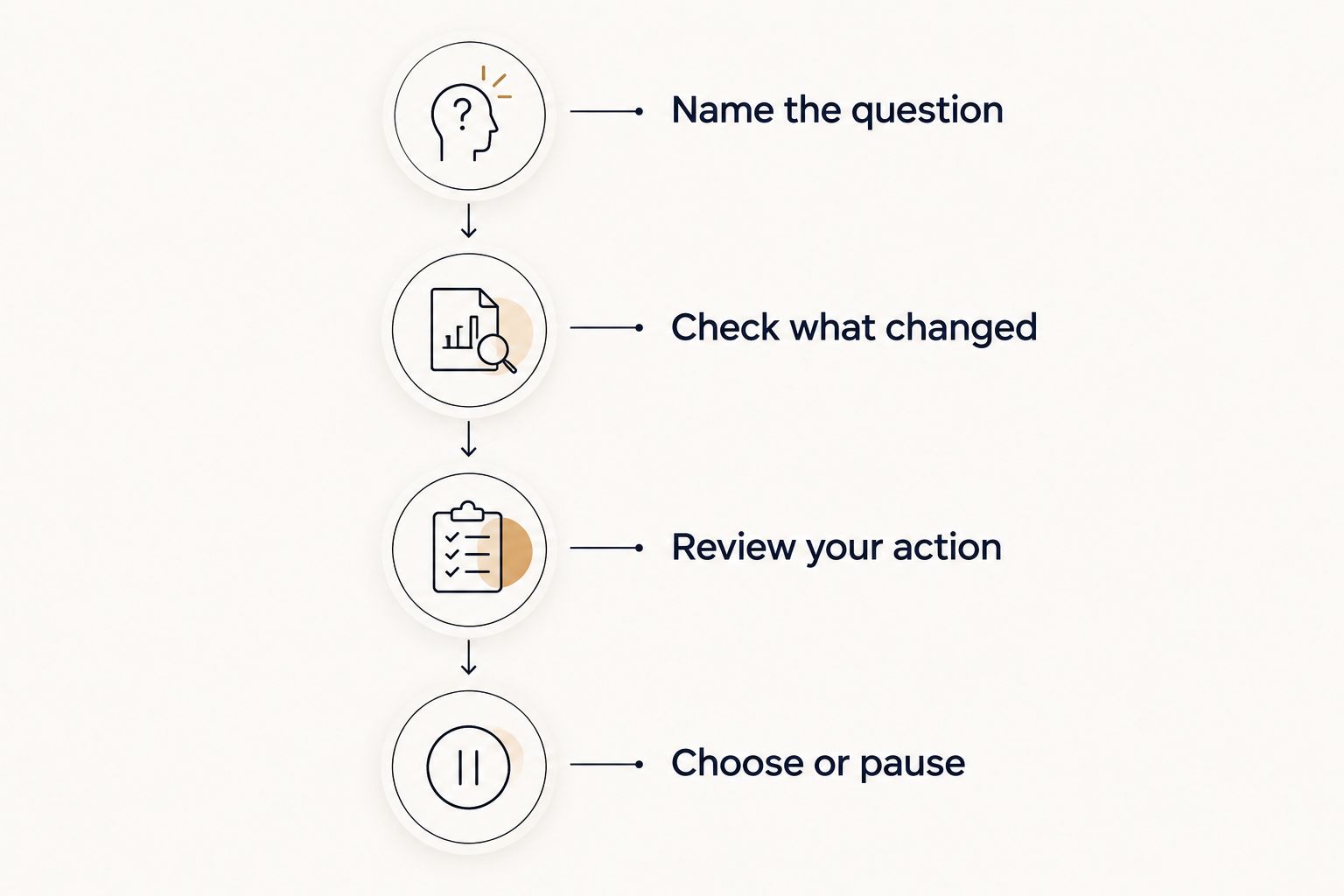
Before your next tarot reading, work through this sequence. You do not need a new spread to answer these questions.
- Name the question. Write the exact question you want to ask. Remove assumptions about what someone else secretly feels or what the future must deliver.
- Check what changed. Identify the new event, information, or decision since the previous reading. Be specific.
- Review your action. Look at what you intended to do afterward. If it remains undone, decide whether action is more useful than another interpretation.
- Choose or pause. Book only if you can explain what the next reading adds. Otherwise, let the question rest.
This process separates a new question from a familiar urge. It also gives you a record of why you chose to return, rather than letting the appointment itself decide the timing.
What should you do between tarot readings?
Between readings, separate what happened from what you interpreted. A message arriving is an observable event; deciding that it confirms a predicted reconciliation is an interpretation.
Keep a short record with these headings:
- Original question: What did you actually ask?
- Interpretation: What meaning did you take from the cards?
- Next action: What did you choose to do?
- Observed outcome: What happened, including anything that did not match?
When choosing between paper notes and journaling apps for self-discovery, prioritize a record you can revisit without editing away your original expectations. The point is to distinguish your first interpretation from what you learned later—not to produce a perfect spiritual journal.
For your 2026 entries, date the question and preserve the original wording. If you change your view afterward, add a separate note explaining why.
A useful record includes misses and ambiguity, not just apparent matches. Do not turn every ordinary event into confirmation, and do not treat a journal as proof that tarot predicts the future.
When is it better to pause tarot readings?
Pause when you are repeatedly asking an unchanged question, moving between readers to find a preferred answer, or putting off an ordinary decision until another reading gives permission. These are reasons to reconsider the routine, not grounds for diagnosing yourself.
A pause does not require a punishment period or a cleansing ritual. Put the cards and booking pages aside while you identify the practical issue underneath the question.
For a relationship concern, that might mean deciding what boundary you need or having a direct conversation. For a work concern, it might mean reading the offer, asking about responsibilities, or seeking qualified advice.
If the urge to check feels difficult to control or disrupts your sleep, responsibilities, or finances, speak with a qualified mental health professional. Spiritual guidance does not replace that support.
Does a professional reader change how often you should book?
A professional reading does not remove the need for boundaries. Before booking, decide what you want to explore and what would make the session different from the previous one.
Jahben tarot readings are best for spiritually curious adults seeking personal guidance on love, career, and timing. Jahben offers personal readings delivered by email or live session, with tarot among the systems used in the practice.
The fit is personal reflection and spiritual guidance. The limit is equally important: do not use a reading as proof of another person's intentions, a guaranteed forecast, or a replacement for professional advice.
Choose the question before choosing another appointment. A service format cannot resolve an unchanged question simply by giving you another interpretation.
Can you read your own tarot cards every day?
Daily self-reading is different from getting a full reading about the same unresolved outcome. If you enjoy studying tarot, you can use a card as a reflection prompt without treating it as an instruction or prediction.
Keep learning separate from checking. Studying symbolism asks what a card represents; repeatedly pulling until you feel reassured asks the cards to remove discomfort.
If a daily practice turns into repeated outcome-checking, stop the pulls and return to the situation itself. You do not need another card to make an ordinary choice.
Should you ask the same tarot question again?
Ask the same tarot question again only after identifying why revisiting it adds something. New circumstances or a genuinely unclear explanation are different from disliking the original answer.
If an interpretation is confusing, request clarification rather than automatically starting another reading. If nothing has changed, preserve the original question in your notes and act on the parts you can control.
FAQ
How often should you get a tarot reading?
Choose tarot reading frequency by your purpose, changed circumstances, and whether you have acted on the previous reading. Weekly, monthly, and event-based schedules are optional structures, not established accuracy standards.
Is getting a tarot reading every week too much?
A weekly tarot reading is a reason to pause if you keep repeating an unchanged question or feel unable to make decisions without it. A fresh reflection question is different from repeatedly seeking a preferred answer.
How long should I wait between tarot readings?
There is no established waiting interval that makes tarot readings more accurate. Wait until you can explain what the next reading adds, rather than booking because you feel impatient.
Can too many tarot readings change my future?
Do not treat repeated tarot readings as a way to change or control future events. Focus on your choices, observable information, and actions instead.
Should I get another reading if I disliked the answer?
Disliking an answer is not, by itself, a reason to get another tarot reading. Ask for clarification if needed, and do not treat an interpretation as an instruction you must obey.
Is a monthly tarot reading better than a weekly reading?
A monthly tarot reading is not inherently better than a weekly reading. Choose a schedule that leaves you room to act and does not encourage repeated checking.
What should I do if I feel anxious without tarot readings?
Pause repeated checking and consider speaking with a qualified mental health professional if the urge feels difficult to control or disrupts daily life. Tarot is not a substitute for mental health care.
One last thing
Before another reading, finish this sentence: The new information I have is… If you cannot finish it, ask whether you need a fresh reflection question—or simply room to live with an unanswered one.
For the rest of 2026, let that distinction guide your schedule. You do not have to fill every gap in certainty with another reading.
Related guides
Ready for your own reading?
Astrology, numerology, and tarot brought together into one clear, written answer about your love, career, or timing.
Book a Personal Reading Get Your Free Report