For tattoo clients, numerology for choosing a tattoo date is a way to compare available appointment dates by their symbolic numbers, with the aim of choosing one that fits the meaning of the tattoo. Use the numbers to break a tie, not to override your artist’s availability, your readiness, or your ability to follow aftercare. A tattoo is lasting; the date calculation is only one part of the decision.
- Numerology for choosing a tattoo date works best as a tie-breaker between dates you can actually book.
- Calculate each date’s universal number, then compare your Personal Day for a more individual reading.
- Jahben is best for tattoo clients who want personal timing guidance; a manual calculation is better for a quick comparison.
- No number guarantees a good tattoo or a meaningful experience.
Why tattoo-date numerology matters
A date can carry meaning beyond the appointment itself. If your tattoo marks a change in identity, a relationship, a loss, or a fresh start, you might want the day to reflect that intention. Numerology gives you a consistent way to compare dates instead of choosing one because its digits look appealing.
The useful distinction is between a universal date number, calculated from the calendar date, and a Personal Day number, calculated in relation to your birth date. Everyone shares the first number on a given day. The second makes the comparison more specific to you. For a step-by-step explanation of that distinction, start with how to calculate your Personal Day number.
Neither number measures an artist’s skill, predicts healing, or tells you whether you will still want the design later. In 2026, treat numerology as a reflection tool within a practical decision: choose a design you understand, discuss it with your artist, and make room for the aftercare the artist recommends.
How to choose a tattoo date with numerology
Start with dates that work in real life. Then calculate and compare them using the same method throughout. That order matters: a number cannot make an unsuitable appointment suitable.
Name what the tattoo represents
Write down the reason for the tattoo before looking at a calendar. A memorial piece, a marker of independence, and a shared design with someone else carry different intentions. Your intention gives you something to compare with the symbolic meaning of a date; without it, every number can sound persuasive.
Keep the description plain. You do not need to settle the meaning of the rest of your life to choose an appointment in 2026. You need to know what this particular decision means to you now.
- Finish the sentence: “This tattoo marks…”
- Decide whether the focus is remembrance, change, commitment, or self-expression.
- Separate your own reason from someone else’s expectations.
- Write down any date that already has personal meaning.
Shortlist dates you can actually use
Ask your artist which appointments are available before doing the math. Compare dates only if you can attend, have time to discuss the design, and follow the artist’s aftercare instructions. A date with an attractive number is not helpful if it puts pressure on the appointment or the days after it.
Best for a first pass: compare 3 calendar dates. That is enough to see a difference without turning the choice into an endless search. The number is a planning suggestion, not a rule of numerology.
- Confirm the artist’s available appointments.
- Keep dates that fit your schedule and preparation.
- Note any conflicts with travel or commitments.
- Set aside dates that feel rushed, regardless of their number.
Calculate each universal date number
Add every digit in the full calendar date, then reduce the total by adding its digits until you reach a single digit. Some numerology approaches keep 11, 22, or 33 as master numbers; decide whether you will use that convention before comparing dates.
For example, June 14, 2026 gives 6 + 1 + 4 + 2 + 0 + 2 + 6 = 21, then 2 + 1 = 3. June 15, 2026 gives 22, which is 22 if you retain master numbers or 4 if you reduce it. The calculation does not make either date better. It gives you two different symbolic themes to consider.
- Write the full date, including 2026.
- Add its digits once and check your arithmetic.
- Reduce the total using one consistent convention.
- Record the result beside the available appointment.
Compare the number with your intention
Read the number as a theme, not a verdict. In common numerology interpretations, 1 points to beginnings, 2 to partnership, 3 to expression, 4 to structure, and 5 to change. The remaining single digits are often read as 6 for care, 7 for reflection, 8 for ambition, and 9 for completion. These are symbolic associations, not promises about what will happen on the appointment day.
A date reducing to 3 might appeal to someone whose tattoo is about creative expression. Someone marking a deliberate new chapter might prefer a date reducing to 1. The better match is the one you can explain in your own words, not the one that sounds most powerful on a list.
- Match each date’s theme to your written intention.
- Note where the meaning feels forced.
- Keep a personally significant date in consideration.
- Do not reject a workable appointment solely because its number differs.
Calculate your Personal Day
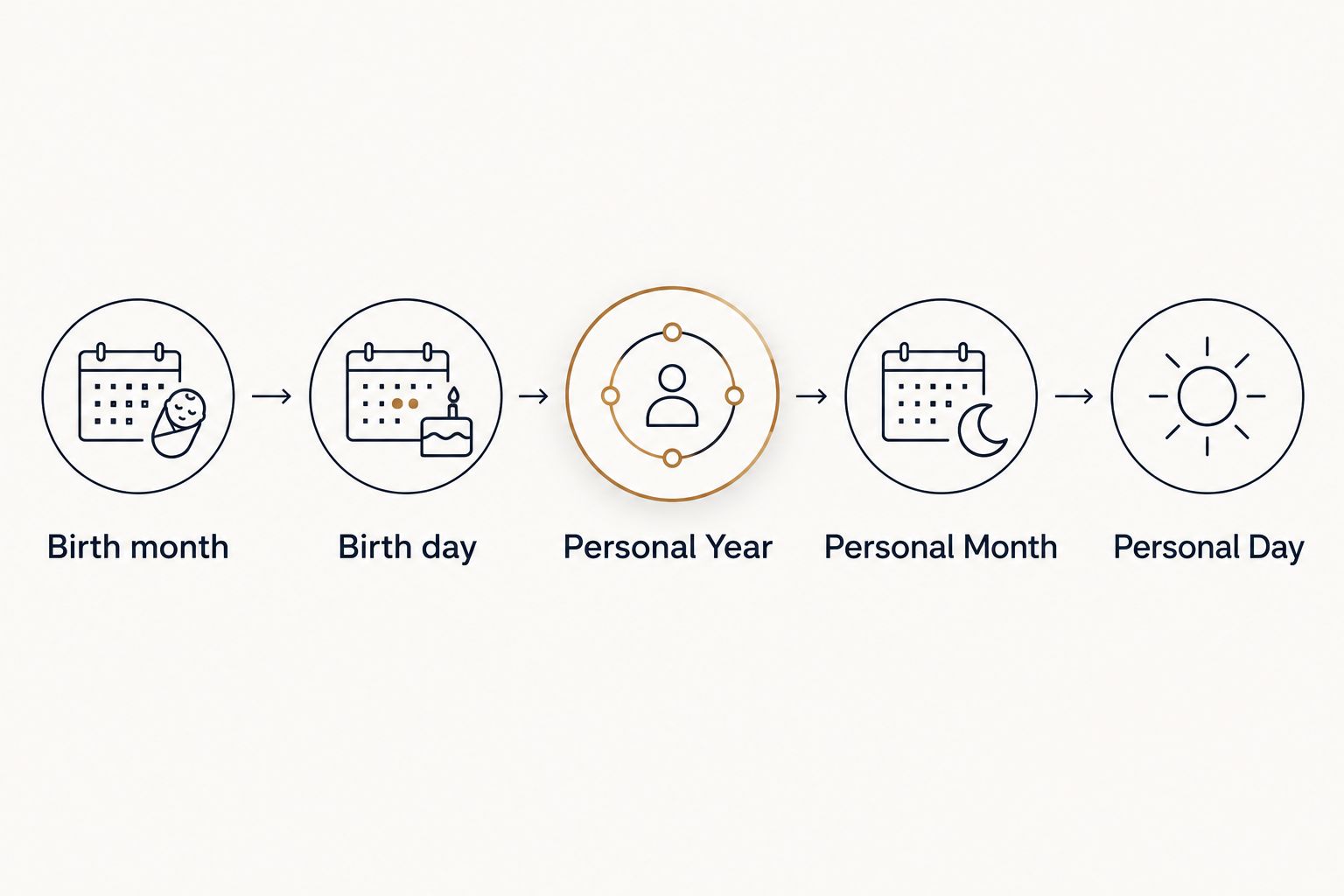
A universal date number describes the date in general. A Personal Day adds a personal layer, using your birth month and day with the year, month, and day you are considering. Calculation conventions differ, particularly around master numbers, so use the same convention for every candidate date. If you are new to the cycle, calculate your Personal Year number for 2026 before moving to the month and day.
Here is an illustration using a birthday of April 9 and an appointment of June 14, 2026. Reduce 2026 to 1; add birth month 4 and birth day 9 to get a Personal Year of 14, then 5. Add June’s month number 6 to get a Personal Month of 11, which reduces to 2 under a single-digit convention. Add appointment day 14 and reduce the result to get a Personal Day of 7. This example shows the method, not a recommendation for anyone with that birthday.
- Use your birth month and day, not your current age.
- Calculate the Personal Year before the Personal Month.
- Calculate a Personal Day for each shortlisted date.
- Keep or reduce master numbers consistently.
- Recheck the result before assigning it meaning.
Weigh personal meaning against the numbers
Put your shortlist on one page. For each date, write its universal number, its Personal Day, its practical fit, and any meaning the date already holds. This exposes a common conflict: a numerologically appealing date is not always the one that feels right or works well.
You do not need agreement between every column. If a meaningful anniversary fits your schedule but carries a number you would not have chosen, the anniversary can still be your strongest reason. If two appointments feel equally right in 2026, the Personal Day can help you choose between them.
- Compare the same factors for every date.
- Give practical fit a place beside symbolic fit.
- Identify any date with personal history.
- Circle the reason you would give for your final choice.
Ask for a personal reading if you are stuck
You can make a useful comparison with a calendar, your birth details, and written notes. If the numbers conflict or the tattoo marks a difficult life change, a personal reading gives you space to ask a more precise question. Jahben is best for tattoo clients who want personal timing guidance rather than a number in isolation. Jahben offers personal psychic readings, and the $40 Email Reading includes Pythagorean numerology; ask which format fits your tattoo-date question before booking. A reading cannot confirm that a tattoo or appointment will turn out a particular way.
Bring the actual candidate dates and explain what the tattoo represents. An open question such as “Which of these workable dates fits my intention, and why?” is more useful than asking for a guaranteed lucky day. In 2026, keep the decision yours even when you seek another perspective.
- Share the birth details needed for the method you choose.
- Bring the dates your artist can offer.
- State what the tattoo means to you.
- Ask how the reader handles master numbers.
- Make the final choice with your artist’s guidance in mind.
Which way should you compare tattoo dates?
You have three practical options: calculate by hand, use a general date calculator, or discuss the dates in a personal reading. Start with the least involved option that answers your question. Jahben’s personal reading is best when the meaning of the tattoo needs discussion; it is unnecessary when you only want to check arithmetic.
| Option | Best for | What you get | Key limitation |
|---|---|---|---|
| Manual calculation | Comparing a small shortlist yourself | A visible calculation you can check and repeat | You interpret the symbolic fit on your own |
| General date calculator | Checking several date totals quickly | A quick result for each date entered | A result alone does not explain your intention or practical constraints |
| Jahben personal reading | Talking through personal timing and meaning | Individual guidance you can question and consider | It does not replace your artist’s advice or make the outcome certain |
A calculator is only as useful as the method behind it. Check whether it reduces master numbers and whether it shows a universal date number or a Personal Day. If those settings differ from your handwritten work, the results are not directly comparable.
Common mistakes when choosing a tattoo date
Treating a number as a guarantee
No universal date number or Personal Day can guarantee that you will like the design, feel calm during the appointment, or heal in a particular way. Use the number to express intention. Let your artist address the tattoo process and aftercare.
Changing methods to get a preferred result
Reducing 22 for one date but retaining it for another makes the comparison meaningless. Choose a convention first, write it down, and apply it to every candidate date. This matters most when a result includes a master number.
Mistaking a shared date for a personal one
The universal number for June 14, 2026 is 3 for everyone using the single-digit method shown above. Your Personal Day depends on your birth details. If you want timing that relates to you rather than the calendar alone, calculate both and label them clearly.
Letting the search postpone the decision
Finding another date will not settle uncertainty about a design you have not discussed with your artist. Decide whether the unresolved question is really about timing, the tattoo itself, or what it represents. Numerology helps with reflection; it does not answer every part of that decision.
FAQ
How do I use numerology for choosing a tattoo date?
Start with dates your artist can book, calculate each universal date number, and compare the results with your tattoo’s meaning. Add your Personal Day if you want a more individual comparison, then choose a date that also works in practice.
What is the best numerology number for a tattoo date?
There is no best number for every tattoo date. A number that symbolizes expression, change, or remembrance is useful only when that theme fits your reason for getting the tattoo.
Is a Personal Day better than a universal date number?
A Personal Day is more specific to your birth details; a universal date number is shared by everyone on that date. Use both if you want to compare the date’s general theme with your personal cycle.
Do I need my birth time to choose a tattoo date with numerology?
No birth time is needed for the date calculations described here. Your birth month and day are used for the Personal Year, Month, and Day method.
Should I keep master numbers when calculating a tattoo date?
You can keep 11, 22, and 33 if that is the numerology convention you choose. The important part is applying the same convention to every date you compare.
Can a numerology reading guarantee a good tattoo appointment?
No numerology reading can guarantee an appointment’s outcome. It can help you discuss timing and personal meaning, while your artist handles questions about the tattoo process.
What if my meaningful date has a number I do not like?
You do not have to reject a personally meaningful date because its number is not your favorite. Decide whether the date’s existing significance and practical fit matter more to you than its calculated theme.
One last thing
If one date still stands out after you put the numbers away, pay attention to why. In 2026, the clearest tattoo-date choice is a date you can book, prepare for, and explain without needing a number to defend it. Numerology should clarify your reason, not supply one.
Related guides
- How to get an accurate numerology reading online
- Pythagorean numerology for Life Path calculation
- How to choose an auspicious wedding date with numerology
Ready for your own reading?
Astrology, numerology, and tarot brought together into one clear, written answer about your love, career, or timing.
Book a Personal Reading Get Your Free Report