Perimenopause Reiki healing is a complementary relaxation practice aimed at helping you make space for rest while symptoms and routines change. Reiki healing for perimenopause does not treat hormonal changes, hot flashes, or sleep problems; its place is alongside medical care, not instead of it.
- Reiki healing for perimenopause is a relaxation practice, not a treatment for hormonal symptoms.
- Jahben Reiki sessions are best for adults who want reflective support alongside medical care, not a diagnosis.
- Track what you notice, ask about session format, and keep decisions about symptoms with a clinician.
Why Reiki matters during perimenopause
Perimenopause is the transition before menopause. Periods can change, sleep can become difficult, and symptoms can affect work, relationships, and your sense of control. Menopause is reached after 12 consecutive months without a period; perimenopause does not follow one fixed schedule.
That uncertainty is the reason to set a clear boundary around Reiki. A quiet session can give you time to notice stress and name what you need. It cannot tell you why bleeding has changed or which treatment is appropriate. If sleep disruption, mood changes, or other symptoms interfere with daily life, bring them to a qualified clinician rather than asking an energy practice to explain them.
You can also choose how much contact and conversation you want. If you are considering a remote session, the guide to distance Reiki healing explains that format. The question for 2026 is not whether you can make Reiki replace care. It is whether a session has a useful, limited role in the support you already have.
How to use Reiki during perimenopause in 2026
Start with the simplest approach: define what is happening, make room to rest, and see whether the experience helps you. You do not need to book a session to do those things. If guided Reiki appeals to you, Jahben Reiki sessions are an option after you have decided what you want from one.
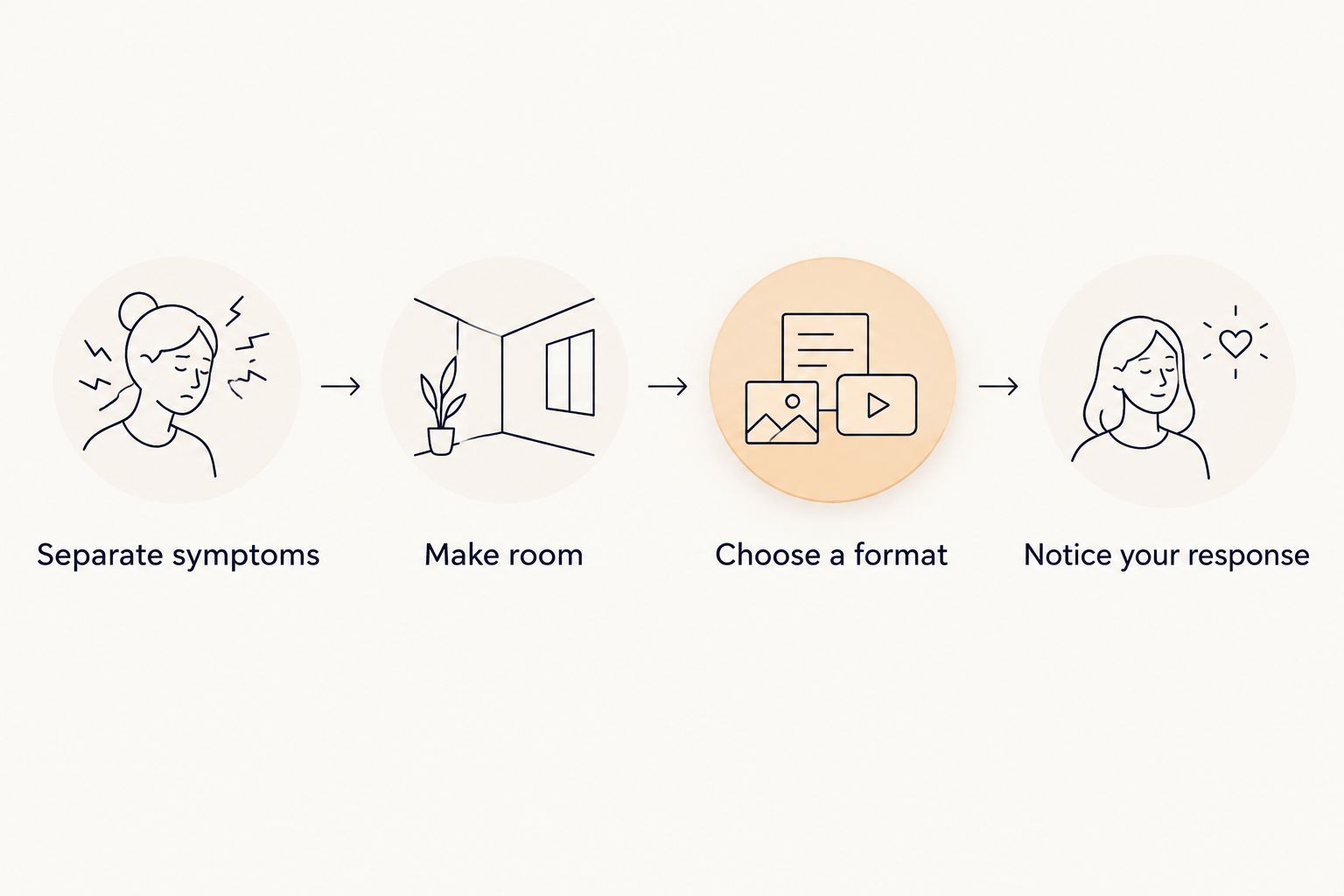
Separate symptoms from your session goal
Write down the symptom that concerns you and the experience you want from Reiki. Those are different statements. “I wake feeling exhausted” belongs in a healthcare conversation; “I want a calmer space to reflect on that exhaustion” is a workable session goal.
Do not ask a practitioner to confirm that an unfamiliar symptom is normal. Perimenopause is not an explanation for every change in your health, even when the timing seems to fit.
- List symptoms and questions to take to a clinician.
- Choose one nonmedical aim for a session, such as rest or reflection.
- Keep notes about symptoms separate from notes about how the session felt.
- Seek medical assessment for new, persistent, or concerning changes.
Make room for rest before booking
Try a short, quiet pause without paying for anything. Sit somewhere comfortable, put aside distractions, and notice your breathing without trying to force a result. If that kind of pause feels useful, a guided session gives it a dedicated setting; it is not the only way to create one.
In 2026, the most practical test is whether you can fit rest into your actual day. A ritual that adds pressure defeats your stated aim. Keep the starting point small and repeatable.
- Set aside 10 minutes without a screen or another task.
- Choose a chair or position that feels comfortable.
- Notice tension without assigning it a spiritual cause.
- Write down whether the pause felt helpful, neutral, or uncomfortable.
Choose a format that fits your needs
Decide what would make a session easier to participate in: being in the same room as the practitioner, staying in your own space, or having time to speak before and after. Ask what the session involves rather than assuming every Reiki practitioner works in the same way. If you dislike touch, say so before agreeing to an in-person format.
Jahben offers Reiki Healing as distance sessions (60–90 minutes), followed by a written post-session summary. For a broader preparation checklist, read how to prepare for your first Reiki session.
- Ask whether touch is involved and how consent is handled.
- Explain any comfort or accessibility needs in advance.
- Check how much conversation is included.
A useful choice keeps your comfort and medical boundaries visible. The format matters less than being able to say what you do and do not want.
Set a question that Reiki can address
A useful question focuses on your experience, not a prediction about your body. You can ask what you need to feel more settled through a period of change. Do not ask whether Reiki can confirm the cause of a symptom, predict your final period, or tell you to stop a treatment.
This distinction is especially useful if your concerns overlap. Poor sleep, work stress, and uncertainty about a changing cycle can feel like one problem. Give each its own place so a reflective session does not become a substitute for a clinical answer.
- Ask, “What would help me feel grounded this week?”
- Name one situation you want space to reflect on.
- Keep medication and treatment questions for your clinician.
- Leave room to decide that the session was not useful.
Notice your response without chasing a result
After a session, describe what you experienced in plain language. You felt relaxed, restless, emotional, distracted, or no different. None of those reactions proves that a hormonal symptom has improved, and a strong feeling does not require a spiritual explanation.
If you want to compare experiences, keep your notes brief. Check whether the session helped you make time for rest or identify a practical need. Do not turn every shift in sleep or temperature into evidence that Reiki is working; symptoms can change for many reasons.
- Note your session goal before it starts.
- Write 2 sentences afterward about what you noticed.
- Record symptoms separately if you are tracking them for healthcare.
- Stop if the experience leaves you distressed or pressured.
Keep medical care in the picture
Reiki belongs on the supportive side of your plan. A clinician can assess changing bleeding, sleep problems, and other symptoms, then discuss appropriate care with you. A Reiki practitioner cannot diagnose perimenopause or rule out another condition.
Be particularly clear about bleeding after menopause: bleeding after 12 consecutive months without a period needs medical assessment. Do not wait for a Reiki session to address it. If someone tells you to abandon prescribed care because of an energy reading, leave that advice out of your health decisions.
- Bring a written symptom list to your appointment.
- Ask which changes warrant follow-up.
- Tell your clinician about any complementary practices you use.
- Treat urgent or alarming symptoms as healthcare questions first.
Which support option fits your situation?
There is no single option that does every job. The table separates clinical assessment, self-directed rest, and guided Reiki so you can choose without asking one to stand in for another. Check current terms directly for any service you consider.
| Option | Best for | Starting price | Key limitation |
|---|---|---|---|
| Clinical care | Assessing symptoms and discussing treatment | Check current terms | An appointment is not a dedicated reflective session |
| Self-directed quiet time | Trying a rest practice on your own schedule | No purchase required | You set the structure yourself |
| Jahben Reiki sessions | Adults seeking guided, reflective support alongside care | Check current terms | Cannot diagnose or treat perimenopause |
Jahben Reiki sessions are best for adults who want guided reflection alongside medical care, not an answer to what is causing a symptom. Their advantage is a dedicated session; their limitation is the same boundary that applies to any Reiki practice. Choose clinical care when you need an explanation or treatment decision. Choose self-directed rest first if you want to see whether making quiet time helps at all.
The distinction still holds in 2026 if you already have several forms of support. You do not have to rank them by how meaningful they feel. You have to give each one the job it can actually do.
Common perimenopause Reiki mistakes
Treating a calming session as proof of treatment
Feeling calmer is a valid description of your experience. It is not proof that Reiki changed your hormones or resolved a symptom. Keep your language exact so you can tell a clinician what happened without overstating it.
Booking before naming the real concern
If your immediate concern is unusual bleeding, worsening sleep, or a mood change, start by naming that concern. A session goal such as reflection is separate. This saves you from leaving a session with a reassuring feeling but no answer to the question that brought you there.
Asking for a predicted menopause date
Reiki cannot determine when your final period will occur. If timing uncertainty is on your mind in 2026, use the session to consider how you want to handle uncertainty; discuss cycle changes with a clinician.
Assuming more sessions mean better results
Do not commit to repeated sessions to chase a promised symptom change. Decide whether one session served the limited purpose you set, then reassess. A practitioner should not make your health depend on booking again.
Ignoring comfort and consent
You can ask questions, decline touch, request a different format, or end a session. Those choices are part of making the experience workable for you, not signs that you are doing Reiki incorrectly.
FAQ
Can Reiki healing for perimenopause stop hot flashes?
Reiki is not an established treatment for hot flashes. Use it for relaxation if you find the experience helpful, and discuss disruptive hot flashes with a clinician.
Is Reiki a replacement for perimenopause care?
No. Reiki cannot diagnose hormonal changes, evaluate bleeding, or replace treatment decisions made with a qualified clinician.
What should I ask for in a Reiki session during perimenopause?
Ask for a session focused on rest or reflection. Keep questions about the cause of symptoms and medical treatment for a healthcare appointment.
Is distance Reiki better than an in-person session?
Neither format is established as better for treating perimenopause symptoms. Choose the format that suits your comfort, access, and preferences, and confirm how the practitioner works.
How many Reiki sessions do I need for perimenopause?
There is no established number of Reiki sessions that treats perimenopause. Set a nonmedical goal, consider how one session felt, and do not commit to more based on promised symptom relief.
Can Reiki tell me when menopause will start?
No. Reiki cannot predict when your final period will occur. Track cycle changes and bring timing or bleeding concerns to a clinician.
Should I get medical advice before trying Reiki?
Bring new, persistent, or concerning symptoms to a clinician rather than waiting for Reiki. Reiki can remain a separate relaxation practice while you seek appropriate care.
One last thing
You do not need to decide whether Reiki works on perimenopause to decide whether a quiet, guided session is right for you. In 2026, use a narrower test: did it give you useful space to rest without delaying an answer you need from a clinician? That question protects both parts of your care.
Related guides
- Reiki healing for menopause symptoms
- How many Reiki sessions do you need to feel results?
- Reiki healing for insomnia and sleep problems
Ready for your own reading?
Astrology, numerology, and tarot brought together into one clear, written answer about your love, career, or timing.
Book a Personal Reading Get Your Free Report