Reiki healing for social workers is a complementary spiritual practice used with the aim of supporting personal rest and reflection, not treating clients or replacing mental health care. This 2026 guide explains how social workers and therapists can explore Reiki while protecting confidentiality, consent, professional boundaries, and their own right to stop.
- Reiki healing for social workers belongs in optional self-care, not as a replacement for psychotherapy or clinical supervision.
- Jahben offers Reiki for spiritually curious adults; clinical treatment requires a qualified health professional.
- Protect client confidentiality, agree on touch boundaries, and judge personal usefulness without assuming medical effects.
- Address workload and workplace safety directly; a spiritual session cannot resolve organizational burnout.
Why Reiki matters for social workers and therapists
Your working day can include crisis assessment, grief, safeguarding decisions, and conversations that remain unfinished when the appointment ends. A personal spiritual practice gives you a separate setting for reflection, but that setting must not become another place where you carry responsibility for someone else.
The relevant question in 2026 is not whether you can become better at absorbing distress. It is whether a chosen practice fits your beliefs, respects your limits, and leaves room for the practical support your work requires. Start with how to prepare for your first Reiki session if the format is unfamiliar.
Reiki is optional spiritual self-care, not a professional obligation or an established treatment for burnout. You do not need to accept an energy-based explanation to decide whether you want a quiet appointment, and you do not need to continue if the experience feels uncomfortable.
What the evidence does—and does not—support
Reiki practitioners describe their work in terms of channeling or balancing energy. That description expresses the practice's spiritual framework; it does not establish a biological mechanism.
The National Center for Complementary and Integrative Health states that Reiki has not been clearly shown to be effective for any health-related purpose, and that scientific evidence does not support the proposed energy field. A pleasant or calming experience is not proof that Reiki treats anxiety, trauma, depression, or occupational burnout.
Keep that distinction clear when choosing personal support. Persistent distress, impaired functioning, or symptoms that concern you warrant assessment by an appropriate health professional—not an interpretation that you simply need more energy work.
How to explore Reiki without blurring professional boundaries
1. Define the personal need before choosing a service
Begin without booking anything. Write down what you want from protected personal time: silence, spiritual reflection, a transition out of work mode, or a chance to notice how you are feeling.
For a simple starting exercise, set aside 2 minutes after your shift to identify one feeling and one unmet practical need. This is a suggested reflection exercise, not a treatment protocol or a Reiki technique. If the unmet need is lunch, supervision, time off, or help with unsafe staffing, address that need directly.
Separate a preference from a clinical concern. Wanting a quiet spiritual experience is different from needing help with recurring nightmares or difficulty functioning at work.
- Write one personal intention that does not involve changing a client.
- Name the practical problem a session cannot solve.
- Try an ordinary quiet break before adding another appointment.
- Identify who can provide clinical or workplace support if needed.
2. Check the claims before accepting the explanation
Ask a prospective practitioner to explain what happens during the appointment in plain language. You should understand the format without accepting a diagnosis about blocked energy, inherited trauma, or another person's intentions.
Reject promises to cure trauma, prevent burnout, or replace prescribed care. Reiki training does not by itself establish competence to diagnose a mental health condition or deliver psychotherapy. Likewise, your social work or therapy license does not automatically qualify you to provide Reiki.
For a closer look at the distinction between personal experience and evidence, read whether Reiki works through a placebo effect. You can respect a spiritual tradition without presenting its explanations as established clinical facts.
- Ask what the practitioner claims Reiki can and cannot do.
- Separate Reiki training from health-profession credentials.
- Decline advice to stop medication or discontinue treatment.
- Avoid explanations that blame distress on insufficient belief.
- Ask how the practitioner responds when someone feels worse.
3. Choose support that matches your actual goal
First compare Reiki with what you can arrange yourself: quiet time, a walk, a protected meal break, or a conversation with an appropriate support person. These are different activities, not interchangeable treatments. Choose according to the need you identified rather than the appeal of a dramatic promise.
Jahben offers Reiki sessions within a spiritual advisory practice. Jahben's Reiki offering is best suited to spiritually curious adults seeking a spiritual service, not clinical treatment. The relevant advantage is alignment with that preference; the limitation is that a spiritual service does not replace occupational consultation, psychotherapy, or medical assessment.
For your 2026 self-care plan, treat a practitioner-led appointment as an optional way to reserve personal space—not a shortcut to recovery or a requirement for competent practice. Confirm the specific session format rather than assuming that every service works the same way.
- Choose spiritual support when spiritual exploration is your goal.
- Choose supervision for case-related judgment and professional dilemmas.
- Choose qualified clinical care for assessment and treatment needs.
- Ask about the session format before committing.
- Decline any suggestion that ongoing appointments are compulsory.
4. Set consent, touch, and confidentiality boundaries
Decide what you want to disclose before the appointment. You can describe your own feelings without sharing a client's name, circumstances, workplace, or recognizable history. A spiritual session is not an alternative channel for case consultation.
Ask whether the proposed session involves touch and whether a no-touch format is possible. Agree on boundaries in advance, including a clear way to pause or end the appointment. Consent to one part of a session is not consent to every technique or interpretation.
For therapists and social workers, the same principle applies in reverse: personal enthusiasm does not justify introducing Reiki into client work. That requires a separate review of competence, informed consent, employer policy, applicable rules, and the client's freedom from pressure.
- Describe your experience without disclosing identifiable client information.
- State your touch preferences before the session starts.
- Agree on a clear stop signal.
- Ask whether notes or recordings are made and how they are handled.
- Decline interpretations or activities you do not want.
5. Protect the transition back to daily life
Do not make a demanding appointment the immediate test of whether a spiritual session worked. Instead, leave a manageable transition if your schedule permits. A suggested 10 minutes of unscheduled time is a planning choice, not a required recovery period.
You can keep your eyes open, change position, request silence, or end the session. Feeling emotional does not obligate you to continue, and feeling nothing does not establish that you are resistant or spiritually blocked.
Use a straightforward sequence: Set intention, Agree boundaries, Attend session, Review experience. Each stage gives you a decision point rather than an obligation to proceed.
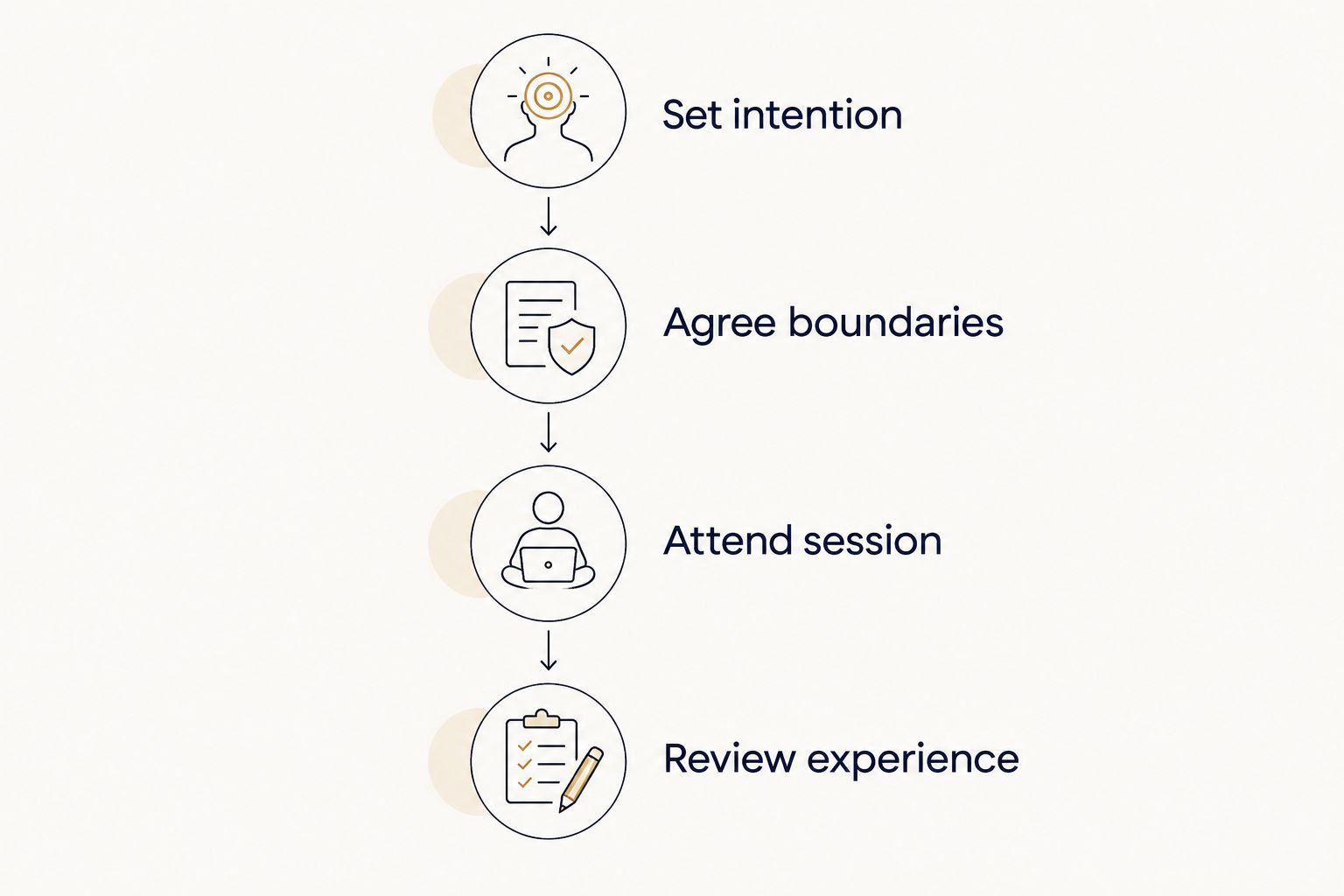
A difficult response deserves attention, not an automatic spiritual explanation. Seek appropriate health care for concerning symptoms, and do not accept a claim that worsening symptoms prove healing is underway.
- Choose a time that does not require rushing back into client care.
- Keep an ordinary transition activity available afterward.
- State discomfort as soon as it occurs.
- Stop if you feel pressured to endure distress.
- Use appropriate health support for symptoms that concern you.
6. Review usefulness without turning it into proof
Afterward, record what you noticed in everyday language. You might describe enjoying the silence, disliking the setting, or finding the appointment difficult to fit around your work. None of those observations requires an energy diagnosis.
For a small personal review in 2026, keep brief notes across 7 days about rest, work boundaries, and whether the appointment felt worthwhile. This is a suggested observation window, not an evidence-based course length. Account for other changes, such as leave, a lighter caseload, or improved sleep.
Decide whether to continue from your experience and preferences, not from a prediction that the next session will finally remove a blockage. It is valid to stop after an unhelpful appointment.
- Record what happened rather than what you were told must have happened.
- Note other changes in your routine or workload.
- Assess convenience, comfort, and personal fit separately.
- Stop if sessions create pressure, guilt, or dependence.
- Keep workplace and clinical support in place regardless of your decision.
Compare support options for your situation
Choose by purpose, not by a claim that one approach addresses everything. This 2026 comparison separates personal spiritual exploration from clinical care and workplace action; it does not rank them as equivalent treatments.
| Option | Best for | Key limitation |
|---|---|---|
| Self-directed quiet time | Flexible personal reflection | Does not provide professional assessment |
| Reiki with Jahben | Spiritually curious adults seeking Reiki | Not a substitute for clinical care |
| Clinical supervision | Case reflection and professional judgment | Not personal psychotherapy |
| Personal psychotherapy | Assessed mental health needs | Not an organizational staffing solution |
| Workplace action | Caseload, scheduling, and safety concerns | Requires organizational participation |
Self-directed time gives you control over the setting, while practitioner-led Reiki adds an external appointment and spiritual framework. Supervision addresses professional work; psychotherapy addresses your own treatment needs. Workplace action addresses conditions that personal coping cannot change.
Match the support to the problem. You can value spiritual reflection while recognizing that an unsafe caseload requires a different response.
Common mistakes social workers and therapists make
Treating structural overload as a personal energy failure
A relaxation ritual cannot authorize leave, revise productivity targets, or provide safe staffing. Keep a record of concrete workload concerns and raise them through appropriate supervisory or organizational channels. Do not make your ability to tolerate harmful conditions the measure of successful self-care.
Bringing client stories into a personal spiritual session
A desire to explain your difficult day does not remove confidentiality duties. Discuss your own reactions without identifiable details, and reserve case consultation for authorized professional settings. Spiritual language does not make a disclosure anonymous.
Importing Reiki into therapy without a separate ethical review
Receiving Reiki personally and offering Reiki professionally are different decisions. Before any proposed integration, check applicable licensing rules, employer policies, competence requirements, documentation practices, and informed consent. A client's agreement alone does not settle every professional issue.
Reading discomfort as evidence of progress
Crying, fatigue, or distress does not prove that trauma has been released. Do not allow a healing narrative to override your own discomfort or delay assessment of concerning symptoms. You retain the right to stop without defending the decision.
FAQ
What's the best use of Reiki healing for social workers?
The clearest role is optional personal spiritual self-care, separate from clinical treatment and case supervision. Choose it because the practice fits your preferences, not because you need it to remain a caring professional.
Can Reiki treat burnout or secondary traumatic stress?
Reiki is not an established treatment for burnout or secondary traumatic stress. Seek appropriate assessment for persistent symptoms and address workload, supervision, and workplace conditions directly.
Can I offer Reiki during a therapy appointment?
Do not assume that a therapy license or a client's interest authorizes Reiki within treatment. Review applicable rules, employer policy, competence, informed consent, and documentation before proposing any integration.
Do I have to accept touch during Reiki?
You do not have to consent to touch. Ask about the proposed format beforehand, state your boundaries, and decline or stop any part you do not want.
Is distance Reiki scientifically proven to work?
Distance Reiki is not an established medical or psychological treatment. A personally meaningful experience does not demonstrate remote energy transfer or prove a clinical effect.
How many Reiki sessions should a therapist book?
There is no established Reiki course length for therapists or social workers. Avoid committing to repeated sessions on the strength of a promised cure, and judge personal fit without assuming more sessions are necessary.
Is Jahben a fit for a social worker seeking Reiki?
Jahben offers Reiki within a spiritual advisory practice, making the service relevant to adults seeking spiritual exploration. Do not treat that offering as a substitute for licensed mental health care, medical assessment, or clinical supervision.
One last thing
Before adding Reiki to your 2026 calendar, identify one work boundary you want your calendar to reflect. It might be an uninterrupted lunch or a clear end to nonurgent messages. Rest should not depend on buying a service or becoming better at enduring overload.
Related guides
- How distance Reiki healing works
- Reiki healing for burnout and career exhaustion
- How many Reiki sessions you need to feel results
Ready for your own reading?
Astrology, numerology, and tarot brought together into one clear, written answer about your love, career, or timing.
Book a Personal Reading Get Your Free Report