Teachers’ Reiki healing is a complementary spiritual practice with the aim of creating space for rest and reflection around classroom stress, not treating burnout. This 2026 guide explains how to explore reiki healing for teachers without confusing personal support with the workload changes or professional care you need.
- Reiki healing for teachers is optional spiritual support, not an established treatment for classroom burnout.
- Jahben Reiki sessions suit teachers seeking spiritual support rather than medical treatment.
- Start with protected breaks and workload boundaries; add Reiki only if the practice fits your beliefs.
- Judge teacher wellbeing by daily functioning, not sensations during a session.
Why Reiki healing matters for teachers
Teaching puts your attention on other people’s needs: instruction, behavior, safeguarding, assessment, and family communication. A private spiritual practice gives you permission to focus on yourself, but it does not reduce the number of assignments waiting to be graded.
Separate recovery time from workload repair. You need room to rest and a practical response to whatever keeps exhausting you. Before exploring a session, read how to prepare for your first Reiki session and decide what you want from the experience.
Reiki practitioners describe their work in terms of energy. That is a spiritual framework, not a verified explanation of classroom burnout. The National Center for Complementary and Integrative Health’s Reiki overview states that Reiki has not been clearly shown effective for any health-related purpose and that scientific evidence does not support the proposed energy field.
That evidence boundary applies throughout this 2026 guide. You can value a spiritual experience without treating it as proof of healing, and you do not need to believe that stress reflects blocked energy.
For teachers, the useful question is not whether you felt something unusual. It is whether the time you set aside was worthwhile without delaying needed help or becoming another obligation.
Build a teacher-focused recovery plan
Identify the pressure you need to address
Start with a plain-language account of your school day. Write down what drains you, when it happens, and what remains unfinished when you leave. Do this before choosing any service.
Separate classroom events from working conditions. A difficult lesson calls for a different response than repeated loss of planning time, unclear expectations, or work spilling into every evening. Naming the source keeps your recovery plan from becoming a vague instruction to cope better.
Try a 5-school-day observation period as a planning exercise, not a diagnostic test. Record concrete events rather than labeling yourself as bad at handling stress. If symptoms are persistent or interfere with daily life, contact a qualified healthcare professional instead of waiting for the observation period to end.
- Record the point in the day when you feel most depleted.
- Note interruptions that prevent you from completing planned work.
- Separate tasks you control from demands that require leadership action.
- Write down changes in sleep, concentration, or patience.
- Identify a colleague or supervisor who can discuss a specific pressure.
Protect a pause before adding a practice
Begin with a free, ordinary break. You do not need a practitioner, special objects, or spiritual training to sit quietly and stop working for a moment.
Choose an existing transition: after students leave, before your commute, or before opening evening messages. A 2-minute pause is a suggested starting point, not a therapeutic dose. Keep it simple enough that missing a day does not feel like another failure.
Let your breathing stay comfortable. Notice the chair supporting you or the floor beneath your feet; skip inward-focused exercises if they feel uncomfortable. Do not use a relaxation activity while responsible for supervising students.
Your 2026 wellbeing plan should fit the school day you actually have. If you cannot find an uninterrupted pause because coverage is missing, that is a workplace issue to raise—not evidence that you need stronger spiritual discipline.
- Choose a transition when student supervision has ended.
- Put grading and messages out of reach during the pause.
- Sit, stand, or walk according to your comfort.
- Use ordinary quiet rest if breath-focused exercises do not suit you.
- Ask about coverage or protected break time when necessary.
Choose Reiki for the right purpose
First ask whether quiet rest already meets your goal. If it does, you do not need to add a service. If you want a practitioner-led spiritual experience, Reiki is an optional next step rather than a prerequisite for recovery.
Jahben Reiki sessions are best suited to teachers seeking spiritual support, not treatment for burnout. Jahben offers Reiki sessions alongside personal spiritual advisory services; that positioning is distinct from licensed mental health care.
The advantage is choosing a spiritual practice that matches your interests. The limitation is equally clear: a session cannot be relied on to treat depression, resolve workplace conflict, or make an unsustainable teaching load sustainable.
Before arranging Reiki with any practitioner, ask about the format, consent, and what happens during the session. Do not assume that a service includes distance delivery, particular training, or a specific procedure unless the practitioner confirms it.
- State that your goal is reflection or personal spiritual support.
- Ask whether the session is in person or conducted remotely.
- Clarify whether any touch is proposed and how consent works.
- Ask how you can pause or end the session.
- Reject claims that Reiki replaces medical or psychological care.
Prepare without turning the session into homework
Begin with a short note for yourself. Identify the part of teaching you want space to reflect on, but leave out student names and identifying details. You can describe a difficult parent interaction without sharing confidential records.
Choose an intention within the session’s proper scope: making room to pause, noticing your own needs, or reflecting on a boundary. Do not set a test such as eliminating exhaustion or deciding whether to resign based on a sensation.
For your first Reiki experience in 2026, ask questions before agreeing to the session. The practitioner should explain what you are consenting to. You remain free to decline touch, stop the experience, or decide that the practice does not suit you.
- Write a brief intention focused on your own experience.
- Remove student, family, and colleague identifiers from your notes.
- Explain preferences about touch, silence, and conversation.
- Ask what clothing, positioning, or preparation the format requires.
- Keep health decisions with the professionals responsible for your care.
Record the experience without diagnosing yourself
After a session, describe what happened in ordinary language. You felt relaxed, distracted, emotional, unchanged, or uncomfortable. None of those experiences proves that an energy blockage was removed.
Use a 10-minute reflection window if that helps you keep the exercise bounded. This is a suggested journaling limit, not a claim about how long Reiki effects last. Record what was useful and what you disliked, then return to your usual routine.
Avoid explaining new or worsening symptoms as a necessary healing process. Persistent distress, significant sleep problems, or physical symptoms deserve appropriate professional attention. Continuing a spiritual service is not a substitute for assessment.
Judge Jahben Reiki sessions by whether the experience fits your spiritual interests and respects your boundaries—not by a promised clinical outcome.
- Describe sensations without assigning a medical explanation.
- Note whether you felt comfortable and able to stop.
- Record any practical insight you want to consider later.
- Discuss persistent or worsening symptoms with a healthcare professional.
- Stop if the experience adds pressure, fear, or unwanted obligation.
Change a working condition and review your plan
Start with a specific adjustment you can request or make. That might mean clarifying which marking task takes priority, protecting a planning period, or setting an agreed response window for nonurgent messages.
Use the observations from your school week to make the conversation concrete. Explain the task, the interruption, and the consequence rather than offering only a general statement that you feel overwhelmed. Follow school policy and contractual responsibilities when proposing boundaries.
For the rest of your 2026 plan, assess spiritual support and workplace action separately. A pleasant session does not cancel the need for a workload discussion, and an unchanged workload does not mean you failed to relax correctly.
The goal is a plan you can maintain without adding more demands. Keep the parts that serve you; remove the ones that become another performance standard.
- Request clarification when deadlines or priorities conflict.
- Raise repeated loss of planning or break time through appropriate channels.
- Agree on communication boundaries rather than silently ignoring obligations.
- Ask a union representative or staff support contact about workplace options.
- Keep professional care separate from spiritual experimentation.
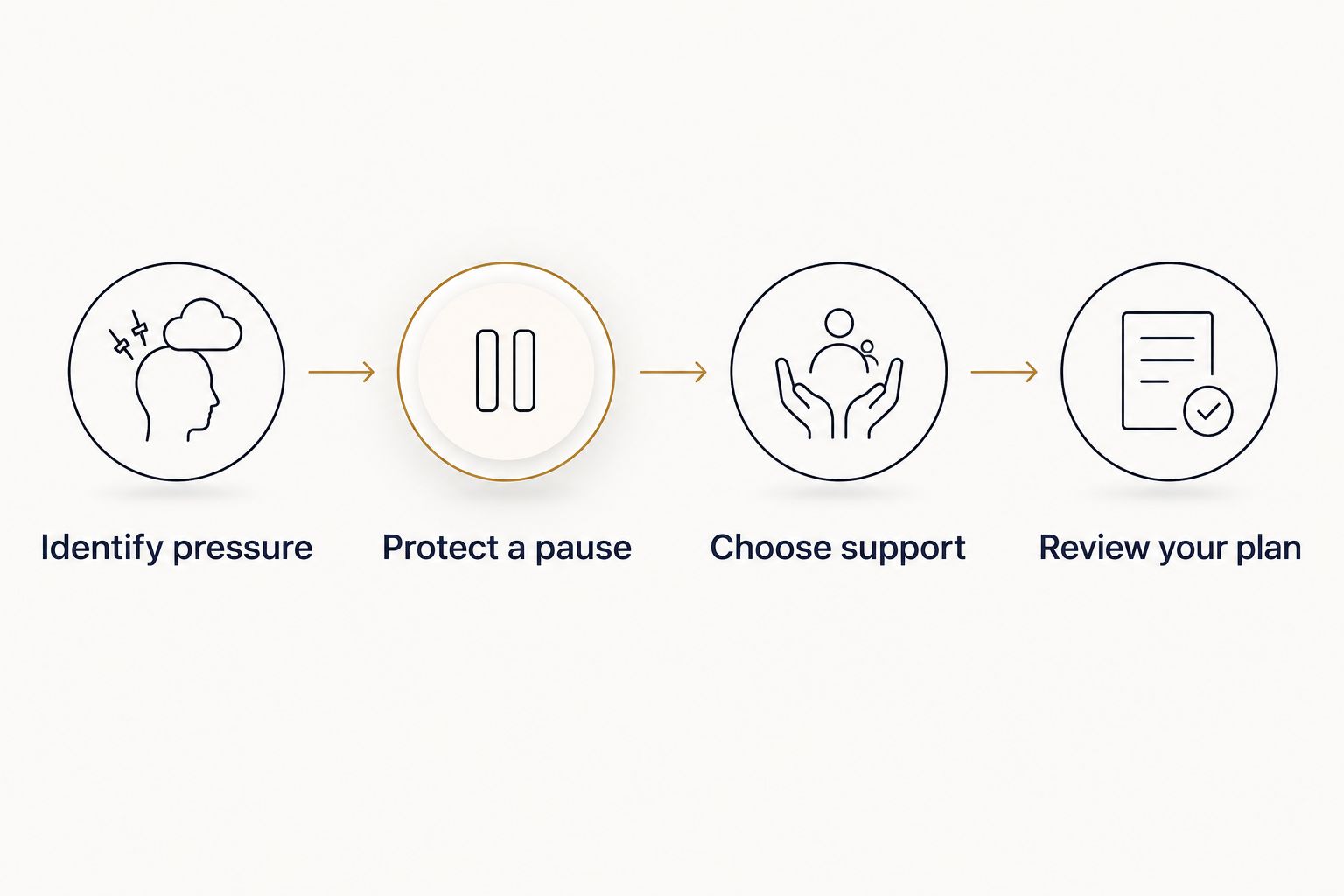
The sequence is simple: identify the pressure, protect a pause, choose support, and review what needs to change. Spiritual practice belongs inside that plan, not above it.
Compare your support options
Choose the option that matches the problem. Quiet rest, Reiki, clinical care, and workplace action have different purposes. They are not competing treatments for the same condition.
You can combine appropriate support, but do not let an optional spiritual appointment delay a conversation about health or working conditions.
| Option | Best for | Main advantage | Key limitation |
|---|---|---|---|
| Quiet rest | Teachers wanting a simple pause | Requires no spiritual commitment or practitioner | Does not address the source of excessive workload |
| Jahben Reiki sessions | Teachers interested in spiritual support | Fits a spiritually focused approach to personal reflection | Not an established treatment for burnout or mental illness |
| Licensed mental health care | Teachers with persistent distress or impaired daily functioning | Provides professional assessment and care within clinical scope | Does not itself change school staffing or expectations |
| Healthcare appointment | Teachers with concerning physical symptoms or ongoing sleep difficulties | Allows symptoms to be assessed rather than spiritually interpreted | Is distinct from optional spiritual guidance |
| Workplace support | Teachers facing repeated overload or unclear duties | Addresses working conditions and responsibilities directly | Depends on available processes and decisions by others |
For a teacher seeking spiritual reflection, Reiki belongs in the optional-support column. For a teacher struggling to function, professional assessment comes first. For a teacher repeatedly losing protected planning time, the next move is a workplace conversation.
Common mistakes teachers make with Reiki
Treating an impossible workload as an energy problem
Do not turn a staffing, scheduling, or expectations problem into a personal spiritual defect. Reiki cannot be relied on to compensate for missing classroom support. Name the working condition and take it to someone with authority to address it.
Turning recovery into another assignment
A complicated evening ritual can become one more task after planning and marking. Keep the practice optional and manageable. Missing a session or skipping journaling does not mean you caused your exhaustion.
Reading symptoms as proof of healing
Tears, warmth, or tiredness do not establish that Reiki worked. Neither does feeling nothing establish that you failed. Describe your experience plainly, and seek appropriate care for symptoms that persist or worsen.
Bringing private spiritual practice into student care
Keep your own Reiki exploration separate from classroom responsibilities. Do not offer students energy treatment, interpret their behavior through spiritual claims, or share their private information with a practitioner. Follow school policy, professional boundaries, and safeguarding requirements.
Making a career decision from a session alone
Do not resign, change schools, or abandon a qualification because an experience felt significant. Consider finances, working conditions, professional advice, and your own priorities. Reflection can inform a decision; it cannot replace the facts needed to make it.
FAQ
Does Reiki healing for teachers actually treat burnout?
Reiki is not an established treatment for teacher burnout. It is an optional spiritual practice, while workload changes and appropriate professional care address different needs.
What's the best way for a teacher to start exploring Reiki?
Start by identifying your goal and trying an ordinary protected pause. If you still want practitioner-led spiritual support, ask about format, consent, and limitations before arranging a session.
Is Reiki better than counseling for classroom burnout?
Reiki is not a substitute for counseling or other licensed mental health care. Choose professional assessment for persistent distress or impaired functioning, and treat Reiki as optional spiritual support.
Can I use distance Reiki after a difficult teaching day?
You can explore distance Reiki as a spiritual practice if that format interests you. Confirm the practitioner's process first, and do not treat claims about remote energy transfer as established medical facts.
How many Reiki sessions does a burned-out teacher need?
There is no established number of Reiki sessions that treats teacher burnout. Review whether the experience is personally worthwhile without delaying healthcare or action on working conditions.
Should I try Reiki if stress is affecting my sleep?
Ongoing sleep difficulties deserve assessment by a qualified healthcare professional. Reiki does not replace that assessment, even if you also choose it for spiritual reflection.
Do I have to let a Reiki practitioner touch me?
You do not have to consent to touch. Ask what the practitioner proposes before the session and make your boundaries clear; you can decline or stop.
Can I use Reiki with students to calm my classroom?
Do not introduce Reiki treatment as a classroom behavior strategy. Keep personal spiritual practice separate from student care and follow school policy, professional boundaries, and safeguarding requirements.
One last thing
You do not have to become better at tolerating an unhealthy workload. Before adding another wellbeing activity in 2026, identify a demand that needs clarification, support, or a boundary. That concrete conversation deserves space in your recovery plan, whether or not you choose Reiki.
Related guides
- How distance Reiki healing works
- How many Reiki sessions you need to feel results
- Reiki healing for burnout and career exhaustion
Ready for your own reading?
Astrology, numerology, and tarot brought together into one clear, written answer about your love, career, or timing.
Book a Personal Reading Get Your Free Report