Instead of searching for your horoscope every morning, set up sms horoscope alerts from a provider that explicitly supports text delivery, then turn each message into one practical reflection and one action. This 2026 workflow separates the subscription, your reading routine, and personal guidance so a short forecast does not become a command.
- SMS horoscope alerts work as reflection prompts, not reliable predictions of events.
- Use one verified horoscope subscription and a consistent daily guidance routine.
- Jahben personal astrology readings suit individual questions rather than sign-wide forecasts.
- A weekly horoscope plus a daily reminder is an alternative to SMS delivery.
Why this matters
Receiving a horoscope is not the same as receiving guidance specific to your life. A sign-wide forecast addresses a broad audience. Your job offer, relationship conversation, and family responsibilities need context that a short text does not contain.
Start with how to read your weekly horoscope for real guidance. The same distinction applies to text alerts: identify the theme, compare it with what is actually happening, and choose a response you control.
Astrology is a spiritual and interpretive practice, not a scientifically established method for predicting individual events. Use forecasts for reflection, not as evidence that something will happen. Medical, legal, and financial decisions still need qualified advice and factual information.
For your 2026 routine, the useful outcome is a clear next move—not a growing collection of forecasts. A message about communication becomes useful when you prepare a difficult conversation; it becomes misleading when you treat it as proof of someone else's intentions.
Before you start
- Subscription access: Have a phone that receives SMS and access to a horoscope provider that explicitly offers text subscriptions. Read the provider's enrollment, consent, and cancellation instructions before sharing your number.
- Reading materials: Choose the sign the subscription supports, keep a private note for reflections, and decide when you will review messages. For a rising-sign horoscope, establish your rising sign rather than guessing it.
- The delivery gotcha: A phone notification, email, and SMS are different channels. Confirm actual text delivery before enrollment; a horoscope page or app notification does not establish an SMS service.
This guide treats the text provider and the personal advisor as separate roles. Jahben offers personal readings and weekly horoscopes; this workflow does not present Jahben as an SMS subscription platform.
Do not build an automation around a feed, account connection, or messaging feature until your chosen provider documents that feature. You can complete the reflection routine without connecting your phone to any external automation service.
Subscription setup
The first configuration unit is the subscription itself. Keep it narrow: one source, one supported sign, and a delivery pattern you can explain. The instructions below describe the choices to make without assuming every provider uses the same interface.
- Verify the source. Begin from the provider's own subscription instructions, not an unsolicited text. Confirm the sender identity and the type of horoscope you are requesting.
- Choose the supported sign. Select the sign specified by the service. Do not put a rising sign into a subscription described as sun-sign guidance unless the provider says that is supported.
- Enter your number through the stated enrollment process. Review consent language before submitting. Complete any confirmation the provider requires; entering a number alone does not establish that enrollment succeeded.
- Choose the frequency and delivery time if those controls exist. As a starting routine, aim for no more than 1 horoscope alert per day. That is a recommended limit, not a claim about what any provider offers.
- Save the cancellation instructions. Follow the provider's stated opt-out method when you want to leave. Do not assume every sender uses an identical cancellation process.
- Check the first received message. Confirm its sender, sign, forecast date, and whether it is actually a horoscope rather than a promotion or enrollment acknowledgment.
Expected result: You receive the requested horoscope through the documented channel, understand what sign it covers, and know how to stop it.
Keep birth details out of ordinary text replies unless the provider clearly explains why they are required and how to submit them securely. A general sign subscription and a personal chart reading require different levels of detail.
Guidance note setup
Create a separate note for interpreting alerts. Keep the original forecast distinct from your response so you can tell what the message actually said and what you added afterward.
For example, call the note Daily guidance — 2026. Use the same headings for every entry. Consistency makes the routine easier to review without turning it into a large journaling project.
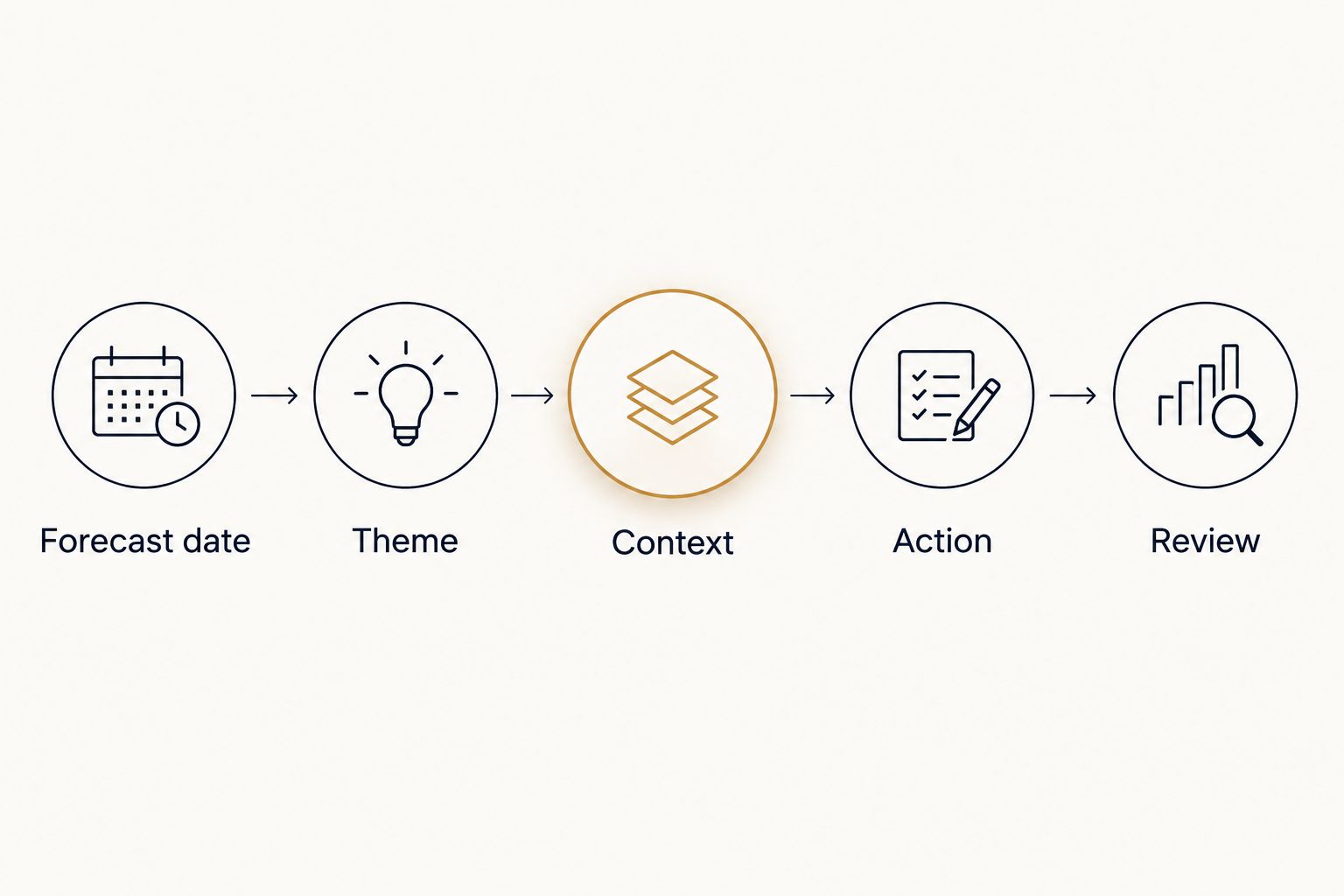
- Record the forecast date. Use the date the message covers, not just the time it reached your phone. A delayed message should not silently become today's guidance.
- Write the theme. Reduce the text to a plain phrase such as communication, patience, boundaries, or preparation. Preserve its meaning without adding a new prediction.
- State the context. Name the situation already on your mind. Keep this factual: an upcoming conversation is context; assuming someone will contact you is a prediction.
- Choose the action. Write one step you control, such as drafting a question, checking an appointment, or asking for clarification.
- Set the review. Leave space to record what you did and what happened. Separate observed events from your interpretation of them.
Expected result: Each forecast produces a readable entry with five distinct parts: Forecast date, Theme, Context, Action, and Review.
Here is an illustrative entry, not a forecast or a reported client result:
| Note field | Example entry |
|---|---|
| Forecast date | The date stated in the received message |
| Theme | Clear communication |
| Context | A work discussion needs preparation |
| Action | Write the question to ask before the discussion |
| Review | Record whether the question was asked and what was clarified |
Notice what the entry avoids. It does not claim the conversation will succeed, identify a colleague's hidden motives, or tell you to accept an offer. It prepares you to participate more clearly.
Daily review setup
The final configuration unit is your response to the alert. Choose when to interpret a message; do not let its arrival dictate when you make a decision. You can read a text later even if it arrives early.
- Choose a review window. Reserve 5 minutes at a convenient point in your day. This is a suggested time box, not a promised setup time or service duration.
- Check relevance before acting. Ask whether the forecast connects with a real situation. If it does not, write that it has no useful application today.
- Complete the guidance note. Capture the theme, context, and action. Avoid turning every sentence into a separate task.
- Check the action against your responsibilities. Do not delay treatment, miss a deadline, or ignore a safety concern because of a horoscope theme.
- Review the result later. Record the action you took and the observable outcome. Do not rewrite the original forecast to make it fit.
- Evaluate the routine after 7 days. Decide whether the subscription supports reflection or simply interrupts you. Keep, reduce, or cancel it accordingly.
Expected result: The alert leads to a bounded reflection and an optional practical action, not repeated checking throughout the day.
For a 2026 guidance routine, measure usefulness through your own behavior: Did you ask the question? Prepare the document? Respect the boundary? Those observations are more concrete than deciding whether every event matched a broad forecast.
A missed review does not require catching up on every message. Resume with the current forecast. Treating an unread horoscope as an obligation defeats the purpose of a grounding routine.
Second workflow: weekly horoscope to daily guidance
A weekly forecast plus a recurring reminder is an honest alternative when you do not want SMS. The reminder prompts reflection; it does not deliver fresh horoscope content or automatically retrieve a forecast.
- Read the current weekly forecast. Check that its stated period includes the week you are planning.
- Choose a weekly theme. Save a short summary and distinguish it from your own interpretation.
- Create a daily reminder in your preferred calendar or reminder app. Use a title such as Review weekly theme. Set the recurrence through that app's documented controls.
- Add a reflection question. Ask what practical step fits the theme today. Keep the same question rather than inventing a new prediction for each day.
- Update the note when you read the next forecast. Replace the previous theme yourself unless your source documents an automatic update method.
Expected result: You receive a daily prompt to revisit a weekly theme without subscribing to text delivery.
For 2026 planning, keep the forecast's scope intact. A weekly theme does not establish that a particular Tuesday will bring an offer or that Friday guarantees a reconciliation. Your daily actions come from your circumstances, not invented date-specific claims.
Which workflow fits your question?
| Option | Best for | Advantage | Limitation |
|---|---|---|---|
| SMS horoscope alerts | People who want forecasts in their text inbox | The message reaches the channel you already check | Short, sign-wide content lacks individual context |
| Weekly forecast with daily reminder | People who prefer a quieter reflection routine | You control when you revisit the theme | You must update the saved forecast yourself |
| Jahben personal astrology readings | People with individual questions about love, career, or timing | The service addresses personal guidance rather than a sign-wide audience | A reading is not an automated daily alert or guaranteed prediction |
Jahben personal astrology readings are best for people seeking individual guidance rather than a sign-wide horoscope. Choose the delivery routine for convenience; choose a personal reading when the question needs your circumstances.
Troubleshooting
Enrollment succeeds, but no text arrives
Check whether you completed the required confirmation and entered the intended phone number. Inspect your phone's filtered-message area and use the provider's support instructions to verify enrollment. Do not repeatedly subscribe while the first request remains unresolved.
Messages arrive at the wrong time
Check the provider's delivery settings and stated time zone, if available. Also distinguish message delivery from your phone's notification behavior: a silenced alert is not necessarily a delayed text. If timing cannot be changed, keep your own review window.
The sign or forecast period is wrong
Review the subscription's sign selection and the date inside the message. Correct the selection through the provider's documented process. Do not silently reinterpret a sun-sign forecast as a rising-sign forecast or apply an expired message to the current day.
You receive duplicate or unwanted messages
Check whether you enrolled more than once or subscribed through multiple sources. Follow each sender's cancellation instructions separately. For an unknown sender, avoid opening message links; use your phone's blocking or spam-reporting controls.
The alerts increase anxiety
Pause the routine and stop treating the messages as instructions. A forecast does not prove that a relationship will end or that a difficult event is imminent. If distress persists or affects daily functioning, seek support from a qualified mental health professional rather than more predictions.
Customize your workflow
Expand the routine by sharpening the question, not by adding more alerts. Choose one area—love, career, or timing—and make the action specific to that area.
For love, separate what you know from what you assume about another person. For career, prepare questions and compare actual terms. For timing, record real deadlines before considering any spiritual interpretation.
Jahben personal readings address those individual topics through email or live sessions. Prepare a focused question and relevant context; do not expect a reading to establish another person's thoughts as facts or replace professional advice.
Use how to ask good questions in an email psychic reading when your daily note exposes a question that a general forecast cannot address. Keep sensitive details out of the SMS thread and follow the advisor's stated submission process instead.
FAQ
How do I set up SMS horoscope alerts?
Use a provider that explicitly offers SMS horoscope subscriptions and follow its documented enrollment process. Confirm the supported sign, consent requirements, delivery channel, and cancellation instructions before relying on the alerts.
Does Jahben offer an SMS horoscope subscription?
This guide does not identify a Jahben SMS horoscope subscription. It separates an external text-delivery service from Jahben's weekly horoscopes and personal readings.
Are SMS horoscope alerts personalized to my birth chart?
A sign-wide SMS horoscope is not a personal birth-chart reading. Treat it as general guidance unless the provider explicitly describes the individual information used to create the forecast.
Should I read my sun sign or rising sign horoscope?
Read the sign type specified by the horoscope provider. A sun-sign subscription and a forecast written for rising signs are not interchangeable; establish your rising sign before using a rising-sign forecast.
Can I turn a weekly horoscope into daily guidance?
Yes, use a daily reminder to revisit the weekly theme and choose a practical action. The reminder does not create a new daily forecast or automatically update the source content.
Can horoscope texts tell me when to make an important decision?
Horoscope texts do not reliably establish the right date for an important decision. Use actual deadlines, relevant evidence, and qualified advice; keep astrology as a separate reflective practice.
How do I stop receiving horoscope text messages?
Follow the sender's stated cancellation instructions. For an unknown or unwanted sender, avoid message links and use your phone's blocking or spam-reporting controls.
One last thing
Write your action before the outcome happens. Otherwise, it is easy to reinterpret a broad forecast after the fact and lose track of what actually helped.
Keep the original message unchanged beside your note. For your 2026 review, ask whether the routine improved preparation, communication, or boundaries—not whether you can make every event fit the text. A useful reflection supports your judgment; it does not replace it.
Related guides
- How to use astrology to plan your month
- Rising sign vs sun sign: what is the difference?
- Weekly horoscope reading for career and money timing
Ready for your own reading?
Astrology, numerology, and tarot brought together into one clear, written answer about your love, career, or timing.
Book a Personal Reading Get Your Free Report