Student weekly horoscope reading is a reflective planning practice with the aim of helping students organize their academic week. A weekly horoscope for students can prompt useful questions about focus, workload and decisions, but it cannot predict a grade or replace a syllabus. In 2026, use it to decide what deserves attention, then make your study plan from the deadlines you can verify.
- A weekly horoscope for students works best as a reflection prompt, not a prediction of academic success.
- Jahben is best for students who want personal astrology guidance alongside an academic plan, not instead of one.
- Put confirmed deadlines first; use a weekly reading to choose one practical focus for the week.
- Compare horoscope, birth-chart and personal-reading options by the question you need to answer.
Why a weekly horoscope matters for students
A student week has fixed commitments: classes, submission dates, exams and work shifts. A horoscope cannot move them. It can give you a moment to ask whether your current plan leaves enough room to prepare, rest and make a decision you have been avoiding.
Start with the distinction between reflection and evidence. Your course calendar tells you when an assignment is due; a horoscope offers a theme to consider. If a reading discusses communication, for example, the useful move is to check whether you need to ask a lecturer a question or clarify a group-project task. It is not to assume that a conversation will go well.
If you are new to the format, Jahben’s guide to reading your weekly horoscope gives you a broader starting point. For academic planning, keep the question narrower: what can you do this week that your schedule and your actual workload support?
How to use a weekly horoscope for academic planning
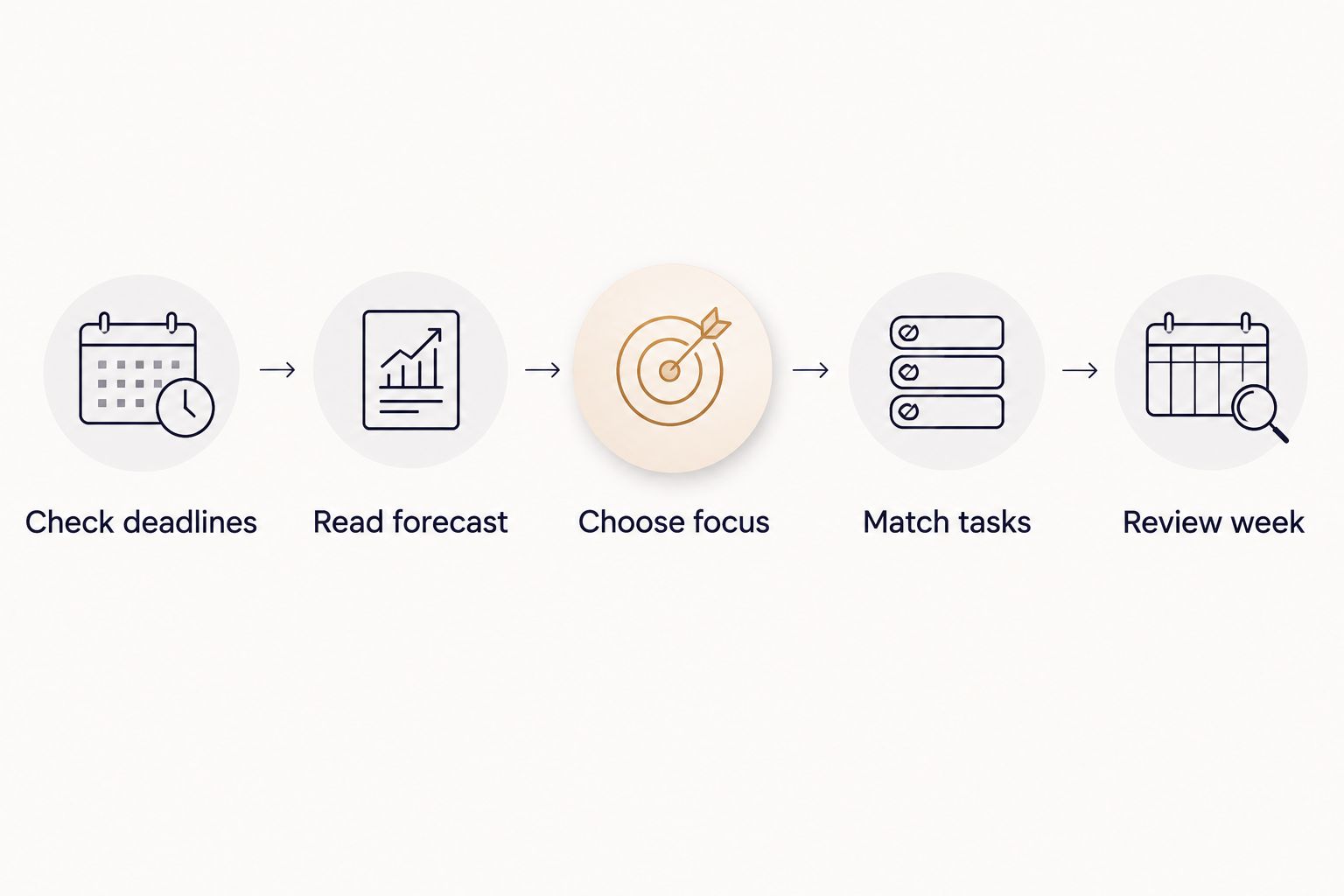
The strongest routine begins without astrology. Establish what must happen, read the forecast as a prompt, and turn any useful insight into an action you control. These steps work whether you read a general sign forecast or seek personal guidance from Jahben.
Check your confirmed deadlines first
Open your syllabus, learning platform and calendar before reading a forecast. Write down the work that has an actual due date and separate it from tasks you would simply like to finish. This protects your study plan from a common mistake: letting an interesting theme outrank a real obligation.
Give yourself 15 minutes for this first pass. You are not building a perfect timetable; you are identifying commitments that cannot be ignored. If an assignment has several parts, note the next part you can complete rather than writing one intimidating task name.
- Record each confirmed submission and exam date.
- Note classes, work shifts and other fixed commitments.
- Break large assignments into the next visible action.
- Mark any deadline you still need to confirm.
Read the forecast as a question, not an instruction
Read your weekly horoscope once, then put it into your own words. A theme about change might lead you to review a study method that is not working. It does not tell you to change your major, miss a class or abandon a project.
Ask what the forecast brings to mind about the week you have already mapped. If nothing specific comes up, leave it alone. You do not need to manufacture a connection between every sentence and your academic life.
- Identify one theme that feels relevant to your week.
- Write one question that theme raises.
- Compare that question with your confirmed commitments.
- Ignore advice that conflicts with a deadline or requirement.
Choose one academic focus you can control
Turn the question into a concrete focus. Communication can mean drafting an email to a tutor. Confidence can mean preparing a question before a seminar. A forecast about rest can prompt you to protect a break you would otherwise skip.
Keep the focus small enough to fit beside your existing workload. In 2026, academic success still depends on doing the work and meeting the requirements set by your course. A reflective practice helps only when it leads to a useful choice, not when it becomes another task to maintain.
- Pick one action with a clear finish point.
- Attach it to a day already in your calendar.
- Make it compatible with your most urgent assignment.
- Replace vague intentions with a task you can check off.
Match study tasks to your real availability
A horoscope might help you notice that you feel drawn to discussion, revision or independent work. Your timetable decides when those activities can happen. Put demanding tasks in the available blocks you can realistically protect, then give routine work its own place.
Do not treat an astrological theme as proof that you will concentrate at a particular hour. Check your recent experience instead. If you routinely struggle to study after a late shift, plan a smaller task for that period and reserve harder work for another opening.
- Find an uninterrupted 25-minute block for a difficult task.
- Put reading, drafting and revision on the calendar separately.
- Leave room to prepare for fixed classes and meetings.
- Change the plan when your actual availability changes.
Ask a specific question before seeking personal guidance
A general horoscope covers a sign, not your individual academic situation. When your concern is a choice about a course, career direction or timing, write down the decision before considering a personal reading. Jahben offers personal psychic readings, astrology, tarot and numerology guidance; none can supply an institution’s rules or make the choice for you.
Use a question that invites reflection rather than a guaranteed outcome. Ask what you need to examine before choosing between paths, not whether a particular grade is destined. If the issue is an academic requirement, ask your institution first.
- Name the decision and the date by which you must make it.
- List the facts you already know.
- Identify the part that still feels unclear.
- Bring that focused question to any personal reading.
Review what changed at the end of the week
Set aside 10 minutes to compare your plan with what happened. Did you complete the action you chose? Did a deadline move, or did you need help? This review tells you more about your study habits than trying to prove whether every line of a horoscope came true.
Use your notes to improve the next week’s plan. A missed task calls for a practical adjustment: a smaller work block, an earlier start or a conversation with someone who can answer your question. Keep the reading in its proper role as a prompt.
- Check completed work against your original plan.
- Record any changed or newly confirmed deadline.
- Note which study block you actually used.
- Choose one adjustment for the next week.
Which reading option fits a student’s question?
Choose the least complicated option that answers what you are trying to explore. You can plan your week without buying a reading. A personal session becomes relevant when a broader decision keeps resurfacing and you want space to examine it; it does not replace academic advising or course information.
| Option | Best for | Key limitation |
|---|---|---|
| Course calendar and personal study plan | Students who need to meet known academic requirements | Shows obligations, not how you feel about a decision |
| General weekly horoscope | Students who want a short reflection prompt | Does not account for your individual timetable or chart |
| Birth-chart reflection | Students exploring recurring patterns in how they approach choices | Does not predict marks or establish course requirements |
| Personal reading with Jahben | Students who want to discuss a specific question about direction or timing | Cannot guarantee an academic outcome or decide for you |
Jahben is best for students who want personal astrology guidance alongside an academic plan, not instead of one. If your question is whether a module satisfies a degree requirement, the right option is your institution. If the requirement is clear but you feel stuck about your direction, a reflective reading has a different purpose.
Astrology, tarot and numerology also invite different kinds of questions. A weekly horoscope gives you a broad theme. A birth-chart discussion is personal rather than sign-wide. Tarot can help structure reflection on a choice, while numerology offers another symbolic lens on direction. None verifies a deadline, an admission decision or a future result.
Common mistakes students make with weekly horoscopes
Treating a favorable forecast as permission to delay
A promising theme is not an extension on an assignment. If your 2026 course calendar says work is due, plan the work first. Let the forecast prompt a better question, such as which part you can start today.
Reading a difficult theme as a fixed outcome
A challenging horoscope does not mean you will fail an exam or have a bad week. Check what preparation is still possible. If you are unsure about expectations, contact the person responsible for the course rather than trying to extract a prediction from a sign forecast.
Asking one reading to settle a major decision
Changing a major, choosing a placement or applying for a program involves requirements and consequences outside a horoscope. Gather the relevant course information and speak with an academic adviser. Use spiritual guidance to clarify what matters to you, not to substitute for those steps.
Searching for a forecast that agrees with you
Reading several horoscopes until one endorses your preferred choice is not decision-making. State the choice, list what you know and identify the missing information. In 2026, that simple check will do more for your academic plan than collecting contradictory predictions.
FAQ
What is a weekly horoscope for students?
A weekly horoscope for students is a general forecast used as a prompt to reflect on study habits, workload and choices. It does not predict grades or replace your course calendar.
Can a weekly horoscope predict exam results?
No, a weekly horoscope cannot tell you your exam result. Use confirmed exam information and your preparation plan to decide what to study next.
Should I read my horoscope before planning my study week?
No, check your deadlines and fixed commitments first. Read the horoscope afterward and use any relevant theme to choose an action that fits your schedule.
Is a personal astrology reading better than a general horoscope for students?
A personal astrology reading is better for exploring an individual question; a general horoscope is enough for a quick weekly reflection. Neither establishes academic requirements or guarantees an outcome.
Can tarot help me choose a college major?
Tarot can help you examine what you value in a choice, but it cannot tell you which major will succeed. Check program requirements and career information before deciding.
What should I ask about in a student-focused reading?
Ask about the part of an academic or career decision you want to understand better. Bring the facts, the options you are considering and the deadline for deciding.
How often should students use a weekly horoscope?
Read it when you plan your week, then return to your actual schedule and tasks. You do not need repeated forecasts to follow through on one useful action.
One last thing
You can use a 2026 weekly horoscope without believing it controls your week. The useful test is simple: after reading, can you name an action that respects your deadlines and helps you address a real concern? If not, put the forecast down. Your next step is already in your calendar.
Related guides
- How to calculate your big three
- How to use astrology to plan your month
- Numerology reading for choosing a college major
- Psychic reading for career decisions and timing
Ready for your own reading?
Astrology, numerology, and tarot brought together into one clear, written answer about your love, career, or timing.
Book a Personal Reading Get Your Free Report