Ask about the decision you face, the pattern you want to understand, and the next step you control. If you are deciding what to ask in a live psychic reading in 2026, start with an open-ended question about love, career, timing, or life direction—not a demand for a guaranteed prediction.
- What to ask in a live psychic reading: focus on your choices, relationship patterns, and practical next steps.
- Jahben offers personal psychic readings for spiritually curious adults seeking guidance on love, career, and timing.
- Ask follow-up questions when an interpretation is unclear; do not treat a prediction as proof.
- Keep medical, legal, and financial decisions with qualified professionals.
Why this matters
A question about your choices gives you something to examine. A question about someone else's hidden thoughts asks a reader to supply information you cannot independently confirm during the session.
Use the conversation for reflection, not permission to hand over your judgment. Before you settle on questions, prepare for your first psychic reading by identifying the issue you actually want to discuss. You do not need to turn your whole life into an agenda.
For a 2026 session, bring the real situation you face now: a relationship conversation, a job decision, or uncertainty about a change. Spiritual language should help you describe that situation—not replace the facts.
What should you ask in a live psychic reading?
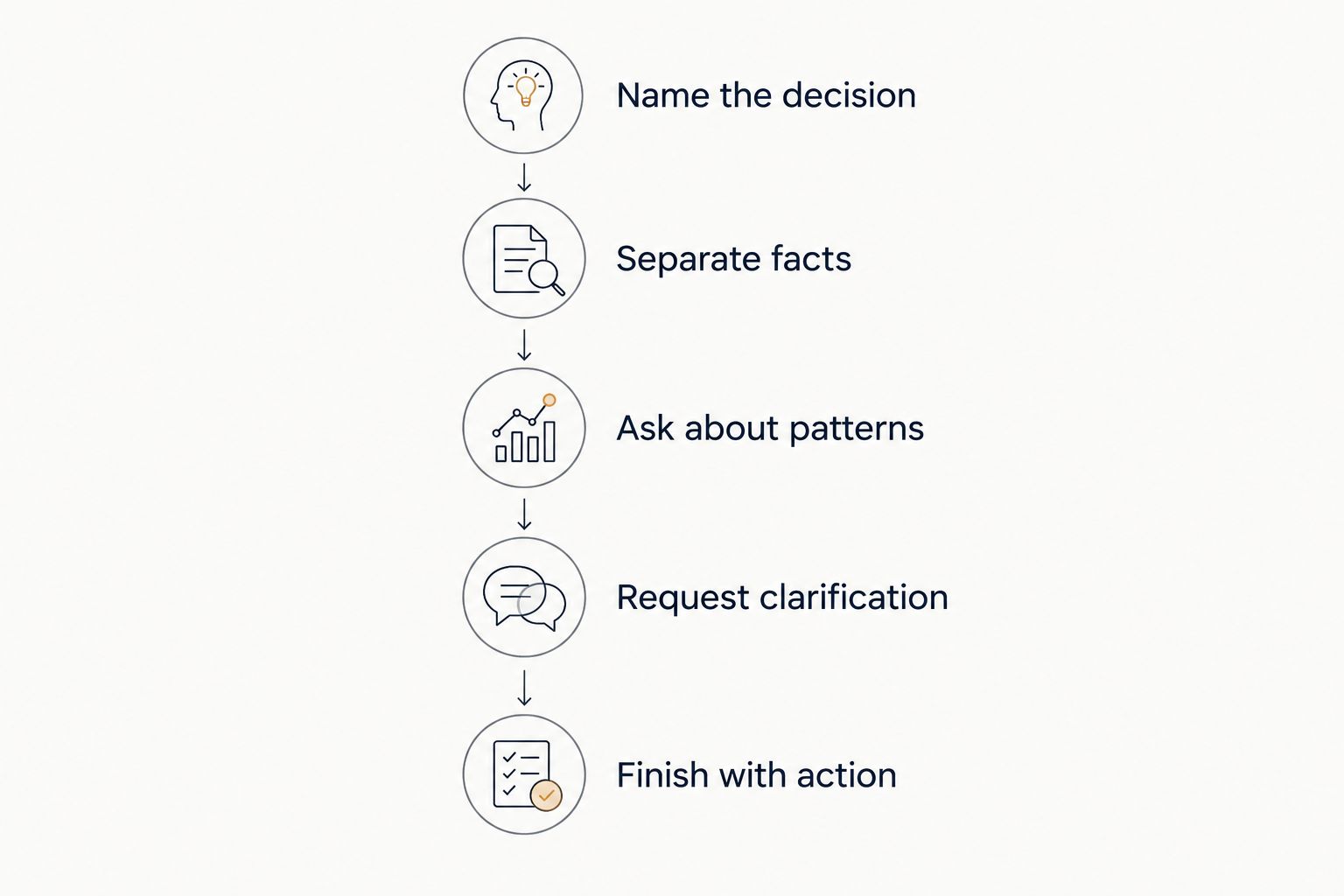
Ask questions that connect a specific situation to your own understanding and actions. Use this sequence to turn a broad concern into a focused conversation:
- Name the decision. Write one sentence explaining what you are trying to decide, without adding your entire history.
- Separate facts from assumptions. Identify what happened, what someone actually said, and what you are guessing.
- Ask about the pattern. Explore recurring reactions, conflicting priorities, or expectations you want to understand.
- Request clarification. Ask what an interpretation means in ordinary language and where uncertainty remains.
- Finish with an action. Identify something you can do without needing a prediction to come true.
For example, replace a broad request to reveal your future with a question about what you need to consider before accepting a role. You still leave room for spiritual interpretation, but you give the conversation a clear subject.
Which question style fits your concern?
Each question style has a purpose and a limit. Choose the style that fits your concern rather than expecting every question to produce the same kind of answer.
| Question style | Best for | Limit |
|---|---|---|
| Open-ended reflection | Exploring patterns | Can become vague |
| Comparing choices | Examining priorities | Does not decide for you |
| Timing exploration | Discussing readiness | Cannot guarantee dates |
| Yes-or-no question | Defining a narrow concern | Leaves little explanation |
Best starting point: open-ended reflection tied to a specific decision. If the discussion becomes abstract, return to what the interpretation means for your actual situation.
What should you ask about love and relationships?
Ask about your needs, boundaries, and choices—not whether a reader can certify another person's feelings. A reading is not evidence that a partner is faithful, unfaithful, destined for you, or planning to return.
Useful questions include:
- What pattern in this relationship do I want to understand more clearly?
- What am I overlooking about my own needs?
- What would a healthier boundary look like here?
- What should I consider before reopening contact with my ex?
- What conversation am I avoiding because I fear the answer?
Best for relationship reflection: questions about your participation in the relationship. Their strength is that you can connect the answer to your experience; their limit is that they cannot establish someone else's private intentions.
If you want commitment in 2026, ask what commitment means to you and what behavior would demonstrate it. Do not let a spiritual label outweigh repeated disrespect, coercion, or a clear refusal to commit.
What should you ask about career and life direction?
Ask what you need to evaluate, what matters most to you, and what step would give you better information. Keep the practical evidence—responsibilities, working conditions, qualifications, and contractual terms—separate from spiritual interpretation.
Try these questions:
- What am I hoping a career change will solve?
- Which strengths do I want to use more deliberately?
- What conflict between security and fulfillment needs my attention?
- What should I examine before accepting this opportunity?
- What small experiment would help me explore a different direction?
Best for career reflection: questions that clarify priorities before action. They can structure your thinking, but they cannot establish whether an employer will hire you or whether a business will succeed.
If your concern involves leaving a job, bring the actual decision rather than asking whether success is guaranteed. A reading does not replace reviewing your finances, researching the role, or speaking with people who understand the work.
What should you ask about timing?
Ask about readiness, conditions, and your own milestones rather than demanding an exact date. A forecast is not a confirmed appointment with the future.
Questions that keep timing grounded include:
- What needs to be in place before I make this change?
- Am I waiting for useful information or avoiding discomfort?
- What would tell me that I am ready to move forward?
- Which parts of this timeline depend on other people?
- What should I do while the outcome remains uncertain?
For a decision later in 2026, use the real deadline as context. Distinguish a deadline set by an employer, landlord, or application process from a date suggested through spiritual interpretation.
Best for timing discussions: readiness questions. They direct attention toward preparation; their limit is that preparation does not control every external outcome.
Why your question list varies
Your agenda should reflect the concern you bring and how much clarification it needs. The goal is not to cover every topic; it is to leave knowing what was discussed and what remains unresolved.
- Your main concern: A relationship boundary needs different questions from a career transition.
- Your decision stage: Exploring possibilities is different from choosing between concrete offers.
- What you already know: Confirmed facts should not be presented as mysteries for the reader to solve.
- The reading approach: Ask which methods the advisor uses and what those methods can reasonably address.
- Your comfort with disclosure: Share relevant context without feeling obliged to reveal sensitive details.
- The need for follow-up: An unclear interpretation needs explanation before you introduce another subject.
As a preparation exercise, write 3 priority questions. Under each, add 1 follow-up question and space for 1 practical action. These are suggested planning counts, not a promise about how many questions any particular session includes.
What should you ask when an answer feels vague?
Ask the reader to explain the meaning in plain language. You do not need to agree with an interpretation simply because it sounds spiritual or emotionally significant.
Useful follow-ups include:
- What do you mean by blocked in this situation?
- Are you describing a symbol, an impression, or something I told you?
- What part of that interpretation is uncertain?
- How does that relate to the question I asked?
- What would this mean without the spiritual terminology?
A clear explanation is not the same as a verified claim. You can understand what a reader means while remaining unconvinced that the interpretation describes reality.
Afterward, keep your original question beside your notes. When considering whether a psychic reading was accurate, distinguish specific statements from broad observations and from meanings you added yourself.
How should you ask about dreams, signs, or repeated symbols?
Describe the experience before assigning it a meaning. If you noticed a recurring dream or symbol in 2026, explain what happened and what you associate with it rather than presenting it as proof of a future event.
The distinction behind interpreting dreams without predicting fate matters here: exploring what an image means to you is different from claiming that it forecasts an event. A symbolic interpretation is not evidence that a partner will return or that a particular outcome is inevitable.
Ask what the symbol brings up emotionally, whether it connects with a current concern, and what alternative interpretations deserve consideration. You can find an image personally meaningful without treating it as an instruction.
Best for symbolic questions: reflection on meaning, not certainty about fate. The benefit is room for exploration; the limit is that personal significance does not establish predictive accuracy.
What should you ask the advisor before discussing sensitive details?
Ask about the reading's scope, the methods involved, and the boundaries around sensitive subjects. Confirm how the session works before assuming it includes a particular technique or type of answer.
Questions to raise include:
- Which approaches will you use for this discussion?
- What information do you need from me, and why?
- Can I decline a topic or stop the conversation?
- What are your rules about recording or taking notes?
- How do you handle questions outside the scope of a spiritual reading?
Jahben is best suited to spiritually curious adults seeking personal psychic-reading guidance on love, career, and timing. Jahben offers readings that combine western astrology, Pythagorean numerology, tarot, and 12 Tribes astrology; that spiritual approach is not a substitute for professional advice or independently verified information.
If you prefer an entirely evidence-based decision process, a spiritual reading is not the right substitute. Choose support that matches what you actually need.
What should you leave out of a live psychic reading?
Leave diagnosis, treatment decisions, legal strategy, and investment instructions to qualified professionals. You can discuss how uncertainty feels without asking a psychic to determine the underlying medical, legal, or financial facts.
Do not use a reading to establish pregnancy, accuse someone of wrongdoing, locate a missing person, or decide whether to stop prescribed treatment. For urgent safety concerns, seek appropriate professional or emergency help rather than waiting for a spiritual interpretation.
Also avoid questions that surrender your consent: whether you must stay with someone, obey a supposed destiny, or make a decision because an advisor insists. You remain entitled to disagree, pause, and leave. A prediction does not create an obligation.
FAQ
What's the best first question to ask in a live psychic reading?
Start with the decision you want to understand and ask what you should consider before acting. Keep the question focused on your choices rather than demanding a guaranteed outcome.
How many questions should I prepare for a live psychic reading?
Prepare 3 priority questions as a planning exercise, then put the most important question first. This is not a statement about any provider's session allowance; confirm the session format directly.
Can I ask whether my ex will come back?
You can ask, but a reading cannot establish your ex's intentions or guarantee a return. A more grounded question is what you need to consider before reopening contact.
Should I tell a psychic my whole life story?
You do not need to tell your whole life story. Share the context needed to explain your question, and keep a distinction between facts you supplied and interpretations the reader offered.
Can I ask for an exact date when something will happen?
You can ask about timing, but do not treat an exact date as a guarantee. Ask about readiness, practical conditions, and the parts of the timeline you control.
What should I do if the answer doesn't make sense?
Ask for a plain-language explanation and say what does not fit your experience. You do not need to invent a connection or agree to keep the conversation comfortable.
Is Jahben's psychic reading a replacement for professional advice?
Jahben's psychic reading is spiritual guidance, not a replacement for medical, legal, financial, or mental health care. Use qualified professionals for decisions that require those forms of expertise.
One last thing
Before your 2026 reading, write down what would change your mind about the decision you face. That question gives you a way to notice whether you are genuinely exploring possibilities or only seeking confirmation.
End with an action that makes sense even if the prediction is wrong. Have the conversation, investigate the opportunity, or state the boundary because it fits your judgment—not because you feel bound to a forecast.
Related guides
- What happens in a live psychic reading session
- Is a live psychic reading more accurate than email?
- How to ask good questions in an email psychic reading
Ready for your own reading?
Astrology, numerology, and tarot brought together into one clear, written answer about your love, career, or timing.
Book a Personal Reading Get Your Free Report