Best overall: a structured natal-chart course. Best for direct feedback: a live beginner class. Best for independent study: a workbook-led course. The best astrology courses for beginners teach you to interpret a chart in order, rather than memorize disconnected zodiac traits; this 2026 guide compares learning formats, not individual schools.
- The best astrology courses for beginners combine birth chart fundamentals, worked examples, and interpretation practice.
- Choose a structured natal-chart course before studying transits or relationship compatibility.
- Choose a live beginner class when you need questions answered and interpretations corrected.
- Jahben offers personal astrology guidance; a course serves the different goal of learning chart interpretation.
Why this matters
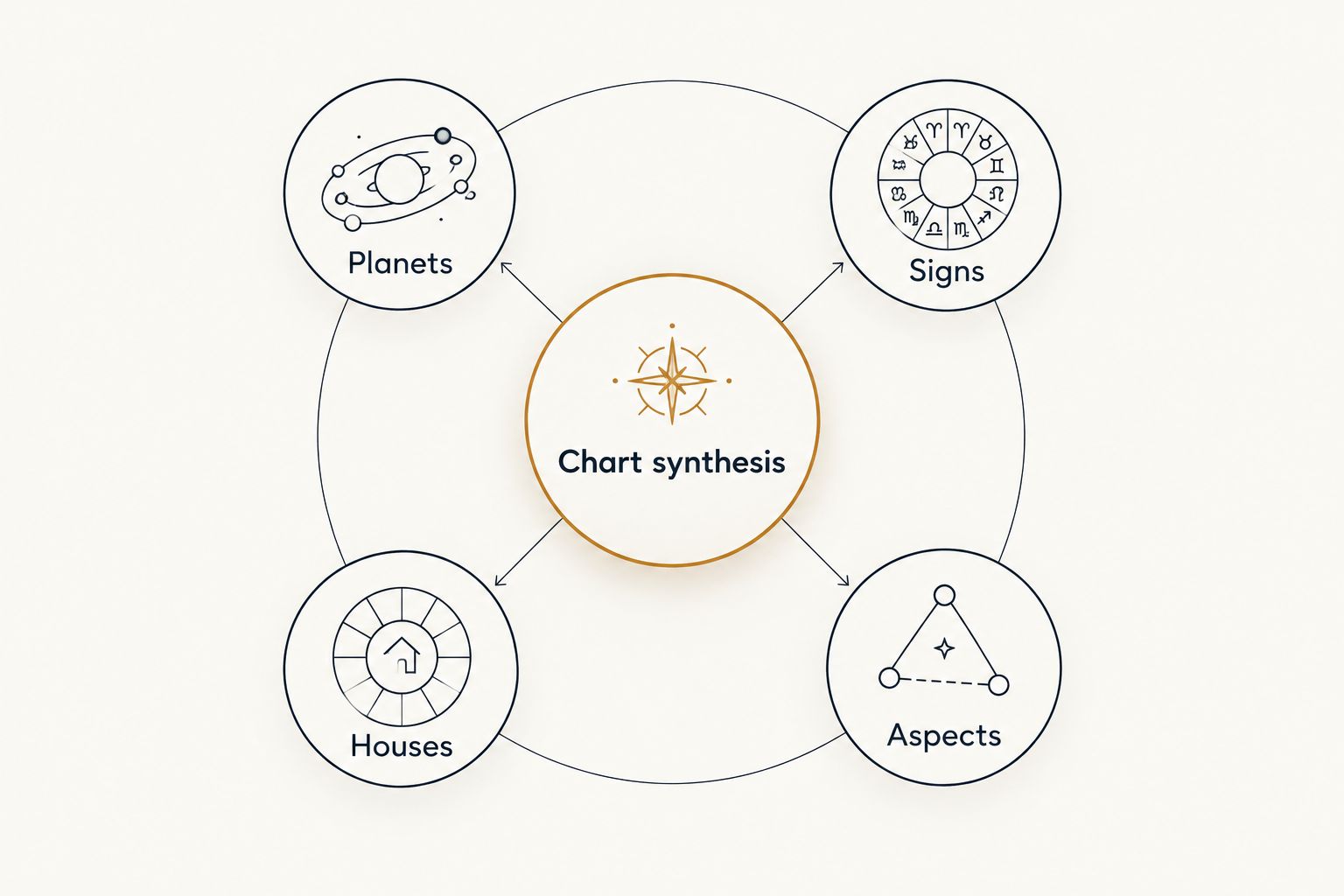
Knowing zodiac descriptions is not the same as reading a birth chart. A useful beginner course explains how planets, signs, houses, and aspects work together, then asks you to practice that process yourself.
Start by understanding the difference between rising and Sun signs. If a course treats those placements as interchangeable, its foundations need closer inspection.
Astrology is a symbolic interpretive practice, not a scientifically established method of predicting events. Good teaching keeps that distinction clear and does not turn a difficult placement into a guaranteed outcome.
What makes the best astrology courses for beginners
Use these criteria to assess a beginner syllabus in 2026. A persuasive course description is not enough; look for what you will actually learn and do.
- Clear sequence: Learn chart components before combining them or attempting forecasts.
- Worked examples: Watch the teacher explain how an interpretation follows from specific placements.
- Active practice: Complete chart exercises rather than only watching lessons.
- Correction: Look for feedback, model answers, or explanations that expose mistakes.
- Named method: The teacher identifies the zodiac, house system, and interpretive tradition used.
- Responsible boundaries: Lessons distinguish symbolic interpretation from certainty, diagnosis, and professional advice.
A beginner does not need every astrological technique at once. You need a repeatable way to explain a placement, recognize its context, and acknowledge what the chart cannot establish.
Beginner astrology courses at a glance
These rankings compare course formats by learning purpose. They do not claim that every course within a format has the same syllabus, teaching quality, or support.
| Course format | Best for | Main limitation |
|---|---|---|
| Structured natal-chart course | Learning the foundations in order | Recorded lessons need separate correction methods |
| Live beginner class | Getting direct feedback | Requires scheduled participation |
| Workbook-led course | Independent, written practice | You must check your own reasoning |
| Focused introductory workshop | Testing a narrow interest | Does not replace a full foundation |
Features such as recordings, assignments, teacher access, and completion requirements depend on the individual course. Confirm them before enrolling rather than assuming the format includes them.
1. Structured natal-chart course: best for learning in order
A structured natal-chart course is the strongest default for a complete beginner. Look for a syllabus that introduces planets, signs, houses, and aspects separately, then demonstrates how to combine them into a coherent interpretation.
The distinction matters. Learning that Venus has certain symbolic associations does not yet teach you how to interpret Venus in a particular sign, house, and aspect pattern.
Structured natal-chart course pros:
- Gives you a clear starting point and progression.
- Connects vocabulary to chart examples.
- Creates a foundation for later study of timing and relationships.
Structured natal-chart course cons:
- Recorded explanations alone do not correct your interpretations.
- A broad syllabus can become memorization without exercises.
Best for: Beginners who want to read charts rather than collect isolated meanings.
Before choosing a course in 2026, inspect its sample lesson. The teacher should show the reasoning between a placement and an interpretation, not simply announce what a placement means.
Verdict: Buy a structured foundation course when the syllabus includes worked examples and practice. Hold if it offers only a large video library.
2. Live beginner class: best for direct feedback
A live beginner class gives you the opportunity to ask questions while learning. Its strongest use is correction: you explain your interpretation, and a teacher identifies where the reasoning became incomplete or inconsistent.
Do not assume that live teaching automatically means individual attention. Ask whether students discuss charts, submit exercises, or mainly listen to lectures.
Live beginner class pros:
- Lets you clarify unfamiliar terminology during a lesson.
- Gives you a setting for discussing competing interpretations.
- Adds an external schedule to your study.
Live beginner class cons:
- Scheduled sessions must fit your routine.
- A lecture-heavy class can leave little room for personal questions.
Best for: Beginners who learn through discussion and need someone to challenge their reasoning.
For a 2026 class, check the actual participation arrangements. Ask how questions are handled, whether missed lessons can be reviewed, and what feedback students receive.
Verdict: Buy when discussion and correction are explicit parts of the course. Skip a live format if you cannot attend and recordings are essential but unconfirmed.
3. Workbook-led course: best for independent practice
A workbook-led course organizes learning around reading, written exercises, and chart interpretation. Choose this format if you understand material better by writing explanations than by watching someone speak.
The strongest workbook exercises require synthesis. Matching a symbol to a definition is useful at first, but eventually you need to explain how several chart factors relate.
Workbook-led course pros:
- Makes your reasoning visible on the page.
- Lets you revisit difficult concepts at your own pace.
- Builds a written record of questions and revisions.
Workbook-led course cons:
- Without model answers, errors can remain unnoticed.
- Independent study requires you to maintain your own routine.
Best for: Self-directed learners who enjoy reading, annotation, and written analysis.
Check whether the material explains why an example interpretation works. An answer key that supplies only keywords does not show how to weigh context or handle conflicting chart factors.
Verdict: Buy when exercises include explained answers or a clear correction method. Hold if the material is mostly definitions with blank spaces.
4. Focused introductory workshop: best for testing an interest
A focused workshop introduces a narrow topic, such as the Moon, rising sign, or basic chart structure. It suits a beginner who wants to explore a specific question before committing to broader study.
Keep the scope honest. Understanding lunar symbolism is useful, but it does not establish competence in whole-chart interpretation.
Focused introductory workshop pros:
- Keeps your attention on a defined subject.
- Helps you assess a teacher's explanations.
- Gives you a manageable topic for follow-up practice.
Focused introductory workshop cons:
- Leaves gaps outside its stated topic.
- Specialized material can assume knowledge you do not yet have.
Best for: Curious beginners testing whether they enjoy studying astrology.
Read the prerequisites before enrolling. A workshop labeled introductory should explain its terminology rather than expecting you to understand chart rulers, house systems, or advanced timing methods already.
Verdict: Buy for a specific learning goal. Skip it as your only preparation for reading complete charts.
What a beginner syllabus should actually cover
A useful foundation course distinguishes the chart's main components. The zodiac has 12 signs, a house-based chart has 12 houses, and a complete circle measures 360 degrees; these structures are related, but they are not interchangeable.
Look for lessons covering these core subjects:
- Planets: What each planet represents within the method being taught.
- Signs: How sign symbolism modifies planetary expression.
- Houses: Which areas of life the house system describes.
- Aspects: How angular relationships connect chart factors.
- Chart synthesis: How to combine those factors without treating any placement as the whole person.
Birth data also belongs in the foundation. Your course should explain why birth time and location matter, which chart features depend on them, and how to handle uncertainty without inventing precision.
Different astrological traditions use different conventions. A beginner teacher should name those choices and apply them consistently before introducing alternatives.
How to assess a course before enrolling
Use a sample lesson as a practical test. Pick a passage where the teacher interprets a placement and ask whether you can follow the explanation without supplying missing steps yourself.
Then inspect the learning requirements:
- Starting knowledge: Does the course genuinely begin with fundamentals?
- Practice work: What will you interpret yourself?
- Feedback method: Who or what helps you identify mistakes?
- Study demands: Can you fit the lessons and exercises into your routine?
- Learning outcome: What should you be able to explain at the end?
For your 2026 shortlist, prioritize teaching evidence over promises of transformation. A clear example lesson tells you more about instructional fit than a dramatic claim about discovering your destiny.
Do not confuse a completion certificate with demonstrated interpretive skill. Ask what the assessment requires and whether anyone evaluates your reasoning.
A practical way to use your first course
Start with chart structure, then work toward interpretation. Trying to learn natal astrology, relationship comparison, and forecasting simultaneously makes it harder to identify which concept you have misunderstood.
Use this study sequence:
- Identify: Find a planet, its sign, and its house in the course's chart example.
- Explain: Write what each component means within the teacher's method.
- Combine: Build an interpretation that accounts for the components together.
- Check: Compare your reasoning with the worked example or teacher feedback.
- Revise: Record what changed and why.
Keep your first interpretation separate from your revision. Otherwise, you lose the record of where your understanding improved.
Use your own chart carefully. Familiarity with your life can make an interpretation feel convincing without showing that you have understood the method; additional consent-based practice examples help you test the reasoning itself.
How these formats are ranked
The ranking prioritizes instructional sequence, worked examples, active practice, correction, and clear boundaries. Structured natal-chart study comes first because it directly addresses the beginner's central task: learning to combine chart components.
This is a format-based decision guide, not a review of individual schools or a claim of firsthand course testing. A well-taught workbook course is a better choice than a poorly explained video course, regardless of where its format appears here.
Which beginner astrology course should you choose?
Choose a structured natal-chart course unless you already know that you need live feedback. If discussion keeps you engaged, choose a live class; if written practice helps you think clearly, choose a workbook-led course with explained exercises.
A focused workshop is the right starting point only when your goal is narrow. Return to a full foundation before attempting broad chart readings for other people.
Choose Jahben for personal astrology guidance; choose a course to learn chart interpretation. Personal readings and education answer different needs, even when both involve the same birth chart.
FAQ
What's the best astrology course format for a complete beginner?
A structured natal-chart course is the strongest default for a complete beginner. Choose one that teaches planets, signs, houses, and aspects before asking you to combine them in worked chart exercises.
Is a live astrology class better than recorded lessons?
A live astrology class is better when you need discussion and direct correction. Recorded lessons suit independent review, but you still need exercises and a way to check your reasoning.
Can I learn astrology without knowing my birth time?
You can learn astrology fundamentals without knowing your birth time. Your own rising sign and house placements require careful handling when the time is uncertain, so use clearly documented practice charts for those lessons.
Should beginners learn natal astrology or transits first?
Beginners should learn natal-chart interpretation before transits. Transit study builds on your understanding of planets, houses, aspects, and the underlying birth chart.
Do I need an astrology certificate to read my own chart?
You do not need a certificate to study your own chart. Focus on understanding the method, practicing interpretation, and recognizing uncertainty rather than collecting completion credentials.
Is an astrology reading the same as an astrology course?
An astrology reading interprets a chart for personal guidance, while a course teaches you an interpretive method. Jahben provides personal spiritual guidance; a beginner should assess educational courses by their syllabus and practice requirements.
Can a beginner astrology course teach guaranteed predictions?
No astrology course can establish guaranteed personal outcomes from a birth chart. Astrology is not a scientifically established predictive method, and responsible instruction avoids certainty about health, legal matters, or financial outcomes.
One last thing
Before choosing a course in 2026, look for a teacher who explains what would make an interpretation incomplete. That habit matters more than sounding certain.
Write down what a chart example supports, what remains ambiguous, and which additional information you would need. Learning to recognize a limit is part of learning to read a chart.
Related guides
- How to calculate your Big Three: Sun, Moon, and rising sign
- How to find your rising sign without a birth time
- Is astrology real, and what does the scientific evidence show?
Ready for your own reading?
Astrology, numerology, and tarot brought together into one clear, written answer about your love, career, or timing.
Book a Personal Reading Get Your Free Report