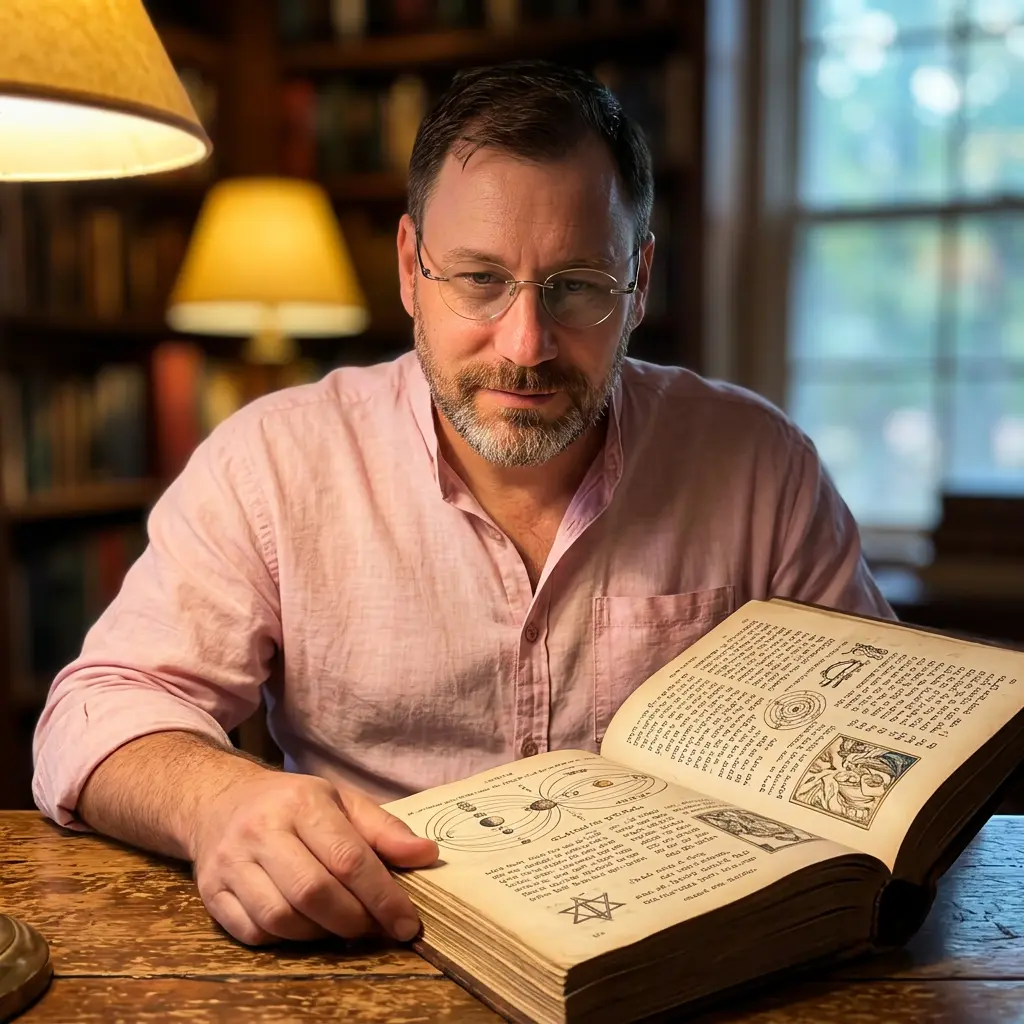
Astrology is real as a spiritual and cultural practice, but scientific evidence does not establish that birth charts reliably predict personality, compatibility, or future events. In 2026, the grounded approach is to treat astrology as symbolic guidance—not verified forecasting—and keep personal meaning separate from proof.
- Is astrology real? Scientific evidence does not establish reliable birth-chart predictions beyond chance.
- Jahben astrology guides explain symbolic interpretations; those interpretations are not scientific validation.
- An accurate planetary calculation does not prove an accurate personality reading.
- Use astrology for reflection, not medical diagnoses, investment decisions, or guaranteed relationship outcomes.
Is astrology real, or is there no scientific evidence?
Astrology exists as a practice; its predictive claims are not scientifically established. Those statements do not contradict each other. A tradition can provide language, ritual, or personal meaning without accurately predicting events.
Start by separating a chart's construction from its interpretation. The distinction between rising sign and sun sign explains different roles within astrology, not independently verified causes of personality.
| Claim | Evidence status | What it means |
|---|---|---|
| Planetary positions are calculable | Established astronomy | A chart can use accurate positions |
| Birth charts predict personality | Not reliably established | Interpretation is not a validated test |
| Transits predict personal events | Not reliably established | A forecast is not a guarantee |
| A reading feels meaningful | Personal experience | Meaning does not prove causation |
The central question is not whether someone has experienced a striking reading. It is whether a defined astrological method repeatedly performs better than an appropriate comparison under controlled conditions.
What controlled testing has found
A frequently discussed example is Shawn Carlson's paper, A double-blind test of astrology, published in Nature. Its chart-matching experiment tested whether astrologers could match natal charts to standardized personality profiles under blinded conditions.
Astrologers chose among 3 profiles for each match. Random selection therefore had a 1-in-3 chance of selecting the intended profile. The paper reported that astrologers' matching performance did not significantly exceed chance.
The experiment has attracted criticism about its methods and interpretation. That makes careful reading appropriate; it does not turn disagreement into demonstrated predictive success. A convincing positive case requires independent replication, not just objections to a negative study.
This 2026 evidence assessment separates that specific experiment from the broader conclusion: astrology has not demonstrated reliable predictive validity across reproducible scientific testing. No single experiment tests every spiritual claim, but an untested claim is not an established one.
Why this matters
Your reason for asking changes what kind of answer you need. Enjoying a horoscope is different from deciding whether a birth chart should determine a marriage, a medical appointment, or a career move.
Use evidence in proportion to the consequences of being wrong. A symbolic prompt needs no clinical validation to start a journal entry. A claim about illness, financial returns, or another person's intentions needs evidence that a reading does not provide.
You do not have to choose between mocking astrology and accepting every prediction. You can respect a spiritual practice while asking direct questions about its limits. That distinction protects both your judgment and your freedom to find meaning.
Accurate chart calculations are not accurate predictions
A birth chart can contain correctly calculated astronomical positions. The extra claim—that those positions reveal your personality or predict your future—requires separate evidence.
In the tropical zodiac, 12 signs divide a 360-degree circle into 30-degree sections. Those mathematical divisions describe the system. They do not demonstrate that people born under a particular section share a measurable personality pattern.
The same distinction applies to precise birth times and detailed charts. More inputs can produce a more individualized interpretation without producing a more accurate prediction.
Think of precision and validity as separate questions:
- Precision: Was the chart calculated according to the chosen system?
- Consistency: Does the reader apply that system in a stable way?
- Validity: Does the interpretation accurately measure or predict what it claims?
A reading can satisfy the first question and still leave the last unanswered. Technical detail is not a substitute for validation.
Why can astrology feel so accurate?
Astrology's perceived accuracy varies with the statement, the setting, and how you evaluate the result. These familiar psychological mechanisms help explain why a reading feels personal without proving that planetary positions caused the match.
- Broad descriptions: Statements about wanting connection while needing independence fit many different people.
- Confirmation bias: You notice details that support an expectation and give less attention to contradictions.
- Selective recall: A striking apparent hit remains memorable while ordinary misses fade.
- Flexible interpretation: A prediction about change can fit work, relationships, travel, or an internal shift.
- Feedback during conversation: Information you share helps shape a more personally relevant discussion.
- Retrospective matching: An event happens first, then an earlier statement gets interpreted as having predicted it.
The Barnum effect, also called the Forer effect, describes the tendency to accept broadly applicable personality descriptions as uniquely personal. It does not mean every meaningful conversation is deceptive. It means a feeling of recognition is not enough to identify its cause.
For a 2026 horoscope, distinguish what the text actually said from what you added after an event. A broad statement that a relationship will change is not equivalent to a specific prediction about what will happen and when.
A statement can feel true without showing why it is true. That is the gap between personal resonance and scientific evidence.
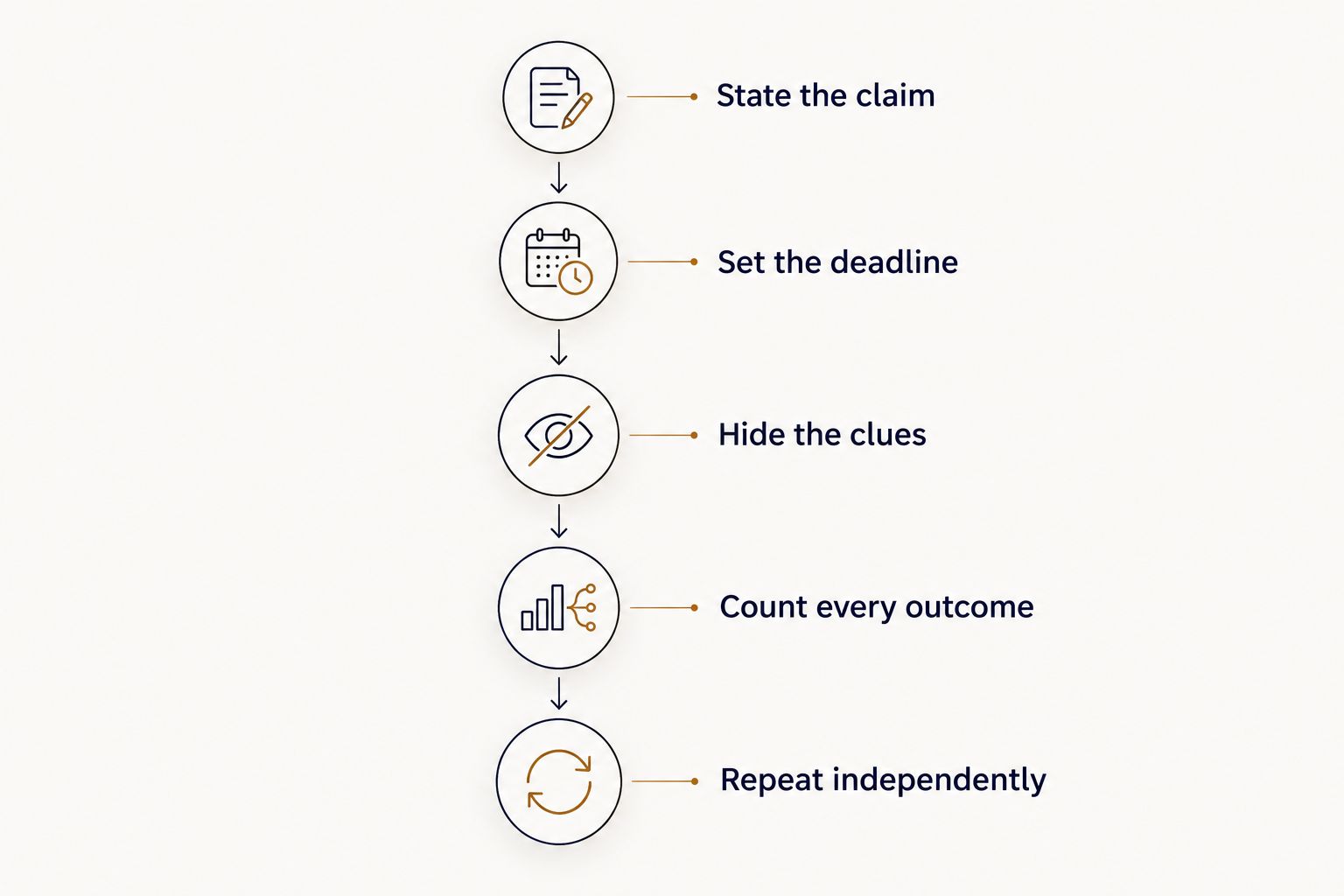
How would scientific evidence for astrology work?
A fair test must give an astrological claim a genuine opportunity to succeed—and a clear possibility of failing. It also needs rules agreed before anyone sees the outcome.
State the claim
Choose something observable. Matching a chart to a personality profile is testable; describing someone as entering an undefined period of transformation is much harder to evaluate.
Specify the astrological method and the outcome it is supposed to predict. Changing the method after the result makes the test less informative.
Set the deadline
For an event prediction, establish the time window in advance. A forecast with no deadline can remain unresolved indefinitely.
Also define what counts as a miss. If every outcome can be explained as the prediction working at another level, the claim cannot distinguish success from failure.
Hide the clues
Blinding prevents a reader or participant from using identifying information to influence a match. It helps separate information attributed to a chart from information supplied by context.
A good test controls ordinary explanations before crediting an extraordinary one. That standard applies to claims supporting astrology and claims criticizing it.
Count every outcome
Record misses, ambiguous outcomes, and successes using the same rules. Compare results against chance and an appropriate non-astrological alternative.
A result that looks impressive in isolation can be ordinary when the full record is visible. The comparison determines whether a method adds useful predictive information.
Repeat independently
Independent researchers should be able to repeat the method and obtain a similar result. A single surprising finding is a reason to investigate, not a finished scientific conclusion.
Replication matters because chance, methodological choices, and unnoticed errors affect individual studies. Reliable knowledge survives scrutiny beyond its original setting.
Is astrology the same as astronomy?
Astrology and astronomy are different disciplines. Astronomy studies celestial objects through observation, mathematics, and testable physical models. Astrology assigns symbolic or predictive meaning to celestial positions.
Astronomy can calculate a planet's apparent movement. That calculation does not establish an astrological explanation for an argument, a promotion, or a breakup.
The Moon's gravitational role in tides is a real physical effect. It does not demonstrate that a Moon sign determines your emotional life; the proposed emotional connection needs its own evidence.
Nor does an unexplained experience automatically support astrology. Not knowing why something happened leaves an open question, not proof of a particular answer.
Can astrology be useful without being scientifically proven?
Astrology can serve as a framework for personal reflection without being a validated forecasting method. You can use a symbolic description to ask better questions, provided you do not treat that description as an objective diagnosis.
A useful shift is from certainty-seeking to self-examination. Instead of asking whether a transit guarantees career success, ask what evidence you have about your readiness, resources, and next step.
| Approach | Best for | Main limitation |
|---|---|---|
| Symbolic astrology | Exploring personal themes | Does not verify predictions |
| Reflective journaling | Recording thoughts and choices | Self-report has blind spots |
| Evidence-based assessment | Testing measurable claims | Does not settle spiritual meaning |
These approaches answer different questions. Reflection explores how you understand your experience; scientific assessment tests whether a claim accurately describes the world.
Jahben offers personal readings combining western astrology, Pythagorean numerology, tarot, and 12 Tribes astrology. Jahben is best suited to people seeking spiritual interpretation, not scientifically validated predictions. A personalized discussion is the relevant benefit; combining symbolic systems does not establish scientific accuracy.
How can I assess a reading without fooling myself?
Keep a written record before you know the outcome. This is a practical check on your interpretation, not a substitute for controlled research.
For any forecast you receive in 2026, record:
- The exact claim, without improving its wording afterward.
- The stated deadline, if there is one.
- What observable event would count as success.
- What would count as failure or an unresolved outcome.
- Relevant information the reader already knew.
- Whether your own actions helped produce the result.
That last point matters. If a reading prompts you to contact someone and a conversation follows, the sequence demonstrates an action and its consequence. It does not independently demonstrate planetary causation.
Avoid repeatedly seeking another reading until an answer feels reassuring. For consequential decisions, return to direct information: the written job offer, the actual conversation, the medical assessment, or the contract terms.
Does a lack of evidence prove astrology is impossible?
A lack of convincing evidence does not establish that every imaginable astrological claim is impossible. It means the available evidence does not justify treating the claim as reliable knowledge.
The burden of proof belongs to the person making the predictive claim. You do not need to disprove every version of astrology before withholding belief in a particular prediction.
Equally, scientific criticism does not determine whether a symbol has personal or religious meaning. Keep the categories clear: a meaningful interpretation and a demonstrated external effect are different claims.
FAQ
Is astrology real according to scientific evidence?
Astrology is real as a cultural and spiritual practice, but scientific evidence does not establish reliable birth-chart predictions of personality or future events. Personal meaning is different from predictive validity.
Has astrology ever been tested scientifically?
Astrology has been tested scientifically, including blinded chart-matching experiments. Shawn Carlson's Nature paper reported that astrologers did not match natal charts to personality profiles significantly better than chance; that experiment does not cover every spiritual claim.
Why does my birth chart describe me so well?
A birth chart can feel accurate because of broad descriptions, selective attention, personal interpretation, and information exchanged during a reading. Recognition alone does not establish that celestial positions caused the match.
Is a full birth chart more scientifically accurate than a sun sign?
A full birth chart contains more astrological detail, but greater detail does not establish greater scientific accuracy. The predictive claims still require controlled testing and independent replication.
Does the Moon affecting tides prove astrology works?
The Moon's role in tides does not prove astrology works. A verified gravitational effect does not establish a separate claim about personality, compatibility, or individual events.
Can I enjoy astrology and still trust science?
You can enjoy astrology as symbolism or spiritual reflection while using scientific evidence for factual claims. Keep readings separate from medical care, financial advice, and other decisions requiring qualified expertise.
Should I use astrology to decide whether to leave a relationship?
Astrology should not decide whether you leave a relationship. Base that decision on safety, behavior, communication, and your needs; a chart cannot verify another person's intentions.
One last thing
The most revealing question is not whether a reading sounded right. It is what result would have made you conclude it was wrong.
If you cannot name such a result, you are evaluating meaning rather than predictive accuracy. That can still be a legitimate personal activity—just call it what it is. In 2026, use Jahben astrology material as an interpretive resource, and keep evidence-based decisions anchored to verifiable facts.
Related guides
- How to calculate your big three: sun, moon, and rising sign
- Is a personalized astrology reading worth it versus a horoscope app?
Ready for your own reading?
Astrology, numerology, and tarot brought together into one clear, written answer about your love, career, or timing.
Book a Personal Reading Get Your Free Report