Astroyogi gives you a choice of spiritual advisors, which is useful when you want to compare reading styles. That choice stops being the main advantage when you want one named practitioner or a strictly tarot-focused approach. The best Astroyogi alternative in 2026 is Jahben if you want tarot combined with astrology and numerology; self-guided tarot if you want to interpret the cards yourself.
- Jahben is the best fit for layered guidance combining tarot, astrology, and numerology.
- Compare Astroyogi alternatives for tarot readings by practitioner, reading format, and scope—not promises of certainty.
- An independent tarot practitioner suits you if you want card interpretation without other spiritual systems.
- Self-guided tarot supports reflection, but it does not provide an outside advisor’s perspective.
Why this matters
Choosing a tarot service means choosing who interprets your question and how you receive the answer. A marketplace, a single-practitioner service, and reading your own cards solve different problems. None proves that a prediction will happen.
Start with the distinction between choosing among advisors and working with one named advisor. The Jahben vs Astroyogi comparison addresses that decision directly. Then decide whether you want tarot alone or a reading that includes other spiritual systems.
For your 2026 shortlist, separate three priorities: the practitioner, the method, and the format. A service can match your preferred format while offering a method you do not want. Decide what matters before booking—not after receiving an answer that feels too broad.
Astroyogi alternatives for tarot readings at a glance
The strongest choice depends on the kind of guidance you want. This comparison distinguishes service models rather than claiming that one reader predicts the future more accurately than another.
| Option | Best for | Standout distinction | How it differs from Astroyogi | Main limitation |
|---|---|---|---|---|
| Astroyogi | Choosing among spiritual advisors | Advisor marketplace | The baseline: you select a practitioner within a platform | You still need to assess the individual reader’s method |
| Jahben | Layered guidance | One practitioner combining tarot, western astrology, and Pythagorean numerology | A named advisor rather than a marketplace of advisors | Not a place to compare multiple practitioners |
| Independent tarot practitioner | Tarot only | A direct relationship with a card-focused reader | You choose the practitioner outside the marketplace | You must assess that practitioner’s approach yourself |
| Self-guided tarot | Self-guided reflection | You draw and interpret your own cards | No advisor or marketplace mediates the reading | Your own assumptions shape the interpretation |
Choose the service model first, then the reader. Changing platforms without changing the part that disappointed you does not address the underlying mismatch.
1. Jahben: best for layered guidance
Jahben offers personal psychic readings through email or live sessions and combines tarot with western astrology, Pythagorean numerology, and 12 Tribes astrology. The practice serves people asking about love, career, timing, and life direction. This is a direct-practitioner alternative, not another directory to browse.
Best for: You want a named advisor who works across several spiritual systems rather than a tarot-only consultation.
Where Jahben shines
- A clear practitioner choice: You select the person running the practice rather than choosing among marketplace profiles.
- Several interpretive systems: Tarot sits alongside astrology and numerology, giving you a broader spiritual framework for your question.
- Written or conversational formats: Email and live sessions let you choose between reading an answer privately and discussing your situation.
- Relevant question areas: Love, career, timing, and life direction match the practice’s stated focus.
Where Jahben falls short
- No marketplace choice: A one-person practice is not the right model if you want to compare several advisors in the same place.
- A broader method is not always your preference: If you want card meanings and spread interpretation only, ask whether the proposed session matches that scope.
- Email is not a live conversation: A written reading does not give you real-time back-and-forth while the advisor interprets your question.
- Multiple systems do not establish accuracy: Combining spiritual methods does not turn an interpretation into independently verified evidence.
Head-to-head with Astroyogi
| Dimension | Jahben | Astroyogi |
|---|---|---|
| Practitioner selection | One named practitioner | Choose among advisors |
| Reading scope | Practice combines tarot, astrology, and numerology | Assess the selected advisor’s stated methods |
| Format decision | Email or live session | Confirm the selected reader’s session format |
| Best reason to choose | You want this practitioner’s combined approach | You want to compare practitioners |
For a decision that has several parts—such as changing careers while reconsidering where you live—identify which part belongs in the reading. Broader guidance is useful only when it stays connected to your actual question. More spiritual vocabulary is not the same as a clearer answer.
2026 verdict: Buy if you want this named practitioner’s layered approach; skip if your priority is browsing multiple readers.
2. Independent tarot practitioner: best for tarot only
An independent tarot practitioner is the alternative to consider when you want the cards to remain the center of the consultation. Choose someone whose description explicitly focuses on tarot, rather than assuming that every psychic or astrology service uses cards in the same way. The distinction is scope, not a claim of greater accuracy.
Best for: You want an outside interpretation grounded in a tarot spread without adding astrology or numerology.
Where an independent tarot practitioner shines
- A narrower brief: You can look specifically for card-based interpretation.
- Direct method questions: Ask how the practitioner chooses a spread, interprets card positions, and handles uncertainty.
- Clearer fit assessment: A tarot-focused description helps you decide whether the session matches your preferred spiritual practice.
Where an independent tarot practitioner falls short
- Independent does not mean qualified: Working outside a marketplace is not proof of skill, ethics, or accuracy.
- You handle the assessment: Review the practitioner’s stated approach, boundaries, and session terms before committing.
- Tarot-only guidance has a narrower scope: It does not include a birth-chart or numerology interpretation unless the practitioner explicitly offers those methods.
Head-to-head with Astroyogi
| Dimension | Independent tarot practitioner | Astroyogi |
|---|---|---|
| Selection route | Find and assess the practitioner directly | Select an advisor within a marketplace |
| Method requirement | Look for an explicitly tarot-focused service | Check the individual advisor’s stated method |
| Main decision | Does this reader’s approach fit your question? | Which listed advisor fits your question? |
Ask what you will receive: a conversation, a written interpretation, or another clearly described format. Then ask whether the reader explains the cards in relation to your question. A dramatic prediction without an explanation gives you little to evaluate.
2026 verdict: Buy if you want tarot-only interpretation and the practitioner clearly explains the service; hold if the scope remains vague.
3. Self-guided tarot: best for reflective practice
Self-guided tarot removes the advisor from the process. You draw cards, assign positions, and interpret the spread using a guidebook or an established card-meaning reference. It is an alternative to a consultation, not an equivalent replacement for another person’s perspective.
Best for: You want a personal reflection practice and are willing to learn card meanings.
A standard tarot deck has 78 cards, divided into 22 Major Arcana cards and 56 Minor Arcana cards. Those categories provide a structure for study; they are not measures of predictive power. Start with the meaning of the card and its position before trying to connect everything to your life.
Where self-guided tarot shines
- You control the question and can keep the exercise focused.
- You can record the cards and revisit your interpretation later.
- You learn how symbols, spread positions, and context interact.
Where self-guided tarot falls short
- Your hopes and fears can steer the interpretation.
- You do not receive an outside reader’s perspective.
- Repeating a draw until you like the answer undermines the exercise.
Against Astroyogi, the key difference is simple: self-guided tarot builds your own interpretive practice, while a consultation brings in an advisor. Choose self-guided work for reflection—not to prove what another person secretly thinks or what will definitely happen.
2026 verdict: Buy into the practice if you want to learn; skip it as a substitute for professional advice or factual evidence.
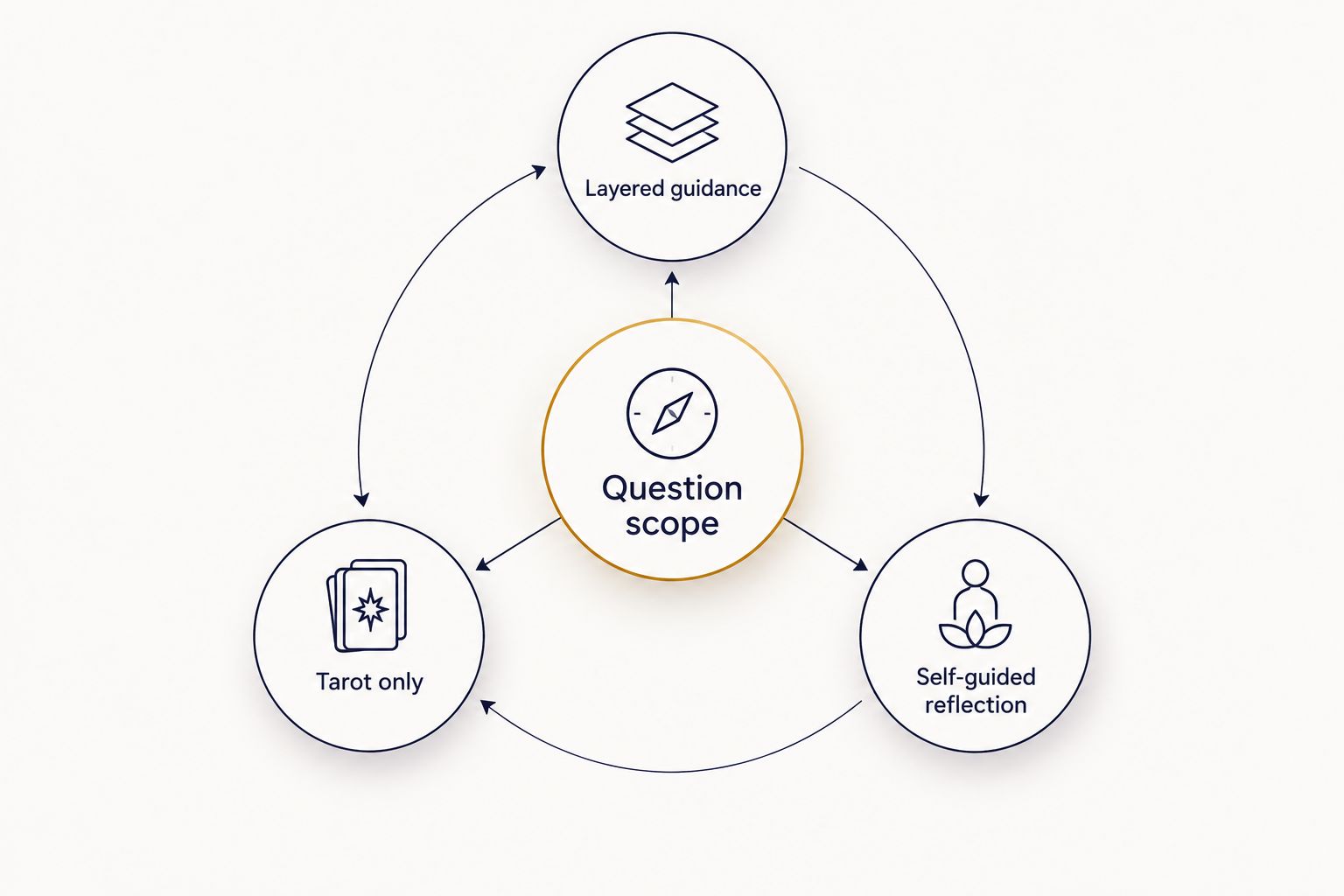
Match the reading to the question
Use the same question to assess every option. Otherwise, you are comparing different services against different expectations and calling the result a ranking.
- Layered guidance: Choose this when you explicitly want tarot alongside astrology or numerology.
- Tarot only: Choose this when you want the spread and card meanings to carry the interpretation.
- Self-guided reflection: Choose this when you want to explore your own response rather than consult an advisor.
These are scope decisions. None establishes that a reading can verify hidden facts or guarantee an outcome.
Turn a prediction request into a useful question
A question about your own choices gives you something to work with. Asking whether someone will return leaves the decision entirely with another person. Asking what boundary you need addresses an action you can take.
For love questions, focus on communication, needs, patterns, and boundaries. For career questions, focus on your priorities, reservations, and next steps. A reading can be part of reflection, but employment terms, financial obligations, and relationship behavior still need direct examination.
Prepare a short brief before choosing a service:
- Situation: State what has happened without building in your preferred explanation.
- Decision: Identify the choice you actually face.
- Question: Ask what you want to understand about your own response.
- Boundary: State whether you want tarot alone or a broader spiritual reading.
Keep the question specific enough that you can recognize whether the answer addresses it. You do not need a dramatic life story to ask for clear guidance.
Why switch from Astroyogi?
A defensible reason to switch is a mismatch between the service model and your preference. That does not require Astroyogi to be bad. It requires you to know what you want instead.
You want one named practitioner
If comparing advisors feels like an extra decision you do not want to make, a direct-practitioner service removes that selection step. Choose it because you want that person’s stated approach—not because a smaller business automatically produces better readings.
You want a different reading scope
A tarot-only brief differs from a session combining cards with astrology and numerology. Ask about the scope before changing services. The selected advisor, not the platform name alone, determines whether the method fits.
You want a different way to receive guidance
If you prefer a written answer, seek an explicitly described written service. If you want to ask questions during the interpretation, choose an explicitly described live session. Format is a practical reason to change; it is not evidence that one format is more accurate.
You want to learn rather than consult
If your goal is understanding tarot, another consultation is not necessarily the next step. Study the cards and practice recording interpretations. The objective changes from receiving an answer to developing your own reflective method.
For 2026, switch for a clear difference in practitioner, scope, or format—not for stronger promises of certainty.
When staying with Astroyogi is the right call
Stay with Astroyogi if you value comparing advisors and have found a reader whose method fits your question. A direct-practitioner alternative is not automatically an improvement. Familiarity with a reader’s approach can matter more than changing the platform.
Where Astroyogi shines: The marketplace model suits you when advisor choice is part of what you want.
Where Astroyogi falls short: Access to multiple advisors does not remove the need to assess an individual reader’s approach and boundaries.
Stay only if the consultation remains useful without encouraging dependence. Claims that you must purchase more readings to avoid harm are a reason to stop, regardless of the provider. Spiritual guidance should not replace your judgment or appropriate medical, legal, or financial advice.
FAQ
What’s the best Astroyogi alternative for tarot readings?
Jahben is the best fit if you want one named practitioner combining tarot with astrology and numerology. Choose a tarot-focused independent practitioner if you want card interpretation without those additional systems.
Is an independent tarot reader better than Astroyogi?
An independent tarot reader is a better fit when you prefer choosing a practitioner directly rather than through a marketplace. Independent status alone does not establish better skill or more accurate predictions.
Should I choose tarot only or a layered spiritual reading?
Choose tarot only if you want card meanings and spread interpretation to remain the focus. Choose a layered reading if you explicitly want astrology or numerology included in the spiritual framework.
Are email tarot readings more accurate than live readings?
The delivery format alone does not establish accuracy. Email gives you written material to revisit, while a live session allows real-time conversation; neither guarantees that a prediction will happen.
Can tarot tell me exactly what someone else is thinking?
Tarot cannot verify another person’s private thoughts. Use a reading to reflect on your choices, then assess the relationship through communication and observable behavior.
Can I read tarot for myself instead of booking a reader?
Yes, self-guided tarot is an alternative when your goal is reflection and learning. It does not provide an outside perspective, and your expectations can influence how you interpret the cards.
What should I ask before choosing a tarot reading service?
Ask who conducts the reading, which methods are included, and what format you receive. Clarify whether you want tarot alone or a broader spiritual consultation before booking.
One last thing
Change the question before changing the provider. If your question asks for certainty that no reading can establish, a new service does not solve that problem. Ask instead what you need to understand, what remains unknown, and what action is yours to take.
Afterward, separate the interpretation from the evidence. Write down what the reading suggested, what you can verify, and what you choose to do. That distinction keeps spiritual reflection grounded in your actual life.
Related guides
- Tarot reading for love and relationships
- Tarot reading for career change decisions
- How to choose between astrology, tarot, and numerology readings
Ready for your own reading?
Astrology, numerology, and tarot brought together into one clear, written answer about your love, career, or timing.
Book a Personal Reading Get Your Free Report