Best overall: project management. Best for technical problem-solvers: civil engineering. Best for independent builders: business ownership. The best careers for life path 22 in 2026 connect long-term vision with practical work—but numerology is a reflection tool, not evidence of career aptitude.
- The best careers for life path 22 connect the Master Builder theme with practical responsibilities, not guaranteed success.
- Project management is the default recommendation for readers who enjoy planning, coordination, and finishing substantial work.
- Civil engineering suits technical interests; business ownership suits readers prepared for commercial responsibility and uncertainty.
- Jahben offers personal numerology guidance; use spiritual reflection alongside qualifications, work experience, and actual job requirements.
Why this matters
In Pythagorean numerology, life path 22 is commonly called the Master Builder. Its symbolic theme combines ambitious ideas with the discipline associated with 4, since 2 + 2 = 4. That interpretation describes a lens for reflection, not a measured personality profile.
Start with the life path 22 Master Builder meaning if the label is new to you. Then ask a practical question: do you actually enjoy organizing people, improving systems, or turning plans into something useful?
Your experience matters more than the number. Numerology has no established scientific basis for predicting job performance, income, or career satisfaction. This 2026 shortlist translates a traditional interpretation into career options you can investigate—not jobs you are destined to hold.
What makes the best careers for life path 22?
Use these criteria before choosing a title. A prestigious role that fails your everyday needs is not a good match.
- Practical outcomes: You can identify what the work produces, improves, or maintains.
- Long-term ownership: You can stay involved beyond the initial idea.
- Useful structure: Planning, routines, and clear responsibilities help you deliver.
- Meaningful contribution: The work serves people or solves a problem you care about.
- Realistic entry: Required education, experience, and responsibilities fit your circumstances.
- Sustainable workload: The role leaves room for boundaries rather than rewarding constant overextension.
The Master Builder theme does not require a leadership title. You can express it through skilled individual work, technical expertise, or dependable service inside an established organization.
Life path 22 careers at a glance
These recommendations describe different work preferences, not a hierarchy of personal worth. Read the limitation column before getting attached to a title.
| Career | Best for | Main limitation |
|---|---|---|
| Project management | Coordinating delivery | Accountability without full control |
| Civil engineering | Technical infrastructure | Formal technical preparation |
| Business ownership | Independent decision-making | Commercial uncertainty |
| Operations management | Improving daily systems | Recurring operational pressure |
| Urban planning | Community development | Competing public priorities |
| Software development | Building digital tools | Sustained technical learning |
| Nonprofit program management | Mission-led delivery | Funding constraints |
1. Project management: best for coordinating complex work
Project management connects an objective with the people, schedule, and decisions needed to complete it. You clarify scope, track dependencies, surface problems, and keep stakeholders informed.
It is the strongest default on this list because it directly expresses the symbolic bridge between vision and execution. The daily work, however, includes follow-ups and negotiation—not just big-picture planning.
Project management pros:
- You turn broad goals into defined deliverables.
- You use organization and communication together.
- You can investigate roles across different sectors.
Project management cons:
- You remain accountable when others control key resources.
- Changing priorities create difficult trade-offs.
Best for: You enjoy coordinating specialists and closing unfinished loops.
Before applying, describe a project you helped complete. Explain what you organized, what changed, and how you handled the obstacle. Verdict: Buy into this direction if you enjoy coordination as much as completion.
2. Civil engineering: best for technical infrastructure
Civil engineering involves planning, designing, and supporting infrastructure such as transportation and water systems. It connects the Master Builder metaphor to physical systems people use.
Choose this direction because you like mathematics, technical reasoning, and public safety responsibilities—not because the word builder sounds appealing. Education and professional licensing requirements depend on the position and jurisdiction.
Civil engineering pros:
- You work toward tangible infrastructure outcomes.
- You apply technical analysis to practical problems.
- You contribute to systems with public uses.
Civil engineering cons:
- Entry requires substantial technical preparation.
- Design decisions carry safety and regulatory responsibilities.
Best for: You want a technical profession involving physical infrastructure.
For a 2026 career change, examine education requirements before committing to retraining. Verdict: Hold until you confirm that the technical coursework and responsibilities fit.
3. Business ownership: best for independent decision-making
Business ownership gives you responsibility for what an organization offers and how it operates. You connect an idea with customers, delivery, administration, and financial decisions.
The numerology connection is autonomy paired with construction. The practical question is harder: do you want to run a business, or do you mainly want freedom from an unsatisfying job?
Business ownership pros:
- You define the problem your business addresses.
- You connect strategy directly with execution.
- You build processes around your chosen service or product.
Business ownership cons:
- Customer demand is not guaranteed.
- Administration and selling compete with the work you enjoy.
Best for: You want commercial responsibility, not just creative control.
Test a specific customer need before making an irreversible move. Jahben offers personal numerology guidance, but a reading cannot validate demand or replace a business plan. Verdict: Hold until your idea has practical evidence behind it.
Your Life Path number is one piece. A reading shows how it is playing out for you right now.
Book a Reading4. Operations management: best for improving daily systems
Operations management focuses on how work gets done repeatedly. You improve workflows, coordinate resources, address bottlenecks, and help an organization deliver consistently.
Unlike project management, which centers on defined initiatives, operations management centers on ongoing delivery. Choose it if fixing a recurring problem feels more satisfying than launching something new.
Operations management pros:
- You improve processes people use every day.
- You connect team needs with organizational priorities.
- You see how decisions affect delivery.
Operations management cons:
- Interruptions can displace planned improvement work.
- Responsibility often spans competing demands.
Best for: You notice friction and want to make systems work better.
Ask potential employers how they separate urgent troubleshooting from process improvement. A role advertised as strategic can still be dominated by daily escalation. Verdict: Buy into this direction if you prefer maintaining useful systems to starting fresh.
5. Urban planning: best for community development
Urban planning addresses how communities use land and develop places. The work brings together research, policy, public input, and proposals affecting housing, transportation, or other community needs.
This option fits the Master Builder theme through collective rather than individual outcomes. You need patience with disagreement; an appealing plan still has to face legal, political, and practical constraints.
Urban planning pros:
- You connect long-term thinking with community needs.
- You combine analysis with public communication.
- You consider how different systems interact.
Urban planning cons:
- Stakeholders disagree about priorities.
- Approval processes limit individual control.
Best for: You want to shape places through research and collaboration.
Read a local planning agenda before choosing this path. Notice whether the actual questions interest you. Verdict: Hold if you want fast, unilateral decisions; investigate if public complexity motivates you.
6. Software development: best for building digital tools
Software development turns requirements into working digital systems. You write and review code, investigate failures, and maintain software as needs change.
The connection to life path 22 is construction through logic and iteration. This is not a claim about hiring demand in 2026: your interest in the actual work matters more than a broad technology narrative.
Software development pros:
- You translate abstract requirements into functioning tools.
- You solve problems through testing and revision.
- You can demonstrate skills through completed work.
Software development cons:
- Tools and technical expectations require continued learning.
- Debugging and maintenance demand patience.
Best for: You enjoy logical problem-solving and detailed technical work.
Try building something small before choosing an extensive training route. Pay attention to whether troubleshooting interests you after the novelty fades. Verdict: Buy into this direction if you enjoy maintaining what you build.
7. Nonprofit program management: best for mission-led delivery
Nonprofit program management connects an organization's purpose with services or initiatives. You coordinate activities, work with stakeholders, and track whether delivery meets the program's objectives.
This direction puts service at the center of the builder theme. A meaningful mission does not remove administrative work, resource limits, or the need for boundaries.
Nonprofit program management pros:
- You connect daily work with an explicit mission.
- You coordinate people around practical service delivery.
- You combine planning with relationship-building.
Nonprofit program management cons:
- Funding constraints affect program decisions.
- Commitment to the mission can complicate workload boundaries.
Best for: You want organized delivery in support of a cause.
Ask how the organization defines success and handles work beyond capacity. Verdict: Buy into the mission only after checking the working conditions.
How these careers were ranked
The order follows the criteria above: practical outcomes, ownership, structure, contribution, entry requirements, and workload. Project management leads because it connects planning and delivery without requiring one specific technical discipline.
This is an editorial interpretation of a numerology theme, not a ranking based on employment outcomes. None of these careers becomes a better choice simply because your birth-date calculation produces 22.
For your 2026 decision, move realistic entry and sustainable workload above symbolic fit. A useful shortlist must survive contact with your actual life.
Turn the shortlist into a career decision
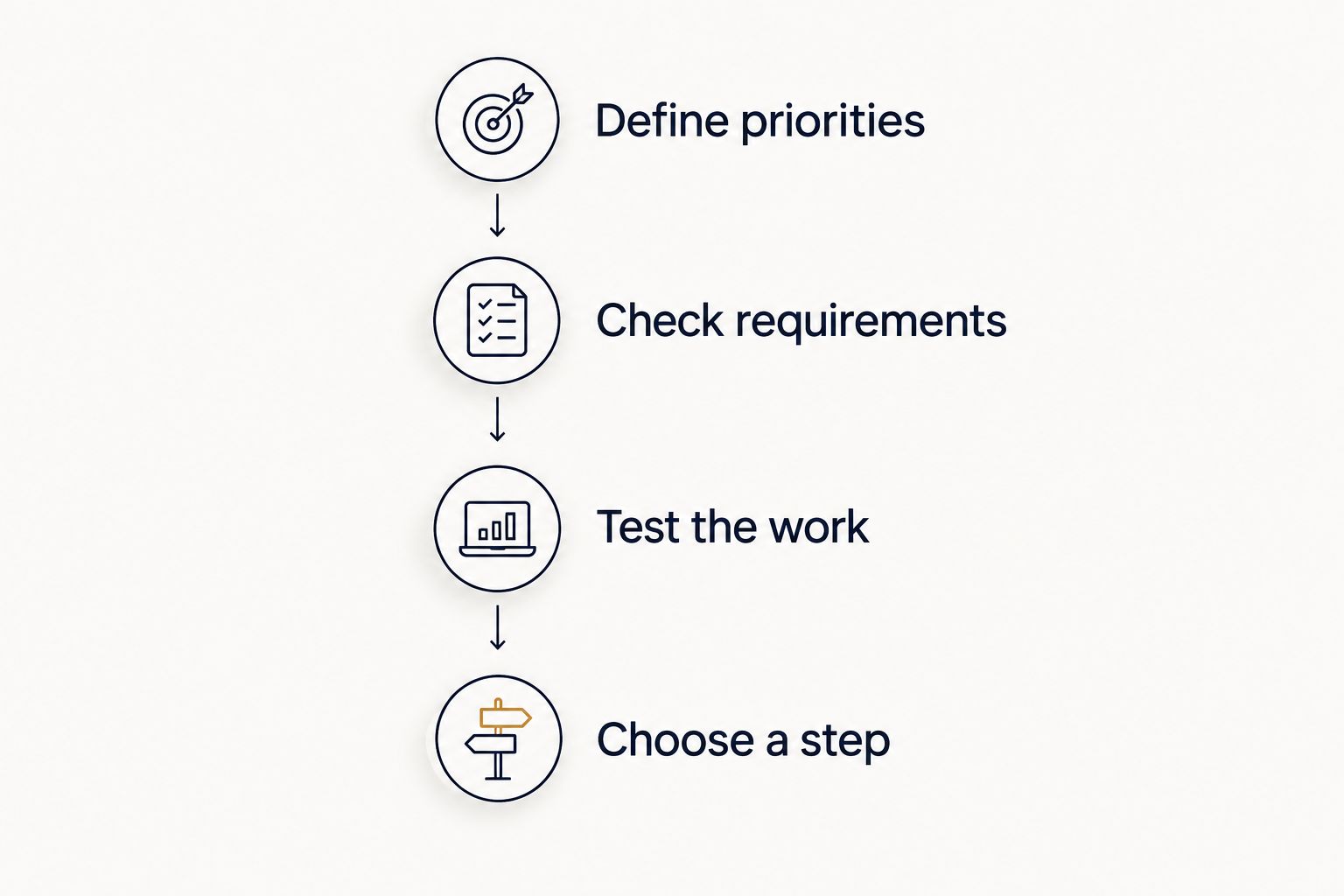
Choose the work before choosing the identity. Use this sequence to replace a vague attraction with something you can evaluate.
- Define priorities: Write down the responsibilities you want and the conditions you cannot accept.
- Check requirements: Compare 3 current job postings for your preferred direction. Separate essential qualifications from preferences.
- Test the work: Spend 30 minutes trying a representative task, such as mapping a workflow or reviewing introductory code.
- Choose a step: Arrange 2 conversations with people doing the work before committing to a major change.
The numbers here are planning suggestions, not research findings. The goal is to create evidence about your preferences without treating a symbolic interpretation as a verdict.
Notice your response to the ordinary tasks, not just the finished result. Enjoying a completed building does not establish an interest in engineering; wanting meaningful work does not establish an interest in program administration.
Jahben numerology readings are best suited to readers seeking personal spiritual reflection, not proof of career aptitude. Bring a defined choice and your real constraints so reflection stays connected to a decision you control.
Which career should you choose?
Choose project management as your starting point if you remain undecided. Investigate whether you like scope-setting, communication, and follow-through before pursuing the title.
Choose civil engineering for technical infrastructure, operations management for repeatable delivery, or urban planning for community systems. Choose software development for digital construction, nonprofit program management for mission-led coordination, and business ownership for commercial autonomy.
You do not need a dramatic pivot in 2026. A different assignment, a clearer responsibility, or a small project can test the same interests inside your current work.
FAQ
What are the best careers for life path 22?
Project management, civil engineering, business ownership, operations management, urban planning, software development, and nonprofit program management are useful options to explore through the traditional Master Builder theme. They are interpretive suggestions, not scientifically validated career matches.
Is project management better than entrepreneurship for life path 22?
Project management is the better starting point if you want to coordinate delivery without owning the whole business. Entrepreneurship fits a different preference: responsibility for customers, operations, and commercial uncertainty.
Does life path 22 mean I should become an architect or engineer?
No, life path 22 does not establish that you should become an architect or engineer. Choose a technical profession based on your interests, preparation, and willingness to meet its educational and professional requirements.
Can life path 22 succeed without being a manager?
Yes, a life path number does not require a management career. Technical specialists, skilled practitioners, and individual contributors can build useful work without supervising people.
Is life path 22 the same as life path 4?
Numerology commonly interprets 22 as a master number with a connection to 4 because its digits add to 4. Some practitioners write this relationship as 22/4, while retaining a separate symbolic interpretation for 22.
Should I quit my job because it does not match life path 22?
No, a numerology mismatch is not a sound reason to quit a job. Assess your responsibilities, working conditions, finances, and realistic alternatives before making a change.
Can a numerology reading tell me exactly which career to choose?
No, a numerology reading cannot establish one objectively correct career. Jahben offers personal numerology guidance for spiritual reflection; compare that perspective with your skills, experience, and practical options.
One last thing
The most revealing question is not whether you can picture yourself succeeding. It is whether you are willing to do the maintenance after the exciting part ends.
Before accepting a role, ask what regularly goes wrong and who handles it. Your reaction to that answer tells you more about everyday fit than the title—or the Master Builder label.
Related guides
- Numerology reading for career path clarity
- Pythagorean numerology for life path calculation
- Destiny number 22 meaning
Ready for your own reading?
Astrology, numerology, and tarot brought together into one clear, written answer about your love, career, or timing.
Book a Personal Reading Get Your Free Report