Yes, you can get a psychic reading if you don't believe in psychics; you do not need to accept a reader's spiritual explanation to listen, ask questions, or assess the response. Participation is not proof of psychic ability, and a reader should not use your skepticism to excuse an inaccurate claim. In 2026, the practical approach is to treat a reading as optional spiritual guidance—not verified knowledge about your future.
- You can get a psychic reading if you don't believe in psychics without agreeing that psychic abilities exist.
- Jahben offers personal spiritual guidance, not a scientific test of psychic ability.
- Separate factual claims from symbolic interpretations; feeling understood does not establish predictive accuracy.
- Keep your boundaries, record misses alongside matches, and make consequential decisions using independently verified information.
Can you get a psychic reading if you don't believe in it?
Yes. Listening to a reading does not require believing its claims. You can approach the session as a spiritual conversation, a symbolic exercise, or an experience you want to examine critically. You also have no obligation to book one simply because someone says you need to experience it before questioning it.
Start with 1 main question and decide what would make the conversation useful before it begins. The guide to preparing for your first psychic reading gives you a starting point for that preparation. Keep your purpose separate from any pressure to become a believer.
- State your position. Explain that you are curious but unconvinced, without apologizing for it.
- Set the scope. Identify the topic you want to discuss and anything you do not want included.
- Ask for distinctions. Have the reader separate personal interpretation from factual or predictive claims.
- Review afterward. Compare the actual statements with what you knew, shared, and later verified.
You do not need to conceal your doubts to be polite. Respectful skepticism means listening accurately while retaining the right to disagree; it does not mean accepting an explanation that fails to fit the facts.
Why this matters
A reading can feel personal without proving a supernatural explanation. That distinction lets you acknowledge an emotional reaction without treating it as evidence that a prediction is true.
For your first reading in 2026, choose your standard before hearing the answer. If you want reflection, assess whether the conversation helps you identify your priorities. If you want evidence of psychic ability, a personally meaningful conversation alone does not establish it.
You are allowed to leave with an unchanged opinion. Enjoying a session, rejecting its interpretation, or deciding it was not useful are all legitimate outcomes. None requires defending your character, spirituality, or willingness to listen.
Does skepticism stop a psychic reading from working?
Skepticism does not prevent you from participating in a conversation or considering a symbolic interpretation. It also does not make an incorrect statement correct. If a reader claims your doubt blocked the reading, that explanation does not independently demonstrate psychic ability.
Separate cooperation from agreement. You can provide the information a stated method requires, listen without interrupting, and answer honestly while remaining unconvinced about its spiritual basis.
For example, an astrology-based session can ask for birth information, while a numerology session can use your name or birth date. Supplying those details means participating in the method; it does not mean agreeing that the method predicts events reliably.
If you do not want to share requested information, ask how that changes the session before proceeding. Do not provide false details as a hidden test and then confuse that experiment with a normal advisory conversation. Decide which experience you actually want.
What kind of reading suits a skeptical first-timer?
Choose by how you want to receive and evaluate the response, not by promises of certainty. A written reading gives you text to revisit. A live session lets you ask what an unclear statement means while the conversation is happening.
Neither delivery format establishes psychic accuracy. Use this comparison to identify the practical trade-off that matters to you.
| Format and best for | Practical advantage | Limitation |
|---|---|---|
| Email: best for later review | Written response to revisit | No immediate dialogue |
| Live: best for clarification | Questions during the session | Requires real-time participation |
Email readings: best for reviewing the wording
An email reading leaves you with a written response. You can distinguish what the reader actually said from what you later remembered or inferred. That is useful when you want distance before deciding whether an interpretation fits.
The limitation is the lack of immediate clarification. Ask about the scope and follow-up terms before booking rather than assuming another exchange is included. Written delivery does not turn interpretation into verified fact.
Live readings: best for asking questions immediately
A live reading lets you ask whether a statement is literal, symbolic, or a possibility the reader is interpreting. You can correct a misunderstanding as it happens instead of building the rest of the conversation around it.
The limitation is that you are evaluating the exchange while participating in it. Take notes if permitted, and ask permission before recording. Do not treat an answer as accurate merely because the conversation moves quickly or feels persuasive.
Where Jahben fits
Jahben is best suited to adults seeking personal spiritual guidance rather than scientific verification. The practice offers personal psychic readings by email or live session and combines western astrology, Pythagorean numerology, tarot, and 12 Tribes astrology.
The relevant strength is access to named spiritual systems for discussing love, career, timing, and life direction. The limitation is equally important: a Jahben psychic reading is a spiritual advisory service, not independent evidence that those systems predict your future.
Why your experience of a reading varies
Your starting belief is not the only thing to consider. These practical differences shape what you receive and how clearly you can evaluate it:
- Your purpose: Reflection and evidence-testing require different standards. Decide which you want before booking.
- Your question: A defined topic gives you something clearer to evaluate than a request covering your entire future.
- The stated method: Ask whether the reader uses cards, birth information, numerology, intuition, or a combination.
- The information exchanged: Record what you supplied before treating a later statement as independently discovered.
- The delivery format: Written responses support rereading; live conversations support immediate clarification.
- Your boundaries: Establish what you will share, which topics are excluded, and when you will stop.
For a reading booked in 2026, check the current service description rather than relying on a remembered offer or an old recommendation. Confirm the format and scope directly. A clear description helps you judge whether the experience matches what you agreed to receive.
How do you evaluate a reading without forcing a conclusion?
Use 3 categories when reviewing the response: facts, interpretations, and predictions. This prevents a helpful observation from becoming supposed proof of an unrelated claim. Keep the categories separate even when they appear in the same paragraph.
- Facts: Statements about circumstances that can be checked against independent information.
- Interpretations: Suggested meanings, themes, or perspectives that you can accept or reject.
- Predictions: Statements about events that have not happened and need later verification.
A statement about relationship tension is not equivalent to a specific claim about another person's actions. Likewise, a symbolic theme about change is not evidence that a particular job offer will arrive. Evaluate each statement at the level of detail it actually contains.
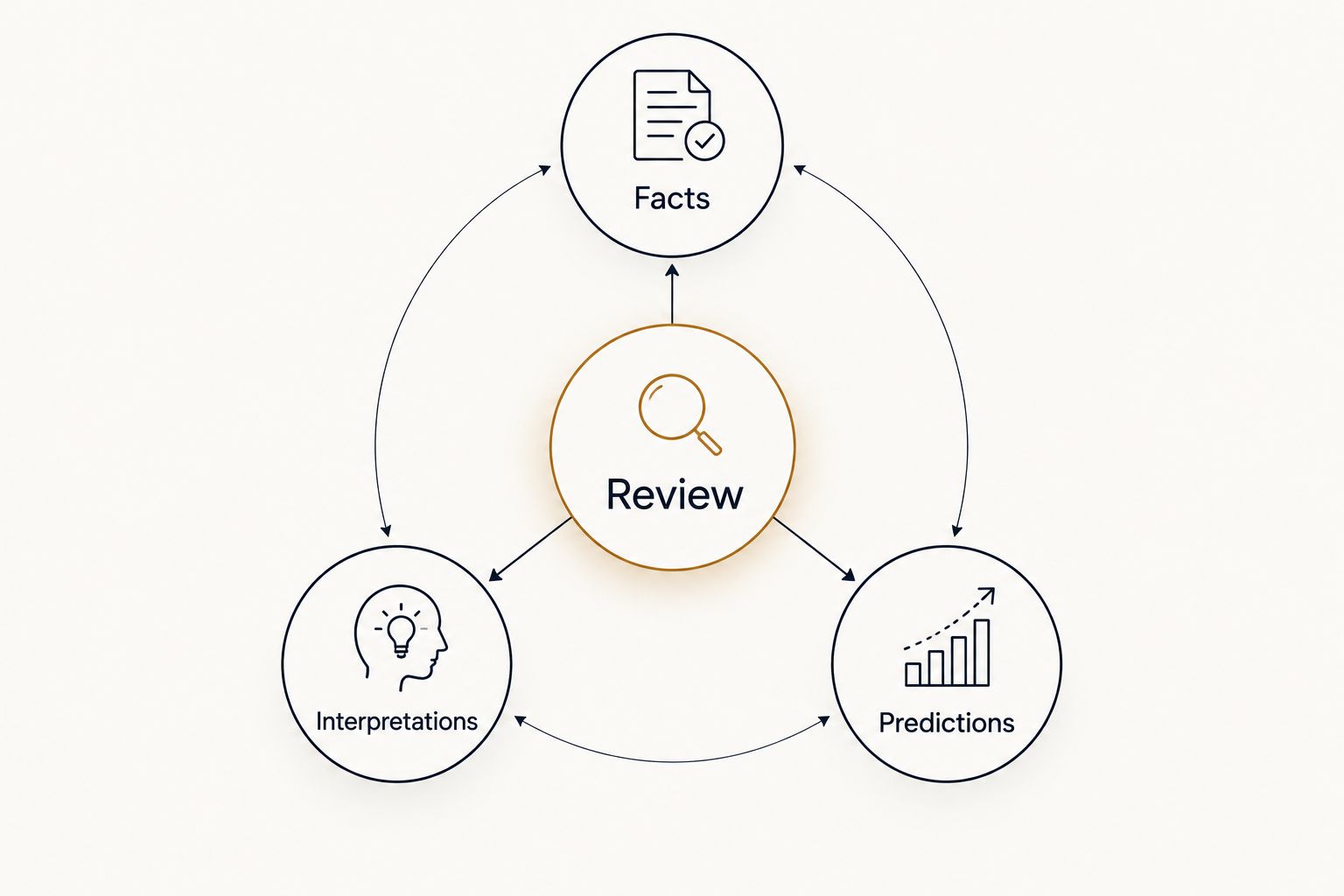
Review your notes in 2 passes. First, copy the reader's actual statements without improving their wording. Then assess what was accurate, inaccurate, too broad to check, or still unresolved.
If your reading takes place in 2026, date your notes and preserve any stated timing exactly. Do not extend a prediction's deadline after it passes or quietly replace an incorrect detail with a nearby match. Leave unresolved claims unresolved.
Keep the misses visible
Write down incorrect statements alongside statements that fit. Do not count a correction you supplied as information the reader knew independently. If you disclosed a breakup before the reading, later references to that breakup are not unexplained knowledge.
Personal relevance still has a place. An interpretation might help you articulate a concern or consider a different response, but that usefulness is a separate question from whether the reader demonstrated psychic perception.
Decide what action survives without the prediction
Ask whether you would consider the suggested action sensible without its spiritual explanation. Preparing questions for a job interview stands on its own. Resigning because a reader predicts guaranteed success does not have the same evidential basis.
For health, legal, financial, or safety concerns, use qualified professional advice and independently verified information. A reading should not replace medical assessment, legal counsel, or a practical safety plan.
What should you ask if you are curious but unconvinced?
Ask questions that leave room for your judgment. Focus on your own choices rather than requesting certainty about another person's private thoughts or an outcome nobody can guarantee.
Useful prompts include:
- What assumptions about this relationship should I examine?
- What priorities should I clarify before changing careers?
- How are you arriving at this interpretation?
- Which parts of this answer are symbolic rather than factual?
- What would count as this prediction being wrong?
You can explain your skepticism in plain language without turning the appointment into an argument. Tell the reader that you want to understand the process and will assess the response afterward. You do not need to perform enthusiasm or pretend that a statement resonates.
Avoid inventing a personal crisis to test the reader. If your purpose is a formal test of psychic ability, an ordinary personal reading is not designed to settle that question. You can simply decline the service if reflection alone is not something you want.
Should you stop if a reading makes you uncomfortable?
Stop when the conversation crosses a boundary you set. You do not need to continue because the reader says discomfort proves the message is important. A spiritual interpretation does not override consent.
Do not accept pressure to purchase additional services to prevent a threatened disaster or remove an alleged curse. Likewise, do not treat a demand for secrecy, isolation, or obedience as evidence of special insight. Keep control of your decisions and your access to outside support.
Discomfort and disagreement are different. You might hear an interpretation you dislike and still choose to consider it; you might also hear a claim you reject immediately. Neither response obligates you to book another session to resolve the uncertainty.
FAQ
Can I get a psychic reading if I don't believe in psychics?
Yes, you can get a psychic reading if you don't believe in psychics. Participation does not require agreement with the reader's spiritual explanation, and you can evaluate the response critically.
Will my skepticism make a psychic reading inaccurate?
Skepticism is not a reason to count an inaccurate statement as accurate. If a reader blames your doubt, that explanation does not independently establish psychic ability.
Should I tell a psychic that I am skeptical?
Yes, state your skepticism if you want the reader to understand your expectations. Explain that you are willing to listen but will distinguish interpretation from verifiable claims.
Is an email reading better than a live reading for a skeptic?
Email is better suited to reviewing written wording, while a live reading is better suited to immediate clarification. Neither format by itself demonstrates psychic accuracy.
Does a reading feeling accurate prove psychic ability?
No, feeling that a reading is accurate does not by itself prove psychic ability. Check the exact claims, the information you supplied, and the incorrect statements as well as the matches.
Can I use a Jahben psychic reading for reflection without believing everything?
You can approach a Jahben psychic reading as spiritual reflection without accepting every interpretation. Keep responsibility for your decisions and verify consequential factual claims independently.
Do I need another reading if the first one leaves me uncertain?
No, uncertainty does not create an obligation to purchase another reading. Review the original response, identify what remains unanswered, and decide whether further spiritual guidance is something you actually want.
One last thing
Before any reading in 2026, write down what would make you decide it was not useful. That gives your later evaluation a boundary as well as a hope. Include unclear answers, pressure, or claims that contradict facts you already know.
You can find a conversation meaningful and still remain skeptical. You can also finish it unimpressed and stop there. The point is not to force belief or disbelief; it is to keep your judgment intact.
Related guides
Ready for your own reading?
Astrology, numerology, and tarot brought together into one clear, written answer about your love, career, or timing.
Book a Personal Reading Get Your Free Report