Yes, you can ask for a tarot reading for someone else without them knowing, but keep the reading about your own experience and choices rather than treating it as access to their private thoughts. In 2026, the practical distinction is consent: discussing your relationship does not give you permission to speak for another person, and a card interpretation is not proof of what they feel, do, or intend.
- A tarot reading for someone else without them knowing does not establish their private thoughts or future actions.
- Choose relationship questions about your boundaries, communication, and next steps instead of secret surveillance.
- Jahben offers personal tarot readings for spiritual guidance; interpretations are not evidence about an absent person.
- Ask permission before arranging a reading that the other person is expected to receive or participate in.
Can you get a tarot reading for someone else without them knowing?
You can pull cards about an absent person or ask a reader a question involving them. That describes what you can do—not what the cards can verify or what you should claim afterward.
The useful boundary is between reflecting on your connection and claiming to reveal someone else's confidential life. A question about how you handle uncertainty stays within your experience. A claim that the cards prove infidelity, pregnancy, illness, or hidden intentions crosses that boundary.
For relationship-specific examples, see the guide to tarot reading for love and relationships. Keep the same distinction throughout: guidance for your choices is different from evidence about another person.
| Reading approach | Best for | Main limitation |
|---|---|---|
| Self-focused reading | Your next decision | Cannot answer for them |
| Shared, consensual reading | Discussing a connection | Requires willing participation |
| Secret third-party inquiry | Not recommended for fact-finding | Cannot verify private claims |
Choose a self-focused reading when the other person has not agreed to participate. A shared reading gives both people room to explain themselves, but it still does not establish facts through the cards alone.
Why this matters
A private reading and an invasion of privacy are not automatically the same thing. You do not need someone's permission to reflect on how their behavior affects you, just as you can privately journal about a difficult conversation.
The problem starts when interpretation becomes an accusation or a substitute for asking. If you leave a reading convinced you know another person's motives, you risk treating an unverified story as their testimony.
For your 2026 relationship decisions, separate spiritual reflection from factual investigation. Use cards to explore a question; use direct communication and observable information to establish what happened.
Reading about your relationship without their permission
Best for: understanding your own role, needs, and boundaries. You can discuss a connection without making the absent person the object of an investigation.
Ask what you need from the relationship, what you have actually observed, and what decision belongs to you. These questions leave room for spiritual meaning without claiming ownership of someone else's inner world.
The advantage is a clear focus on actions you control. The limitation is equally clear: a reading about your choices cannot deliver the other person's answer.
For example, uncertainty after an unanswered message is part of your experience. Whether the recipient is busy, upset, uninterested, or simply offline remains unknown until there is information to support an explanation.
Arranging a reading as a surprise for someone else
Best for: a gift the recipient has already said they would welcome. Ask whether they want a reading before sharing their details or commissioning personalized material on their behalf.
A surprise gift does not create an obligation to receive spiritual advice. Someone who enjoys your tarot practice does not necessarily want a reader discussing their relationships, beliefs, or future.
The benefit of asking first is straightforward: the recipient chooses whether to participate and what to discuss. The trade-off is losing the surprise, which is less important than respecting their decision.
If you have already arranged something, offer it without pressure. Do not present the interpretation as a message they must accept or act on.
Asking about an ex, crush, partner, or coworker
Best for: deciding how you will respond to an uncertain situation. Keep questions tied to your own relationship with the person, not unrelated details of their life.
With an ex, ask what helps you move forward rather than whether they secretly regret leaving. With a coworker, ask how to address a difficult interaction rather than whether the cards expose a hidden plan against you.
This approach gives you a practical question without pretending uncertainty has disappeared. Its limit is that some answers still require a conversation, a workplace process, or a decision to stop waiting.
Respect an existing boundary. A reading is not permission to contact someone who has asked for distance, bypass a block, or use mutual friends to monitor them.
Why the ethical boundary varies by question
The subject alone does not determine whether a question is respectful. Look at what you are asking, whose information is involved, and what you intend to do with the interpretation.
- Focus: Exploring your response differs from claiming to expose another person's secrets.
- Consent: Someone agreeing to participate can choose their own questions and decline topics.
- Privacy: A relationship concern does not justify sharing intimate messages, medical details, or identifying records.
- Stakes: An accusation, health concern, or legal decision needs information beyond a symbolic interpretation.
- Action: Private reflection differs from confronting, pressuring, or publicly labeling someone because of a reading.
Before a 2026 reading, decide what would make the session useful even if it reveals nothing about the other person's thoughts. If there is no answer, reframe the question before proceeding.
How do I ask about someone else respectfully?
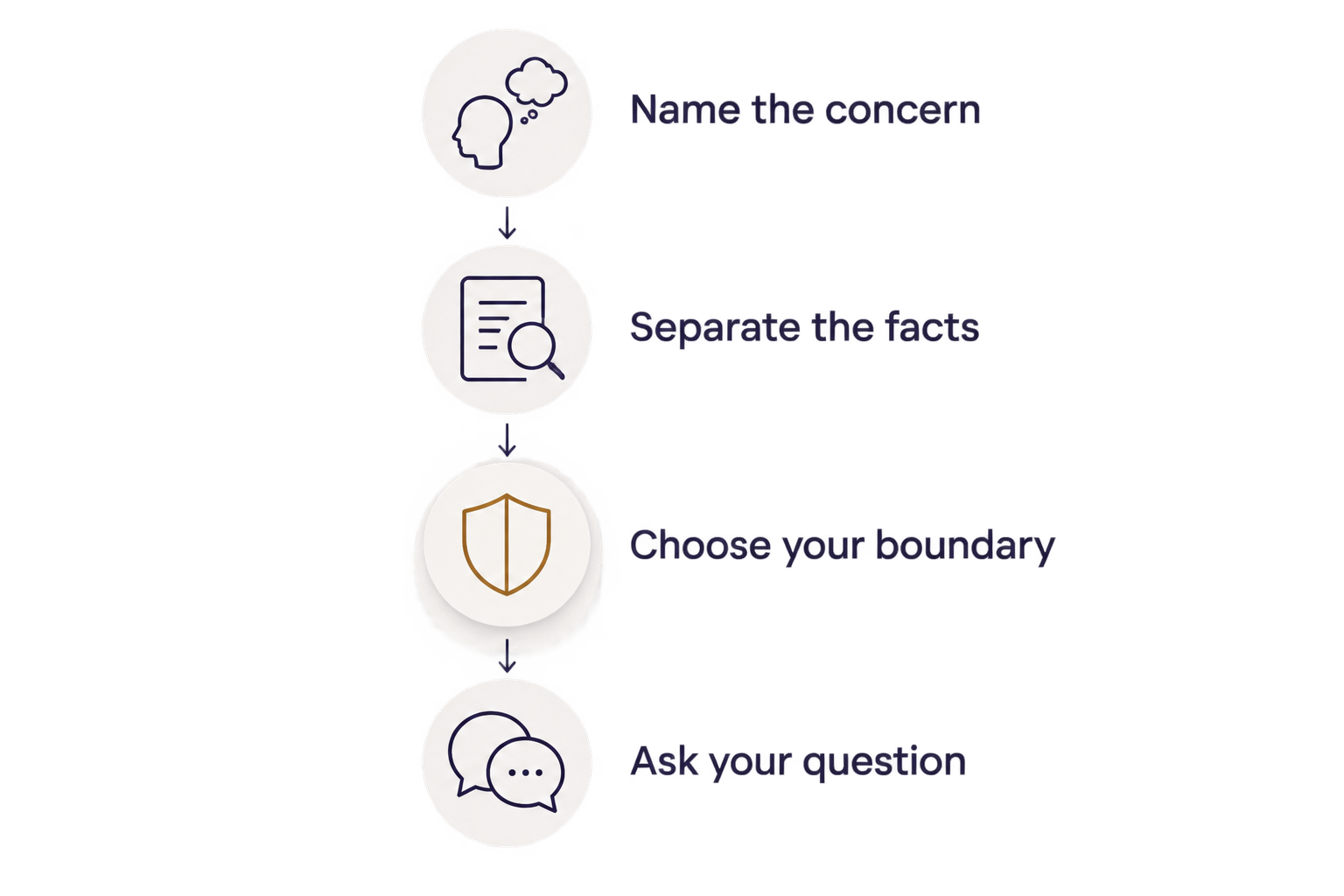
Use this 4-step process to turn a third-party inquiry into a question you can act on. The aim is not to disguise a request for secrets with different wording; it is to change what you are asking the reading to do.
- Name the concern. Write down what happened without assigning a motive. For example, your partner canceled plans and has not discussed rescheduling.
- Separate the facts. Identify what you know directly and what you are assuming. A canceled plan is observable; a loss of interest is an interpretation unless they have said so.
- Choose your boundary. Decide what matters to you, such as reliable communication or clarity about exclusivity. You do not need a prediction to recognize a need.
- Ask your question. Focus on the conversation, decision, or response within your control. Ask how to express your needs clearly rather than what the other person is hiding.
After reframing, check whether you would be comfortable explaining the question to the person involved. Discomfort is a reason to examine the wording and purpose, not automatic proof that you have done something wrong.
Useful question changes include:
- Replace a request to identify hidden feelings with a question about the communication you need.
- Replace a prediction about reconciliation with a question about what rebuilding trust would require.
- Replace a demand to expose betrayal with a question about which concerns need a direct conversation.
- Replace a question about controlling an outcome with a question about accepting another person's choice.
Can I use a tarot spread without reading their mind?
A 3-card spread can focus entirely on your experience. Assign each position a question before drawing, so the interpretation stays within the boundaries you chose.
- Card 1 — My experience: What feelings, expectations, or assumptions should I examine?
- Card 2 — My boundary: What do I need to express, protect, or clarify?
- Card 3 — My next step: What action can I consider without controlling someone else?
Treat the interpretation as a reflection prompt. If a card brings up secrecy, conflict, or separation, that theme is not evidence that someone is lying or planning to leave.
Write down a practical action separately from the symbolism. That action might be asking a clear question, declining an arrangement that does not meet your needs, or accepting that you do not yet know.
For more on setting positions before drawing, read how to do a three-card tarot spread for clarity. The structure matters more here than getting a dramatic answer.
Can tarot tell me what someone secretly thinks?
Tarot does not establish what someone secretly thinks. A reader's interpretation is not that person's statement, consent, or confirmation.
You can explore how you understand a connection, but leave room for the other person to explain their own feelings. Silence is not a blank space that a card reading can turn into verified testimony.
Do I need permission to ask about my own relationship?
You do not need permission to reflect on your own relationship experience. You should ask permission before arranging a reading for another person to receive or presenting them as a willing participant.
Keep those situations separate. Your private decision-making belongs to you; participation in a spiritual practice belongs to each person individually.
Should I tell someone what a reading said about them?
Ask whether they want to hear it before sharing. Describe the reading as your interpretation or experience, not a verdict about their character.
Do not use a card to override their account of their feelings. If you have a concrete concern, discuss the behavior itself rather than claiming the reading has already settled the matter.
What to ask a professional reader before starting
Ask whether the reader accepts questions involving absent people and how they distinguish reflection from claims about private facts. Do not assume every practitioner follows the same boundaries.
A useful opening request states your situation briefly, explains that the other person is not participating, and asks for guidance about your choices. You can also say which topics you do not want discussed.
Jahben is best for adults seeking personal spiritual guidance, not proof about someone else's private life. Jahben offers tarot readings alongside other spiritual advisory services; confirm the scope of your question before arranging a session.
The value of a personal reading is having a focused space for your question. Its limitation is that interpretation cannot replace another person's answer, professional advice, or independently checked facts.
If you choose Jahben for a tarot reading in 2026, bring a question about what you can understand, communicate, or decide. Do not treat any spiritual service as a way around consent.
FAQ
Is it wrong to get a tarot reading about someone without telling them?
Private reflection about your relationship is different from claiming to expose someone's secrets. Keep the question about your experience, avoid unnecessary personal details, and do not present an interpretation as verified information about them.
Can someone feel that I am getting a tarot reading about them?
Do not assume someone can sense that you are getting a tarot reading about them. A message, dream, or coincidence afterward does not establish that they knew about the session.
Can tarot prove that my partner is cheating?
No, a tarot interpretation is not proof that your partner is cheating. Address specific behavior and seek information you can verify rather than using cards as an accusation.
Can I get a tarot reading for my friend as a surprise?
Ask whether your friend wants a reading before arranging personalized guidance for them. Let your friend choose whether to participate and which questions to discuss.
Do I need to give a reader the other person's full name?
Ask the reader what information the session requires, and avoid sharing unnecessary identifying details. A self-focused question can describe the relationship and your concern without disclosing the absent person's private records.
What should I ask instead of whether my ex still loves me?
Ask what you need to understand before considering contact or reconciliation. Focus on your boundaries, the history you can verify, and whether renewed contact would respect both people's wishes.
Should I keep asking until the cards give a clear answer?
Do not keep drawing solely to obtain the answer you want. Pause, record the original interpretation, and identify whether your next step requires reflection, direct communication, or factual information instead.
One last thing
Before your next reading in 2026, write this question at the top of your notes: What can I decide even if I never learn what this person privately thinks? Answer it before drawing a card.
That question keeps your choices from depending on an interpretation of someone else's mind. You can want clarity, respect their privacy, and still decide what is right for you.
Related guides
- Can a tarot reading tell you if someone is thinking of you?
- How to journal after a tarot reading for deeper insight
Ready for your own reading?
Astrology, numerology, and tarot brought together into one clear, written answer about your love, career, or timing.
Book a Personal Reading Get Your Free Report