Chakra healing is not scientifically established as a way to unblock energy or treat disease, although a session can feel calming or spiritually meaningful. Feeling better does not prove that a chakra changed, and using energy work instead of medical or mental health care creates a separate risk: delaying treatment that you need.
- Does chakra healing actually work? Relaxation is possible; chakra unblocking and disease treatment are not scientifically established.
- NCCIH states that Reiki has not been clearly shown effective for any health-related purpose.
- Jahben's guide separates spiritual meaning from medical evidence: personal benefit does not establish an energy mechanism.
- Use chakra balancing as optional spiritual practice, never as a diagnosis or replacement for treatment.
Why this matters
You do not have to choose between respecting a spiritual practice and asking whether its claims hold up. Those are compatible positions. A calming experience can matter without proving the explanation attached to it.
If you are exploring Reiki healing for chakra balancing and blocked energy, keep the goal clear: spiritual reflection is different from treating a health condition. That distinction matters more than how confident a practitioner sounds.
For your 2026 wellness decisions, judge the promise before judging the practice. An invitation to rest deserves a different response from a promise to cure anxiety, correct hormones, or remove the cause of chronic pain.
Does chakra healing actually work, or is it pseudoscience?
Chakra healing is unproven as a medical treatment or measurable energy intervention. Calling a session relaxing describes an experience. Claiming that a practitioner has identified and corrected an invisible blockage makes a separate claim that requires evidence.
The National Center for Complementary and Integrative Health, or NCCIH, states in its Reiki fact sheet that Reiki has not been clearly shown effective for any health-related purpose. It also states that there is no scientific evidence supporting the energy field proposed to explain Reiki.
That source addresses Reiki, not every practice marketed as chakra healing. Its scope matters: evidence about Reiki cannot automatically establish what crystals, guided imagery, meditation, or sound practices do. Equally, research on meditation does not prove that chakras are anatomical structures or that energy blockages cause illness.
| Claim | What supports it? | Practical verdict |
|---|---|---|
| A session feels calming | Your reported experience | Valid as personal experience |
| A chakra was unblocked | No validated clinical test | Not scientifically established |
| Energy work treats disease | Reliable clinical evidence required | Do not substitute for treatment |
| Chakra imagery feels meaningful | Personal or spiritual interpretation | Not a medical finding |
Pseudoscience is the right criticism when someone presents unsupported chakra claims as established science, dismisses contrary evidence, or makes the claim impossible to test. A person using chakra imagery as a spiritual metaphor is doing something different. The problem is not finding meaning; it is presenting belief as medical fact.
What would count as evidence that chakra healing works?
A convincing study needs to identify the intervention, specify the outcome, and compare it with an appropriate control. Otherwise, improvement after a session cannot tell you what caused that improvement.
For example, a comparison with doing nothing does not separate the claimed energy effect from receiving attention, resting in a quiet room, or expecting relief. Researchers also need to consider whether participants know which treatment they received and whether the findings are repeated independently.
When you read a chakra-healing claim in 2026, ask:
- What changed? Feeling calmer, sleeping better, and treating a disease are different outcomes.
- What was the comparison? A waiting list answers a different question from a credible sham session.
- What else happened? Medication, therapy, rest, and natural symptom changes affect interpretation.
- Was the result repeated? An isolated positive finding does not settle effectiveness.
- Was the mechanism tested? Symptom improvement alone does not demonstrate energy transfer.
Testimonials cannot answer these questions. They describe what someone noticed, not what would have happened without the session. They also do not establish how another person will respond.
Which approach fits your goal?
Choose according to the outcome you want, not the strongest spiritual language. The comparison below separates reasonable uses from claims that exceed the evidence; it is not a ranking of treatments.
| Approach | Best for | Main limitation |
|---|---|---|
| Chakra-focused reflection | Spiritual symbolism | Not a diagnostic method |
| Reiki | Optional spiritual ritual | Health benefits remain unestablished |
| Mindfulness meditation | Practicing present-moment attention | Not suitable for every person |
| Licensed clinical care | Assessing persistent symptoms | Requires individual assessment |
Chakra-focused reflection: best for spiritual symbolism
You can use chakra themes to organize journaling about security, relationships, confidence, or communication. The benefit is having a framework for reflection. You do not need to treat that framework as literal anatomy.
Its limitation appears when symbolism becomes diagnosis. Difficulty speaking up does not establish a throat-chakra blockage, and chest discomfort must not be interpreted as evidence of a heart-chakra problem.
Reiki: best for optional spiritual ritual
Reiki provides a spiritual framework for a session that some people find restful. Its central limitation is the evidence gap: a pleasant experience does not establish energy transfer or a treatment effect.
Jahben Reiki sessions are best approached as optional spiritual experiences, not medical diagnosis or treatment. That is a boundary for how to use the service, not a claim that its health effects have been demonstrated.
Mindfulness meditation: best for practicing attention
Mindfulness asks you to observe present experience rather than diagnose an energy blockage. It has its own research literature; findings about mindfulness should stay attached to the particular practice and outcome studied.
It is not automatically comfortable or appropriate for everyone. If inward attention increases distress, stop rather than interpreting the distress as proof that healing is happening.
Licensed clinical care: best for persistent or concerning symptoms
A licensed clinician can assess symptoms, consider possible causes, and discuss treatment choices. Spiritual practices cannot replace that assessment.
Clinical care also has limits: an assessment does not guarantee an immediate explanation or a successful first treatment. Those limits do not make an unsupported energy diagnosis equally reliable.
Why experiences of chakra healing vary
Different experiences do not establish that one person has stronger energy or a deeper blockage. Sessions differ, expectations differ, and symptoms change for reasons unrelated to the practice.
These factors help explain why reports are difficult to interpret:
- The session's contents. Chakra healing can include conversation, visualization, touch, meditation, or Reiki. Those are not interchangeable interventions.
- Expectations. What you anticipate can influence how you interpret sensations and report symptoms.
- The setting. Quiet rest and focused attention are part of the experience, separate from the proposed energy mechanism.
- The outcome chosen. A report of temporary calm does not answer whether a medical condition improved.
- Other care and ordinary fluctuation. Symptoms can change while you also receive treatment or make changes to your routine.
A practitioner who treats every possible response as confirmation has removed the possibility of being wrong. Feeling warmth proves energy moved; feeling nothing proves a deep blockage; feeling worse proves release. That reasoning does not test a claim—it protects it from testing.
How can you judge a session without fooling yourself?
Use a modest goal and a clear stopping rule. You are deciding whether an optional experience is useful to you, not running a clinical trial or measuring chakras.
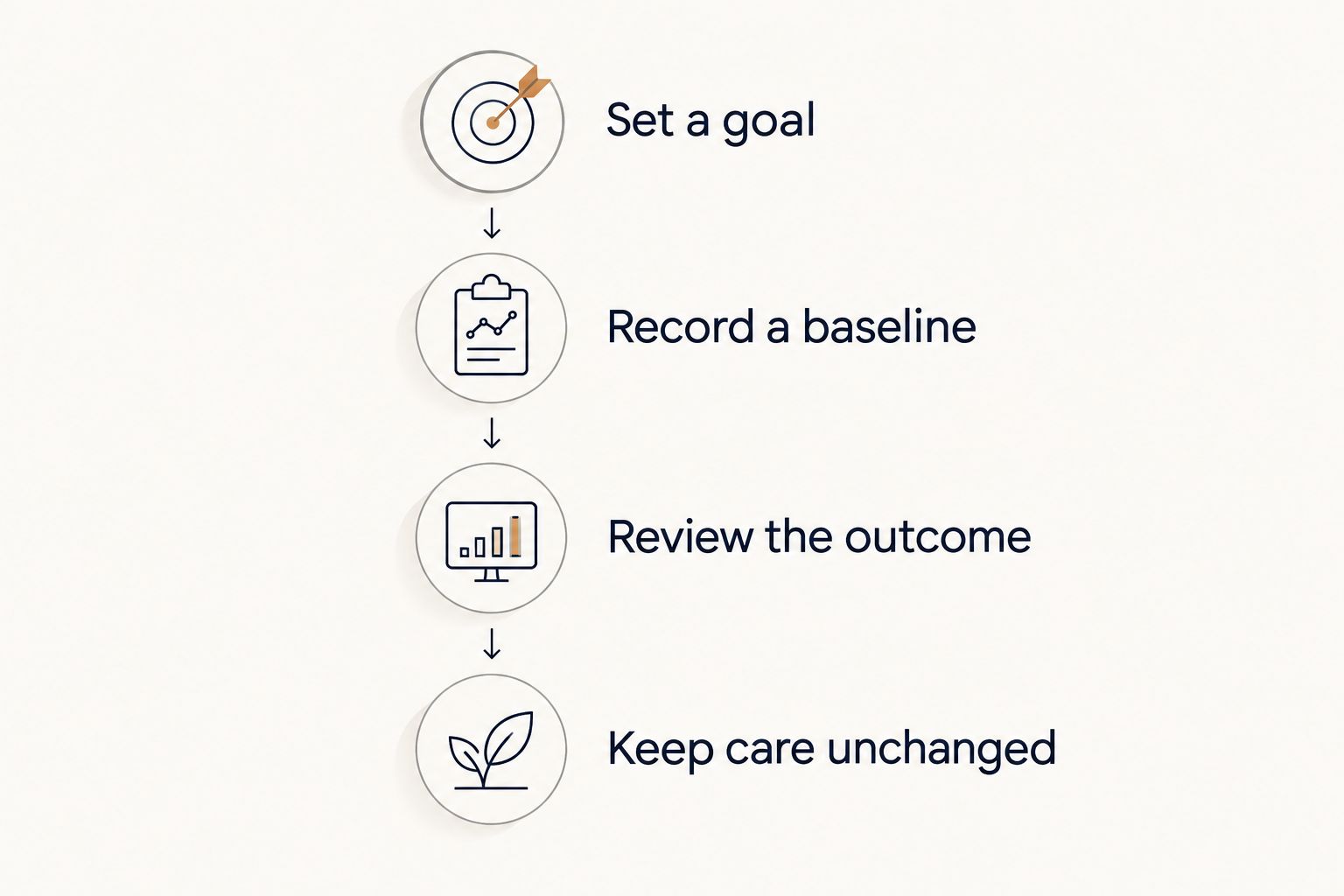
- Set a goal. Write down an ordinary outcome, such as feeling less tense. Avoid goals that depend on an unmeasurable energy claim.
- Record a baseline. Spend 5 minutes noting how you feel before the session. If useful, choose a 0–10 scale and define what its endpoints mean to you.
- Review the outcome. Record your experience afterward and keep brief notes over 7 days. These are suggested observation periods, not proven treatment intervals.
- Keep care unchanged. Do not stop prescribed treatment to isolate an energy effect. Discuss treatment changes with your clinician.
This sequence keeps your observations separate from the explanation offered by a practitioner. It also makes room for an honest result: the session was pleasant, but nothing useful changed afterward.
Even careful notes cannot establish causation. Their purpose is narrower: helping you avoid rewriting your expectations after the session or accepting a claim because you already invested in it.
For a 2026 wellness journal, record disappointments as plainly as benefits. You do not owe a practice a positive review, and you do not need to book again to validate the experience.
Does feeling heat or tingling mean a chakra opened?
Heat or tingling does not establish that a chakra opened. A sensation is something you experienced; its cause requires a separate explanation.
Attention, posture, nearby warmth, and breathing changes can affect bodily sensations. New, persistent, or concerning symptoms deserve clinical assessment rather than an automatic spiritual interpretation.
Is chakra healing just a placebo effect?
Placebo and contextual effects are possible explanations for some reported benefits, but an individual experience cannot identify its cause. Rest, attention, expectation, concurrent treatment, and symptom fluctuation can overlap.
A placebo-related improvement is not the same as faking. It also does not prove that an energy field exists or that the underlying condition has been treated.
Can chakra healing replace therapy or medication?
Chakra healing cannot replace evidence-based therapy, prescribed medication, or medical assessment. Use it, if you choose, as an optional spiritual activity alongside appropriate care.
Do not accept instructions to reduce medication, postpone testing, or explain worsening symptoms as necessary cleansing. Seek urgent help for urgent symptoms, including chest pain, severe breathing difficulty, or thoughts of harming yourself.
What should make you walk away?
Leave when a practitioner turns uncertainty into pressure or a health diagnosis. You retain the right to decline touch, stop a session, ask questions, and reject an explanation that does not make sense to you.
Clear warning signs include:
- Promises to cure a disease or guarantee a health outcome.
- Claims that skepticism prevents healing or makes you responsible for failure.
- Instructions to replace medical care with energy work.
- Claims that distress proves a session worked and requires more sessions.
- A diagnosis of trauma, infection, infertility, or another condition based only on sensing energy.
For anyone considering a Jahben session or another spiritual service in 2026, the same standard applies: confidence is not clinical evidence. A practitioner should respect your boundaries without requiring belief in an unproven mechanism.
A spiritual interpretation must remain optional. You can reject the explanation, enjoy the quiet, and still decide not to return.
FAQ
Does chakra healing actually work for anxiety?
Chakra healing is not an established treatment for an anxiety disorder. A session can feel calming, but persistent anxiety deserves assessment and evidence-based care.
Is there scientific proof that chakras exist?
Chakras are not established anatomical structures or clinically validated energy centers. Their role in spiritual traditions does not establish a biological mechanism.
Is Reiki the same thing as chakra healing?
Reiki and chakra healing are not identical, although practitioners sometimes combine them. Evidence about a particular Reiki intervention does not automatically apply to every chakra-focused practice.
Can chakra healing be useful even if the energy claims are unproven?
Chakra healing can have personal value as spiritual reflection or a restful ritual without proving its energy claims. Keep that value separate from claims about diagnosing or treating illness.
How many sessions do I need to unblock my chakras?
There is no scientifically established session count for unblocking chakras. Do not treat a recommended package or repeated booking as evidence that a blockage exists.
Is feeling worse after chakra healing a good sign?
Feeling worse is not proof that chakra healing worked. Stop the practice if it causes distress, and seek appropriate care for new, persistent, or concerning symptoms.
What should I ask a chakra healer before a session in 2026?
Ask what happens during the session, whether touch is involved, and what outcomes the practitioner claims. Reject guaranteed health results and instructions to replace medical care.
One last thing
The most useful question is not whether you felt something. It is whether the explanation goes further than the experience supports.
For 2026, keep this boundary: you can value a ritual without accepting its medical claims. If quiet reflection helps you, keep the reflection. You do not need an invisible blockage to justify taking care of yourself.
Related guides
- Is Reiki real, or does it work through a placebo effect?
- How to prepare for your first Reiki session
Ready for your own reading?
Astrology, numerology, and tarot brought together into one clear, written answer about your love, career, or timing.
Book a Personal Reading Get Your Free Report