The Judgement tarot card means it is time to face what you know, reckon with the past, and make a conscious choice about what comes next. Upright, it points to recognition and renewal; reversed, it asks what truth or decision you are resisting. In a 2026 reading, treat it as a prompt for honest reflection, not a prediction that someone else will decide your future.
- Judgement tarot card meaning: acknowledge the past, answer a call to change, and choose your next step.
- Upright Judgement favors honest recognition; reversed Judgement points to avoidance or harsh self-judgment.
- For love and career questions, read Judgement against the question and surrounding cards before deciding what it asks of you.
- Jahben tarot readings are best for people who want to examine a decision rather than be told their future is fixed.
How do you interpret the Judgement tarot card in a reading?
Start with the question you asked. Judgement is not a blanket instruction to return to a former partner, leave a job, or make a dramatic announcement. Its core question is simpler: What are you ready to see clearly, and what will you do once you see it? If you are new to positions and surrounding cards, begin with how to read a tarot card spread for beginners.
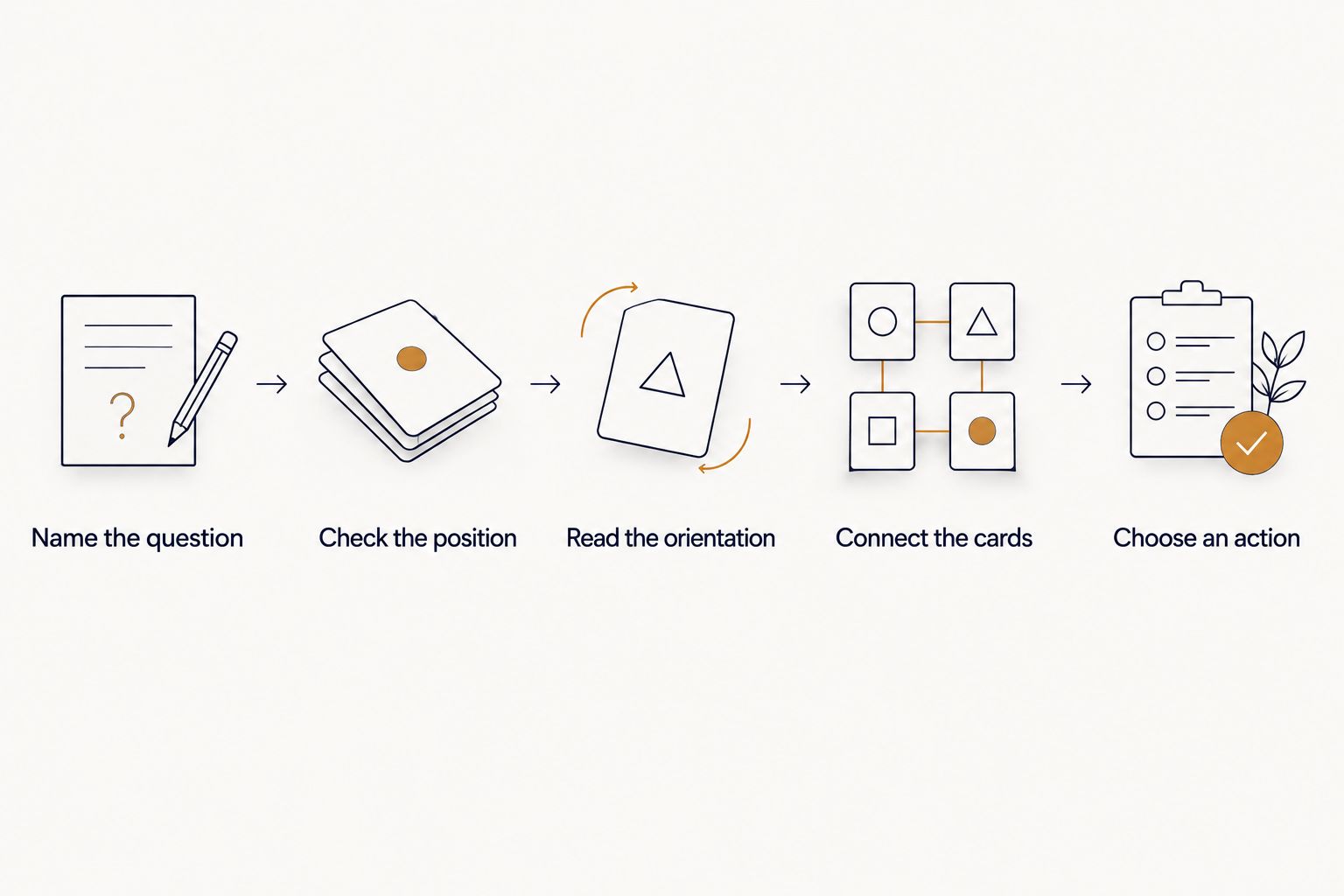
Use these steps each time Judgement appears:
- Name the question. Write down the decision or situation in plain language. A card about accountability means something different when you ask about an apology than when you ask about a career change.
- Check the position. In a past position, Judgement can describe a realization that has already shaped your choices. In an advice position, it asks for a response now.
- Read the orientation. Upright emphasizes recognition and response. Reversed emphasizes resistance, self-doubt, or judgment that keeps you stuck. Reversal is a reading convention, not proof of a bad outcome.
- Connect the cards. Look at the card beside Judgement before settling on a meaning. Ask whether the surrounding cards support a clear next step, expose an unresolved pattern, or show a choice that still needs examination.
- Choose an action. Turn the reading into a question you can answer or a conversation you can have. Do not treat the card as permission to make a decision for someone else.
| Judgement appears as | Read it as | Useful question | Watch for |
|---|---|---|---|
| Upright | Recognition, accountability, and a chance to act differently | What truth am I ready to acknowledge? | Mistaking a fresh start for a way to avoid repair |
| Reversed | Resistance, self-doubt, or a judgment you cannot release | What am I refusing to face, or blaming myself for too long? | Treating hesitation as evidence that change is impossible |
Neither orientation supplies a verdict about another person's private thoughts. Both bring the focus back to your response. Judgement asks for an honest choice, not a guaranteed outcome.
Why this matters
Judgement often appears in readings about a turning point: whether to revisit a relationship, speak up at work, or leave an old role behind. A broad interpretation such as renewal sounds reassuring but does not tell you what to do. The position, the question, and your real-world circumstances turn that theme into usable guidance.
The traditional Rider–Waite–Smith image shows an angel sounding a trumpet as figures rise below. Read that scene as a call to wake up and respond. You do not need to take the image as a literal promise of rebirth; its value in a 2026 reading is the question it puts in front of you: What can no longer stay unexamined?
Judgement is a Major Arcana card, so readers commonly use it to examine a larger pattern rather than a passing mood. That does not make a single draw more authoritative than your lived experience. If the card seems to conflict with what you know, inspect the question before forcing the interpretation.
Upright Judgement: recognition followed by action
Upright Judgement is the moment you stop rehearsing the same story and recognize your part in it. Sometimes that brings relief. Sometimes it brings an uncomfortable conversation or a decision you have postponed. The card describes the opening for a different response, not evidence that the response has already happened.
In a love reading, ask whether there has been an honest reckoning with an old conflict. Reconnection is one possible topic, but the card alone does not say a former partner will return. If your question is about staying together, look for what each person can acknowledge and whether changed behavior is visible outside the reading.
In a career reading, Judgement can focus attention on a role, ambition, or professional identity that no longer fits. It is a prompt to review your reasons before acting, not an instruction to resign. If you are weighing a job offer, compare what you know about the work with what you are hoping the move will solve.
For personal growth, upright Judgement can mark a willingness to own a past choice without letting it define every future one. Responsibility and self-punishment are not the same. The useful reading identifies what you can repair, what you can release, and what you still need to decide.
Reversed Judgement: the decision you keep postponing
Reversed Judgement commonly points to difficulty answering that call. You might know a conversation is overdue but keep waiting for perfect certainty. Or you might have made a reasonable choice and still judge yourself so harshly that you cannot move on. The reversal asks what is blocking a response; it does not label you a failure.
If you are asking about love, distinguish between fear of repeating an old pattern and evidence that the pattern is still present. Those are different problems. One calls for examining your assumptions; the other calls for paying attention to behavior and boundaries.
If you are asking about work, consider whether you are avoiding a practical decision or demanding an impossible guarantee before making one. Write down what information you already have and what remains unknown. A tarot reading can help frame the question, but it cannot verify a job's terms or decide what level of risk works for you.
A reversed card also changes meaning with its spread position. In a past position, it can describe an earlier period of self-doubt. In an advice position, it can ask you to stop repeating a verdict about yourself that no longer helps. Read the position first, then decide whether avoidance is actually the issue.
Why Judgement's meaning varies from reading to reading
The same card can point to a needed apology in one spread and a career decision in another. These factors keep the interpretation tied to the reading rather than a memorized keyword:
- Your question: An open question about your own choices gives Judgement room to address accountability. A question asking what someone else will do invites claims the card cannot verify.
- Its spread position: Past, present, advice, and outcome positions serve different purposes. Judgement as advice calls for a response; as an outcome, it points to a matter reaching a point of reckoning.
- Its orientation: Upright emphasizes acknowledgment and action. Reversed puts attention on resistance, self-criticism, or an unfinished decision.
- The surrounding cards: They show which part of the situation deserves closer attention. Do not let Judgement erase a concern another card brings into focus.
- Your circumstances: A conversation you can safely initiate is different from one that would put you at risk. Your circumstances outrank a dramatic interpretation.
If the reading still feels vague, narrow the question rather than drawing cards until you get a preferred answer. Try asking what you need to acknowledge, what information is missing, or which choice is yours to make. That gives the card a job it can actually do.
What does Judgement mean in a love reading?
In love, Judgement asks whether you and the other person are responding to the relationship as it is now or replaying an old version of it. It does not, by itself, mean reconciliation. A renewed connection needs more than recognition; it needs choices and behavior you can observe.
If you are considering an ex, separate missing the relationship from wanting to rebuild it. What changed? What would have to be different this time? For a current relationship, the question might be whether a hard truth has been spoken clearly enough to address. If those questions are central to your spread, a tarot reading for love and relationships gives that topic its own space.
When you are single, Judgement can turn attention toward a story you carry into new connections. The action might be recognizing an assumption rather than contacting someone. No card can establish whether another person is ready for commitment; ask what evidence you have beyond the reading.
What does Judgement mean in a career reading?
In career questions, Judgement points to a reckoning with your direction, past decisions, or the work you want to do next. That can be constructive without requiring an immediate change. A good interpretation names the decision in front of you and the information needed to make it.
For example, if you are weighing a change of role, ask which part of your current work you are trying to leave and which part you want to carry forward. If you are waiting to hear about an offer, Judgement cannot confirm the employer's decision. It can help you examine what you will do under either outcome.
In a 2026 career reading, resist turning a symbolic call into a deadline. Check the facts of the role, speak with the people involved, and decide from there. The card's strength is in making the choice clearer, not removing the need to choose.
Does Judgement mean yes or no?
Judgement is not a dependable yes-or-no card on its own. Its clearest answer is respond consciously: face what the question leaves out before you commit. If you need a yes or no, first define what yes would require and what would change your answer.
An upright draw can feel encouraging because it emphasizes recognition and renewal. A reversed draw can feel discouraging because it draws attention to hesitation. Neither orientation confirms an event. For a decision involving another person, their stated intentions and actions matter more than a card position.
How can you use Judgement without overreading it?
Give the card one question and one real-world check. Ask, What am I being called to acknowledge? Then identify something you can verify: a conversation you have had, a choice you have avoided, or information you still need. If your answer depends entirely on a prediction, the reading has stopped helping you assess the situation.
A 3-card spread can keep the interpretation focused: use positions for what you know, what you need to face, and what action is yours. If Judgement lands in the middle, do not assume the final card promises a result. Read it as a way to frame your response. You can use the same positions whether the card appears upright or reversed.
Writing down your initial interpretation helps you distinguish a useful insight from a meaning you added after the fact. Revisit the note when you have new information. You are looking for a clearer decision, not proof that every detail of a 2026 reading came true.
Jahben tarot readings are best for people seeking a grounded discussion of what to release and what to choose next. Jahben's practice also offers astrology and numerology, but Judgement does not require another system to have meaning. If you want personal guidance, bring the specific question and the facts you already know; a reading should help you examine them, not replace them.
FAQ
What is the Judgement tarot card meaning in 2026?
The Judgement tarot card means acknowledgment, accountability, and a conscious response to change. In 2026, read it against your question and spread position rather than treating it as a fixed prediction.
Is Judgement a good tarot card to pull?
Judgement can be constructive because it asks you to recognize what needs your attention. It is not a promise that an outcome will feel easy or arrive without action.
What does upright Judgement mean in a tarot reading?
Upright Judgement points to recognition followed by a choice. Look at what you can acknowledge, repair, or change in the situation you asked about.
What does reversed Judgement mean in a tarot reading?
Reversed Judgement points to resistance, self-doubt, or a decision you keep postponing. The spread position helps you tell whether that describes the past or asks for attention now.
Does the Judgement card mean an ex is coming back?
No. Judgement can raise questions about reconciliation or an unresolved relationship, but it does not confirm that an ex will return. Consider the person's actual words and behavior.
Does Judgement mean I should quit my job?
No. Judgement can prompt you to reassess your work and direction, but it does not instruct you to resign. Review the facts of your situation before making a career decision.
Can Judgement give a yes-or-no answer?
Judgement does not give a reliable yes or no by itself. It asks you to face the information and responsibility behind the choice before deciding.
One last thing
The most useful question Judgement asks is not whether you get another chance. It is what you would do differently if you had one. If your 2026 reading points toward a fresh start, name the action that would make it real; recognition alone does not change a pattern.
Related guides
- How to interpret the Death tarot card in a reading
- How to interpret the Tower tarot card in a reading
- How to journal after a tarot reading for deeper insight
Ready for your own reading?
Astrology, numerology, and tarot brought together into one clear, written answer about your love, career, or timing.
Book a Personal Reading Get Your Free Report