The Justice tarot card means accountability, fairness, and a decision shaped by what is true rather than what you wish were true. Upright, it asks you to weigh the facts and own your part; reversed, it points to bias, avoidance, or an imbalance that needs attention. In a reading, its message depends on the question, its position, and the cards around it—not on a promise that events will turn out in your favor.
- Justice tarot card meaning: weigh the facts, act fairly, and take responsibility for your choice.
- Upright Justice favors an honest assessment; reversed Justice asks where the assessment is incomplete or biased.
- Jahben's tarot readings are best for personal guidance on love or career, not guaranteed outcomes.
- Read Justice against the question and surrounding cards before deciding what action it suggests.
Why this matters
Justice is easy to misread as a promise that the right person will win. It is more useful as a question: What decision can you defend when you look at the whole picture? If you are learning how position changes a card's meaning, start with a three-card tarot spread for clarity. The same Justice card can describe your role, another person's response, or the action in front of you, depending on where it falls.
In a 2026 reading about a relationship, Justice does not prove that someone is telling the truth. In a career reading, it does not predict an employer's decision. It directs your attention to evidence, responsibility, and the standards you are using to judge the situation.
How do you interpret the Justice tarot card in a reading?
Start with the question you asked. Then identify what the card's position refers to, check whether you read reversals, and compare Justice with the surrounding cards. The Justice tarot card meaning is a call to assess and act fairly, not a guaranteed favorable verdict.
| What appears in the reading | How to interpret it | What to ask yourself |
|---|---|---|
| Upright Justice | Examine the facts, apply a consistent standard, and accept the consequences of your choice. | What do I know, and what am I assuming? |
| Reversed Justice | Look for a missed fact, unequal standard, or responsibility you are avoiding. | Where am I giving myself or someone else a pass? |
| Justice as a challenge | Treat fairness as the work to do, not as an outcome already secured. | Which conversation or decision have I delayed? |
| Justice as advice | Make the next step clear, proportionate, and accountable. | What action would still make sense after I calm down? |
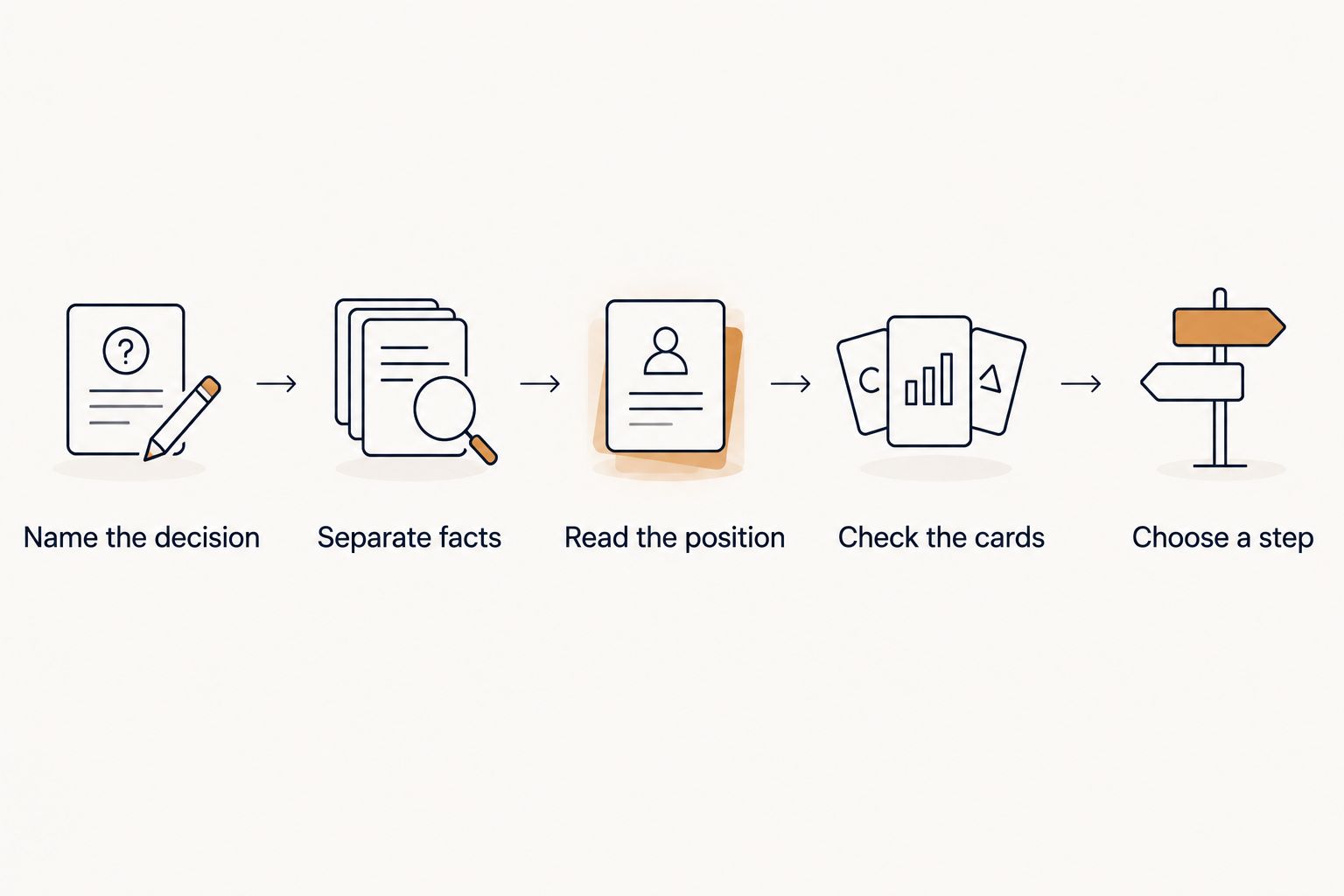
Use this order when you read Justice in a spread:
- Name the decision. Replace a broad question such as whether everything will work out with the choice you actually face.
- Separate facts from interpretations. Note what happened, what you were told, and what you have inferred. Do not treat a tarot card as proof of a private conversation or motive.
- Read the position. Justice in a position about your actions asks something different from Justice in a position about an obstacle.
- Check the surrounding cards. Let them narrow the issue without changing Justice into a promise of punishment or reward.
- Choose a grounded next step. That might be asking a direct question, reviewing an agreement, or correcting an unfair assumption.
A reading can help you frame a choice. It cannot establish legal facts, verify someone else's intentions, or replace professional advice where the stakes require it.
What does upright Justice mean?
Upright Justice asks for a fair accounting. Look at what each person has done, what information is available, and whether you are applying the same standard to everyone involved. Its constructive side is clarity: you can make a decision without pretending that every detail feels comfortable.
Its difficult side is responsibility. If your actions contributed to the problem, upright Justice does not let you skip that part because another person also acted poorly. Likewise, fairness does not require you to accept treatment you would reject for someone you care about.
In a 2026 love reading, upright Justice can prompt a direct conversation about expectations or a boundary that needs to be stated. It does not certify that a partner is faithful or that a relationship will last. In a career reading, it can direct you toward written terms, documented work, or the criteria behind a decision rather than a guess about what a manager thinks.
If you pull Justice as the outcome, keep the interpretation narrow: the issue calls for an assessment of actions and consequences. An outcome position is not permission to announce who will be rewarded. Ask what remains within your control while the decision is unresolved.
What does reversed Justice mean?
Reversed Justice draws attention to an assessment that is off balance. You might be ignoring a relevant fact, applying different rules to different people, or delaying a decision because the answer carries a cost. It can also reflect feeling unfairly judged; the card alone cannot tell you whether that feeling matches the facts.
Do not translate reversed Justice into a verdict that someone lied. A useful reading names the uncertainty and tests it. What can you verify? What standard are you using? What would change your view if you learned more?
In a 2026 relationship reading, reversed Justice can be a prompt to examine a pattern of blame without deciding that either partner is guilty. At work, it can raise questions about unclear expectations or your own contribution to a conflict. Neither interpretation predicts the result of a complaint, review, or negotiation.
The useful difference between upright and reversed Justice is where you begin: upright, assess what is in front of you; reversed, check whether your assessment itself needs correcting. Both orientations still call for honesty and a measured response.
What do the symbols on Justice tell you?
In the familiar Rider–Waite–Smith image, Justice holds scales and a sword. The scales support the reading's central question: what belongs on each side of the assessment? The sword brings the decision into focus. Together, they ask you to examine carefully and then be clear about what you decide.
Do not make the symbols do more than the reading supports. Scales do not prove that someone will receive a fair ruling, and a sword does not mean a conflict must end in a break. Symbols are prompts for interpretation, not evidence about events outside the reading.
Look at the card in the deck you are using before applying a guide written for another deck. Artwork and numbering differ across tarot traditions. The question and position still matter more than memorizing a single visual detail. If an image draws your attention to a different feature, ask how that feature relates to the decision at hand instead of forcing it into a fixed definition.
What does Justice mean for love and relationships?
In love, Justice asks whether words, actions, and expectations line up. If you are deciding whether to stay, leave, reconcile, or set a boundary, name the behavior behind the choice. Do not use the card to declare what your partner secretly feels.
An upright Justice reading can highlight a fair conversation: both people understand the issue, can state what they need, and know what each has agreed to do. The harder reading is that an agreement exists but actions do not match it. In that case, accountability matters more than another promise.
Reversed Justice can point to unequal expectations or a story you have settled on before hearing the other person. It can also prompt you to notice when you keep accepting the same mismatch. The card does not tell you to remain in a relationship or end it; it asks you to make the choice with open eyes.
If your question is whether an ex will return in 2026, Justice offers no reliable return date. Ask what a fair reconciliation would require instead. For a closer look at questions you can bring to a session, see tarot reading for love and relationships.
What does Justice mean for work and money?
In a career reading, Justice directs attention to terms, responsibilities, and evidence. If you are weighing an offer, read what is written rather than filling gaps with hope. If a workplace dispute is involved, distinguish what you can document from what you suspect.
Upright Justice can support a decision made against clear criteria: duties, boundaries, and the commitments people have actually made. Reversed Justice asks whether those criteria are uneven or incomplete. Either way, the card gives you a way to examine the choice; it does not predict a promotion, hiring decision, or dispute outcome.
Money questions need the same restraint. Justice can prompt you to review an agreement or take responsibility for a choice you have delayed. It cannot tell you that an investment will succeed or that a debt will disappear. In a 2026 reading, use it to sharpen the questions you take to a qualified financial or legal professional when the decision calls for one.
For someone who wants to discuss the personal meaning of a love or career decision, Jahben's tarot readings are best used to clarify the question and your next step, not to certify a future result. Bring the facts you know and the choice you face. A reading has less to work with when the question asks it to uncover private facts about someone who is not there.
Why does the Justice tarot card meaning vary?
Justice has a consistent theme, but a reading changes with the context you give it. Check these factors before you settle on an interpretation:
- Your question: Advice about your conduct is different from a question about what another person will do. Frame Justice around the part you can assess.
- The spread position: A challenge position can describe fairness as unresolved; an advice position asks how you can act fairly now.
- Upright or reversed orientation: If your reading uses reversals, reversed Justice invites a closer look at bias or missing information. If it does not, explore those possibilities through the question and surrounding cards.
- Nearby cards: Other cards can show whether the decision concerns a new start, a relationship, a disruption, or an internal conflict. They add context; they do not turn Justice into proof.
- Known facts: A documented agreement and an unspoken expectation are not interchangeable. Base real-world action on what you can verify.
- The deck: Different imagery can shift which detail catches your eye. Use the image in front of you while keeping the question central.
Consider 2 readings that both contain Justice. In one, you ask how to respond to an agreed deadline you missed. Accountability starts with your own action. In the other, you ask about a responsibility no one has clearly accepted. Fairness starts with making the terms explicit. Neither example needs a prediction to give you a useful next move.
How can you ask a better question when Justice appears?
Ask a question that separates the decision from the outcome you want. Instead of asking whether you will be proven right, ask what information you still need or what a fair response would look like. The change matters: you can act on the answer without asking tarot to verify facts it cannot know.
Try these prompts in a journal or your next pull:
- What part of this situation is mine to own?
- Which fact am I avoiding because it complicates my preferred answer?
- Am I holding both people to the same standard?
- What agreement needs to be stated plainly?
- What would a proportionate next step look like?
If you read a spread, write down the question and each card's position before you interpret any individual card. Then record your first response to Justice and a second, less comfortable possibility. That gives you something concrete to revisit if new information emerges. It also helps you tell the difference between an interpretation that fits the spread and one that only confirms what you hoped to hear.
FAQ
What is the Justice tarot card meaning in 2026?
Justice means fairness, accountability, and making a decision based on what you know. Its meaning in a 2026 reading still depends on the question, spread position, and surrounding cards.
Is Justice a yes or no card?
Justice is not a reliable automatic yes or no. It asks whether the choice, evidence, and consequences have been assessed fairly.
Does upright Justice mean I will win?
No. Upright Justice calls for an honest assessment and responsibility for your actions; it does not guarantee a favorable outcome.
Does reversed Justice mean someone is lying?
No. Reversed Justice can prompt you to check for bias, avoidance, or missing information, but a card cannot establish whether someone lied.
What does Justice mean in a love reading?
Justice in love asks whether expectations and actions match. Use it to examine boundaries and accountability, not to claim certainty about a partner's private thoughts.
What does Justice mean in a career reading?
Justice in a career reading points you toward terms, responsibilities, and evidence. It cannot predict an employer's decision or settle a workplace dispute.
How should I read Justice next to other tarot cards?
Read Justice in its spread position first, then use nearby cards to identify the context of the decision. Do not let a neighboring card turn Justice into proof of an event.
One last thing
Justice is not only about judging someone else. Its sharpest question is whether you would use the same standard if the roles were reversed. If the answer is no, pause before making the call. That is a concrete place to start, whether the reading concerns love, work, or a decision you have put off.
Related guides
- How to interpret the Lovers tarot card in a reading
- How to interpret the Emperor tarot card in a reading
- How to journal after a tarot reading for deeper insight
Ready for your own reading?
Astrology, numerology, and tarot brought together into one clear, written answer about your love, career, or timing.
Book a Personal Reading Get Your Free Report