No, buying your own tarot deck is not bad luck: there is no established evidence that paying for the cards causes misfortune or makes them less useful. The belief that your first deck must be a gift is a spiritual custom, not a requirement you need to follow. Choose a deck you can understand and treat tarot as a reflective practice, not a guarantee about the future.
- Is it bad luck to buy your own tarot deck? No evidence supports that belief; gifting is optional.
- A standard tarot deck contains 78 cards: 22 Major Arcana cards and 56 Minor Arcana cards.
- Choose readable imagery and clear instructions rather than waiting for someone else's permission.
- Jahben offers personal tarot readings; buying a deck is a separate choice, not a prerequisite.
Is it bad luck to buy your own tarot deck?
Buying your own tarot deck does not carry an established bad-luck consequence. A gifted deck can be meaningful because of the relationship behind it. That personal meaning does not make a self-purchased deck spiritually inferior.
Separate three ideas: a custom someone follows, a preference that helps them feel comfortable, and a claim about what causes events. Only the last needs evidence of cause and effect. Someone sincerely believing a rule does not establish that breaking it brings harm.
If preparing the cards matters to you, Jahben's guide to cleansing your tarot deck before a reading addresses that separate practice. Preparation is not proof that a purchased deck was dangerous beforehand.
| How you get it | Best for | Trade-off |
|---|---|---|
| Buy it yourself | Choosing your imagery | You assess it yourself |
| Receive a gift | Personal significance | Someone else chooses |
| Buy secondhand | Reusing an existing deck | Check condition carefully |
None of these routes establishes greater predictive accuracy. The practical differences are choice, condition, and personal meaning—not a measurable amount of luck.
Why this matters
A rule about who must buy your cards can turn a simple learning decision into a test you cannot verify. You do not need to wait for a gift, perform a corrective ritual, or interpret an ordinary setback as punishment for purchasing a deck.
If you are starting tarot in 2026, begin with a clear boundary: the cards can prompt reflection, but they do not replace evidence or your judgment. A picture that raises a useful question is different from proof that a specific event will happen.
You can respect a friend's spiritual tradition without adopting it. Ask whether the gifting rule belongs to their own practice or whether they are presenting it as something everyone must follow. That distinction leaves room for respect without giving away your choice.
Buying your own deck: best for choosing how you learn
Buying your own deck lets you inspect the artwork, written guidance, and physical format before committing to a learning approach. You can choose images that you actually understand instead of trying to connect with something selected for you.
The limitation is that attractive artwork alone does not explain a reading system. Look at sample cards, not just the box. Ask whether the accompanying instructions explain the symbols or simply give a few keywords.
A standard tarot deck has 78 cards: 22 Major Arcana cards and 56 Minor Arcana cards. Some creative decks depart from that structure, so read the description rather than assuming every illustrated card set uses the same system.
For a first deck in 2026, prioritize a format you can comfortably study. There is no need to choose the most mysterious imagery or the deck someone describes as the most powerful. Choose for readability, not promised powers.
Receiving a deck as a gift: best for personal significance
A gifted deck can mark a friendship, a family connection, or the beginning of a spiritual practice. Those are valid reasons to value it. They do not establish that the cards work differently because someone else paid.
The drawback is fit. Your friend's favorite artwork might leave you confused, or the symbolism might conflict with your own beliefs. Gratitude does not require you to use an object that makes learning uncomfortable.
You can keep a gifted deck as a meaningful possession and learn with another one. You can also tell someone which deck interests you before they choose a gift. Neither decision needs a supernatural explanation.
Accept a gift because it matters to you, not because you fear the alternative. The significance comes from what the exchange means, not from a rule that invalidates other decks.
Buying a secondhand deck: best for reusing existing cards
A secondhand deck deserves a physical inspection rather than an assumption about its previous owner's energy. Check for missing cards, water damage, unreadable printing, or bent edges that make handling difficult.
For a standard deck, count the 78 cards and check them against the deck's contents list. An incomplete set is a practical problem because some intended cards cannot appear in a draw. It is not evidence of a curse.
The benefit is giving an existing deck another use. The limitation is uncertainty about condition, especially when you cannot inspect it beforehand. Ask for clear photographs and an accurate description.
If a previous owner's association makes you uncomfortable, choose another deck. You do not have to prove or disprove an energy claim before deciding what you want to handle. Comfort is a sufficient preference; fear is not a fact.
Why beliefs about buying tarot decks vary
Disagreements about gifting do not establish that one person has access to a universal rule. They show that people approach tarot with different assumptions. Keep these distinctions clear when deciding what belongs in your practice:
- Personal tradition: You can follow a gifting custom because you value it without declaring other approaches unsafe.
- Religious boundaries: Your beliefs can lead you to avoid tarot altogether. That is separate from how a deck is purchased.
- Meaning attached to gifts: A deck from someone important carries an association a shop purchase does not.
- Ritual preferences: Shuffling, arranging, or storing cards deliberately can mark a transition into reflection without proving an energetic effect.
- Learning goals: Studying symbolism calls for understandable images and instructions, not someone else's permission.
In 2026, use the same standard for a confident social-media claim as for advice from someone you know: ask what supports it. Repetition makes a claim familiar; it does not establish cause and effect.
You do not need to argue someone out of their custom. A simple boundary is enough: you respect their approach and will choose your own.
How do you start using a deck you bought yourself?
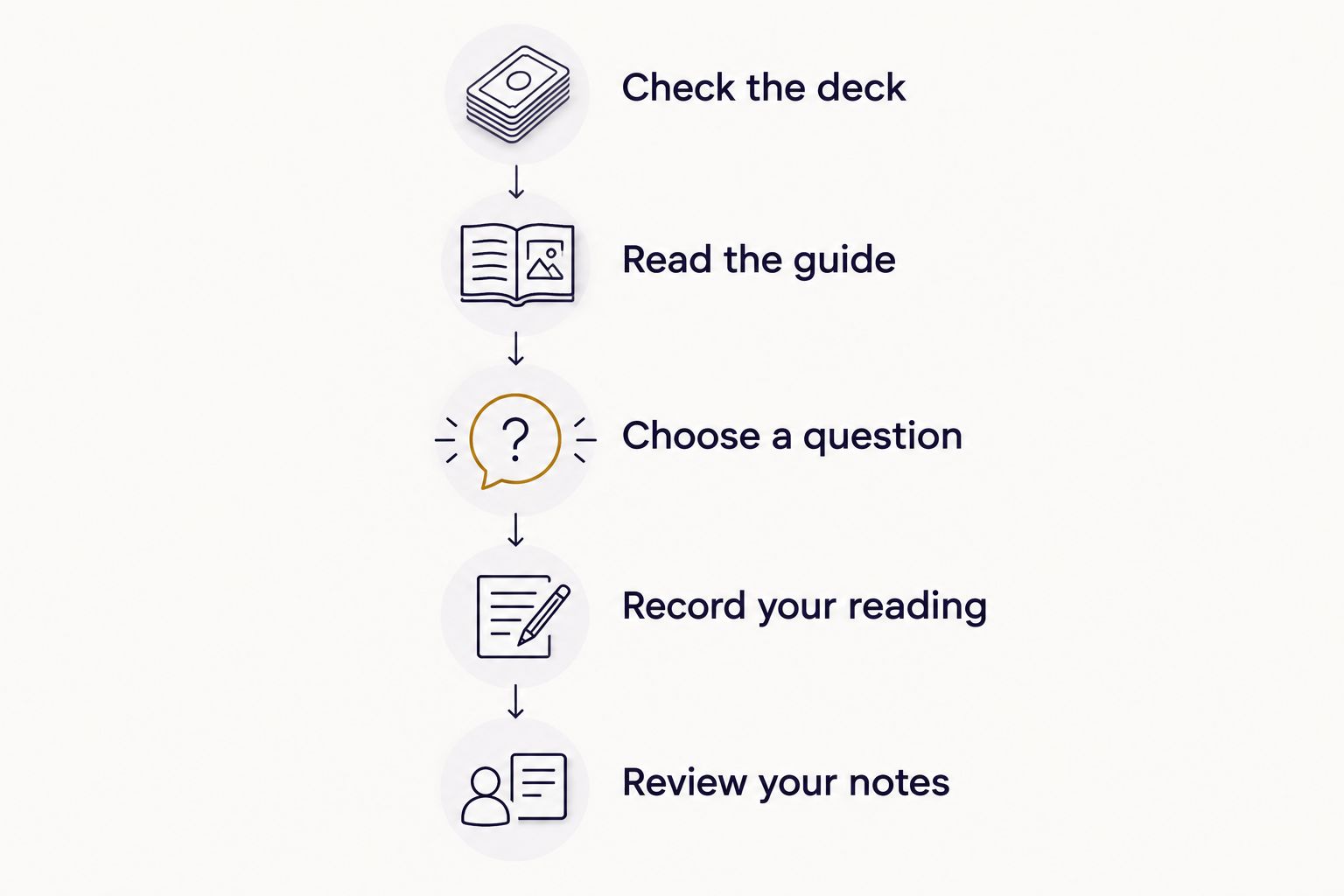
Start with inspection, a focused question, and a written record. This keeps your first session manageable and gives you something concrete to review rather than relying on how mysterious the experience feels.
- Check the deck. Read the contents list and look through the cards. For a standard set, confirm the 22 Major Arcana cards and 56 Minor Arcana cards are present.
- Read the guide. Learn how the creator explains the imagery. Notice whether the instructions use reversals, specific spreads, or a particular interpretive tradition.
- Choose a question. Ask something you can reflect on, such as what you are overlooking in a decision. Avoid treating a draw as a medical diagnosis or a verdict about another person's private thoughts.
- Record your reading. Write the question, card, interpretation, and relevant facts. Separate what the picture suggests from what you actually know.
- Review your notes. Revisit the original interpretation without rewriting it to match later events. Include what did not fit, not only what seemed meaningful.
If you begin a tarot journal in 2026, date each entry and preserve the wording of your question. A question about your own choices creates a different exercise from a request for certainty about someone else's behavior.
Keep the first practice small. Draw a card, describe what you see before consulting the guide, and write down an alternative interpretation. This is a learning exercise—not a test the deck must pass to prove it accepts you.
Do you need a cleansing ritual after buying tarot cards?
No cleansing ritual is required to correct the act of buying a deck. You can choose a symbolic preparation ritual, but there is no established evidence that it removes a harmful consequence caused by the purchase.
The same distinction applies to objects described as crystals for good luck: symbolic meanings are not evidence that an object controls future events. If you include a crystal in your tarot practice, decide what it represents rather than treating it as insurance against misfortune.
A simple preparation can be entirely practical: clear a space, wash and dry your hands, inspect the cards, and decide what question you want to explore. You do not need extra objects to make the deck acceptable.
If you prefer a spiritual ritual, keep its purpose clear. Use it to mark your intention, not to create a new obligation you must repeat whenever you feel uncertain. Avoid water, smoke, or heat around cards when those methods risk damaging the material.
Can you read tarot cards for yourself with a deck you purchased?
You can practice reading tarot for yourself with a self-purchased deck. Who paid does not establish how accurately you will interpret a card or whether a prediction is reliable.
The more relevant limitation is your involvement in the question. Wanting a particular answer can influence which meanings you notice and which you dismiss. Write down an interpretation that challenges your preferred outcome as well as one that supports it.
For example, a relationship reading should not become proof that someone secretly loves you or has been unfaithful. Use the imagery to examine your expectations, boundaries, and available choices. Verify claims about the relationship through communication and observable behavior.
Jahben's tarot readings are best suited to spiritually curious adults seeking personal guidance on love, career, and timing. A personal reading offers another person's interpretation, but it does not remove uncertainty or replace qualified medical, legal, or financial advice.
What if something bad happens after you buy the deck?
A difficult event after a purchase does not establish that the purchase caused it. Timing alone is not proof. Look for ordinary explanations and respond to the event itself rather than assigning responsibility to the cards.
If you draw an unsettling image, describe the artwork before interpreting it. A card associated with endings, conflict, or uncertainty is not evidence that harm is approaching. You are allowed to close the guide and stop the session.
For your 2026 practice, set a boundary before an anxious moment arrives: do not keep redrawing the same question until you get reassurance. Repeated checking does not resolve the underlying uncertainty. Put the deck aside and identify a real-world action instead.
If tarot increases persistent fear, interferes with sleep, or becomes difficult to stop checking, take a break. Seek support from a qualified mental health professional when distress continues. You do not need another reading to earn permission to step away.
FAQ
Is it bad luck to buy your own first tarot deck?
No established evidence shows that buying your own first tarot deck causes bad luck. Receiving a deck as a gift is an optional custom, not a requirement for beginning.
Does someone have to give you tarot cards as a gift?
No, someone does not have to give you tarot cards as a gift. Choose a gifted deck for its personal meaning, not because a self-purchased deck is supposedly invalid.
Can I buy a secondhand tarot deck?
Yes, you can buy a secondhand tarot deck. Check its condition and contents; a standard tarot deck contains 78 cards, although some creative decks use a different structure.
Do I have to cleanse a new tarot deck before using it?
No, you do not have to perform a cleansing ritual before using a new tarot deck. A ritual is a personal spiritual choice, not an evidence-backed requirement for making the cards safe.
How many cards should my first tarot deck have?
A standard tarot deck has 78 cards: 22 Major Arcana cards and 56 Minor Arcana cards. Check the creator's description because nonstandard decks can differ.
Does buying my own deck make tarot readings less accurate?
There is no established evidence that buying your own deck makes readings less accurate. The purchase method does not validate predictive claims or eliminate interpretation bias.
Can I give away a tarot deck I do not connect with?
Yes, you can give away a tarot deck you do not want to use. Disliking the imagery or finding the instructions unclear does not establish that the deck has rejected you.
What should I do if my tarot deck makes me anxious?
Stop using the deck and take a break if it makes you anxious. If fear persists or repeated checking disrupts daily life, seek support from a qualified mental health professional.
One last thing
Feeling uncertain about a deck is not evidence that the deck is sending you a warning. Sometimes an unfamiliar image is simply unfamiliar. You can learn about it, choose different artwork, or decide tarot is not for you.
The clearest starting question is not whether you are allowed to own the cards. It is what you want the practice to help you examine—and what evidence you will use before acting.
Related guides
Ready for your own reading?
Astrology, numerology, and tarot brought together into one clear, written answer about your love, career, or timing.
Book a Personal Reading Get Your Free Report