No—tarot reading is not scientifically proven to predict future events or reveal hidden facts. In 2026, the defensible distinction is between finding a reading personally meaningful and demonstrating that its predictions work under controlled testing. You can use tarot for spiritual reflection without treating the cards as verified evidence about your future.
- Is tarot reading scientifically proven? No: personal resonance does not establish predictive accuracy.
- Jahben tarot readings are best treated as spiritual guidance, not scientific forecasts.
- The Barnum effect and confirmation bias help explain why broad interpretations can feel personally accurate.
- Evaluate specific predictions against recorded outcomes, including misses, rather than remembering only the strongest matches.
Why this matters
A reading about love, work, or a major transition can influence what you do next. That makes the evidence question practical: should you treat a card interpretation as a prompt to think, or as information that establishes what will happen?
Use tarot to explore a question, not to settle a factual dispute. A card cannot establish whether a partner is faithful, whether a medical treatment works, or whether an investment is safe. Those questions require evidence appropriate to the decision.
You can still explore symbolism. For example, this guide to interpreting the Fool tarot card concerns interpreting a card in a reading; an interpretation is not itself a scientific test.
Is tarot reading backed by any scientific evidence?
Tarot has not been established as a reliable method for predicting events or obtaining information unavailable through ordinary means. A compelling story, a sincere reader, and a satisfied client do not establish that ability. The claim needs a test that separates prediction from chance, prior information, flexible interpretation, and selective memory.
It also matters which claim you are evaluating. Saying that a reading prompted useful reflection is different from saying that the cards identified an unknown fact.
| Claim | Evidence needed | What does not establish it |
|---|---|---|
| Predicts future events | Recorded predictions outperforming a suitable baseline | Remembered successes |
| Reveals hidden facts | Accurate results with information access controlled | Statements shaped by feedback |
| Supports reflection | Research measuring a defined reflective outcome | Assuming reflection proves divination |
A study of how people experience tarot would not automatically test whether tarot predicts anything. Likewise, research on storytelling or reflection would not establish that tarot has a unique benefit. The evidence must match the claim.
For your 2026 decisions, that distinction prevents a common mistake: upgrading an emotionally useful experience into a factual guarantee.
What would convincing scientific evidence look like?
A fair test would define success before anyone saw the outcome. Otherwise, a statement about change can become a successful prediction whenever something changes—which leaves almost no way for the prediction to fail.
A useful study would need these safeguards:
- Specific claims: State what is predicted and what would count as a miss.
- Recorded predictions: Preserve the original wording before the outcome occurs.
- Blinded evaluation: Keep relevant information from readers or evaluators where the test requires it.
- Fair comparison: Compare results with chance, ordinary information, or another suitable baseline.
- Independent replication: Check whether separate researchers can obtain the same result.
These are standards for evaluating a claim, not instructions for dismissing someone's experience. If an ability exists reliably, a well-designed test gives it an opportunity to appear without relying on hindsight.
A single striking match is not enough. You also need to know how many predictions were made, how they were scored, and how often similar matches would occur without the proposed ability.
Why can a tarot reading feel so accurate?
A reading can feel accurate for reasons that do not require supernatural prediction. Established psychological concepts offer explanations for parts of that experience, without establishing what happened in every individual session.
The APA Dictionary of Psychology describes the Barnum effect and confirmation bias. These concepts concern how people interpret descriptions and evidence; they are not tarot-specific proof that every reader uses the same methods.
- Broad personal descriptions: The Barnum effect describes accepting general personality descriptions as specifically applicable to yourself. Statements about wanting connection while fearing disappointment can fit many people.
- Selective attention: Confirmation bias involves favoring information that supports an existing belief. A matching detail can receive more attention than a contradiction.
- Flexible meanings: Symbolic language allows different interpretations. Without a meaning fixed beforehand, the same card can be connected to several outcomes afterward.
- Conversation and feedback: Your question, reactions, and volunteered details provide information. A relevant response based on that information does not demonstrate access to hidden facts.
- Chance matches: Predictions sometimes match events without a special predictive mechanism. Evaluating accuracy requires counting misses as well as matches.
These explanations do not mean you are foolish for feeling understood. They mean that feeling understood and verifying a paranormal claim are different tasks.
Accuracy needs a record; resonance needs only recognition. Keep those standards separate when you assess a reading.
Does a meaningful reading prove the cards work?
No. Meaningfulness establishes something about your experience, not necessarily about how the cards produced it. You might recognize an avoided conversation, an unresolved fear, or a choice you have postponed while discussing an image.
That recognition can matter to you. It does not establish that the image was selected through supernatural knowledge or that its interpretation predicts an external event.
For example, interpreting a card as a prompt to examine boundaries gives you a question to investigate. Interpreting it as proof that another person is deceiving you makes a factual accusation without supporting evidence.
The difference is not whether the session feels serious or spiritual. It is whether you treat an interpretation as an invitation to investigate or as a substitute for investigation.
Which approach fits reflection, prediction, or treatment?
Choose the approach according to the job you need done. Tarot, journaling, and licensed mental health care are not interchangeable, and none should receive a claim simply because another approach has evidence behind it.
| Approach | Best for | Benefit and limit |
|---|---|---|
| Tarot reflection | Exploring spiritual symbolism | Offers interpretive prompts; does not verify predictions |
| Journaling | Recording your own thinking | Preserves a reviewable record; remains subjective |
| Licensed mental health care | Assessing mental health concerns | Provides professional assessment; outcomes depend on the concern and treatment |
For factual decisions, choose verifiable information over symbolic interpretation. For a spiritual practice, decide whether the experience helps you think without surrendering your judgment.
Tarot's symbolic flexibility is useful for generating questions, but that same flexibility makes an unsupported prediction easier to reinterpret. Journaling gives you a record, but writing a belief down does not make it true. Professional care addresses a different need and should not be presented as a guaranteed solution to every problem.
How can I evaluate a reading without fooling myself?
Use a written record rather than memory alone. This exercise is a personal checking method, not a clinical assessment or a scientific validation of tarot.
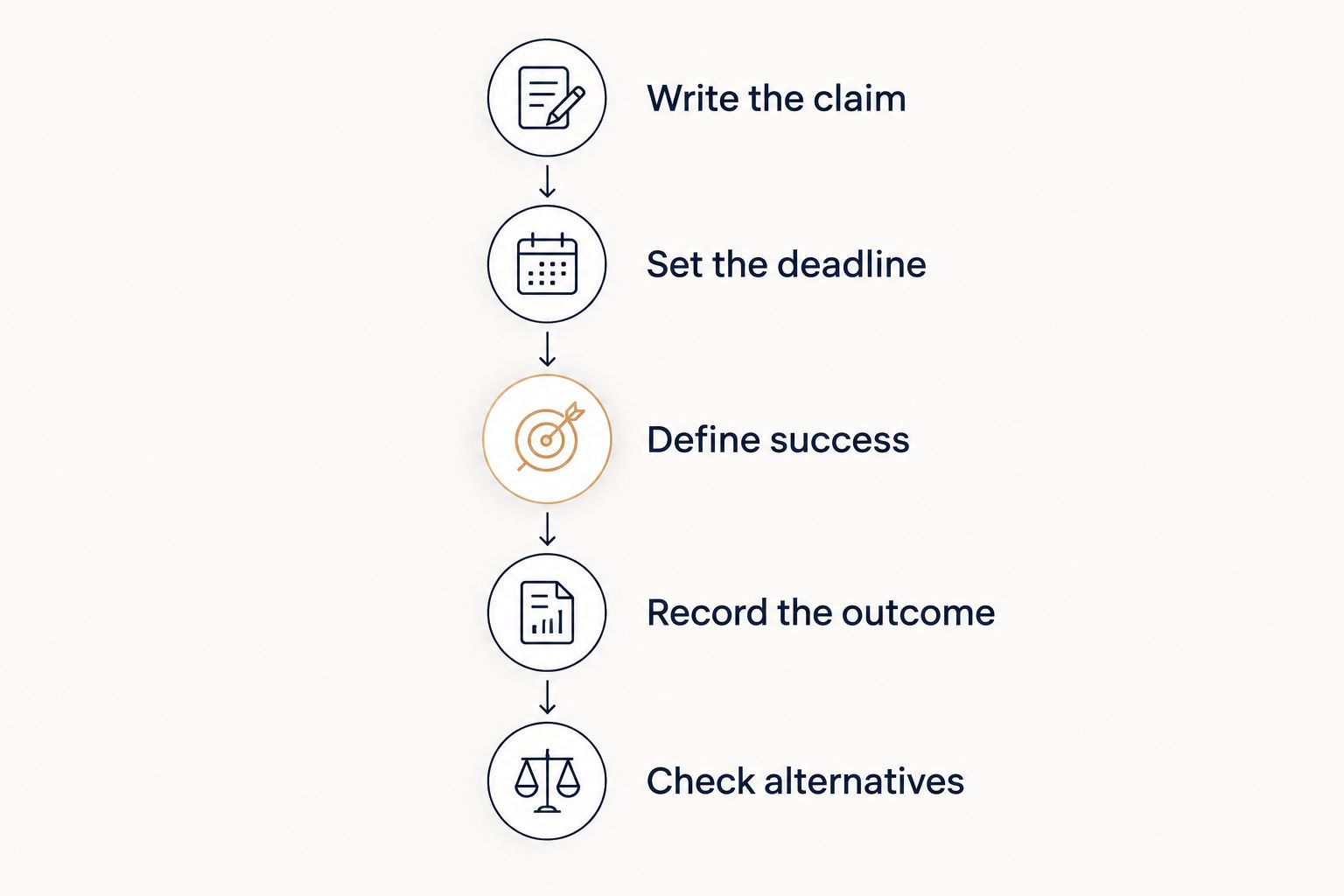
- Write the claim. Copy the prediction exactly before events unfold. Separate statements about your feelings from statements about external facts.
- Set the deadline. Record the reader's stated timeframe. If there is no timeframe, mark the prediction as difficult to evaluate rather than inventing one later.
- Define success. Specify what would count as a match, a miss, or an ambiguous result before checking the outcome.
- Record the outcome. Preserve contradictory information as carefully as confirming information. Do not silently rewrite the original statement.
- Check alternatives. Ask whether the result followed from common circumstances, information already shared, or actions taken after the reading.
For a simple review, use 3 columns in your notes: original claim, outcome, and assessment. Keep 1 prediction per row so a successful detail cannot conceal several unsuccessful ones. Add the full date, including 2026, rather than recording only the day and month.
A personal log still has limits. You know the reading, your actions can influence events, and you are evaluating your own results. It is more useful than unaided memory, but it does not replace a controlled study.
What questions are safer and more useful to ask tarot?
Ask questions that return attention to your choices. A reflective question does not require you to accept that the cards know another person's thoughts or can determine an outcome.
Try these formulations:
- What am I assuming about this relationship?
- Which concern am I avoiding in this career decision?
- What information do I need before I act?
- Which boundary do I want to communicate clearly?
- What action remains within my control?
Choose 1 question per session as a practical boundary, not as a rule about how tarot works. Write down your answer before seeking another interpretation. If you keep repeating the question until you receive reassurance, pause instead of treating the next draw as more authoritative.
For a 2026 career decision, for example, turn an interpretation about change into a concrete investigation: review the role, speak with the employer, and examine your obligations. The card does not establish whether the opportunity is suitable.
Where does Jahben fit into an evidence-based view?
Jahben offers personal spiritual readings using tarot, astrology, and numerology. That makes the service relevant to spiritually curious adults exploring love, career, timing, and life direction—not a replacement for scientific forecasting or professional assessment.
Jahben is best for spiritually curious adults seeking personal guidance, not scientifically validated predictions. The service's relevance is its spiritual and interpretive format; the limit is that a reading cannot establish an unknown fact simply by presenting an answer confidently.
Apply the same standard to any provider: distinguish the service offered from the evidence supporting a particular claim. A clear explanation of a spiritual practice is not equivalent to independent confirmation that its predictions are reliable.
Can tarot predict the future accurately?
Tarot is not established as a reliable way to predict future events. An individual prediction matching an outcome does not identify the cause of the match or show that the method performs consistently.
Ask whether the prediction was specific, recorded beforehand, and evaluated alongside misses. Without those conditions, apparent accuracy is difficult to distinguish from hindsight and chance.
Is tarot a scientifically proven therapy?
Tarot is not an established evidence-based treatment for a mental health condition. A supportive conversation or reflective exercise does not make the practice equivalent to a tested treatment.
If distress affects your sleep, relationships, work, or safety, seek a qualified mental health professional. You do not need to abandon spiritual beliefs to receive appropriate care.
Can I enjoy tarot and still think scientifically?
Yes—you can enjoy tarot while distinguishing spiritual belief from established evidence. Scientific thinking asks whether a claim survives a fair test, not whether a symbol has personal meaning.
In 2026, a grounded boundary remains straightforward: let symbolism generate questions, then use relevant evidence to answer factual ones. You retain responsibility for the decision.
FAQ
Is tarot reading scientifically proven in 2026?
No—tarot reading is not scientifically proven to predict future events or reveal hidden facts. Personal meaning and a convincing interpretation do not establish predictive ability.
Why did my tarot reading describe me so well?
A close-feeling match can reflect broad descriptions, information shared during the session, flexible interpretation, and selective attention. That experience alone does not determine which explanation applies or demonstrate supernatural knowledge.
Does the Barnum effect explain every tarot reading?
No—the Barnum effect describes accepting general descriptions as personally specific; it does not establish what happened in every reading. It is one relevant explanation to consider when evaluating perceived accuracy.
Can tarot tell me what another person is thinking?
Tarot cannot reliably establish another person's private thoughts. Use direct communication and observable behavior rather than treating a card interpretation as evidence of intent.
Can I use tarot instead of therapy?
Tarot is not a replacement for mental health assessment or evidence-based treatment. You can keep a spiritual practice while seeking qualified care for distress or symptoms.
What should I expect from a Jahben tarot reading?
Treat a Jahben tarot reading as personal spiritual guidance, not a scientifically validated forecast. Keep factual verification and consequential decisions separate from symbolic interpretation.
How should I check whether a tarot prediction came true?
Record the exact prediction, its deadline, and your success criteria before the outcome occurs. Count misses and ambiguous results as well as matches; a personal record still does not establish scientific validity.
One last thing
A useful interpretation does not have to be a true prediction. If a reading helps you formulate a better question, take that question seriously—but test its answer in the real world.
Before acting, write down the evidence that would change your mind. If no possible outcome would count against the interpretation, you are working with a belief rather than a testable forecast. That distinction protects your judgment without requiring you to discard your spiritual interests.
Related guides
- How to journal after a tarot reading for deeper insight
- How to do a three-card tarot spread for clarity
Ready for your own reading?
Astrology, numerology, and tarot brought together into one clear, written answer about your love, career, or timing.
Book a Personal Reading Get Your Free Report