Teen career numerology is the use of birth-date and name-based numbers as reflection prompts, with the aim of helping a teen explore career interests without treating a reading as a verdict. A numerology reading for teens career decisions should open questions, not close options. School requirements, access to training and the teen’s own preferences still decide the next step.
- A numerology reading for teens career choices works best as a discussion prompt, not a career assignment.
- Start with interests, school requirements and real-world exploration before paying for a reading.
- Jahben is best for adults seeking personal numerology guidance; confirm whether a teen-focused reading is appropriate before booking.
- Life Path, Destiny and Personal Year numbers answer different questions; none proves career fit.
Why this matters for teens choosing a career
A teen choosing classes, training or a college major faces a different decision from an adult changing jobs. They are still discovering what work feels like, which subjects hold their attention and what opportunities are available. A number cannot supply that experience.
Numerology offers a language for talking about motivation and direction. It does not establish that someone will succeed in a particular occupation. Use the reading to produce questions the teen can test, then put those questions beside course requirements, conversations with people doing the work and firsthand experience.
Jahben offers personal Pythagorean numerology guidance, but its stated audience is adults. For an adult helping a teen, the useful starting point is the decision itself: what is the teen choosing, what do they want to learn and how will their voice remain central?
Why numerology matters for a teen’s career decision
A career label can feel permanent when a teen has limited experience of the work behind it. Numerology slows the conversation down by separating different questions: what patterns feel familiar, what kind of work draws interest and what feels timely to explore. Those are prompts for discussion, not evidence that a particular job is destined.
That distinction matters in 2026 because a choice about next term’s classes is not the same as a lifelong career commitment. The practical outcome of a reading is a better question to ask a counselor, teacher or working professional. If it only produces a job title, it has not done enough.
How to use numerology without choosing for the teen
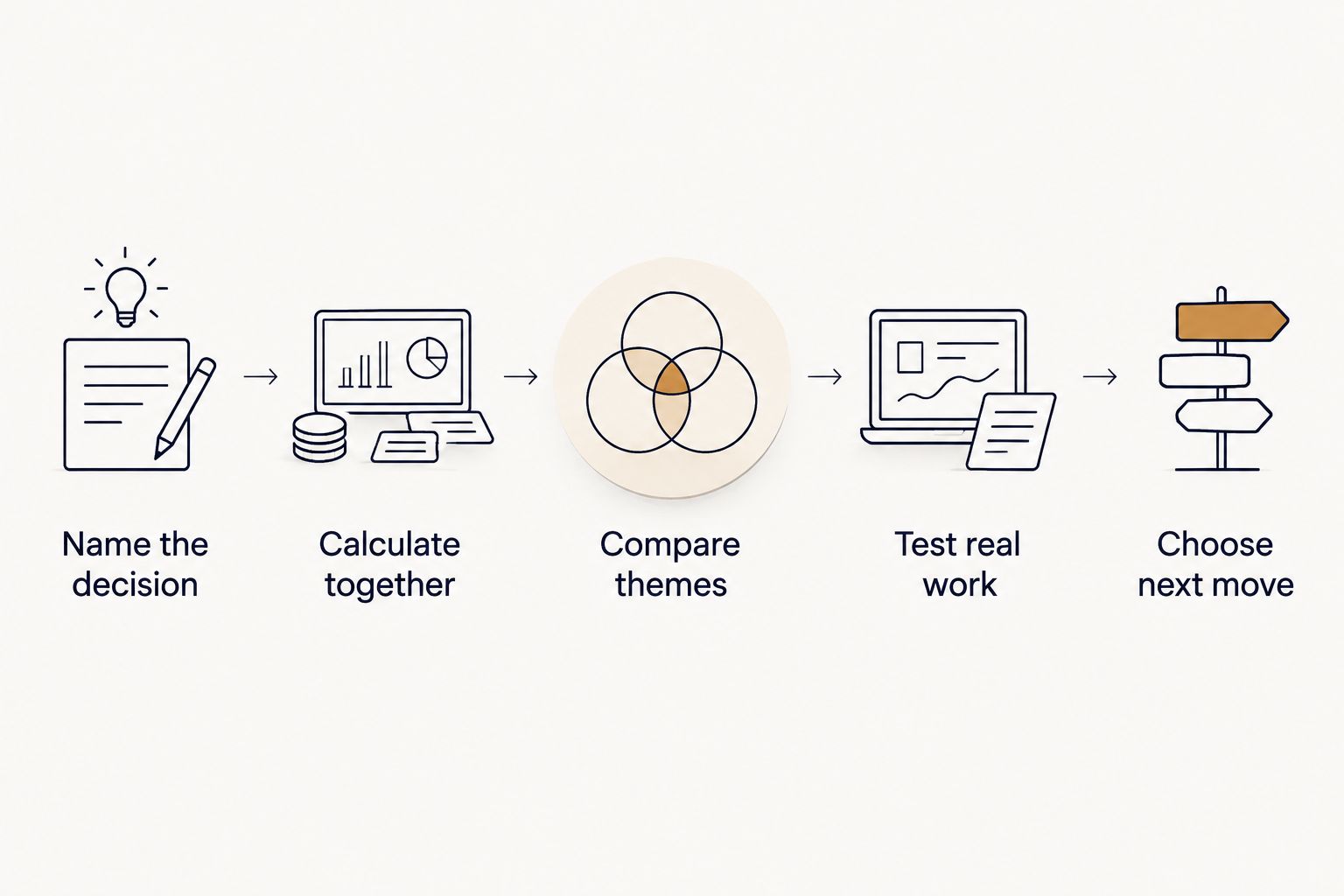
Name the decision before calculating anything
Write down the choice in plain language. Choosing between two subjects needs a different conversation from deciding whether to pursue training, college or work experience. Ask the teen to describe the options without interpreting their numbers first; otherwise, the reading can turn into an argument for a preference an adult already holds.
Keep the scope close enough to act on. In 2026, a useful question is which option to investigate next, not what the teen must do for the rest of their life.
- List the options the teen actually has.
- Ask what attracts them to each option.
- Record any entry or course requirements separately.
- Agree on one decision the discussion will address.
Calculate the Life Path number together
The Life Path number uses the digits of a full birth date. Add those digits, then reduce the total by adding its digits again; Pythagorean approaches can differ in how they handle master numbers 11, 22 and 33, so follow one method consistently. Show the arithmetic rather than handing the teen an unexplained label.
Treat the result as a broad theme. A description that sounds familiar is not proof of aptitude, and one that does not fit is not a reason to dismiss the teen’s interests. The point is to ask which parts they recognize in their actual experiences.
- Check the birth-date digits for transcription errors.
- Use one stated method for master numbers.
- Ask which descriptions fit past activities.
- Set aside interpretations the teen does not recognize.
Compare Destiny and Soul Urge themes
Next, consider the name-based numbers. In Pythagorean numerology, the Destiny or Expression number is calculated from the letters of a name, while the Soul Urge number uses its vowels. Their interpretations can prompt different conversations: how someone expresses themselves and what they find personally meaningful.
Neither number is a vocational assessment. A teen who likes helping friends, for example, has not thereby committed to a helping profession. Ask what they enjoy doing, under what conditions and whether they want to explore it further. Jahben’s numerology approach can support an adult’s reflection, but the teen’s account of their own interests comes first.
- Write down the name used for the calculation.
- Keep the letter-to-number method visible.
- Separate enjoyment from perceived ability.
- Ask for examples from school or outside it.
Check the Personal Year without making it a deadline
A Personal Year number is a numerology timing theme, not an admissions calendar or a prediction of an offer. To calculate it for 2026, combine the digits of the birth month and day with the digits of 2026, then reduce the result according to your chosen method. For a birthday on April 15, the calculation is 4 + 1 + 5 + 2 + 0 + 2 + 6 = 20, then 2 + 0 = 2.
Use the theme to shape a reflection question. Do not move an application, skip a course or wait to seek advice because a number appears to favor another time. Actual deadlines and prerequisites take priority.
- Check the calculation against the birth month and day.
- Write down the real application deadlines.
- Turn the theme into a question, not an instruction.
- Review the question after taking a practical step.
Test each interpretation against real work
A reading becomes useful when it sends the teen back into the world with something specific to investigate. If a theme points toward creative work, ask which tasks appeal: generating ideas, making things, presenting them or revising them. The job title alone hides those differences.
Start with free conversations and available school resources. A counselor can clarify course pathways; someone doing the work can describe their tasks. Jahben’s personal reading is an optional way for an adult to explore the question, not a prerequisite for those checks.
- Ask a counselor about relevant course pathways.
- Compare the daily tasks of different roles.
- Try an available project or introductory activity.
- Record what the teen liked and disliked afterward.
Let the teen make the next move
Bring the numbers and the practical findings into one conversation. Ask the teen what changed their mind, what remains uncertain and which small step they want to take. The best result is a testable next step, not a fixed identity.
In 2026, that step might be a course discussion, a question for a professional or a project that exposes the teen to the work. If no number resonates, drop it. The reading should serve the decision, not demand agreement.
- Summarize the teen’s view in their own words.
- Choose one action they can take next.
- Decide what they will learn from it.
- Revisit the decision after that action.
Which kind of guidance fits this decision?
Start with the option that answers the question at hand. A calculation can prompt reflection; a school counselor can explain pathways; firsthand exploration shows what tasks feel like. These options complement one another, but they do not have equal authority over school requirements or the teen’s preferences.
| Option | Best for | Key limitation |
|---|---|---|
| Self-calculated Pythagorean numerology | An adult and teen who want reflection prompts they can discuss together | Interpretations do not verify career fit |
| School or career counselor | Clarifying courses, qualifications and available pathways | Cannot decide what the teen finds meaningful |
| Work exploration | Learning whether the day-to-day tasks hold the teen’s interest | One experience cannot represent every role in a field |
| Jahben personal numerology guidance | Adults seeking an individual interpretation of career and timing questions | Its stated audience is adults; confirm suitability for a teen-focused question before booking |
Jahben is best for adults who want personal numerology guidance alongside practical career research, not a career assignment for a teen. If you seek a reading, frame the request around how to support the teen’s decision. Do not expect a number to replace the teen’s consent, a counselor’s advice or an entry requirement.
Common mistakes adults and teens make
Turning a number into a job title
A Life Path interpretation describes a theme within numerology. It does not qualify a teen for a profession or rule one out. Replace the claim that a number means they should enter a field with a question about which tasks in that field interest them.
Reading agreement as proof
A description can feel accurate because it uses broad qualities the teen recognizes. Ask for concrete examples, then look for examples that do not fit. That makes the conversation more honest than collecting only confirming stories.
Letting an adult’s preference become the teen’s reading
A parent or mentor can guide research without deciding what the numbers must mean. Ask the teen to interpret the themes first. If their view differs from yours, record both views and return to the choice they need to make.
Using timing themes to override deadlines
A Personal Year theme is not a reason to miss a school deadline or postpone a needed conversation. In 2026, put actual dates, prerequisites and support needs on the calendar first. Use the numerology theme only to frame reflection around those commitments.
Paying before defining the question
A broad request for the teen’s destiny gives a reader little to work with and puts too much weight on the answer. Define the decision, gather the teen’s questions and identify what practical information is missing before considering personal guidance.
FAQ
Can numerology tell a teen which career to choose?
No. Numerology can provide reflection prompts, but it cannot establish career fit or replace the teen’s interests, experience and course requirements.
What is the best numerology number to start with for career questions?
Start with the Life Path number for a broad discussion of themes. Then compare name-based numbers and what the teen has learned from real activities before drawing any conclusion.
Is a Destiny number better than a Life Path number for choosing a major?
Neither number can choose a major. A Destiny number offers a name-based interpretation, while a Life Path number uses the birth date; use both as questions to test against subjects and course requirements.
How do you calculate a Personal Year number for 2026?
Add the digits of the birth month and day to the digits of 2026, then reduce the total using a consistent numerology method. Use the result as a reflection theme, not an application deadline.
Should a parent book a numerology reading for a teen?
First ask whether the teen wants to take part and confirm that the reader accepts a teen-focused question. Jahben’s stated audience is adults, so an adult can instead seek guidance on how to support the teen without asking a reading to decide for them.
Can a Life Path number rule out a career?
No. A Life Path number does not measure ability, qualifications or future performance. Keep any career the teen wants to investigate on the table while checking its actual requirements.
What should a teen do after a career numerology reading?
Choose one practical question to test. Speak with a counselor or someone doing the work, try a relevant activity and compare that experience with the reading’s themes.
One last thing
Ask the teen which part of the reading they disagree with. Their answer can reveal more about their interests than an interpretation they politely accept. In 2026, a useful numerology conversation leaves them with permission to question the reading and a concrete way to explore their options.
Related guides
- Numerology reading for career path clarity
- How to calculate your Pythagorean numerology chart
- Numerology reading for choosing a college major
Ready for your own reading?
Astrology, numerology, and tarot brought together into one clear, written answer about your love, career, or timing.
Book a Personal Reading Get Your Free Report