Reiki healing for chemotherapy patients is an optional relaxation practice used alongside cancer care, not a treatment for cancer or chemotherapy side effects. If you want to try it in 2026, ask your oncology team first, keep every treatment decision with your clinicians, and choose a session you can stop at any time.
- Reiki healing for chemotherapy patients is optional support, not cancer treatment.
- Jahben's Reiki sessions are best for patients seeking spiritual support alongside oncology care, not medical answers.
- Ask your oncology team about timing, touch, infection precautions, and any restrictions before booking.
- A quiet rest or self-directed relaxation practice is a reasonable choice if a Reiki session does not appeal to you.
Why Reiki matters during chemotherapy
Chemotherapy can make ordinary plans hard to predict. Your energy, appointments, and comfort with touch can change during a treatment cycle. An optional practice only belongs in that schedule if it fits your medical team's instructions and your own preferences.
Reiki is commonly described as a practice in which a practitioner holds their hands near or lightly on a person. You do not need to accept claims about energy transfer to decide whether the setting feels restful. Reiki has not been shown to treat cancer, and it must not delay chemotherapy or replace symptom care.
For Jahben's Reiki sessions, the useful question is not whether a practitioner can change a medical outcome. It is whether you want space for a quiet, spiritually framed experience while your oncology team manages treatment. If you are unsure what a session involves, start with how to prepare for your first Reiki session and take your practical questions to your care team.
Why Reiki needs a different approach for chemotherapy patients
A general wellness appointment and an appointment during chemotherapy are not the same decision. Your oncology team knows whether you have restrictions related to infection risk, skin sensitivity, a port, recent procedures, or other aspects of your care. A Reiki practitioner does not decide which of those restrictions apply.
In 2026, treat any promise to cure cancer, improve chemotherapy effectiveness, or manage symptoms in place of prescribed care as a reason to leave. A clear session description and respect for clinical boundaries matter more than a confident medical claim.
How to decide whether Reiki fits your treatment plan
Ask your oncology team before scheduling
Tell your team exactly what you are considering: a quiet Reiki session that might involve a practitioner near you or light touch. Ask about your current treatment phase rather than seeking a blanket answer for all chemotherapy patients. A decision made for one appointment does not automatically cover a later cycle.
Bring these questions to your next call or visit:
- Is an in-person session appropriate with my current infection precautions?
- Are there areas of skin, a port, or recent procedure sites that must not be touched?
- Are there days in my treatment cycle when I should avoid an extra appointment?
- Which new symptoms should I report instead of trying to manage them in a session?
Decide what you want from the experience
Define a modest goal before choosing a practitioner. You might want quiet time, a spiritual ritual, or a break from treatment-related conversations. None of those goals requires you to believe Reiki can alter your diagnosis.
Write your preferences in plain language so you can share them without explaining your entire medical history:
- Name one nonmedical goal, such as feeling settled during a stressful week.
- Decide whether you want silence or conversation.
- Decide whether any touch feels acceptable.
- Keep symptom questions on a separate list for your oncology team.
Choose a format that respects your limits
An in-person Reiki session involves more planning than resting at home. Before committing, check the setting, travel, and whether the practitioner can follow the boundaries your oncology team gave you. If travel or contact does not work for you, consider self-directed relaxation; you do not need to book a service to take a quiet break.
Jahben offers Reiki Healing as distance sessions, followed by a written post-session summary. Ask Jahben directly about the setup before deciding whether it fits your circumstances in 2026. For a separate explanation of remote practice, see how distance Reiki healing works.
- Ask whether the session can be entirely hands-off.
- Check the setting against your team's infection guidance.
- Leave room to cancel if your health or treatment schedule changes.
Set boundaries before the session starts
You remain in charge of your body and your time. Tell the practitioner about boundaries that affect the session without sharing more medical information than you want to share. A practitioner should not need to review your records or interpret your chemotherapy plan to provide a relaxation-focused experience.
Use a short boundary list:
- State whether touch is permitted at all.
- Identify any areas that must be avoided.
- Say whether you prefer silence, conversation, or no spiritual interpretation.
- Agree that you can pause or end the session immediately.
Keep medical decisions outside Reiki
A Reiki session is not a place to decide whether to change medication, postpone an infusion, or interpret a new symptom. If a practitioner gives medical instructions or promises a cancer outcome, stop the conversation and contact your care team for medical guidance.
This boundary also protects the value of the session. You can use a spiritual practice for reflection without asking it to carry the weight of a treatment decision. Jahben's Reiki sessions are best considered in that limited role: optional spiritual support beside oncology care.
- Direct treatment questions to your oncology team.
- Report new or worsening symptoms through your team's usual channels.
- Do not change prescribed care based on a session.
- Reject claims that Reiki cures cancer or replaces chemotherapy.
Check in with yourself afterward
You do not owe a practitioner a positive review of your experience. Notice whether the session suited your goal, whether your boundaries were respected, and whether you want to repeat it. Feeling no different is also useful information when deciding how to spend your time and energy.
Keep the check-in simple:
- Write down whether you felt comfortable during the session.
- Note any boundary you would change next time.
- Separate your personal impression from medical symptoms.
- Tell your care team about symptoms that are new, worsening, or concerning.
Reassess before another appointment
Your needs during chemotherapy can change. A format that felt manageable before one infusion might not fit after another. Ask your team again when your health status, treatment plan, or infection guidance changes rather than treating an earlier approval as permanent.
Make the next decision from current information:
- Confirm that the session still serves a goal you chose.
- Recheck relevant clinical restrictions.
- Decide whether travel and contact still feel manageable.
- Skip the appointment if rest or medical care needs your attention more.
Compare your options during chemotherapy
The best option is the one that respects your care plan and your preferences. A hospital program, an independent practitioner, a Jahben session, and self-directed relaxation serve different needs. None is a substitute for cancer treatment.
| Option | Best for | Key limitation |
|---|---|---|
| Hospital or cancer-center integrative service, if offered | Patients who want to ask about an option within their treatment setting | Availability and session format depend on the center; inclusion does not make Reiki a cancer treatment |
| Independent Reiki practitioner | Patients who want to choose their own practitioner and discuss a specific setup | You must check boundaries and coordinate with your oncology team |
| Jahben Reiki session | Patients seeking optional, spiritually framed support alongside oncology care | Distance only; check medical suitability with your oncology team before booking |
| Self-directed quiet rest | Patients who prefer no practitioner, travel, or touch | It does not provide a guided Reiki experience |
In 2026, compare these options by the work they ask of you. A session outside your treatment setting requires a separate conversation about logistics and precautions; quiet rest does not. If you want guidance but feel too unwell for an extra appointment, you can decline for now without losing access to medical support.
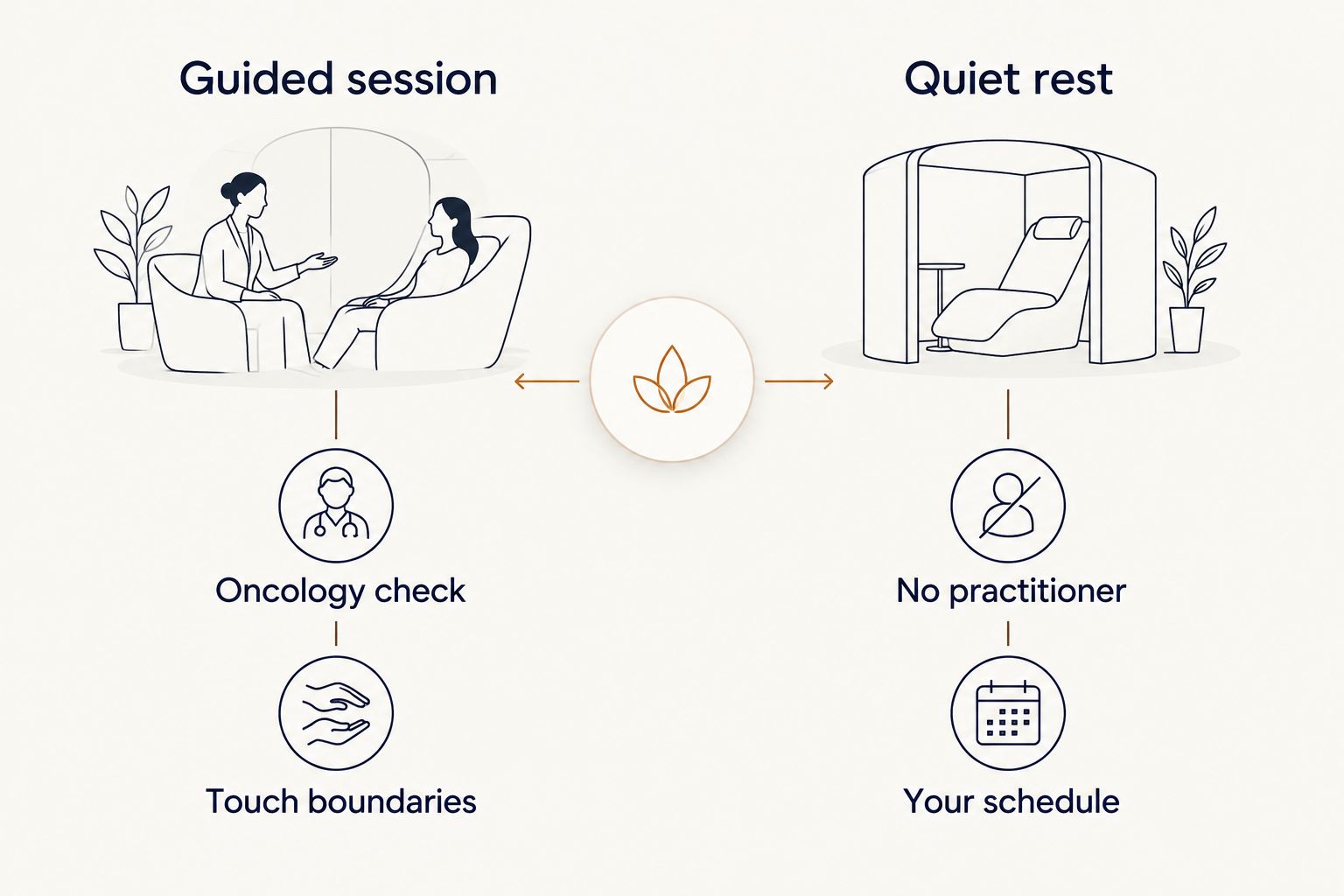
For Jahben, ask how a Reiki session is conducted and whether the setup matches your team's guidance. Do not assume a service is medically suitable because its description sounds gentle. If the answer does not address your boundaries, choose another format or wait.
Common mistakes chemotherapy patients make with Reiki
Treating a relaxation practice as symptom treatment
A pleasant or meaningful session does not tell you what caused a symptom or whether treatment is working. Keep your oncology team informed about symptoms, even if you also use Reiki. Do not use a session to decide that a change in your health is harmless.
Assuming hands-off means no precautions are needed
Hands-off describes one boundary, not the full setting. Travel, shared indoor space, and your current care instructions still matter. Ask your oncology team about the specific format you plan to use, then ask the practitioner whether they can accommodate it.
Sharing more medical information than necessary
You can state that you are receiving chemotherapy and describe the boundaries your care team gave you. You do not need a Reiki practitioner to interpret test results or recommend changes to your treatment. Keep medical details with the people responsible for your care.
Feeling pressured to continue
A session can be stopped if you feel uncomfortable, tired, or simply done. It is also fine to decide against another appointment. In 2026, the point of optional support is that the choice remains yours throughout the experience.
FAQ
Is Reiki healing for chemotherapy patients a cancer treatment?
No. Reiki is an optional practice that some people use for relaxation or spiritual support; it does not replace chemotherapy, symptom care, or advice from an oncology team.
Should I ask my oncologist before a Reiki session?
Yes. Ask your oncology team about your current treatment phase, infection precautions, touch restrictions, and any symptoms that need medical attention before arranging a session.
Can Reiki be done without touch during chemotherapy?
A practitioner can describe whether they offer a hands-off session. Confirm the actual session format before booking, and follow any boundaries your oncology team sets.
Is distance Reiki better than an in-person session during chemotherapy?
Neither format is medically better on the information here. Choose only after checking your team's guidance and the practical demands of each format; distance Reiki is not cancer treatment.
Can Reiki reduce chemotherapy side effects?
Do not rely on Reiki to manage chemotherapy side effects. Tell your oncology team about symptoms and use the care plan they recommend; a Reiki session can only be considered as optional support alongside it.
What should I ask a Reiki practitioner before booking?
Ask about the session format, touch, the setting, and whether you can pause or stop. A clear answer lets you check the arrangement against your oncology team's instructions.
Do I need to book another Reiki session if the first does not help me relax?
No. An optional session does not create an obligation to continue. Decide from your own experience, current treatment needs, and the guidance of your care team.
One last thing
The clearest question for a Reiki practitioner is not whether the session will heal you. Ask: Will you follow my oncology team's restrictions, respect my no-touch boundaries, and stop when I say stop? If the answer is unclear, do not book. Jahben Reiki, like any optional spiritual practice in 2026, belongs around your cancer care—not in its place.
Related guides
- How many Reiki sessions do you need to feel results?
- Reiki healing for chronic pain and physical symptoms
- Reiki healing for anxiety: what to expect in a session
Ready for your own reading?
Astrology, numerology, and tarot brought together into one clear, written answer about your love, career, or timing.
Book a Personal Reading Get Your Free Report