Musicians’ Reiki healing is a reflective practice used alongside performance preparation with the aim of feeling more grounded before a show. A performer needs more than general relaxation: the routine has to fit rehearsals, travel, soundcheck, and the moment before stepping onstage. Reiki can give you space to notice what you’re feeling, but it does not treat performance anxiety or replace practice or clinical care.
- Reiki healing for performance anxiety musicians is an add-on to rehearsal and established anxiety support, not a treatment.
- Jahben Reiki sessions are best for musicians who want guided reflection around performance pressure.
- Build a short, repeatable pre-show routine; judge it by what you can do onstage, not by a promised feeling.
Why Reiki matters for musicians
Performance pressure is tied to a specific task. You still need to remember the arrangement, listen to the other players, and recover if a note goes wrong. A calming practice only earns its place in your 2026 routine if it leaves room for those skills. For a closer look at the practice itself, start with Reiki healing for anxiety.
Reiki is a spiritual practice, not a test of whether you can eliminate nerves. A musician can leave a session feeling reflective and still feel anxious at soundcheck. That distinction matters: the goal is to perform while making room for discomfort, not to demand perfect calm before you play. If anxiety regularly stops you from performing or disrupts daily life, seek help from a licensed mental health professional.
In 2026, use this guide to decide where Reiki fits in your preparation, what to ask a practitioner, and how to tell whether a routine helps you do your job. The steps also work if you decide to skip Reiki and use a self-directed pause instead.
Build a pre-show Reiki routine you can actually use
Start with what you can do yourself. Then decide whether a session adds something useful. Keep your instrument, voice, and performance plan at the center; a spiritual practice is support for the work, not a substitute for it.
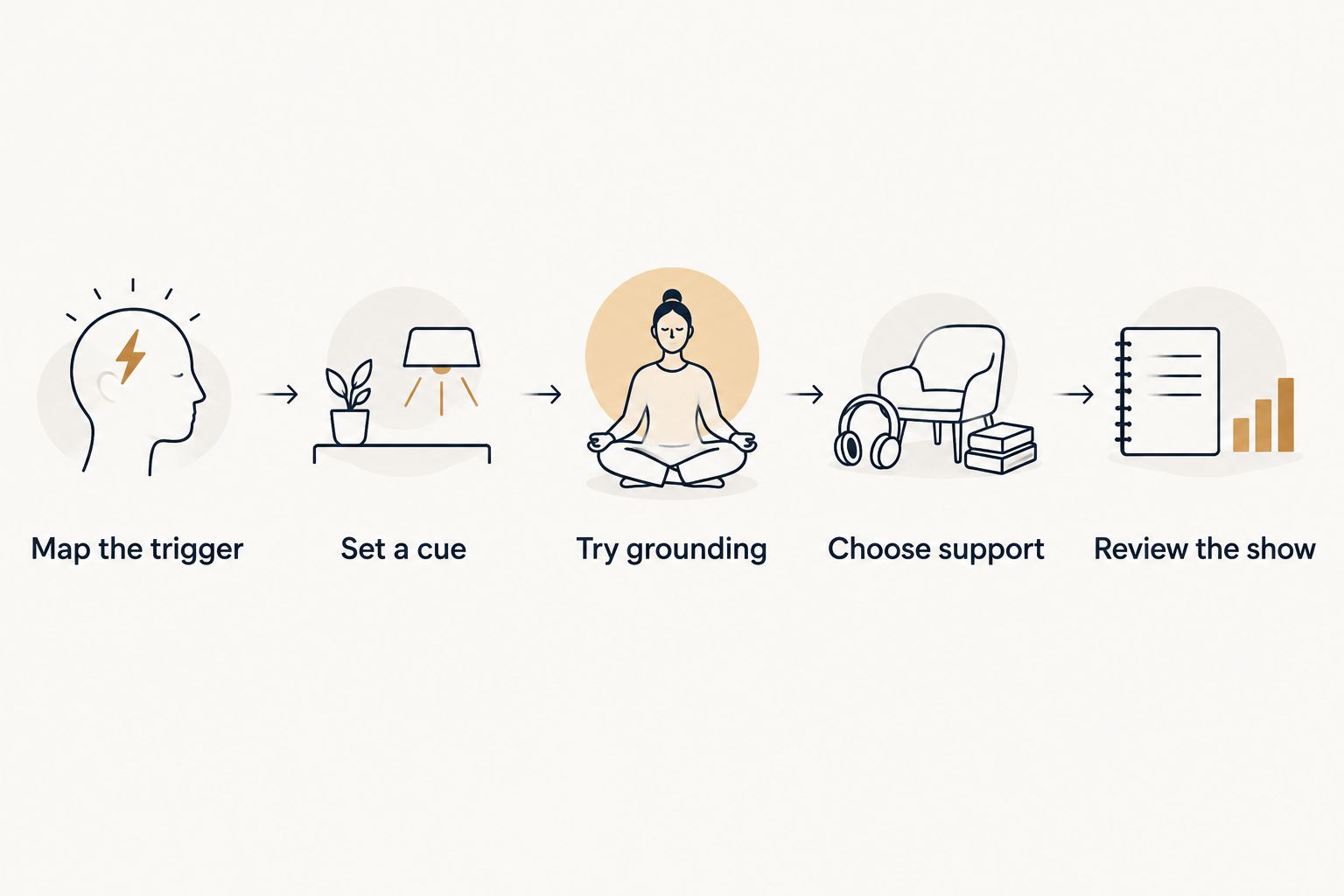
Map the trigger before the next show
Write down what happens before, during, and after a performance. Name the moment, not just the emotion: waiting in the wings, starting a solo, seeing a familiar face, or replaying a mistake afterward. This gives you a clear situation to bring to rehearsal, a Reiki session, or a mental health professional.
Do not turn the notes into a verdict on your talent. You are looking for a pattern you can act on in 2026, including the parts of the show that already feel manageable.
- Note where you are when pressure rises.
- Record what you notice in your body without diagnosing it.
- Identify the musical task that becomes harder.
- Write down what you do next, including anything that helps.
Set a cue you can use backstage
Choose a cue that belongs to the performance rather than to an idealized version of calm. You might place both feet on the floor, notice the weight of the instrument, or silently name the opening phrase. Practice the cue during rehearsal first. Backstage is a poor place to introduce an unfamiliar routine.
Make the cue simple enough to use after a mistake, too. If it only works before the first note, it will not help you rejoin the music when your attention shifts toward self-criticism.
- Pick one physical point of contact, such as your feet on the floor.
- Pair it with a familiar musical entry or lyric.
- Rehearse the cue while playing, not only while resting.
- Return to the next phrase if you lose your place.
Try grounding without changing your technique
Before adding Reiki, test a self-directed pause that does not interfere with your playing or singing. Notice your posture and the sounds around you. Then return to the task you have prepared. Avoid making any breathing pattern or body position a condition for performing well, particularly if it conflicts with your technique.
This is the manual path: it requires no practitioner and travels with you. Its limitation is equally clear. If you want guided spiritual reflection, a solo pause will not provide that conversation.
- Notice the floor beneath your feet.
- Release unnecessary tension where you can without forcing it.
- Listen for a sound in the room before your entrance.
- Resume your usual warm-up rather than replacing it.
Choose support for the problem you named
Match the support to the task. Jahben Reiki sessions are best for musicians who want a guided, reflective pause around performance pressure, not treatment for anxiety. Ask what a session involves and how you can frame a performance-specific intention. There is no musician-specific Reiki program and no guaranteed result.
If the central problem is a passage you cannot reliably play, take it to rehearsal or a performance coach. If fear is persistent or disabling, take it to a licensed mental health professional. These options address different needs; you do not have to choose only one for all of 2026.
- Bring a concrete situation, such as waiting to begin a set.
- Ask the practitioner how the session is structured.
- Keep technique problems in your practice plan.
- Seek clinical support when anxiety affects performance or daily life.
Keep your performance plan intact
A Reiki session belongs beside your established preparation, not in place of it. Keep the parts you already rely on: practicing difficult transitions, checking equipment, warming up appropriately, and agreeing on cues with other performers. A reflective session cannot tell you whether an instrument is ready or a passage is secure.
Be careful with last-minute changes. If a new ritual takes attention away from soundcheck or makes you feel that you cannot play without it, simplify the ritual. In 2026, the useful routine is the one that lets you return to the music.
- Protect your normal rehearsal and warm-up time.
- Check instruments and equipment as usual.
- Agree on entrances and recovery cues with collaborators.
- Keep any spiritual practice optional on show day.
Plan for a mistake before it happens
Stage anxiety can attach itself to the idea that one error will define the show. Build a musical recovery plan instead of trying to promise yourself a flawless performance. Know where you can re-enter, who gives the cue, and what you will focus on next. You can pair that plan with your grounding cue.
Reiki may give you time to reflect on how you respond to mistakes. It cannot prevent them. Your practical goal is to keep participating in the performance after one occurs.
- Mark reliable re-entry points in the piece.
- Practice continuing after a missed entrance.
- Choose a cue you can use while performing.
- Discuss recovery with your group when relevant.
Review the show without grading your nerves
Afterward, ask what you did, not whether you felt perfectly calm. Did you start, stay with the music, recover, and communicate with the other performers? Write down anything you want to change before the next show. If you used Reiki, judge its place in the routine by whether the process felt useful, not by a promise that anxiety should disappear.
Keep your review short enough to finish. Repeatedly replaying a difficult moment can pull attention away from the next rehearsal. Give yourself a specific practice task, then stop reviewing.
- Record what helped you begin.
- Note whether you used your recovery cue.
- Choose one passage or transition to rehearse.
- Decide whether to keep, change, or drop the Reiki element.
Compare your support options
Best for depends on what is getting in the way. A reflective practice, a music lesson, and clinical care do different jobs. None should be presented as a replacement for the others.
| Option | Best for | Key limitation |
|---|---|---|
| Self-directed grounding | Musicians who want a portable cue before or during a show | Offers no individual guidance or treatment |
| Jahben Reiki session | Musicians who want guided spiritual reflection around performance pressure | Is not anxiety treatment or a substitute for rehearsal |
| Performance coaching | Musicians working on stagecraft, preparation, and recovery after mistakes | Does not replace mental health care |
| Licensed mental health care | Musicians whose anxiety is persistent or disrupts daily life | Is not a rehearsal or instrument lesson |
If you are considering a remote session, read how distance Reiki healing works before asking any practitioner about format. That guide explains the subject; Jahben's Reiki sessions are held at a distance. Ask directly rather than building your pre-show plan around an assumption.
For 2026, choose the option that addresses your actual obstacle. A shaky entrance calls for musical practice. A desire for spiritual reflection points toward Reiki. Anxiety that limits your life calls for qualified care. You can combine appropriate forms of support without claiming that one does every job.
Common mistakes musicians make with Reiki
Using a session instead of practicing the hard passage. Reiki does not rehearse a transition for you. Bring the passage into your practice schedule, then use any reflective time to consider how you respond to pressure around it.
Treating calm as the requirement for playing. Waiting until every uncomfortable sensation disappears gives anxiety control over the start of the show. Prepare a cue that returns your attention to the music even when you feel unsettled.
Changing the routine on performance day. A new ritual can become another thing to get right. Test your cue in rehearsal, keep your usual preparation, and avoid adding steps you cannot comfortably repeat backstage.
Reading ordinary nerves as proof that a session failed. A spiritual session does not guarantee a particular feeling at the venue. Review your actions after the show: what you played, how you recovered, and what you will practice next.
Asking Reiki to replace clinical help. If anxiety keeps you from performing or affects your life outside music, contact a licensed mental health professional. Spiritual support can remain a personal choice; it is not a diagnosis or treatment.
FAQ
Can Reiki cure performance anxiety in musicians?
No. Reiki is a spiritual practice, not a treatment for performance anxiety. Keep rehearsing, and seek licensed mental health care if anxiety regularly prevents you from performing or affects daily life.
What is Reiki healing for performance anxiety musicians best used for?
It is best used as optional reflective support alongside musical preparation. Choose a concrete performance situation to discuss and keep your rehearsal plan intact.
Should I book Reiki before a concert in 2026?
Book only if the reflective format suits you and does not displace preparation or needed clinical care. Ask what the session involves before making it part of your concert routine.
Is Reiki better than grounding backstage?
Neither is better for every musician. Self-directed grounding is portable; a Reiki session adds guided spiritual reflection but requires a practitioner and does not treat anxiety.
Can distance Reiki help with stage nerves?
Distance Reiki is an option to ask a practitioner about, not a guaranteed fix for stage nerves. Confirm the available format and keep your musical and mental health support separate.
What should I do if I panic before performing?
Prioritize your safety and seek appropriate professional help when anxiety is severe or recurring. For routine performance pressure, use a familiar cue and the preparation you have already rehearsed.
How do I tell whether a pre-show Reiki routine is useful?
Review what you could do during the performance rather than demanding perfect calm. Note whether you began, stayed engaged, recovered from mistakes, and want to repeat the routine.
One last thing
The most useful pre-show cue is one you can use after the first note, not just before it. Try it during a rehearsal mistake in 2026. If it helps you return to the next phrase, keep it; if it pulls your attention away from playing, change it.
Related guides
- How to prepare for your first Reiki session
- Reiki session for confidence and self-love
- Psychic reading for creative block and artistic direction
Ready for your own reading?
Astrology, numerology, and tarot brought together into one clear, written answer about your love, career, or timing.
Book a Personal Reading Get Your Free Report