Infidelity tarot reading is a way to examine doubt, boundaries, and possible next steps with the aim of making a clearer relationship decision. If you suspect betrayal or are trying to rebuild trust after it, you need more than a symbolic answer: you need to separate what you know from what you fear, then decide what to ask your partner directly.
- For tarot reading infidelity questions, use the cards to examine your choices, not to prove a partner cheated.
- Jahben is best for adults who want a personal reading about relationship uncertainty alongside practical questions to ask.
- Rebuilding trust requires honest conversation and observable actions; a tarot spread cannot do that work for either partner.
- Start with what you know, what you need to ask, and what boundary you will hold.
Why this matters when trust is shaken
A late reply, a changed routine, or a feeling you cannot shake can become the entire story in your head. A tarot reading gives that story structure, but no card can verify an affair, identify a third person, or tell you what someone has done in private. Treat it as a prompt for reflection, not evidence to present in a confrontation.
The same limit applies when infidelity has already been disclosed. A card cannot establish whether an apology is sincere. You can use a reading to name the conditions under which you would consider rebuilding trust, then judge what happens outside the reading. Jahben’s tarot reading for love and relationships is a starting point if you want to frame the issue as a relationship decision rather than a search for a hidden fact.
In 2026, the useful question is not whether tarot can catch a partner. It is whether the reading helps you have a more honest conversation and make a decision you can stand behind.
Why tarot matters after suspected or confirmed infidelity
Suspected infidelity and confirmed infidelity call for different questions. When you have a suspicion, the first task is to distinguish observations from interpretations. When a partner has acknowledged a breach of trust, the task shifts to accountability, boundaries, and whether repair is something you want.
Tarot is useful here because a spread assigns separate places to separate questions. You can look at your feelings without treating them as proof, and you can consider a next step without asking a card to choose your future. Its limitation is just as clear: the person whose behavior concerns you is not answering the cards. A direct conversation remains the way to ask that person for an account.
If you feel unsafe raising the subject, do not use a reading as a reason to confront someone alone. Prioritize your safety and seek support from someone you trust. No spread requires you to put yourself at risk.
How to use a tarot reading for infidelity and rebuilding trust
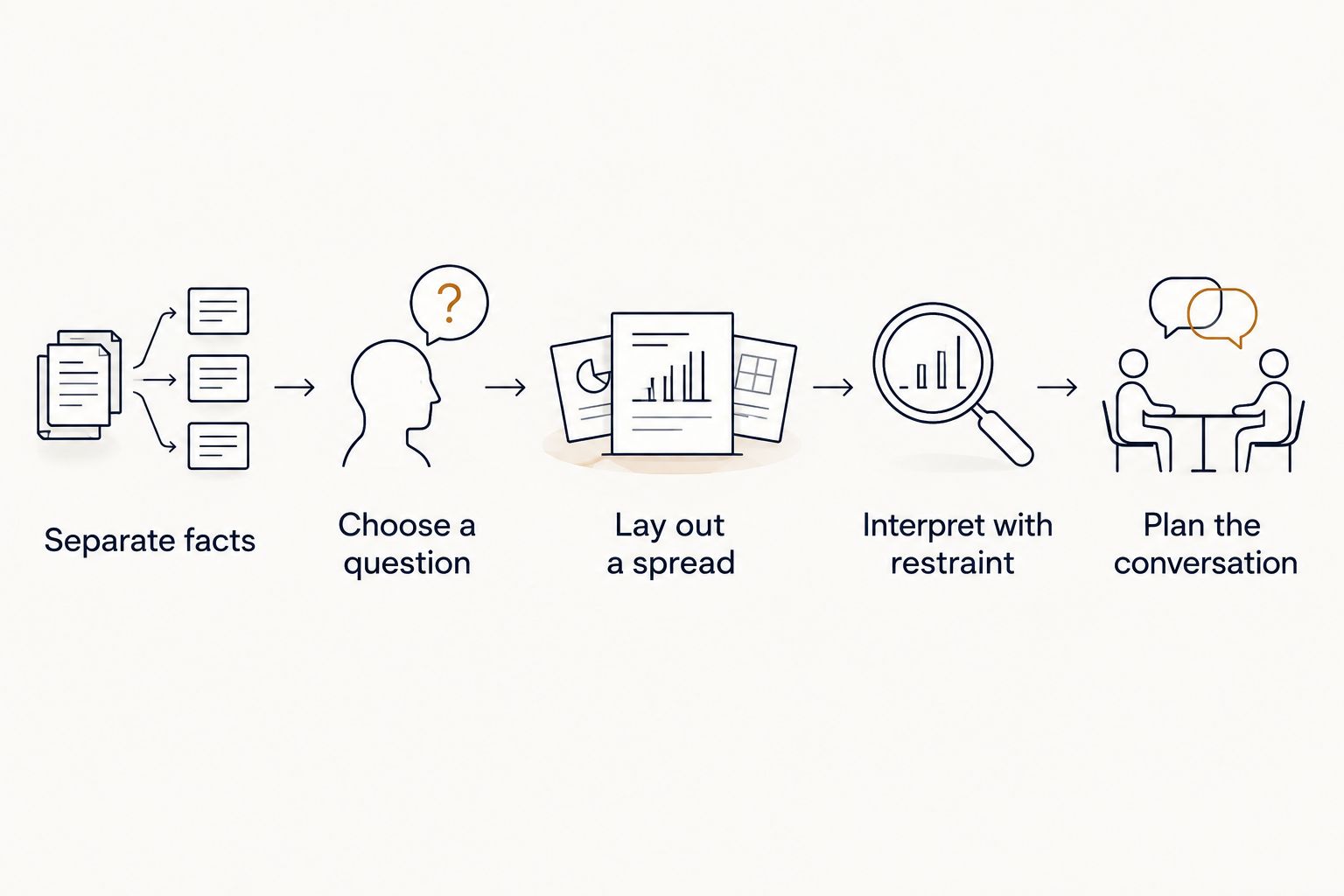
Separate facts from fears
Before you draw a card, write down what you have personally observed and what you have inferred. Keep those columns distinct. Feeling uneasy matters, but an uneasy feeling is not the same thing as knowing why someone acted differently.
This step also protects you from building a question around a conclusion you have not reached. Ask what needs your attention, not for a symbolic confirmation of the outcome you dread.
- Record the words, actions, or events you can describe without guessing motive.
- Put assumptions in a separate column, including explanations that favor your partner.
- Note what you would need to ask to close the gap between the columns.
- Pause the reading if writing the facts makes you realize you need immediate support instead.
Choose a question you can act on
A question such as Is my partner cheating? asks tarot to report on someone else’s private behavior. Replace it with a question about your position: What am I avoiding asking? or What boundary do I need to state? You retain the ability to act on either answer.
In 2026, you can use the same test for every question: if the cards answered it, would you know what to do next without treating symbolism as proof? If not, rewrite it. A reading should clarify your choice, not create a new accusation.
- Ask what you need to understand about your own response.
- Ask which conversation you have been postponing.
- Ask what you need before you can consider rebuilding trust.
- Avoid questions that demand a name, a secret act, or a guaranteed outcome.
Lay out a spread with distinct positions
Start manually with a 3-card spread: What I know, What I feel, and What I need to ask. Write the question at the top of a page, shuffle, draw the cards, and label each position before interpreting. This keeps an emotionally charged card from answering every question at once.
If trust has already been broken, expand to a 5-card spread: What happened, What I feel, What accountability requires, What boundary I need, and My next step. The first position is your account of events, not a way to discover undisclosed facts. For help with the smaller layout, see how to do a three-card tarot spread.
Give every position a job before turning over a card. If you decide the position after seeing the image, you risk fitting the question to the answer you wanted.
- Label the positions before drawing.
- Keep your written observations beside the spread.
- Describe each card in the context of its assigned position.
- Stop if you find yourself repeatedly drawing until you get reassurance.
Interpret cards without making accusations
A dramatic image is not a factual report. If a card brings betrayal to mind, ask why it resonates with your experience; do not translate that reaction into a claim about your partner. Likewise, a reassuring card does not erase a disclosure, a broken agreement, or a question that remains unanswered.
Look for the difference between what a card suggests and what you can verify. You can explore how a card relates to commitment and choice in the Lovers tarot card guide. Its presence in your spread still does not decide whether your relationship should continue.
- Write your first interpretation before looking for a more comforting one.
- Name the real-life question the image raises.
- Mark any claim about another person’s actions as unverified.
- Keep contradictory evidence in view rather than explaining it away.
Plan the conversation outside the spread
Take one question from the reading into a conversation you can actually have. State the observation, explain its effect on you, and ask for a direct answer. If infidelity has been acknowledged, ask what your partner is willing to do to address the breach; you do not have to promise reconciliation to ask.
Jahben offers personal readings by email and live session. A personal reading can help you organize what you want to say, but it cannot answer on your partner’s behalf or make them participate in repair. In 2026, judge the value of a reading by the clarity of the conversation it helps you prepare, not by whether it predicts your partner’s response.
- Choose a time when you can speak without rushing.
- Lead with what you observed, not what a card appeared to reveal.
- Ask one direct question and allow room for an answer.
- Decide beforehand how you will end the conversation if it becomes unsafe or unproductive.
Measure trust by behavior, not repeated pulls
Rebuilding trust is a separate question from deciding to stay. You can care about someone and still need a boundary. You can also decide that an apology does not give you enough to continue. The reading can help you articulate your standard; subsequent behavior tells you whether that standard is met.
Write down the agreements you need, who is responsible for each one, and what you will do if an agreement is broken. Revisit your notes after a conversation rather than pulling more cards to resolve every uncomfortable feeling. A second reading is most useful when the situation or your question has changed, not when you want a different first answer.
- Identify the specific behavior that damaged trust.
- State the boundary you control rather than a promise you cannot enforce.
- Record what your partner agrees to do in their own words.
- Notice whether actions match those agreements over time.
Which reading option fits your situation?
You do not need a paid reading to ask a better question. Choose a format based on whether you want private reflection, another person’s interpretation, or space to respond in real time. None of these options can verify infidelity.
| Option | Best for | Starting price | Key limitation |
|---|---|---|---|
| Self-guided tarot spread | Writing down your feelings and next question privately | No paid reading required | You must watch for interpretations that confirm your fears |
| Jahben tarot reading | A personal interpretation of a relationship question | Check current pricing | The reader cannot confirm another person’s private actions |
| Jahben email reading | Putting a considered question in writing | Check current pricing | You cannot clarify your question in real time |
| Jahben live session | Discussing an evolving question during the session | Check current pricing | Conversation does not replace evidence or your partner’s account |
Jahben is best for adults who want personal tarot guidance on trust without treating a reading as proof of infidelity. The advantage of a personal session is room to explore a question with another person; its limit is that the decision and the conversation with your partner remain yours. If you already know what you need to ask, a self-guided spread can be enough.
Common mistakes when trust is the question
Treating a card as a witness
A reading can surface your concerns; it cannot testify to what happened. Confronting a partner with a card as evidence shifts the discussion away from the behavior you observed and the answer you need. In 2026, keep the distinction plain: describe the event, then ask about the event.
Asking the same question until the answer changes
Repeated pulls can turn a reading into a search for relief. If you dislike an interpretation, write down what unsettled you before drawing again. You may find that the useful issue is your fear of a particular answer, not a need for more cards.
Confusing forgiveness with restored trust
Forgiveness is a personal choice; trust concerns what you are willing to rely on. You do not have to make both decisions at once. Ask what accountability looks like to you before promising that things can return to normal.
Using the spread to avoid a boundary
Insight has little use if it never reaches a decision. If you already know what you cannot accept, say it plainly. A tarot reading is not a substitute for stating your limit, seeking support, or leaving a situation that feels unsafe.
FAQ
Can a tarot reading tell me if my partner is cheating?
No, a tarot reading cannot verify whether your partner is cheating. Use it to clarify your observations, feelings, and questions, then seek a direct account rather than treating a card as evidence.
What should I ask tarot when I suspect infidelity?
Ask what you need to understand, what you need to ask your partner, and which boundary matters to you. Avoid asking the cards to name a person or confirm an act they cannot verify.
What does a tarot reading for infidelity focus on?
A tarot reading for infidelity focuses on your uncertainty, choices, and next conversation. It is not an investigation into another person's private behavior.
Can tarot help rebuild trust after cheating?
Tarot can help you name the conditions under which you would consider rebuilding trust. Rebuilding itself depends on conversations, agreements, and actions outside the reading.
Is a 3-card or 5-card spread better for relationship trust?
Use a 3-card spread to separate what you know, feel, and need to ask. Use a 5-card spread when you also want to examine accountability, a boundary, and your next step.
Is an email reading or a live session better for this question?
An email reading suits a question you want to put in writing; a live session suits a question you want to discuss as it develops. Neither format can confirm whether infidelity occurred.
Should I tell my partner what the tarot cards said?
Tell your partner what you observed and what you need to know, not that the cards proved something. You can share that a reading helped you organize your thoughts without presenting it as evidence.
One last thing
Before your next reading, try writing the question you would ask your partner if tarot were not available. That sentence often shows you where the work really sits: in a conversation, a boundary, or a decision about what you need. In 2026, the strongest outcome of an infidelity reading is a clearer next move, not a claim of certainty about someone else.
Related guides
Ready for your own reading?
Astrology, numerology, and tarot brought together into one clear, written answer about your love, career, or timing.
Book a Personal Reading Get Your Free Report