A tarot reading for negotiating a raise is a way to examine your position, your fears, and your next move before asking for better pay. It works best alongside a record of your contributions and a direct conversation with your manager—not as a prediction of what your employer will decide. If you are new to tarot, start with a three-card tarot spread for clarity and keep the question tied to a decision you control.
- A tarot reading for negotiating a raise helps you prepare your request; it cannot determine your employer’s decision.
- Jahben is best for individuals who want personal tarot guidance before a raise conversation, not a guaranteed pay outcome.
- Bring evidence of your work, ask a focused question, and turn the reading into a specific conversation plan.
- Use manager feedback for workplace facts; use tarot to examine your response to those facts.
Why this matters in 2026
A raise conversation has two parts: what you can demonstrate and what you need to say. Tarot can help with the second part by giving you a structure for examining hesitation, ambition, or a difficult choice. It cannot tell you your employer’s budget, replace a compensation policy, or make a manager agree.
That distinction matters if you are deciding whether to ask now, seek a promotion instead, or wait until you have stronger evidence. In 2026, use the reading to prepare questions and test your own assumptions. Use your job description, documented results, and direct feedback to establish the workplace facts.
Why tarot matters for someone negotiating a raise
A raise request can feel personal even when the discussion is about work. You might know you have taken on more responsibility yet struggle to state it plainly. Or you might want a promotion without knowing which duties your manager considers promotion-level work. A reading gives those uncertainties names so you can address them before the meeting.
The useful question is not whether a card promises more money. It is which part of the conversation needs attention: your evidence, your request, your timing, or your response to a refusal. Jahben is best for individuals who want personal tarot guidance before a raise conversation, not a guaranteed pay outcome. That is a narrower, more useful role for a reading than asking it to decide your salary.
Keep a firm boundary between reflection and evidence. If a card makes you think you have outgrown your role, check that feeling against the responsibilities you actually hold. If it makes you anxious about your manager’s reaction, prepare a clear opening statement rather than treating the feeling as proof of what your manager thinks.
How to use tarot before a raise or promotion conversation
Work through these steps in order. Each one turns an interpretation into something you can write down, verify, or say aloud. You can do the process yourself with a deck and a notebook; a personal reading is an option when you want help interpreting the question.
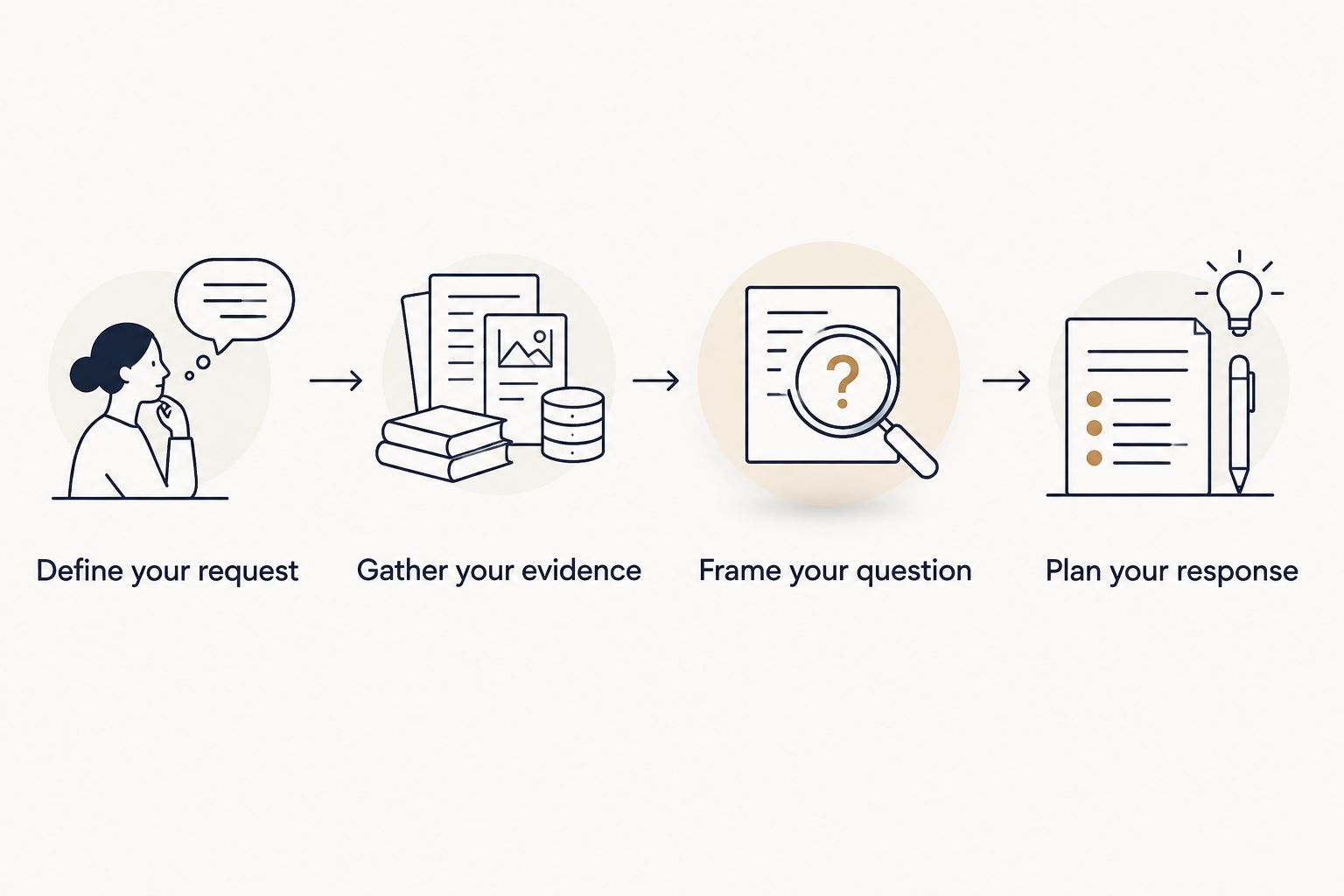
Define your request
Write down what you want before drawing a card. A raise, a new title, and a change in responsibilities are different requests. If you ask about all of them at once, an interpretation can become broad enough to confirm whatever you already believe.
For a raise, identify the work you want recognized. For a promotion, identify the role or scope you want to discuss. In either case, phrase the request so you could say it to your manager without explaining tarot. That simple test keeps your intention connected to the real conversation.
- Write one sentence stating the request you intend to make.
- Separate a pay request from a title or responsibility request.
- Note what you know about the decision process from your employer.
- Mark any assumption you still need to verify with your manager.
Gather your evidence
Before you interpret timing or confidence, collect the facts that support your case. Make a 1-page evidence sheet you can scan before the meeting. Include work you completed, responsibilities you added, and feedback you received. Use only results you can explain; a vague claim about being indispensable will not help you answer a follow-up question.
This is also where tarot has a limit. A card can prompt you to consider whether you are underselling your contribution. It cannot verify the impact of a project or tell you which evidence your employer accepts. In 2026, keep the reading separate from the record you will bring to work.
- List completed projects and describe your contribution to each.
- Record added duties that differ from your current role.
- Save written feedback you are comfortable discussing.
- Remove claims you cannot support with an example.
Frame your question
Ask about your approach, not your manager’s private thoughts. Try: What am I avoiding in this conversation? Which part of my request needs clearer language? What should I prepare if the answer is no? These questions keep the reading focused on choices you can make.
A direct yes-or-no question can be useful when you need to name a decision, but it can flatten a complicated workplace situation. If you want to practice the mechanics, use a beginner’s guide to reading a tarot card spread. Then write your question before you shuffle. Changing it after seeing a card makes it harder to distinguish insight from the answer you hoped to get.
- Ask what you can clarify, prepare, or communicate.
- Avoid asking tarot to reveal a manager’s intentions.
- Keep a separate question for a raise and a promotion.
- Write the question down before drawing any cards.
Read the cards against the decision
Use 3 cards for a compact reading: your current position, the obstacle you can address, and your next action. Treat each position as a prompt rather than a fixed forecast. A card associated with structure might point you toward a clearer request; one associated with uncertainty might send you back to missing information. Neither card establishes what your manager will do.
Read the cards in the context of your written question and evidence sheet. If an interpretation conflicts with a documented fact, keep the fact. If it highlights a concern you cannot explain, write that concern as a question to investigate. This is how a 2026 tarot reading stays useful without turning symbolism into workplace evidence.
- Label each card position before drawing.
- Write your first interpretation before checking another source.
- Connect each interpretation to an action you control.
- Set aside claims about outcomes you cannot verify.
Rehearse the conversation
Turn your notes into a short opening statement. State the work you have done, the request you are making, and your reason for raising it now. Practice saying it without referring to the reading; your manager needs a clear case, not an account of the cards.
Prepare for more than one response. Your manager might ask for examples, describe a decision process, or decline the request. You do not need tarot to script their answer. You need a way to remain direct when the conversation moves somewhere you did not expect. A 20-minute practice session can expose a sentence that sounds clear on paper but feels awkward aloud.
- Say your request aloud without reading from your notes.
- Practice explaining one contribution in plain language.
- Prepare a question about the decision process.
- Decide what you will ask if the answer is not yet.
Plan your response
Before the meeting, decide what information you need from each possible outcome. If your request is approved, clarify the change with your employer. If it is deferred, ask what must happen before it can be reconsidered. If it is declined, ask which part of your case needs work. Keep the response tied to what your manager actually says.
You can use tarot afterward to reflect on your reaction, especially if the answer leaves you disappointed or unsure. Do not use another card draw to overwrite direct feedback. In 2026, the next useful step is the one you can confirm, document, or act on.
- Write a follow-up question for an approval, deferral, and refusal.
- Record the manager’s stated reasons after the meeting.
- Agree on a follow-up point when the decision is deferred.
- Revisit the reading as reflection, not as a substitute for feedback.
Which kind of guidance should you use?
Choose the source that fits the question. Tarot and workplace feedback do different jobs, and neither becomes stronger when you ask it to do the other’s work. Start with your evidence and your manager’s decision process; add tarot when you need clarity about your approach.
| Option | Best for | Strength | Key limitation |
|---|---|---|---|
| Self-directed tarot | Someone comfortable interpreting their own cards | Lets you examine your question privately and at your own pace | Your preferred answer can shape the interpretation |
| Jahben personal tarot reading | Someone who wants another perspective on a career question | Gives you personal guidance to consider before the conversation | Cannot confirm an employer’s budget or guarantee an outcome |
| Manager feedback | Someone who needs to know what their employer expects | Provides information about your role and the decision process | A manager may not settle every question in one conversation |
| Career mentor | Someone who wants to rehearse their case with another person | Can challenge unclear examples and help you practice | Cannot make the employer’s decision |
These options are not competing predictions. A self-directed reading works when you can hold your interpretation lightly. Jahben’s tarot guidance fits when you want a personal reading rather than another solo card pull. For the terms of a raise or promotion, ask the people involved in that decision. For rehearsal, a mentor can help you hear where your case needs detail.
If your uncertainty extends beyond one meeting—whether to stay in the role, pursue a different path, or rethink your priorities—frame that as a separate career question. Trying to settle your entire future inside a raise spread makes the immediate conversation harder to prepare for.
Common mistakes when reading for a raise
- Asking whether your manager will say yes. Tarot cannot establish someone else’s decision. Ask what you need to prepare and find out how the decision is made.
- Treating a confident interpretation as proof. A reading can change how you feel about your case. Your evidence sheet still needs examples a manager can assess.
- Combining a raise and promotion into one question. You can want both, but each request has its own rationale. Name the request you plan to make first.
- Pulling more cards whenever you dislike an answer. Repeated draws can replace preparation with reassurance-seeking. Write down the first reading and identify one action from it.
- Skipping the response to a no. A refusal is not the end of the conversation if you can ask for specific criteria and a follow-up point. Prepare that question before the meeting.
FAQ
Can a tarot reading tell me if I will get a raise?
No, a tarot reading cannot determine whether your employer will approve a raise. Use it to examine your approach, then ask your employer about the decision process.
What is the best tarot question to ask before negotiating a raise?
Ask what you need to communicate more clearly in the raise conversation. That question focuses the reading on an action you control rather than your manager’s private thoughts.
Should I ask about a raise and promotion in the same tarot spread?
Use separate questions for a raise and a promotion. The requests can overlap, but separating them makes your interpretation and your workplace case clearer.
How many cards should I pull for a raise reading?
A 3-card spread is enough to examine your position, an obstacle, and a next action. Label the positions before drawing so you do not reshape the question around the cards.
Is a personal tarot reading better than reading for myself?
A personal reading is better when you want another perspective; a self-directed reading suits private reflection. Neither replaces your evidence or direct feedback from your manager.
Can tarot help me choose when to ask for a promotion?
Tarot can help you examine why you feel ready or hesitant, but it cannot confirm your employer’s promotion schedule. Check the decision process and your record of responsibilities before choosing when to ask.
What should I do if my raise request is declined?
Ask which criteria your request did not meet and when you can revisit the discussion. Record the answer before using a reading to reflect on how you feel about it.
One last thing
The most useful question after a raise meeting is often the one you prepared before it: What would need to change for this request to be approved? Ask it when the answer is unclear. A tarot reading can help you find the nerve to have that conversation; only the employer can answer it.
Related guides
- Tarot reading for career change decisions
- Psychic reading for career decisions and timing
- Tarot reading for job offer decisions
Ready for your own reading?
Astrology, numerology, and tarot brought together into one clear, written answer about your love, career, or timing.
Book a Personal Reading Get Your Free Report