No tarot card is proven to be the most accurate at predicting a yes-or-no outcome. The Sun upright is a clear symbolic yes in common tarot interpretations, but a positive meaning is not evidence that an event will happen. This 2026 guide explains which cards communicate a clear answer, how to interpret uncertainty, and when to stop pulling.
- No card is established as the most accurate yes or no tarot card; symbolic clarity is not predictive accuracy.
- The Sun upright represents a clear symbolic yes, not a guaranteed outcome.
- Use a one-card pull for a focused question; leave room for an unclear answer.
- Jahben offers personal tarot guidance, not a substitute for checking facts or seeking qualified advice.
Why this matters
When you want an answer about love or work, a positive card can feel like permission to stop questioning. Keep the distinction clear: a tarot interpretation gives you a symbolic perspective; it does not verify another person's intentions or a future result.
A useful reading should leave you with something you can examine or do. If the answer only encourages another pull, another interpretation, or another attempt to get reassurance, pause before continuing.
What is the most accurate yes-or-no tarot card to pull?
There is no established accuracy ranking for individual tarot cards. If you mean the card with an especially clear affirmative meaning, The Sun tarot card upright is a useful example because its conventional themes include vitality, openness, and success.
The comparison below uses common symbolic readings, not measured prediction rates. Meanings also depend on the deck, the question, and the interpretive system you choose.
| Card | Symbolic answer and best use | Strength and limit |
|---|---|---|
| The Sun upright | Yes; best for openness | Clear positivity; no guarantee |
| Ace of Swords upright | Yes with clarity; best for decisions | Highlights truth; requires action |
| The World upright | Favorable completion; best for closure | Shows fulfillment; can mean an ending |
| The Moon upright | Unclear; best for examining uncertainty | Flags ambiguity; not proof of deception |
| The Hanged Man upright | Pause; best for reconsideration | Invites perspective; gives no deadline |
These are interpretive examples, not a universal answer key. You should not select The Sun from the deck and treat its appearance as confirmation: choosing a card deliberately is a reflection exercise, not a random pull.
The Sun upright: a clear symbolic yes
The Sun upright is best for exploring confidence, visibility, and openness. Its affirmative symbolism makes it easier to interpret than a card centered on uncertainty or suspension.
For a question such as whether to share a creative project, The Sun offers a prompt to consider being seen. The practical follow-through is to check whether the work is ready and identify an appropriate audience.
The limitation is straightforward. The Sun does not establish that an employer will hire you, that a partner will return, or that a venture will succeed. A positive interpretation should support thoughtful action, not replace preparation.
Recommendation: use The Sun as a clear affirmative symbol; skip treating it as a promise.
Ace of Swords upright: clarity before commitment
The Ace of Swords upright is best for questions involving truth, communication, and a decision. Its conventional symbolism emphasizes mental clarity, insight, and cutting through confusion.
For a question about having a difficult conversation, this card offers a useful focus: say what you mean and distinguish facts from assumptions. That is more actionable than reading the card as an unconditional yes.
The drawback is that clarity can be uncomfortable. A candid conversation might reveal disagreement rather than produce the response you wanted. Read the card's theme before assigning a favorable outcome.
Recommendation: use the Ace of Swords to examine what needs to be said; skip assuming agreement.
The World upright: completion is not always continuation
The World upright is best for questions about finishing, fulfillment, and closure. Its conventional association with completion supports an affirmative reading when your question concerns bringing something to a conclusion.
That same meaning complicates relationship questions. Completion does not automatically mean reconciliation; it can provide a prompt to consider whether a chapter has run its course.
The strength is its clear theme. The limitation is that a satisfying ending and an ongoing commitment are different outcomes. Make sure you have asked which one you actually want to understand.
Recommendation: use The World to reflect on completion; skip translating every ending into a reunion.
Why a yes-or-no tarot interpretation varies
A clear method matters more than finding a supposedly perfect card. These factors explain why the same card receives different interpretations:
- Question wording: Asking whether you should act is different from asking whether someone else will act.
- Timeframe: A question about a conversation this week is narrower than a question about a relationship's entire future.
- Deck system: Artwork and guidebook meanings differ, so a memorized answer list does not cover every deck.
- Reversal rules: Reading reversed cards adds interpretive possibilities; ignoring them creates a different method.
- Spread position: A card assigned to an obstacle describes a different role from a card assigned to a next step.
- Reader judgment: Turning symbolism into a binary answer requires interpretation, not simply recognizing a card.
In 2026, an app's confident yes-or-no label still needs the same scrutiny as a printed guidebook. A decisive presentation does not establish predictive accuracy.
How do you do a one-card yes-or-no tarot pull?
Use a repeatable process and decide the rules before drawing. Best for a focused reflection: one question, one card, and one written interpretation. The strength is simplicity; the limitation is that a single image cannot explain every part of a complicated situation.
- Write the question. Name a specific decision or action. Avoid combining love, money, timing, and another person's intentions in the same sentence.
- Set the rules. Decide whether you will read reversals and whether unclear is an acceptable answer. Do not change those rules after seeing the card.
- Draw the card. Shuffle and draw using your chosen method. Keep the question unchanged.
- Read the meaning. Identify the card's central theme before assigning yes, no, or unclear. Write down the reason for your interpretation.
- Check the facts. Separate what the card suggests from what you know. Choose a practical next step that does not depend on a prediction being true.
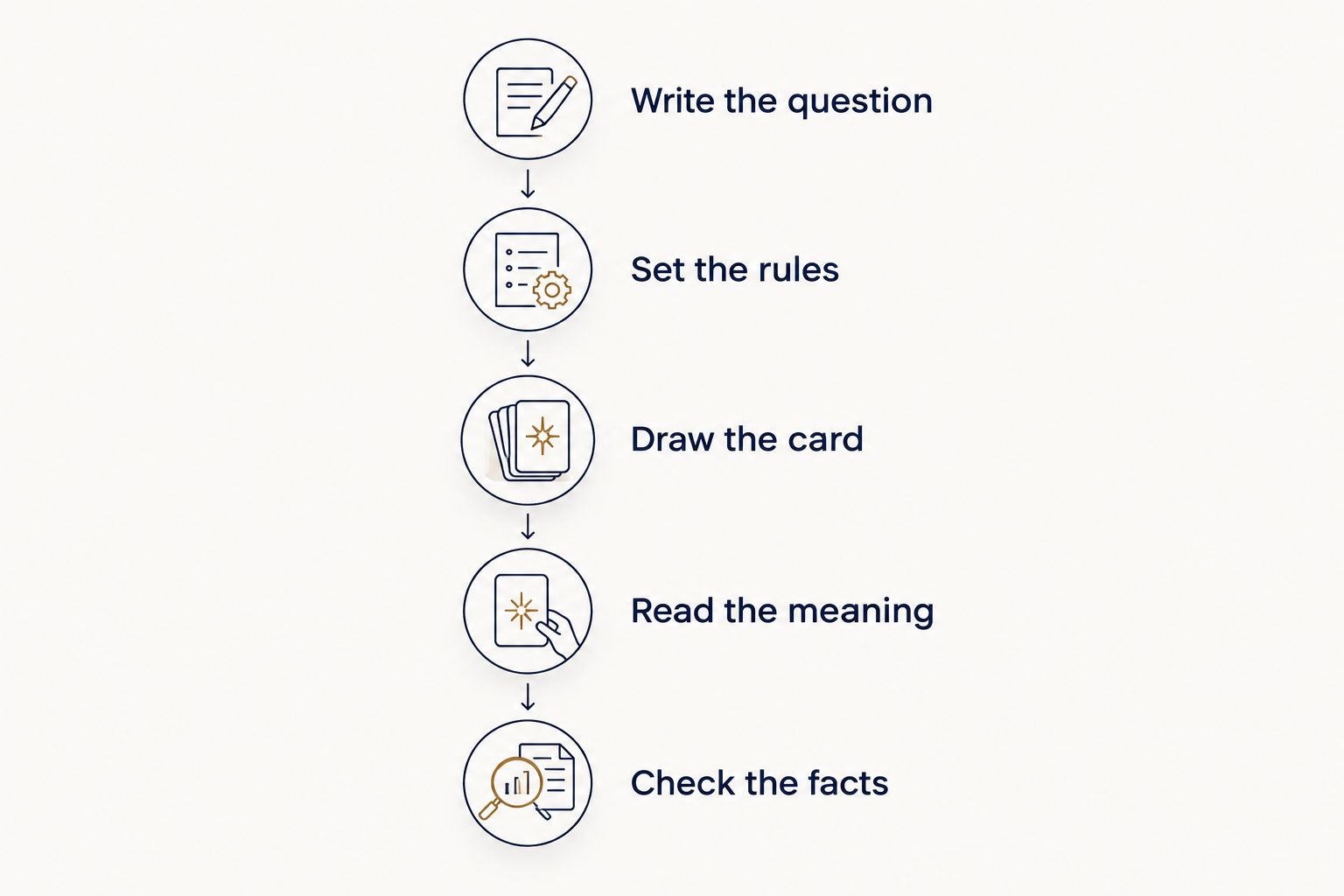
For example, replace a broad question about whether your career will work out with a question about whether to request a conversation about your responsibilities. You can then examine the card alongside your workload, priorities, and what you want to say.
Is one card or a three-card spread better?
One card is best for keeping a narrow question focused; three cards are best for separating different aspects of a situation. More cards add interpretive material, not proof of greater accuracy.
| Method | Best for | Strength and limit |
|---|---|---|
| One-card pull | A focused prompt | Simple; limited context |
| Three-card spread | Exploring a decision | More context; more interpretation |
A standard tarot deck has 78 cards, commonly divided into 22 Major Arcana cards and 56 Minor Arcana cards. A larger selection of symbols does not turn a draw into a verified forecast.
For a three-card reflection, assign the positions before drawing: situation, obstacle, and next step. Do not call a favorable card the outcome after you originally assigned it to the obstacle position.
This 2026 approach keeps the purpose modest and useful: identify a perspective, examine a concern, and decide what to do next. Neither method establishes what another person secretly thinks.
Which questions give you a clearer reading?
Ask about a decision you can examine rather than demanding access to someone else's private thoughts. You can still ask a binary question, but define what the answer would mean in practice.
For love, a focused question might concern whether you are ready to initiate a direct conversation. Compare the symbolic response with the person's actual communication, stated boundaries, and behavior.
For work, ask about preparing for an interview or discussing responsibilities. Do not treat a favorable card as evidence that an offer is coming. Continue checking the details and pursuing appropriate opportunities.
For timing, name the period you are considering. If you are planning a move in 2026, distinguish the reflective question about readiness from factual questions about housing, employment, and obligations.
A clearer question improves the usefulness of an interpretation; it does not establish predictive accuracy. Keep that distinction even when the card feels unusually relevant.
Does a reversed card always mean no?
A reversed card does not always mean no. Reversals have different meanings across reading methods, including blockage, delay, inward expression, or an opposite emphasis.
You can use an upright-only method or include reversals. Either approach needs consistent rules. Choosing whichever interpretation feels more reassuring after the draw defeats the purpose of setting a method.
What if you pull The Moon or The Hanged Man?
The Moon and The Hanged Man are useful prompts for uncertainty and pause, not automatic predictions of failure. In a yes-or-no reading, leaving the answer unresolved is more honest than forcing either card into a confident verdict.
The Moon conventionally concerns ambiguity, intuition, and illusion; it does not prove someone is lying. The Hanged Man conventionally concerns suspension and a changed perspective; it does not supply an exact waiting period.
Should you keep pulling until you get a clear answer?
Do not keep pulling until you receive the answer you want. Repeated draws create more material to reconcile without resolving the underlying factual uncertainty.
Write down the original card and your interpretation. Revisit the question after circumstances change, rather than treating disappointment with the answer as a reason to start again.
If the urge to check keeps increasing, put the deck aside. A direct conversation, a written decision list, or support from someone you trust addresses a different need from another symbolic answer.
When a personal tarot reading fits
Jahben tarot readings are for spiritually curious adults seeking personal guidance on love, career, timing, and life direction. Jahben offers personal readings by email or live session and uses tarot alongside other named spiritual systems.
The useful distinction is between receiving an interpretation and receiving verified information. A personal reading provides a setting for discussing your question; it should not replace medical care, legal advice, financial analysis, or another person's explicit consent.
In 2026, bring the decision you face, the facts you already know, and the point you find difficult to assess. That keeps the conversation centered on your situation rather than a demand for certainty no card can establish.
FAQ
What is the most accurate yes or no tarot card?
No tarot card is established as the most accurate predictor of yes-or-no outcomes. The Sun upright has a clear affirmative meaning in common tarot interpretations, but symbolic clarity is not predictive accuracy.
Is The Sun always a yes in a tarot reading?
The Sun upright supports an affirmative interpretation, but it is not an unconditional yes. The question, spread position, and reading method still shape its meaning.
Can tarot cards tell me whether someone loves me?
Tarot cards cannot verify another person's private feelings. Use a reading to reflect on your needs, then assess the person's communication, behavior, and stated intentions.
Should I use reversed cards for a yes-or-no reading?
You can include reversals or use an upright-only method, but decide before drawing. A reversed card does not automatically mean no across all tarot methods.
Are three tarot cards more accurate than one?
Three tarot cards provide more interpretive material, not established predictive accuracy. Use assigned positions when you want to examine the situation, obstacle, and next step separately.
Can a Jahben tarot reading guarantee the right decision?
A Jahben tarot reading is personal spiritual guidance, not a guarantee of a correct decision or future outcome. Check the relevant facts and seek qualified advice when the decision requires it.
One last thing
The most useful response to a positive card is a grounded next step, not a larger promise. Write down what you would do if the card had not appeared. If the action still makes sense when you remove the prediction, you have something practical to work with.
Related guides
Ready for your own reading?
Astrology, numerology, and tarot brought together into one clear, written answer about your love, career, or timing.
Book a Personal Reading Get Your Free Report