Distance Reiki can feel as relaxing or personally meaningful as an in-person session, but it has not been established as equally effective for treating health conditions. Neither format is a substitute for medical care, and feeling warmth, tingling, or calm does not prove that healing energy was transferred. Your choice should depend on comfort, access, and clear expectations—not a promise that either format will cure a problem.
- Can distance Reiki work as well as in person? Personal experiences differ; equivalent medical effectiveness is not established.
- Distance Reiki is best for avoiding travel; in-person Reiki is best for those wanting a shared physical setting.
- Jahben offers Reiki sessions; approach Reiki as spiritual support, not diagnosis or medical treatment.
- Choose clear consent, realistic expectations, and a comfortable setting over promises of guaranteed healing.
Can a distance Reiki session work as well as in person?
For personal relaxation, the experience can feel comparable. For medical outcomes, equivalence is not established. Those are different claims, and a responsible comparison keeps them separate.
The National Center for Complementary and Integrative Health’s Reiki overview explains that Reiki has not been clearly shown effective for any health-related purpose and that scientific evidence does not support the energy field proposed to explain it. That evidence standard applies to your decision in 2026: practitioner explanations and client experiences are not proof of a treatment mechanism.
| Consideration | Distance Reiki | In-person Reiki |
|---|---|---|
| Best for | Staying in your own space | Sharing a physical setting |
| Travel | No shared location needed | Travel usually needed |
| Physical contact | None from the practitioner | Ask about touch beforehand |
| Main advantage | Control over your surroundings | Separation from home distractions |
| Main limitation | You arrange the setting | Less control over the setting |
| Medical effectiveness | Not established | Not established |
For the spiritual explanation practitioners use, read how distance Reiki healing works. Keep that explanation separate from what clinical research establishes.
Why this matters
The word work can mean that you felt peaceful, enjoyed dedicated attention, or noticed a change in symptoms. Those experiences deserve different interpretations. A pleasant session is not automatically an effective medical intervention.
Before choosing a format, finish this sentence: I want this session to help me… If your answer is rest or spiritual reflection, compare the experience and practical arrangements. If your answer involves persistent pain, depression, unexplained fatigue, or another health concern, involve a qualified healthcare professional rather than using Reiki to decide what is wrong.
Distance Reiki: best for staying in your own space
Distance Reiki removes the need to share a room with the practitioner. That makes the format a practical choice when you prefer being at home or want to avoid travel. It does not establish that a remote healing mechanism exists.
The main advantage is control. You choose where to sit or lie down, whether the room stays quiet, and how much privacy you have. You also avoid being physically touched by a practitioner.
The limitation is that home is not automatically restful. Work messages, other people, pets, or household tasks can interrupt the experience. A remote appointment also needs clear arrangements: ask whether you will speak live, whether any connection stays open, and how the session ends.
Choose distance Reiki for convenience and personal comfort—not because someone promises it is stronger than an in-person session. In 2026, the ability to deliver a service remotely is a practical feature, not evidence of a health benefit.
In-person Reiki: best for a separate physical setting
In-person Reiki gives you a shared location and physical presence. If leaving home helps you put everyday responsibilities aside, that setting might suit your preferences better than receiving a session where you work or handle household tasks.
The advantage is direct communication in the room. You can ask about positioning, request a change, and clarify boundaries before the session begins. Some practitioners use light touch; others hold their hands above the body, so confirm the approach rather than assuming.
The drawbacks are travel and reduced control over the surroundings. You also need to discuss touch explicitly if it is part of the proposed session. Agreeing to an appointment is not blanket consent to every technique.
Choose in-person Reiki if you want the shared setting and feel comfortable with the agreed boundaries. Physical proximity does not make medical claims more credible, and a peaceful room does not prove that energy transfer occurred.
Why your Reiki experience varies
Your experience depends on more than whether the practitioner is nearby. Use these factors to compare the formats without turning personal preferences into claims about healing power:
- Privacy: Choose somewhere you can rest without monitoring who might interrupt.
- Communication: Confirm what happens before, during, and after the appointment.
- Touch preferences: State whether you consent to physical contact in an in-person session.
- Surroundings: Consider noise, lighting, temperature, and your ability to change position.
- Expectations: Separate wanting a meaningful spiritual experience from expecting treatment of a condition.
- Practical access: Compare travel requirements with your ability to arrange uninterrupted time at home.
A familiar room is not better for everyone. Neither is a practitioner’s room. Choose the setting that fits your boundaries rather than treating discomfort as something you must endure to receive a benefit.
How do you compare distance and in-person Reiki fairly?
Start with a modest question: Which setting helps me rest comfortably? That question is more useful than trying to prove an invisible mechanism through sensations.
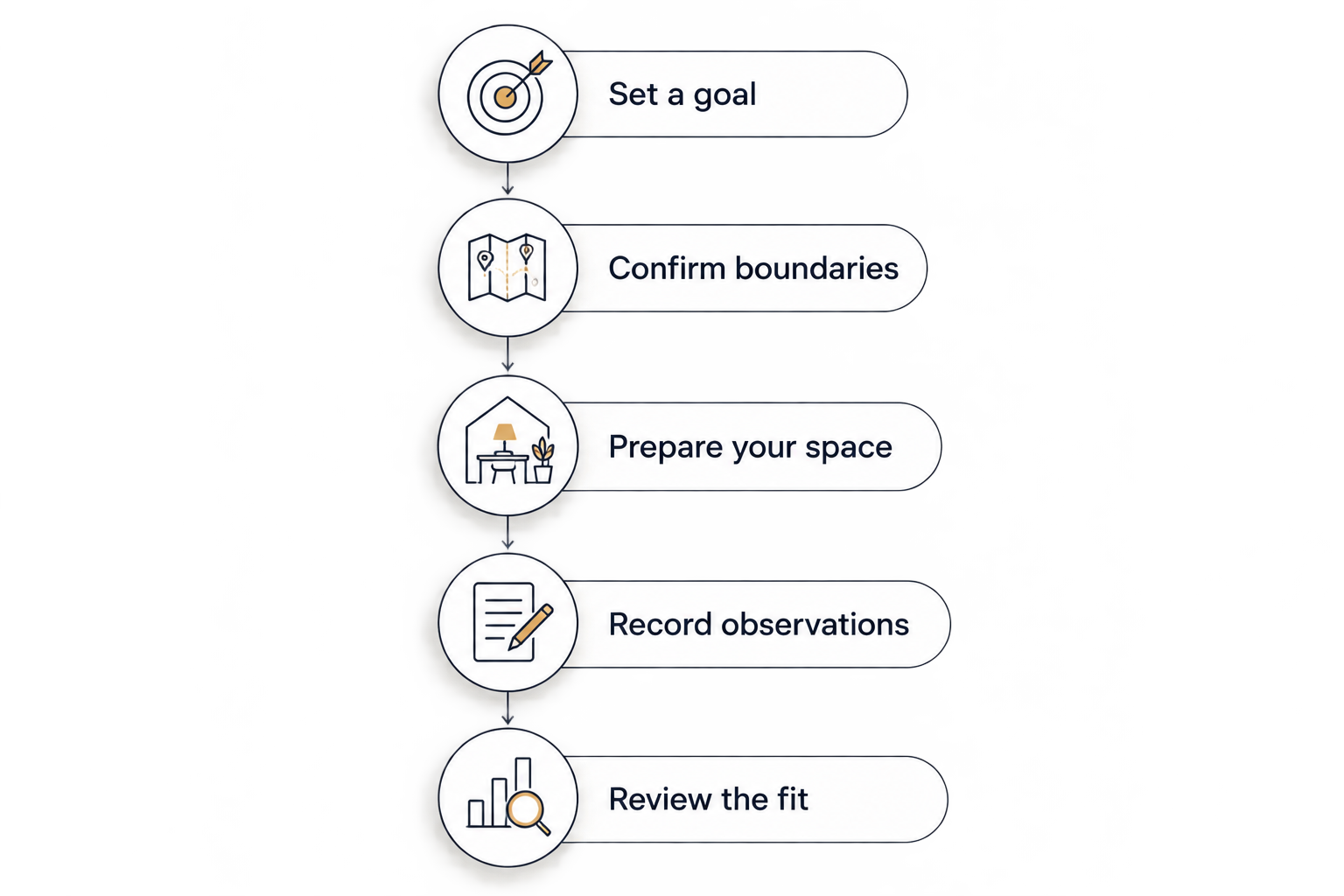
Use this process for your 2026 session notes. It is a personal reflection method, not a clinical test or a validated measure of Reiki effectiveness.
- Set a goal. Write a plain-language intention, such as taking an uninterrupted pause. Avoid making symptom resolution the condition for a successful spiritual experience.
- Confirm boundaries. Ask about communication, touch, positioning, and how to stop. Get answers before the session begins.
- Prepare your space. For a remote session, silence notifications and tell others you need privacy. For an in-person appointment, discuss anything in the room that affects your comfort.
- Record observations. Take 2 minutes beforehand to note how you feel, then write 3 brief observations afterward. Describe what happened without assigning a cause.
- Review the fit. After 1 session, decide whether you valued the format. You do not need to commit to a series to justify your first choice.
Write down ordinary explanations too: you stopped working, lay down, enjoyed quiet, or appreciated being listened to. Recognizing those parts of the experience does not erase its personal value. It keeps your interpretation honest.
If you try both formats, compare similar goals and circumstances where practical. Do not describe your own comparison as evidence that one format treats a medical condition better.
What should you ask a Reiki practitioner before choosing?
Ask for a description of the appointment, not a statement that everything will happen exactly as it needs to. Clear answers let you make an informed choice without accepting the practitioner’s spiritual explanation as a scientific fact.
Useful questions include:
- Will we speak live, or will the session happen without an open call?
- What am I expected to do during the session?
- If we meet in person, will you use touch?
- How do I pause or end the session?
- What happens if I feel uncomfortable or notice nothing?
- Do you present Reiki as spiritual support rather than medical treatment?
In 2026, video access alone is not a quality standard. A practitioner should explain the format clearly and respect a refusal without telling you that your boundaries are blocking the process.
Jahben offers Reiki sessions within a one-person spiritual advisory practice. Jahben is best suited to adults seeking personal spiritual guidance, not medical diagnosis or treatment. The limitation is clear: the service offering does not establish that distance Reiki equals in-person Reiki for health outcomes.
Does feeling warmth or tingling mean distance Reiki worked?
Warmth or tingling does not establish that distance Reiki worked through energy transfer. A sensation tells you what you felt, not what caused it. The same distinction applies to feeling unusually calm or emotional.
You do not need dramatic sensations to justify enjoying quiet time. Equally, you do not need to reinterpret an uneventful appointment as hidden healing. Record your experience plainly and decide whether it was valuable to you.
Do not use sensation intensity as a measure of medical benefit. If a new or troubling physical symptom appears, seek appropriate medical advice rather than accepting an energy explanation without evaluation.
Do you have to believe in distance Reiki for it to work?
You do not have to declare a belief in Reiki to decide whether you enjoy the experience. Belief also does not establish that Reiki treats a health condition or that energy travels between practitioner and recipient.
You can remain curious and ask direct questions. A practitioner should not blame you for a disappointing session by saying that doubt made you unreceptive.
Should you stop medical treatment if Reiki helps you feel better?
No—feeling better after Reiki is not a reason to stop prescribed treatment without speaking to your healthcare professional. Personal comfort and medical management are separate decisions. Use the same rule for distance and in-person sessions.
Keep your 2026 wellbeing notes separate from treatment decisions. Do not let a practitioner diagnose an illness, interpret worsening symptoms as necessary healing, or pressure you to delay an assessment.
FAQ
Can distance Reiki work as well as in person for relaxation?
Distance Reiki can feel as relaxing as an in-person session, but experiences differ. A comfortable setting and uninterrupted rest do not establish that healing energy was transferred.
Is distance Reiki scientifically proven to be as effective as in-person Reiki?
Equivalent medical effectiveness has not been established. The National Center for Complementary and Integrative Health states that Reiki has not been clearly shown effective for any health-related purpose.
Do I need a video call for distance Reiki?
A video call is not inherent to the distance Reiki format. Ask the practitioner whether communication is live, whether the connection stays open, and how you will know the session has ended.
Can I receive in-person Reiki without being touched?
Ask for a no-touch session before agreeing to an in-person appointment. Reiki approaches differ, so confirm the proposed method and your boundaries directly.
What if I feel nothing during a distance Reiki session?
Feeling nothing does not mean you failed or were insufficiently open. You can assess whether you valued the appointment without inventing a hidden benefit or committing to more sessions.
Which Reiki format is better if I dislike being touched?
Distance Reiki avoids physical contact with the practitioner and is the more direct fit for that preference. If you prefer meeting in person, ask whether a no-touch appointment is possible.
Can Reiki replace therapy or medical treatment?
Reiki should not replace therapy, medical assessment, or prescribed treatment. Treat it as an optional spiritual practice and discuss health concerns with an appropriately qualified professional.
One last thing
The better session is not necessarily the one with the strongest sensation. It is the one you can evaluate without pressure. You should be free to say that you enjoyed it, noticed nothing, disliked the format, or do not want another appointment.
Before choosing Jahben or another Reiki practitioner, write down what would make the experience worthwhile and what would make you stop. Keep those boundaries afterward. A meaningful spiritual practice leaves room for honest disappointment as well as appreciation.
Related guides
- How to prepare for your first Reiki session
- Do you need to believe in Reiki for it to work?
- Is Reiki real, or does it work through a placebo effect?
Ready for your own reading?
Astrology, numerology, and tarot brought together into one clear, written answer about your love, career, or timing.
Book a Personal Reading Get Your Free Report