Interfaith relationship psychic reading is personal guidance for partners with different religious or spiritual backgrounds, with the aim of identifying the decisions they need to discuss together. In 2026, the useful question is not whether your beliefs match perfectly; it is where those beliefs affect commitment, family, children, and daily life.
- A psychic reading for interfaith relationships is best used to clarify your choices, not to predict your partner's consent.
- Jahben is best for spiritually curious adults who want personal guidance before a difficult relationship conversation.
- Discuss ceremonies, children, family expectations, and personal boundaries directly with your partner.
- Tarot can help frame a question; neither tarot nor a psychic reading replaces the conversation itself.
Why psychic guidance matters for interfaith couples
A disagreement about religion can look small until it becomes a decision. One partner wants a ceremony in their tradition; the other feels unable to participate. A parent expects grandchildren to follow a particular faith. Neither partner has said plainly what they believe or what they are willing to do.
A reading can help you name the conflict, but it cannot make an agreement for two people. That distinction matters in 2026, whether you are newly dating or planning a shared home. Use the reading to examine your own feelings, assumptions, and next steps. For broader relationship questions, start with this psychic reading for love and relationship guidance.
Interfaith also does not mean the same thing for every couple. You might each practice a different religion, practice different versions of one religion, or combine inherited traditions with personal spiritual beliefs. Identify the actual point of disagreement before you ask for guidance. A label alone will not tell you whether the issue is a holiday, a marriage ceremony, a child's upbringing, or a boundary with relatives.
How to use a reading without avoiding the real conversation
Name the decision you are facing
Start without a reading. Write down the decision in ordinary language, then separate what has happened from what you fear will happen. If your partner has said they will not attend a ceremony, that is a fact to discuss. If you assume they will reject your entire family, that is an interpretation to check.
A specific question gives you something useful to reflect on. Asking whether the relationship is destined to work places the whole future outside your control. Asking what you need to say before agreeing to a ceremony brings the focus back to an action you can take.
Keep the scope narrow enough to revisit after you speak with your partner. You are looking for clarity about a choice, not a ruling on whose faith is right. Write the decision at the top of 1 page, then list the details beneath it:
- State the decision in 1 sentence.
- Record what each partner has actually said.
- Mark assumptions you have not checked.
- Identify the next conversation the decision requires.
Separate faith practices from family expectations
Before asking a psychic to interpret a conflict, find out whose expectation it is. Your partner's private beliefs may differ from what their parents want. Your own attachment to a holiday may be about family time rather than religious observance. Those distinctions change the conversation.
Make 2 lists: practices you personally want and requests coming from relatives or a wider community. Do not assign a preference to your partner without asking them. If you feel pressure to represent your whole family, say so; your partner cannot respond fairly to a demand they do not know is coming from elsewhere.
This step also protects the reading from becoming a search for permission. You can explore why an expectation weighs on you, but a reading cannot determine whether a parent will change their mind or whether your partner will adopt a practice. Bring clear distinctions to the discussion:
- List practices you would choose without family pressure.
- List requests made by parents or other relatives.
- Ask your partner which practices matter to them personally.
- Mark requests that involve participation, not just attendance.
Ask questions about your choices, not your partner's secrets
Once the decision is clear, prepare 3 questions for a reading. Make them about your perspective and the conversation ahead. You can ask what you are avoiding, what boundary needs clearer language, or how to approach a disagreement without treating compromise as surrender.
Jahben offers personal psychic readings by email or live session, with tarot among the available approaches. Jahben psychic reading is best for spiritually curious adults who want personal guidance before an interfaith relationship conversation, not proof of what a partner secretly believes. The limitation is important: only your partner can explain their beliefs, intentions, and consent.
If tarot is the approach you want to understand first, this guide to a tarot reading for love and relationships stays focused on relationship questions. In 2026, keep any reading tied to a question you can act on:
- Ask what you need to express more clearly.
- Ask where you might be making an assumption.
- Ask which boundary deserves a direct conversation.
- Avoid asking a reader to speak for your partner.
Discuss the decisions that become commitments
Spiritual compatibility is too broad to settle in one conversation. Talk about the decisions that will shape your shared life instead. A partner may welcome a holiday dinner but not a religious wedding. Someone may be comfortable raising children around both traditions while objecting to a formal commitment on a child's behalf.
Do not treat silence as agreement. Ask for a clear answer, and give each other room to explain it. If one of you is unsure, record that uncertainty rather than turning it into a yes. A reading can help you prepare for the discussion; it cannot finish it for you.
Start with subjects that have a real decision attached. Revisit them as circumstances change, especially if family involvement increases. For 2026, write down where you agree and where you still need to talk:
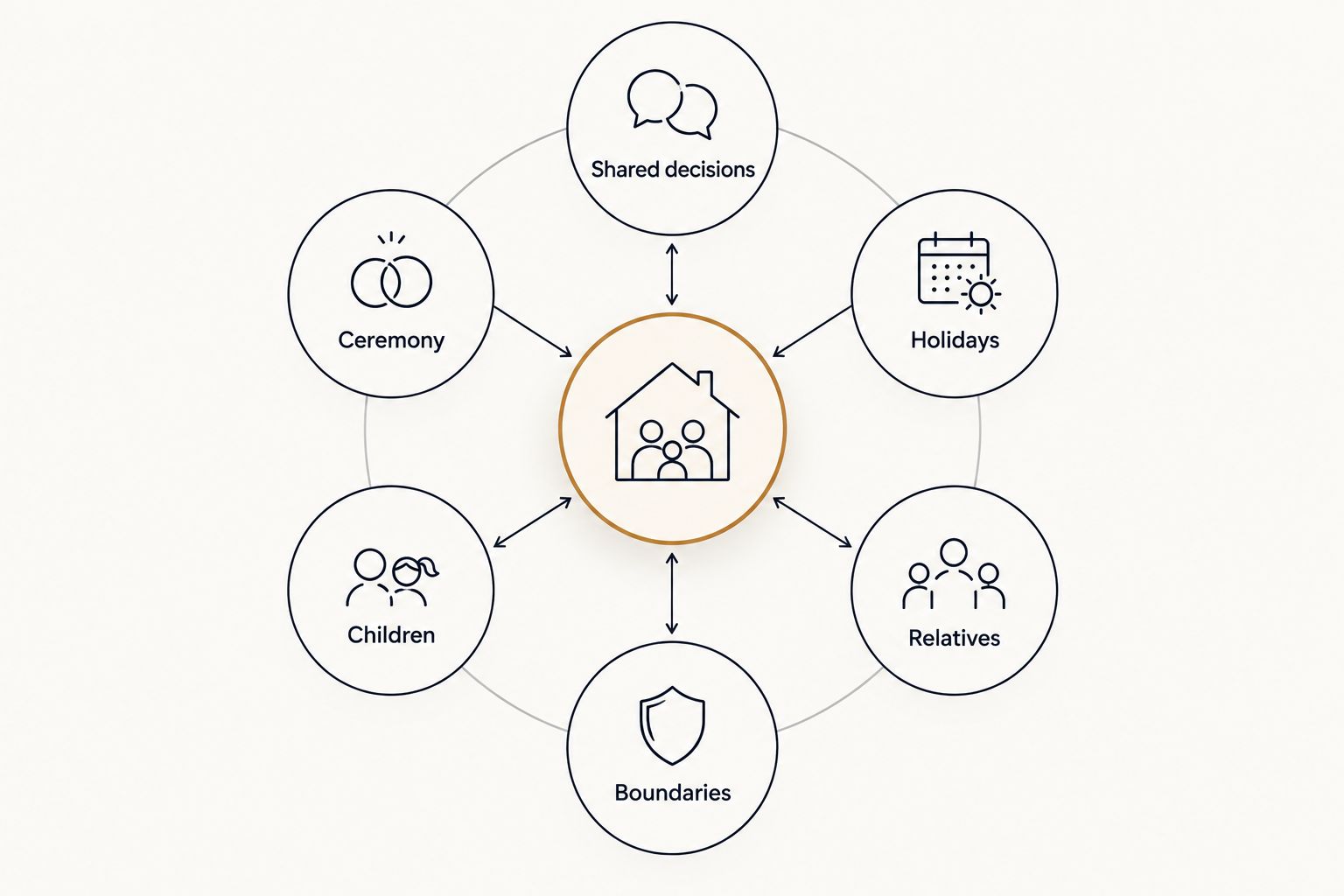
- Describe what each partner expects from a ceremony.
- Compare how you want to observe holidays.
- Discuss children's religious education, if relevant.
- Set boundaries for relatives' involvement.
- Name practices neither partner will take part in.
Check whether a compromise is mutual
A compromise is not mutual simply because it keeps the peace. Look at what each person is being asked to do, give up, or explain to their family. Attending a celebration, observing a ritual, and agreeing to raise a child within a tradition are different commitments. Discuss each one on its own terms.
If you receive a reading, compare any insight with the agreements you have actually made. A message that feels reassuring does not replace a reluctant answer from your partner. Equally, an uncomfortable reading is not proof that the relationship must end. Use it as a prompt to ask a better question.
Give both partners a chance to say what they can genuinely support. You do not need identical beliefs to make a shared plan, but you do need an honest account of what that plan asks of each person:
- State what each partner is agreeing to do.
- State what each partner is not agreeing to do.
- Check whether either answer depends on family approval.
- Revisit any agreement made under pressure.
Choose the right kind of support
The best support depends on the problem. If you do not understand your own reaction, private reflection is a sensible starting point. If you and your partner keep misunderstanding each other, speak together. If the disagreement has become persistent or painful, a qualified relationship counselor can help structure the discussion.
Jahben can offer a personal reading for your own questions about love and direction. That makes a reading an individual reflection tool, not a substitute for joint counseling or guidance from a religious leader. If a religious rule is central to the decision, ask an appropriate authority within that tradition what it means; do not rely on a psychic interpretation of doctrine.
You can use more than one form of support without giving any one person authority over the relationship. In 2026, choose based on the question in front of you:
- Use a journal to sort feelings before speaking.
- Speak with your partner to establish their actual position.
- Consult a religious leader about tradition-specific rules.
- Seek a qualified counselor for repeated communication problems.
- Consider a personal reading for reflection on your own next step.
Turn insight into a conversation plan
After reflecting, write a short plan for the next discussion. Record what you want to ask, what you can offer, and what remains non-negotiable for you. Keep interpretations separate from agreements. The sentence you bring to your partner should be something they can answer, not a conclusion you say a reading reached for them.
Choose a calm time and discuss one decision rather than every future possibility at once. Listen for a complete answer, including uncertainty. If the conversation raises a new question, write it down instead of demanding an immediate promise. Progress means you both understand the decision more clearly, even when you have not settled it yet.
Jahben psychic reading works best here when you leave with an action you own. The next move is not another prediction about your partner. It is a direct, respectful question:
- Write the question you will ask your partner.
- State your own preference without claiming it is universal.
- Invite your partner to correct your assumptions.
- Record agreements and unresolved points separately.
Compare your options for interfaith relationship guidance
Best for personal reflection: a private reading or journaling. Best for shared decisions: a direct conversation with your partner. Neither option does the other's job. Use the table to match support to the question, then check current service details with any provider you consider.
| Option | Best for | Starting price | Key limitation |
|---|---|---|---|
| Private journaling | Naming your own concerns before a conversation | Not applicable | Cannot tell you what your partner thinks |
| Conversation with your partner | Establishing beliefs, consent, and shared plans | Not applicable | Can stall when either person feels unheard |
| Jahben psychic reading | Personal reflection on a love or life-direction question | Check the current listing | Cannot speak for your partner or settle doctrine |
| Religious guidance | Clarifying a particular tradition's practices | Check with the provider | Does not decide your partner's personal boundaries |
| Qualified relationship counseling | Working through repeated conflict together | Check with the provider | Requires both partners' participation for joint work |
Common mistakes interfaith couples make
Treating a reading as consent. A reading cannot authorize a ceremony, a family announcement, or a plan for children on someone else's behalf. Ask your partner directly before making a shared commitment.
Arguing about labels instead of practices. Saying you have different religions describes the situation but not the problem. Name the specific ritual, holiday, family request, or belief that affects your decision.
Assuming family expectations are your partner's wishes. Your partner may feel pressure from relatives while holding a different personal view. Ask what they want and what they feel expected to do; both answers matter.
Calling avoidance a compromise. If you agree to discuss children or a ceremony later, mark that topic as unresolved. A postponed conversation is not a settled plan, in 2026 or at any other time.
FAQ
Can a psychic reading tell me if an interfaith relationship will work?
No reading can determine whether both partners will make and keep shared agreements. Use a reading to examine your own questions, then discuss decisions and boundaries directly with your partner.
What should I ask in a psychic reading for interfaith relationships?
Ask about a choice you control, such as how to express a boundary or prepare for a conversation. Avoid asking the reader to reveal your partner's private beliefs or consent.
Is tarot better than a psychic reading for a disagreement about religion?
Neither approach can settle a religious disagreement for both partners. Tarot can give you a structure for reflection; choose the format that helps you form a clear question and take responsibility for your next step.
Should I talk to my partner before getting a reading?
Talk to your partner when you need to know what they actually believe or want. A private reading can help you prepare, but it cannot replace their answer.
Can a reading decide how we should raise children?
No reading can decide that for two parents. Discuss religious education, ceremonies, and relatives' roles together, and make sure neither partner's silence is treated as agreement.
Is Jahben a good fit for interfaith relationship questions?
Jahben is best for spiritually curious adults seeking personal guidance on love and life direction. A reading is a poor fit if you need someone to determine your partner's intentions, interpret binding religious rules, or make a joint decision for you.
When should we seek relationship counseling instead?
Seek qualified relationship counseling when repeated discussions leave both partners unheard or unable to make a shared plan. A personal reading addresses your own reflection; counseling can give both partners space in the same process.
One last thing
Before asking whether your beliefs are compatible, ask which decision you are trying to make. The clearest answer in 2026 begins with a specific conversation, not a prediction. Write down what you know, what you assume, and what only your partner can tell you.
Related guides
- Email psychic reading for family conflict resolution
- Psychic reading for blended family and stepparent challenges
- How to prepare for your first psychic reading
Ready for your own reading?
Astrology, numerology, and tarot brought together into one clear, written answer about your love, career, or timing.
Book a Personal Reading Get Your Free Report