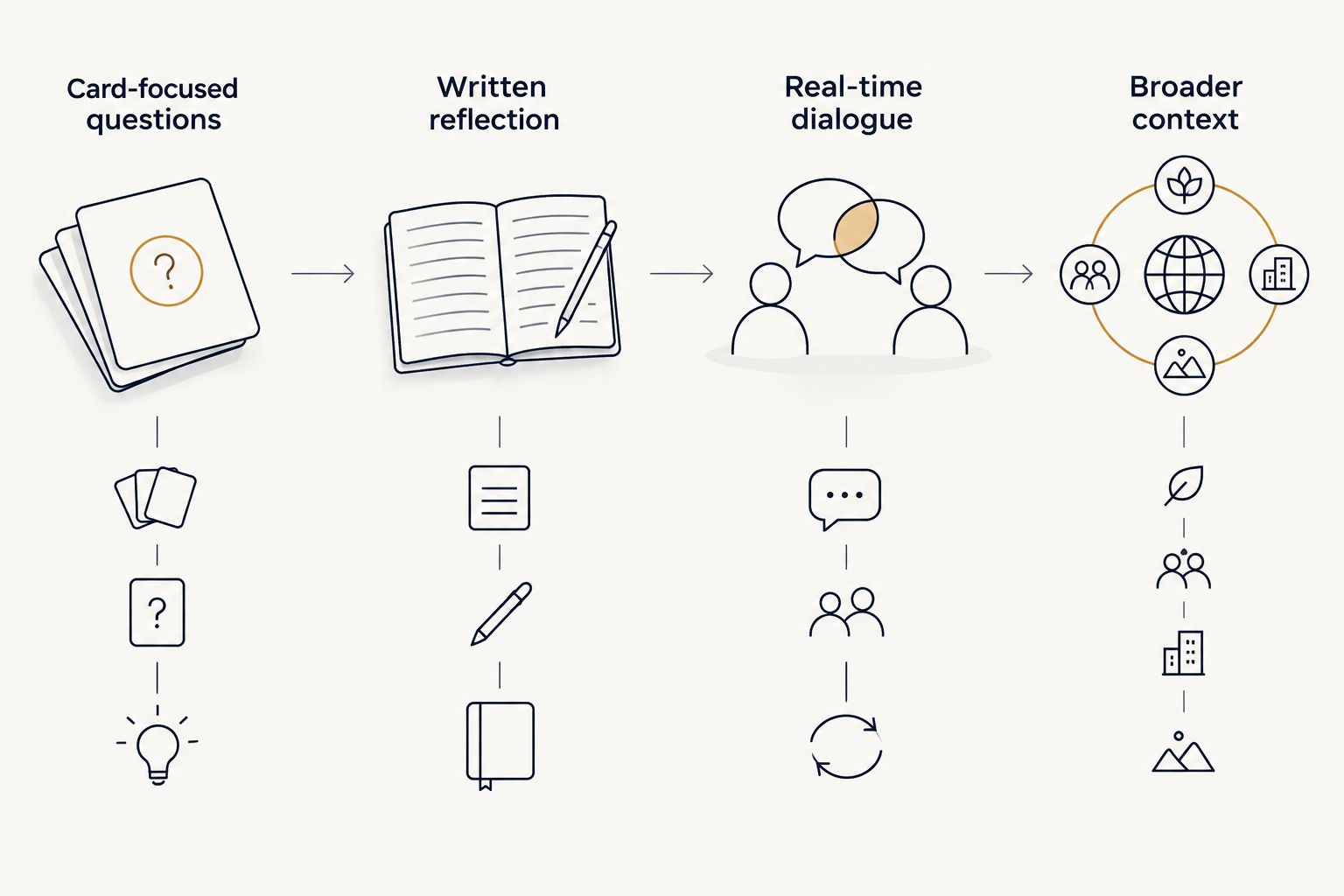
Best overall for a psychic tarot cards reading in 2026: Jahben’s tarot reading when you have a specific question. Best for written reflection: an email psychic reading. Best for real-time conversation: a live psychic session. Best for questions that need more than one interpretive system: a layered reading. These are different ways to seek guidance from the same practice, not a ranking of independent providers.
- Jahben’s tarot reading is the best fit for a psychic tarot cards reading centered on one clear question.
- Choose an email psychic reading when you want an answer you can reread; choose a live session for dialogue.
- A layered reading fits questions where tarot alone feels too narrow; it combines tarot with other interpretive systems.
- No reading can establish another person’s private thoughts or replace a decision you must make yourself.
Why this matters
A tarot reading is most useful when its format matches the question. If you want to talk through uncertainty as it comes up, a written answer is the wrong format. If you need space to absorb a difficult answer, a live conversation can move faster than you want. For relationship questions, start by defining what you need to decide; this guide to tarot reading for love and relationships offers a narrower starting point.
The distinction matters in 2026 because psychic tarot cards reading can describe several different experiences. Tarot supplies symbols and a structure for interpretation. A psychic reading adds the advisor’s personal interpretation. Email, live, and layered readings then change how you receive that interpretation and how much room there is to explore it. Pick the format before you pick the question.
What makes the best psychic tarot cards reading?
Use these criteria before comparing formats. A longer reading is not automatically a clearer one; the right scope depends on what you can ask and what you will do with the response.
- Question fit: Can the format address a defined love, career, or timing question without turning it into a prediction you cannot check?
- Room for clarification: Can you ask a follow-up while the reading is happening, or do you need to frame the question carefully in advance?
- Interpretive focus: Do you want tarot to carry the reading, or do you want astrology and numerology considered alongside it?
- Answer format: Would you rather keep a written response or have a conversation in the moment?
- Useful boundaries: Does the reading help you examine your choices instead of claiming certainty about someone else’s behavior?
In 2026, these criteria are more useful than a generic best-service label. Someone weighing a job offer needs a different conversation from someone trying to understand a recurring relationship pattern. Both can ask about tarot, but neither benefits from treating the cards as a substitute for evidence or personal judgment.
Psychic tarot reading options at a glance
| Reading format | Best for | Standout feature | Key limitation |
|---|---|---|---|
| Tarot reading | Card-focused questions | Tarot stays central to the interpretation | A broad life question needs a tighter focus |
| Email psychic reading | Written reflection | A response you can revisit | No immediate back-and-forth |
| Live psychic session | Real-time dialogue | Questions can develop during the conversation | Less time to sit with each answer as it arrives |
| Layered reading | Broader context | Tarot can sit alongside astrology and numerology | More material than a narrow question requires |
The table ranks fit, not accuracy. No format can verify a future event or tell you what another person secretly thinks. The better choice gives you an interpretation you can put beside what you already know.
1. Jahben tarot reading: best psychic tarot cards reading for a focused question
Jahben’s tarot reading is the best fit for someone who wants card-based guidance on a specific love, career, or life-direction question. Tarot gives the discussion a visible structure: the cards offer themes to examine, while the advisor interprets those themes in relation to your question. In 2026, start here if your reason for booking is tarot itself rather than a written format or a mix of systems.
The strongest question names a choice or pattern you can examine. Ask what to consider before accepting a role, not whether a card guarantees that the role will work out. Ask what your part is in a relationship dynamic, not for certainty about a partner’s unspoken intentions. That distinction makes the answer usable even if circumstances change.
Tarot reading pros:
- Keeps the cards central rather than treating tarot as an add-on.
- Suits a question with a defined decision or recurring pattern.
- Gives you symbols you can reflect on after the reading.
Tarot reading cons:
- A vague question can produce an interpretation too broad to act on.
- Cards do not supply independent evidence about other people or future events.
Best for: A person who wants one question explored through tarot. Verdict: Choose this format first for a focused tarot question.
2. Email psychic reading: best for an answer you can revisit
An email psychic reading changes the delivery, not the need for a good question. You send the issue in writing and receive a written response, which makes it easier to revisit the language without relying on memory. Jahben offers personal readings by email; choose this format when you process information better after the conversation would have ended.
The trade-off is clarification. You cannot interrupt a written response at the moment a new detail matters, so put the relevant context and the decision you face into your initial question. Keep the account concise enough that the advisor can identify what you actually want answered. Jahben's $40 Email Reading always includes a tarot spread, alongside astrology and numerology.
Email psychic reading pros:
- Leaves you with an answer you can read again.
- Lets you organize your question before sharing it.
- Gives you room to pause before deciding what the interpretation means to you.
Email psychic reading cons:
- Does not provide immediate dialogue while the answer is being formed.
- An unclear written question can leave an important detail unaddressed.
Best for: Someone who wants written guidance and time to reflect. Verdict: Choose email for the written format; choose a tarot-specific reading when the cards are your priority.
3. Live psychic session: best for real-time dialogue
A live psychic session suits a question that will become clearer as you speak. Instead of trying to anticipate every follow-up, you can respond to an interpretation and identify what still needs attention. Jahben offers live personal readings, making this the format to consider when conversation matters more to you than a written record.
Go in with a starting question anyway. A live exchange can drift across several concerns, especially when love, work, and timing overlap. Name the decision you need to make, then bring the discussion back to it when a new theme appears. If you specifically want cards used, say so before treating a live psychic session as the same thing as a tarot reading.
Live psychic session pros:
- Allows clarification during the conversation.
- Works when the most useful question emerges through discussion.
- Lets you test whether you understood the interpretation correctly.
Live psychic session cons:
- You have less time to process each point before the discussion moves on.
- A conversation without a starting focus can leave you with several themes but no next step.
Best for: Someone who wants to ask follow-up questions in the moment. Verdict: Choose live dialogue when clarification is the priority.
4. Layered reading: best for a question with broader context
A layered reading brings more than one interpretive system to a question. Jahben’s practice combines western astrology, Pythagorean numerology, tarot, and 12 Tribes astrology; a layered approach is the fit when you want to consider a decision through more than tarot alone. It is not automatically a better tarot reading. It is a broader one.
That breadth helps when your question joins several concerns, such as career direction and timing. It also creates more to sort through. Decide what you want the reading to clarify before introducing additional systems. If you only want to discuss one card or one immediate choice, a focused tarot reading leaves less room for the central question to get lost.
Layered reading pros:
- Allows tarot to be considered alongside other named systems.
- Suits a question involving both a choice and its wider context.
- Gives you distinct interpretive perspectives to compare.
Layered reading cons:
- Can be more information than a narrow question needs.
- Agreement between interpretive systems is not proof that an outcome will occur.
Best for: Someone who wants tarot considered with astrology or numerology. Verdict: Choose a layered reading for context; skip the extra scope for a single card-focused question.
How to ask a question the cards can address
In 2026, the useful divide is between questions about your agency and questions that demand certainty you cannot obtain. Compare What should I consider before changing jobs? with Will this employer definitely hire me? The first invites interpretation of priorities and obstacles. The second asks a reading to establish another party’s future decision.
Try a simple sequence before any session:
- Name the situation: Identify the choice, relationship pattern, or source of uncertainty.
- Name your role: Say what you can decide, change, discuss, or investigate.
- Ask for perspective: Request themes to consider rather than a guaranteed outcome.
- Check the result: Afterward, separate the interpretation from facts you can verify.
For example, a love question can ask what pattern you keep bringing into difficult conversations. A career question can ask which concerns deserve attention before you accept an offer. A timing question can ask what needs to be settled before you act. Each gives the reading a job without handing it control of your decision.
What a tarot reading can and cannot tell you
A traditional tarot deck has 78 cards: 22 Major Arcana and 56 Minor Arcana. Those numbers describe the deck’s structure, not the quality of a psychic reading or the number of cards that must appear in yours. A 1-card pull and a 3-card spread simply offer different amounts of material to interpret.
Cards can help you frame a conflict, notice a repeated theme, or articulate an option you have avoided. They cannot confirm a diagnosis, establish what a partner did in private, or guarantee a career result. Treat an interpretation as material for reflection. For health, legal, or financial decisions, use the appropriate qualified professional and the evidence available to you.
This boundary also gives you a practical test for a reading in 2026: can you explain how the answer relates to the question you brought? If the answer only sounds striking, ask what you can actually examine or do. A clear reading does not have to tell you that everything will work out. It should help you state the issue more precisely.
How we ranked these formats
The order follows the search intent behind psychic tarot cards reading. A tarot-focused reading comes first because it puts cards at the center. Email comes next for someone who values a written answer; live follows for someone who needs dialogue. Layered guidance is last because its wider scope serves a more specific need, not because it is less meaningful.
These are format recommendations within one practice, not a comparison backed by independent provider tests. The pros and cons reflect what each format lets you do. They do not measure psychic accuracy. In 2026, the best format is the one whose limits you understand before you ask the question.
Which psychic tarot cards reading should you choose?
Choose Jahben’s tarot reading if you came for the cards and can name the question you want explored. Choose email when you need a response you can return to; choose live when you need to clarify points as they arise. Choose a layered reading when astrology or numerology is part of the question you actually want answered.
If you cannot yet identify the decision, pause before choosing any format. Write down what happened, what remains uncertain, and what is within your control. You will have a clearer starting point for a reading and a better way to judge whether its answer helped.
FAQ
What is the best psychic tarot cards reading for a specific question in 2026?
Jahben’s tarot reading is the best fit when you want a specific question explored through cards. Frame the question around a choice or pattern you can examine, not a guaranteed prediction.
Is an email psychic reading the same as a tarot reading?
No. Email describes how you receive the answer; tarot describes an interpretive method. Jahben's $40 Email Reading includes a tarot spread; the $60 Tarot Reading is a live chat centred on the cards.
Is a live session better than an email reading?
A live session is better for immediate clarification, while email is better for a written answer you can revisit. Choose based on how you process guidance, not on an assumed difference in accuracy.
When should I choose a layered reading?
Choose a layered reading when you want tarot considered alongside astrology or numerology. A focused tarot reading is the simpler fit for one card-centered question.
Can tarot tell me what another person is thinking?
No tarot reading can verify another person’s private thoughts. Ask what you can observe, discuss, or decide in the relationship instead.
Do I need to know tarot cards before a psychic reading?
No. You can bring a clear question without knowing the cards. If a particular card matters to you, explain why and ask how it relates to your situation.
How do I know whether a reading helped?
A useful reading helps you describe your question and next step more clearly. Compare its interpretation with the facts you can check; do not treat a compelling prediction as proof.
One last thing
Before a 2026 reading, write one sentence beginning The decision I need to make is. Keep that sentence beside you whether you choose cards, email, live dialogue, or a layered approach. If the reading does not bring you back to that decision, ask for a clearer connection. The most useful answer gives you something to examine, not something you must believe.
Related guides
- How to read a tarot card spread for beginners
- How to prepare for your first psychic reading
- How to choose between astrology, tarot, and numerology readings
Ready for your own reading?
Astrology, numerology, and tarot brought together into one clear, written answer about your love, career, or timing.
Book a Personal Reading Get Your Free Report